Start at the top for an easy introduction. Go further down for more detail and scholarship.
- Easy
- Intermediate
- Advanced
For young readers
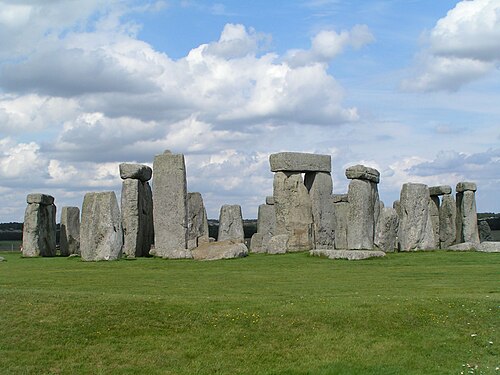
Imagine a huge circle of stones, some taller than a giraffe, with other stones laid across their tops like the lids of doorways. That is Stonehenge. It stands on a wide, grassy plain in southern England, and people have wondered about it for hundreds of years.
It was built by people who had no metal tools at first, no wheels for heavy loads and no writing. They were farmers who kept cattle and pigs and grew crops. Using ropes, wooden sledges, antler picks and hammer stones, they moved and shaped stones weighing as much as four or five elephants.
Stonehenge has two kinds of stones. The big grey ones, called sarsens, came from about 25 km away. The smaller ones, called bluestones, came all the way from hills in Wales, more than 200 km away. That is like dragging a small car across a whole country, many times over.
Stonehenge was built so that on midsummer’s day, the longest day of the year, the sun rises over a special stone at the entrance, and on midwinter’s day, the shortest day, the sun sets in line with the middle of the monument. People today still gather there to watch the sunrise at midsummer.
It was also a place for the dead. The burned bones of many people were buried there in its early centuries. Nearby, archaeologists found a large village where people seem to have come together for great feasts, eating lots of pork in the middle of winter.
Nobody left a note saying what Stonehenge was for. That is why scientists study the stones, the bones and the soil, like detectives, to work out how and why it was built.
At a glance
- Built
- In several stages from about 3000 BCE to about 1500 BCE; the great stone settings date from about 2500 BCE
- Place
- Salisbury Plain, near Amesbury, Wiltshire, southern England
- Builders
- Neolithic and Early Bronze Age communities of Britain
- Stones
- Large local sarsens (silcrete sandstone, averaging about 25 tonnes) from West Woods near Marlborough; smaller bluestones from the Preseli Hills in Wales; the Altar Stone from northeast Scotland
- Layout
- Circular ditch and bank (about 110 m across) around a sarsen circle with lintels, a horseshoe of five trilithons, and circles and ovals of bluestones
- Alignment
- Main axis points to the midsummer sunrise to the northeast and the midwinter sunset to the southwest
- Status
- UNESCO World Heritage Site with Avebury (1986); managed by English Heritage
Easy
What is Stonehenge?
Stonehenge is a prehistoric monument on Salisbury Plain in Wiltshire, southern England. At its heart is a circle of huge upright stones topped with horizontal stones called lintels, surrounding a horseshoe of even larger stone archways. Around the stones runs a circular ditch and bank. Beyond it, the landscape is full of other ancient monuments: burial mounds, earthworks and a long path called the Avenue.
Stonehenge was not built in one go. It began as an earthwork enclosure around 3000 BCE, was transformed by the raising of the great stones around 2500 BCE, and was rearranged and added to for centuries afterwards. The people who built it were farming communities of the Neolithic (New Stone Age) and, later, the Early Bronze Age. They left no writing, so everything we know comes from archaeology.
The word “henge” comes from Stonehenge itself; it probably meant “hanging stones”, a description of the lintels that seem to hang in the air. Archaeologists now use “henge” for a type of circular earthwork with a bank outside a ditch. Stonehenge is unusual because its main bank lies inside its ditch, so strictly speaking it is not a typical henge at all.
Easy
How to “read” the monument
Start from the outside. The circular ditch and bank, about 110 m in diameter, are the oldest parts of the monument. Just inside the bank is a ring of 56 pits known as the Aubrey Holes, named after John Aubrey, who noticed some of them in the seventeenth century. There were entrances in the northeast and south.
In the centre stood the sarsen circle: 30 upright stones about 4 m tall above ground, topped by 30 lintels fitted into a continuous ring about 33 m across. Inside it stood five trilithons, each made of two huge uprights and a lintel, arranged in a horseshoe that opens toward the northeast. The trilithons rise in height toward the back of the horseshoe; the tallest stood more than 7 m above the ground.
The smaller bluestones were set between the sarsens in circles and ovals, rearranged several times. Near the centre lies the Altar Stone, a large flat sandstone slab now fallen and partly buried. Outside the circle, near the northeast entrance, stands the Heel Stone, and the Avenue, a path between two banks and ditches, leads from the entrance about 2.8 km to the River Avon.
All these parts share one axis. Standing in the centre at midsummer, you can watch the sun rise in the northeast near the Heel Stone and along the line of the Avenue. Turning around at midwinter, you would face the setting sun in the southwest, framed by the great trilithon. Many archaeologists think the midwinter sunset was the most important moment for the builders.
Easy
Where did the stones come from?
The sarsens are blocks of a very hard sandstone called silcrete that formed naturally on the chalk downs. On average they weigh about 25 tonnes each, and the largest are heavier still. In 2020 geochemical analysis of a core drilled from one of the stones showed that most of the sarsens came from West Woods, near Marlborough, about 25 km north of Stonehenge.
The bluestones are smaller, weighing about 2–5 tonnes each, and are made of several kinds of rock, mainly dolerite and rhyolite, that appear bluish when freshly broken. Geologists and archaeologists have traced many of them to specific outcrops in the Preseli Hills of southwest Wales, more than 200 km away, where quarry sites such as Carn Goedog and Craig Rhos-y-felin have been excavated. Around 80 bluestones may have been brought to the site; 43 survive today.
The Altar Stone, a six-tonne slab of sandstone, was long thought to come from Wales too. In 2024 a study of tiny mineral grains in it showed that it matches rocks of the Orcadian Basin in northeast Scotland, more than 700 km away. How it was transported, by land or by sea, is unknown.
Moving stones over such distances without wheels or draught animals for heavy loads was a huge task. Most researchers think they were dragged on wooden sledges, perhaps over timber rails, using ropes made of plant fibre and large teams of people. Experiments have shown that such methods can work.
Intermediate
A monument in stages
Long before the monument, around 8000 BCE, hunter-gatherers of the Mesolithic period raised a row of large pine posts near the site, found in the 1960s under the former car park. Whether these had any link with the later monument is uncertain, but they show the place attracted attention very early.
Stage 1 (about 3000 BCE): the circular ditch and bank were dug using antler picks, and the 56 Aubrey Holes were made. Many archaeologists now think the Aubrey Holes originally held bluestones, which would mean some Welsh stones arrived at the very start. Cremated human remains were buried in the holes and ditch, making Stonehenge one of the largest cemeteries of its time in Britain.
Stage 2 (about 2500 BCE): the great sarsen circle and trilithons were raised, and the bluestones were set up in the centre. The stones were shaped with hammer stones, and joints borrowed from woodworking were carved into them: mortise-and-tenon joints to lock lintels onto uprights, and tongue-and-groove joints to link the lintels to one another. The sarsens’ inner faces were dressed more carefully than their outer faces, as if the monument was designed to be seen from inside or along the axis.
Later stages (about 2400–1500 BCE): the bluestones were rearranged into new circles and ovals, the Avenue was built, and around 1800–1500 BCE two rings of pits called the Y and Z Holes were dug around the stones, perhaps for a rearrangement that was never completed. After this, major building stopped, although the monument remained a landmark and a focus for burials in the surrounding barrows.
Intermediate
Who built Stonehenge?
The first builders were Neolithic farmers. Ancient DNA shows that farming populations whose ancestors had come from Anatolia (modern Turkey), by way of continental Europe, had arrived in Britain around 4000 BCE and largely replaced earlier hunter-gatherers. These farming communities built the ditch and raised the great stones.
About 3 km northeast of Stonehenge lies Durrington Walls, a giant henge enclosure. Excavations by the Stonehenge Riverside Project found traces of many houses from about 2500 BCE, perhaps the dwellings of builders or of people who gathered for festivals. Enormous quantities of pig bones, many from animals slaughtered in midwinter, and pottery with food residues suggest large seasonal feasts. Chemical analysis of animal bones shows that some livestock was brought from far away, including Scotland and Wales.
From around 2450 BCE, people associated with the Beaker culture, named after their distinctive pottery, arrived in Britain from the continent. Ancient DNA studies suggest that within a few centuries this migration replaced most of the genetic ancestry of the earlier Neolithic population. Beaker-period people used and modified Stonehenge. The Amesbury Archer, a man buried about 5 km from Stonehenge around 2300 BCE with arrowheads, copper knives and gold ornaments, grew up in central Europe, probably the Alpine region, according to isotope analysis of his teeth.
Stonehenge, then, was not the work of a single people or generation. It was built, used and reshaped by communities across more than a thousand years, including groups whose ancestry and way of life changed over that time.
Intermediate
What was it for?
Because no written records survive, the purpose of Stonehenge must be inferred. Several functions seem certain: it was a monument to the dead, with many cremation burials; it was aligned on the solstices, marking key turning points of the year; and it drew people and materials from far away, making it a meeting place for communities across Britain.
The Stonehenge Riverside Project, led by Mike Parker Pearson, proposed that Stonehenge and Durrington Walls formed a pair: timber circles at Durrington Walls for the living, and the stone circle at Stonehenge as a domain of the ancestors, linked by the River Avon and the Avenue. On this view the midwinter gatherings were times of feasting and of honouring the dead.
Other interpretations emphasise different aspects. Timothy Darvill and Geoffrey Wainwright suggested that the bluestones were believed to have healing powers, pointing to injured and ill people buried nearby. Some researchers stress unification: bringing Welsh stones and Scottish stone to Wiltshire may have symbolised joining distant communities. Others have argued that the sarsen circle encoded a solar calendar; this idea has been strongly criticised by archaeoastronomers.
These explanations are not mutually exclusive. Stonehenge probably meant different things to different generations over the centuries it was in use.
Intermediate
From legends to archaeology
Medieval writers tried to explain Stonehenge with stories. Around 1136 Geoffrey of Monmouth told how the wizard Merlin moved the stones from Ireland to create a memorial for Britons killed by the Saxons. In the seventeenth century the architect Inigo Jones argued it was a Roman temple, while John Aubrey suggested it had been built by the Druids, the priests of the pre-Roman Britons. William Stukeley developed the Druid theory in the eighteenth century and was among the first to record the monument’s alignment with the midsummer sunrise.
Radiocarbon dating later showed that Stonehenge is far older than the Druids of the Iron Age, but the Druid idea shaped its modern image. Since the early twentieth century, modern Druid groups have held ceremonies there, and the solstices continue to be important for pagan and other communities today.
The monument has changed over time. Some stones fell in 1797 and on the last day of 1900. In 1915 the estate was sold at auction to Cecil Chubb, who gave Stonehenge to the nation in 1918. Excavations by William Hawley in the 1920s and Richard Atkinson and colleagues in the 1950s, as well as restorations in the twentieth century that straightened and re-erected several stones and set some in concrete, mean that today’s monument is partly a product of modern intervention.
Intermediate
Stonehenge today: heritage, access and roads
In 1986 Stonehenge and Avebury, with their associated sites, were inscribed together on the UNESCO World Heritage List as outstanding examples of Neolithic and Bronze Age ceremonial landscapes. Stonehenge is owned by the state and cared for by English Heritage, while much of the surrounding land is managed by the National Trust.
Access to the stones has been contested. A free festival held near the stones in the 1970s and early 1980s was banned, and in 1985 police clashed with travellers heading to the site in what became known as the Battle of the Beanfield. Since 2000, English Heritage has allowed managed open access to the stones at the solstices, when thousands of people gather.
Roads have been a long-running problem. In 2013 the road passing right beside the stones was closed and a new visitor centre opened further away. Plans to put the nearby A303 main road into a tunnel divided opinion for decades, with supporters arguing it would restore the landscape and critics, including archaeologists and UNESCO advisers, warning of damage to buried archaeology. The UK government cancelled the scheme in 2024.
Advanced
Scholarly debates and open questions
Chronology. The sequence of building stages has been revised several times. The classic scheme of Stonehenge I, II and III was replaced in the 1990s by a sequence based on a large programme of radiocarbon dating, and was revised again in 2012 into five stages. Dates for particular events, such as when the bluestones first arrived, remain debated, partly because many early excavations were poorly recorded.
Transport of the bluestones. In the twentieth century some geologists argued that glaciers had carried the bluestones to Salisbury Plain. Most researchers now reject this, because quarry sites in the Preseli Hills show evidence of human extraction and because no similar glacial deposits are found near Stonehenge. It has also been proposed that the bluestones first stood in a circle at Waun Mawn in Wales before being moved; this hypothesis is disputed.
Astronomy. The solstice alignment is widely accepted, but more elaborate claims have been controversial. In the 1960s the astronomer Gerald Hawkins argued that Stonehenge was a “computer” for predicting eclipses; Richard Atkinson and others criticised this sharply. More recent claims that the sarsen circle represents a precise calendar have also been challenged. The debate illustrates the difficulty of distinguishing intended alignments from coincidences.
Society and power. Who organised such a project? Some archaeologists see evidence of emerging elites or chiefdoms; others emphasise cooperation among many communities without centralised rulers. The discovery that people, animals and stones came from across Britain has shifted attention to Stonehenge as a product of island-wide networks.
Advanced
Evidence and methods
Excavation records are the foundation. Around half the interior was excavated in the early twentieth century, often with methods that destroyed context. A major English Heritage publication in 1995 brought together the records of twentieth-century excavations with a new series of radiocarbon dates. Modern projects, including the Stonehenge Riverside Project (2003–2009) and later work on the bluestone quarries, have added carefully recorded evidence.
Scientific analyses are transforming understanding. Radiocarbon dating of antler picks and bones fixes the building stages. Geochemistry and petrography link stones to their sources. Isotope analysis of teeth and bones traces where people and animals grew up. Ancient DNA reveals population movements. Laser scanning of the stones has revealed tool marks and prehistoric carvings of axe-heads and daggers.
Landscape archaeology views Stonehenge not in isolation but as part of a wider ceremonial landscape. Geophysical surveys across many square kilometres, such as those of the Stonehenge Hidden Landscapes Project, have mapped buried pits, ditches and monuments. The central lesson is that Stonehenge can only be understood together with its surroundings, its builders and its long afterlife.
Key ideas
- Solstice alignment
- The monument’s axis frames the midsummer sunrise and the midwinter sunset, marking turning points of the year.
- Monument of the dead
- Stonehenge was a burial place from its beginning, with many cremation burials.
- Long-term construction
- It was built and rebuilt over more than a thousand years by changing communities.
- Long-distance connections
- Stones from Wales and Scotland and animals from across Britain show island-wide networks.
- Woodworking in stone
- Mortise-and-tenon and tongue-and-groove joints show carpentry techniques applied to stone.
- A ceremonial landscape
- Stonehenge is linked with Durrington Walls, the Avenue, the River Avon and hundreds of burial mounds.
- Modern meanings
- Legends, Druid revival, national heritage and contested access all shape how Stonehenge is understood today.
Records
- c. 8000 BCE — Mesolithic hunter-gatherers raise large pine posts near the site.
- c. 3000 BCE — The circular ditch, bank and Aubrey Holes are made; cremation burials begin.
- c. 2500 BCE — The sarsen circle and trilithons are raised, with bluestones in the centre.
- c. 2300 BCE — The Amesbury Archer is buried nearby; the bluestones are rearranged and the Avenue is built in this period.
- c. 1700 BCE — The Y and Z Holes are dug around the stones; major building ends by about 1500 BCE.
- c. 1136 — Geoffrey of Monmouth tells the legend of Merlin moving the stones from Ireland.
- 1740 — William Stukeley publishes his study linking Stonehenge with the Druids and describing its solstice alignment.
- 1915 — Cecil Chubb buys Stonehenge at auction; he gives it to the nation in 1918.
- 1986 — Stonehenge, Avebury and Associated Sites are inscribed on the UNESCO World Heritage List.
- 2013 — The road beside the stones is closed and a new visitor centre opens.
- 2020 — Scientists identify West Woods as the source of most of the sarsens.
- 2024 — The Altar Stone is traced to northeast Scotland.
Glossary
- Neolithic
- The New Stone Age, when people in Britain farmed and built monuments but did not yet use metal (about 4000–2500 BCE in Britain).
- Bronze Age
- The period when copper and bronze tools came into use; in Britain from about 2200 BCE (preceded by a Copper Age).
- Henge
- A circular earthwork enclosure, usually with a bank outside a ditch.
- Sarsen
- A very hard silcrete sandstone found on the chalk downs of southern England.
- Bluestone
- The name for the smaller stones at Stonehenge, mostly volcanic rocks from southwest Wales.
- Trilithon
- Two upright stones with a third laid across the top, from the Greek for “three stones”.
- Lintel
- A horizontal stone resting on top of uprights.
- Mortise and tenon
- A joint in which a projection (tenon) fits into a hole (mortise), borrowed from woodworking.
- Solstice
- The two days each year when the sun reaches its highest or lowest point at noon: midsummer and midwinter.
- Barrow
- An ancient burial mound.
- Beaker culture
- A widespread culture of the third millennium BCE named after its bell-shaped drinking vessels.
- Radiocarbon dating
- A scientific method of dating organic material by measuring the decay of carbon-14.
Questions and answers
Who built Stonehenge?
Prehistoric farming communities in Britain, beginning around 3000 BCE, followed by later Neolithic and Early Bronze Age people who rebuilt and changed it. It was not built by the Druids, who lived much later.
How did they move such heavy stones?
Probably by dragging them on wooden sledges with ropes and large teams of people, perhaps using timber tracks. Experiments show this is possible, though the exact routes are debated.
Is Stonehenge a calendar?
Its main axis is aligned on the midsummer sunrise and midwinter sunset, so it marked the turning of the year. Claims that it was a precise calendar or an eclipse predictor are disputed.
Were people buried there?
Yes. Cremated remains of many people were buried at Stonehenge, especially in its early centuries, and hundreds of burial mounds surround it.
Why did they bring stones all the way from Wales?
No one knows for sure. The Welsh stones may have had special meaning, perhaps connected with ancestors, healing or the identity of the communities who brought them.
Did glaciers move the bluestones instead of people?
Some geologists once argued this, but most researchers now think people moved them, because quarry sites with evidence of human extraction have been found in the Preseli Hills.
Why does the Scottish origin of the Altar Stone matter?
It shows that the builders drew on connections reaching the far north of Britain, not only Wales. It raises new questions about how a six-tonne slab travelled more than 700 km, and about the social networks that made such a journey possible.
Can you touch the stones?
Normally visitors walk around the stones on a path. Special access inside the circle is allowed at certain times, including the solstices.
Sources and further reading
- Stonehenge, Avebury and Associated Sites. UNESCO World Heritage Centre
- History of Stonehenge. English Heritage
- Building Stonehenge. English Heritage
- Stonehenge. Wikipedia
- Stonehenge, Avebury and Associated Sites. Wikipedia
- Durrington Walls. Wikipedia
- Stonehenge Riverside Project. Wikipedia
- Amesbury Archer. Wikipedia
- Mike Parker Pearson, Stonehenge: Exploring the Greatest Stone Age Mystery. Simon & Schuster, 2012
- Rosamund M. J. Cleal, K. E. Walker, R. Montague, Stonehenge in its Landscape: Twentieth-Century Excavations. English Heritage, 1995
Related
- Great Pyramid of GizaA royal tomb built for the Egyptian pharaoh Khufu. It is the largest of the Giza pyramids and the only surviving Wonder of the ancient world.
- KnossosA major Bronze Age center on Crete, known for its extensive Minoan palace complex.
- Nazca LinesLarge ground drawings and lines made by ancient communities in the desert of southern Peru.
- Olmec Colossal HeadsMonumental basalt heads made by Olmec communities on Mexico's Gulf Coast, probably depicting rulers.
Written with AI assistance from the published sources listed above, and revised as new research appears.