Start at the top for an easy introduction. Go further down for more detail and scholarship.
- Easy
- Intermediate
- Advanced
For young readers
Imagine a stone head so big that a grown-up standing next to it only reaches its chin, and so heavy that it weighs as much as several elephants. People on the Gulf Coast of Mexico carved heads like this about 3,000 years ago. We call them the Olmec.
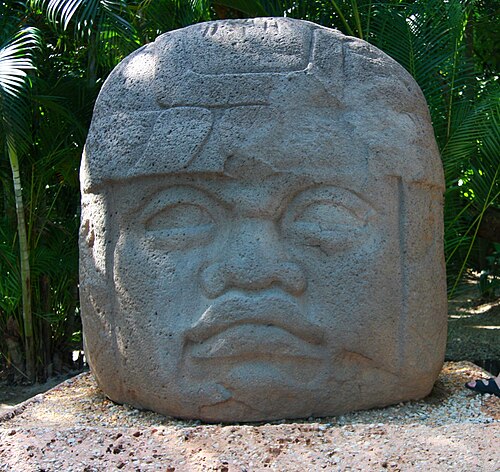
Each head shows a man’s face with full cheeks, thick lips and a serious or thoughtful look. Each one wears a different kind of helmet or headdress, and big round earrings. Because every face is a little different, many archaeologists think each head shows a real person, probably a ruler.
The Olmec did not have metal tools, horses or wheeled carts. They found huge round boulders of volcanic stone called basalt on the slopes of the Tuxtla Mountains, and then somehow moved them more than 100 kilometres across swamps and rivers. They may have pulled them on wooden sledges and floated them on rafts. Then they shaped the stone by hitting it with harder stones and polishing it with sand.
Some of the heads were made by re-carving old stone thrones, the big seats where rulers sat. It is as if a new ruler took his grandfather’s throne and turned it into a giant portrait.
For many centuries the heads lay buried or hidden in the forest. Local people knew about some of them, and in the twentieth century archaeologists began to dig them up and study them. Today all seventeen heads are in Mexico, most of them in museums in the cities of Xalapa, Villahermosa and Mexico City.
At a glance
- Made by
- The Olmec, the earliest known complex society of Mesoamerica (the name is a later Aztec word meaning “rubber people”)
- Date
- Mostly Early Formative (Preclassic) period; the San Lorenzo heads were buried by about 900 BC, and some heads may be later (about 1000–400 BC)
- Number
- 17 confirmed heads: 10 from San Lorenzo, 4 from La Venta, 2 from Tres Zapotes, 1 from La Cobata
- Place
- The Olmec heartland on the southern Gulf Coast of Mexico, in the states of Veracruz and Tabasco
- Material
- Basalt from the Sierra de los Tuxtlas, mostly Cerro Cintepec basalt, moved more than 100 km to some sites
- Size
- About 1.5 to 3.4 m tall; about 6 to 40 tonnes or more
- First recorded
- Tres Zapotes head, reported in the 1860s; systematic study from Matthew Stirling’s excavations beginning in 1938
Easy
What are the Olmec colossal heads?
The Olmec colossal heads are huge stone sculptures of human heads, carved from single boulders of basalt, a hard, dark volcanic rock. They were made by the Olmec, the people who created the first complex society with large ceremonial centres and monumental art in Mesoamerica (the cultural region that includes much of Mexico and Central America). Seventeen heads are known from the Olmec heartland on Mexico’s southern Gulf Coast.
The heads are not attached to bodies and were never meant to be. They were carved as complete monuments, often with a flat back. The smallest are about 1.5 m high and weigh about 6 tonnes; the largest, from La Cobata, is about 3.4 m high and is estimated at around 40 tonnes. Most were found at three major Olmec centres: San Lorenzo, La Venta and Tres Zapotes.
Although we do not know what the Olmec called themselves, or the names of the men shown, the heads are among the most powerful images from the ancient Americas. They show that, around 3,000 years ago, Olmec leaders could organize hundreds of people to quarry, move and carve enormous stones, and that they wished to be remembered as individuals.
Easy
How to “read” a colossal head
Look first at the face. All the heads show mature men with broad faces, fleshy cheeks, flat noses and full lips. Many frown slightly; a few, like La Venta Monument 2, smile. The eyes are often slightly crossed, and details such as wrinkles and creases around the nose and mouth are carved with care. The faces are realistic and not idealized, and each one is different. For this reason most scholars think the heads are portraits of particular rulers, perhaps made while they were alive or soon after they died.
Next, the headdress. Every head wears a close-fitting cap or helmet, but no two are the same. Some have a plain band tied at the back; others carry feathers, cords, rows of beads, a net, bird heads, human hands, or the claws of a jaguar or eagle. These may be emblems that identified each ruler or his family, a little like a coat of arms. Earlier researchers thought the helmets showed ballplayers’ protective gear; today this idea is less popular, though rulers may have been shown ready for the ritual ballgame, which the Olmec probably played with rubber balls.
Finally, the ears. Most heads wear large earspools, round or square ornaments inserted through the earlobes. Real earspools of jade and other stones have been found at Olmec sites. Traces of plaster and red paint on one San Lorenzo head suggest that the heads were once brightly painted.
Easy
Who were the Olmec?
The Olmec lived in the hot, wet lowlands of what is now southern Veracruz and western Tabasco, a land of rivers, swamps and fertile riverbanks. From about 1400 BC they built ceremonial and political centres there. The first great centre was San Lorenzo, built on a plateau above the Coatzacoalcos River. After about 900 BC, La Venta, near the coast in Tabasco, became the most important centre, with a tall earthen pyramid and buried offerings of polished greenstone.
The name “Olmec” was not their own. It comes from Nahuatl, the language of the Aztecs, and means “rubber people”; the Aztecs used it, more than two thousand years later, for the people then living in the rubber-producing Gulf Coast. Archaeologists borrowed the name in the twentieth century. The Olmec probably spoke a language related to the Mixe–Zoquean languages still spoken in the region, but this is not certain.
The Olmec grew maize, beans and squash, fished and hunted, and traded widely for obsidian, jade and other precious materials. Their art includes small jade figures, ceramic figurines, stone thrones and fantastic creatures that combine human and animal features, such as the were-jaguar. Many later Mesoamerican traditions, including the ballgame and some religious symbols, may have roots in Olmec times.
San Lorenzo itself shows the same capacity for organized labour as the heads. Its builders reshaped a natural plateau rising about 50 m above the floodplain, moving by one estimate between half a million and two million cubic metres of earth, basket by basket, to level and extend it. They also laid long lines of carved U-shaped basalt drain stones that channelled water across the site, a system that may have had ritual as well as practical meaning. The colossal heads stood within this built landscape, not in isolation.
Intermediate
Stone, transport and carving
All seventeen heartland heads were carved from basalt from the Sierra de los Tuxtlas, a volcanic mountain range near the coast. Most came from Cerro Cintepec, on the south-eastern side of the range. Large rounded boulders had been carried down the slopes by ancient volcanic mudflows (lahars), so the Olmec did not have to cut the stone out of a cliff; they could choose boulders already roughly the shape of a head. The Tres Zapotes heads and the La Cobata head were carved from stone from another hill, Cerro El Vigía, much closer to their final locations.
Moving the stones to San Lorenzo and La Venta, more than 100 km away in straight-line distance, was a major engineering feat. The Olmec had no draft animals and no wheeled vehicles for transport. Most researchers think they dragged the boulders on sledges or rollers over prepared paths and causeways, and floated them on rafts along rivers wherever possible. Two badly damaged Olmec sculptures show a person seated on a rectangular block bound with ropes, which may depict the transport of stone monuments.
Excavations of Olmec workshops show how the heads were made. Sculptors first roughed out the shape by striking off flakes with hammerstones, then refined the surface by pecking with smaller stones, and finally smoothed and polished it with abrasives such as sand. The work required skilled carvers, labourers to move the stone, boatmen, and people to feed them all. A single head might have taken years to complete and would have been possible only for a ruler who could command such resources.
Many heads were not carved from fresh boulders. The flat backs of most heads, and traces of niches on two San Lorenzo heads, show that some were re-carved from older monumental thrones, the massive rectangular stone altars on which rulers sat. Turning a predecessor’s throne into one’s own portrait would have been a powerful statement about succession and legitimacy.
Intermediate
Placement and meaning: portraits of power
At San Lorenzo, the ten heads seem to have been arranged in two roughly parallel lines running north–south across the plateau, together with stone thrones and other sculptures. Archaeologists such as Ann Cyphers have suggested that they formed a processional route that displayed the history of the ruling line to anyone walking across the site. At La Venta, three heads stood in a row in the northern part of the site, facing north, and a fourth stood in a plaza south of the Great Pyramid.
Most scholars see the heads as monuments to individual rulers. The heads combine individual portrait features with symbols of office in the headdress, so that they represent both a particular man and the institution of kingship. Some Olmec thrones show a figure emerging from a niche, like a cave, holding a baby or connected by a rope to other figures; these scenes suggest that rulers claimed special links with ancestors, the earth and the supernatural world.
Why heads, and not full bodies? One interpretation is that, in Olmec thought, the head was the seat of identity and life force. Another is simply practical: a spherical boulder suited a head. Whatever the reason, the colossal head became a distinctive Olmec form, not found in the same way in any later Mesoamerican culture.
Intermediate
Damage, burial and the decline of San Lorenzo
Many Olmec monuments, including several colossal heads, show deliberate damage: pits hollowed into the face, broken noses and lips, and missing pieces. Some were found buried in lines or in ravines. When Michael Coe and Richard Diehl excavated San Lorenzo in the 1960s, they interpreted this as a sign of violent destruction, perhaps a revolt or conquest, around the time San Lorenzo declined in the tenth century BC.
Later research changed this picture. Diehl himself came to think that monuments were regularly re-carved and reused, and that much of the “mutilation” represented unfinished stages of re-carving. Others suggest that the damage was ritual: the “killing” of a monument when a ruler died, or the deliberate retirement of sacred images. The pits in some faces may even have been made by later people who used the heads for their own purposes.
The decline of San Lorenzo around 900 BC is also debated. Proposed causes include warfare, economic change, the rise of rival centres like La Venta, and environmental change, especially shifts in the course of rivers that may have disrupted farming and transport. Many archaeologists now think several causes worked together.
Intermediate
Discovery and modern history
The first colossal head known to outsiders was found by local farmers near Tres Zapotes, Veracruz, in the mid-nineteenth century. The Mexican scholar José María Melgar y Serrano reported it in the 1860s. His description of the face as “Ethiopian” started a long and misleading debate about African origins, discussed below.
Serious study began with the American archaeologist Matthew Stirling of the Smithsonian Institution, who visited Tres Zapotes in 1938 and excavated the head there the following year. Guided by local residents, he went on to excavate heads at La Venta in 1940 and at San Lorenzo in 1945–46. Mexican archaeologists and artists, such as Miguel Covarrubias and Alfonso Caso, argued strongly in the 1940s that the Olmec were older than the Maya, an idea that radiocarbon dating later confirmed.
More heads were found in later decades. A joint Mexican–Yale project led by Michael Coe excavated at San Lorenzo in 1966–68, and magnetometer surveys detected buried monuments. The La Cobata head was found in 1970. The tenth San Lorenzo head was found by magnetometer survey in 1994 and excavated by Ann Cyphers, who has directed long-term work at the site.
All seventeen heads remain in Mexico. Two San Lorenzo heads are in the National Museum of Anthropology in Mexico City, seven in the Xalapa Museum of Anthropology, and the four La Venta heads are in Villahermosa, most in the Parque-Museo La Venta, which the poet Carlos Pellicer created in the 1950s to save the La Venta monuments from destruction by oil development. In 2009 vandals damaged the La Venta heads by throwing liquids on them. Replicas stand in many cities around the world.
Advanced
Faces and false theories: the “African origins” claim
Because the heads have broad noses and full lips, some writers have claimed that they show Africans who crossed the Atlantic in ancient times. The idea began with Melgar’s 1860s description, resurfaced in 1960 in the work of the Mexican archaeologist Alfonso Medellín Zenil, and was popularized in the 1970s by Ivan van Sertima. It still circulates widely online.
Specialists in Mesoamerican archaeology, including Richard Diehl and Ann Cyphers, reject it. The facial features of the heads are common among Indigenous people of the Gulf Coast today; the heads are stylized sculptures shaped partly by the round form of the boulders; there is no African material, plant, animal or script in Olmec sites; and genetic studies show that the ancient peoples of the Americas descend from populations that came from northeast Asia.
Scholars also point out that the theory, even when presented as celebrating Africa, denies Indigenous Mesoamericans credit for their own achievements. Understanding why such theories arise, and why they are wrong, is part of learning to read ancient images carefully.
Advanced
Dating and the “mother culture” debate
Dating the heads is difficult. Stone cannot be radiocarbon-dated directly, and many heads were found out of their original context, moved by erosion, by later people or by modern relocation. Archaeologists date them indirectly, from pottery, charcoal and stratigraphy associated with them. The San Lorenzo heads were buried by about 900 BC, so they must be earlier; the La Venta heads are associated with contexts radiocarbon-dated to about 1000–600 BC. The Tres Zapotes and La Cobata heads have a distinct, squat style that Beatriz de la Fuente saw as late, while Norman Hammond argued that the La Cobata head looks different mainly because it is unfinished. Estimates of how long heads were made range from about 50 to 200 years, but some scholars allow for a longer period.
The heads are also central to a larger debate about the Olmec role in Mesoamerica. The traditional view, going back to Covarrubias and Caso, sees the Olmec as the “mother culture” (cultura madre) of Mesoamerica, whose ideas spread to other regions. Critics, notably Kent Flannery and Joyce Marcus, argued for a “sister cultures” model, in which several regions, such as Oaxaca and the Basin of Mexico, developed complex societies in parallel and shared symbols through exchange.
Chemical sourcing of pottery, published in the 2000s, showed that San Lorenzo exported pottery with Olmec-style designs to other regions while importing little, which supporters of the mother-culture view took as evidence for Olmec leadership; critics questioned the methods and interpretation. Many researchers now adopt intermediate positions, recognizing both the early precocity of the Gulf Coast and the active roles of other regions.
Advanced
Evidence and methods
Petrography and geochemistry. By comparing the mineral and chemical composition of the heads with basalt sources in the Tuxtlas, geologists and archaeologists identified Cerro Cintepec and Cerro El Vigía as the main quarries. This allows reconstructions of the routes and distances involved.
Geophysical survey. Magnetometers detect buried basalt monuments because the rock is magnetic. Surveys at San Lorenzo in the 1960s and 1990s found several heads and thrones without large-scale digging, and helped map the original arrangement of monuments.
Workshop archaeology. Excavations of basalt workshops at San Lorenzo, including debris, tools and abrasives, show how monuments were made and recycled. Settlement studies and the San Lorenzo project’s work on houses, drainage systems and earthworks place the heads in the context of a living community rather than seeing them only as isolated art objects.
Iconography and comparison. Art historians such as Beatriz de la Fuente catalogued the heads and compared their styles and headdresses to establish possible sequences. Such stylistic dating is useful but uncertain, since differences may reflect workshops, regions or unfinished work rather than time. Richard Diehl’s The Olmecs: America’s First Civilization (2004) offers a standard overview of the evidence.
Key ideas
- Ruler portraits
- Each head shows an individual face and a distinctive headdress, suggesting portraits of particular rulers.
- Monumental labour
- Moving and carving multi-tonne boulders required organized labour, showing the power of Olmec leaders.
- Recycling of monuments
- Some heads were re-carved from older thrones, linking new rulers to predecessors.
- Ritual landscape
- At San Lorenzo, heads and thrones may have lined processional routes that displayed dynastic history.
- Indirect dating
- Heads are dated by the soil, pottery and charcoal around them, since stone itself cannot be radiocarbon-dated.
- Mother culture or sister cultures
- Scholars debate whether the Olmec led the development of Mesoamerican civilization or were one of several interacting regions.
- Indigenous achievement
- Claims of foreign origins for the heads have been refuted; they are works of Indigenous Mesoamerican peoples.
Records
- c. 1400 BCE — San Lorenzo emerges as the first great Olmec centre; its main phase lasts until about 1000 BC.
- c. 1200 BCE — Probable period of the earliest colossal heads at San Lorenzo (dates uncertain).
- c. 900 BCE — San Lorenzo declines; its heads have been buried or displaced by this time. La Venta becomes the leading Olmec centre.
- c. 400 BCE — La Venta is abandoned; the Olmec heartland’s major centres decline.
- c. 1862 — A colossal head near Tres Zapotes is reported by José María Melgar y Serrano.
- 1938 — Matthew Stirling visits Tres Zapotes and begins the first systematic study of Olmec sites; he excavates the head in 1939.
- 1940 — Stirling excavates colossal heads at La Venta.
- 1945 — Stirling begins recording colossal heads at San Lorenzo (excavations 1945–46).
- 1966 — Michael Coe and Richard Diehl start a Mexican–Yale excavation project at San Lorenzo (to 1968).
- 1970 — The La Cobata head, the largest known, is discovered in the Tuxtla Mountains.
- 1994 — San Lorenzo Head 10 is detected by magnetometer and excavated by Ann Cyphers.
- 2009 — Vandals damage the four La Venta heads in Villahermosa; they are later restored.
Glossary
- Mesoamerica
- The cultural region of Mexico and northern Central America where civilizations such as the Olmec, Maya and Aztec developed.
- Olmec
- Modern name for the people of the southern Gulf Coast who created early complex societies there, about 1400–400 BC.
- Basalt
- A hard, dark volcanic rock; all the colossal heads are basalt.
- Formative (Preclassic) period
- The early period of Mesoamerican history, roughly 2000 BC–AD 250, when villages, towns and the first states developed.
- Earspool
- A large ornament worn through a stretched earlobe.
- Throne (altar)
- A massive rectangular stone monument on which Olmec rulers probably sat; some were re-carved into heads.
- Lahar
- A volcanic mudflow that can carry large boulders down a mountain.
- Magnetometer
- An instrument that detects small changes in the earth’s magnetic field, used to find buried stones.
- Were-jaguar
- A creature in Olmec art that combines human and jaguar features.
- Stratigraphy
- The study of layers of soil and debris, used to work out the order and date of archaeological remains.
Questions and answers
How heavy are the heads?
The smallest weigh about 6 tonnes and the largest perhaps 40 tonnes or more, as heavy as several elephants.
How did the Olmec move such heavy stones?
No one knows exactly. Most archaeologists think they dragged them on sledges over prepared paths and floated them on rafts along rivers, using many workers.
Who do the heads show?
Most scholars think they are portraits of Olmec rulers. Each has an individual face and a different headdress that may have identified him.
Do the heads show Africans?
No. This old claim is rejected by specialists. The features are common among Indigenous people of the region, and there is no evidence of African contact.
Why were some heads damaged?
Earlier researchers thought of revolt or conquest. Many now think the damage came from re-carving, ritual “killing” of monuments, or later reuse.
Why is it so hard to date the heads?
Stone cannot be radiocarbon-dated, and many heads were moved from where they first stood. They are dated from the pottery and soil layers around them.
Were the Olmec the “mother culture” of Mesoamerica?
This is debated. Some see the Olmec as the source of many later ideas; others argue that several regions developed in parallel and influenced one another.
Sources and further reading
- Olmec colossal heads. Wikipedia
- Olmecs. Wikipedia
- San Lorenzo Tenochtitlán. Wikipedia
- La Venta. Wikipedia
- Tres Zapotes. Wikipedia
- Matthew Stirling. Wikipedia
- Olmec Civilization. World History Encyclopedia
- Richard A. Diehl, The Olmecs: America’s First Civilization. Thames & Hudson, 2004
- Michael D. Coe and Richard A. Diehl, In the Land of the Olmec (2 vols.). University of Texas Press, 1980
Related
- TeotihuacanA major ancient city in central Mexico, known for its monumental avenues, pyramids and extensive residential compounds.
- Chichén ItzáA major Maya city on the Yucatán Peninsula, with monuments built and used across several centuries.
- Popol VuhK'iche' Maya narrative of origins, divine figures and ancestral history.
- TenochtitlanCapital of the Mexica, founded on an island in Lake Texcoco and conquered in 1521.
- MoaiLarge stone figures carved by the Rapa Nui people on Easter Island over several centuries.
Written with AI assistance from the published sources listed above, and revised as new research appears.