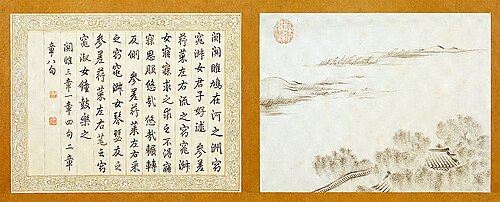
Start at the top for an easy introduction. Go further down for more detail and scholarship.
- Easy
- Intermediate
- Advanced
For young readers
Long, long ago in ancient China, people sang songs while they worked in the fields, when they fell in love, when soldiers went off to war, and when kings made offerings to their ancestors. About 3,000 years ago, some of these songs were collected together. Today we call the collection the Classic of Poetry, or Shijing.
There are 305 songs in the book. Some are short and simple, like songs you might sing with friends. One of the most famous begins with two birds calling to each other on an island in a river, and then tells of a young man who cannot sleep because he is thinking of a girl he likes.
Other songs are about farmers who work hard all year, about a soldier coming home in the snow, or about greedy rulers. One song even calls a greedy lord a “big rat” and says: “Big rat, big rat, don’t eat my millet!”
The songs often repeat the same lines with small changes, like a chorus. This made them easy to remember and to sing. The music is lost now, but the words have been read aloud and memorized for thousands of years.
The great teacher Confucius loved these songs. He told his son that if you had not studied them, you would not know how to speak well. For more than 2,000 years, students in China, Korea, Japan and Vietnam learned these poems by heart, and many sayings that people still use today come from them.
At a glance
- Contents
- 305 poems (plus six titles without text) in three sections: Feng (Airs of the States), Ya (Court Songs, Lesser and Greater) and Song (Hymns)
- Date
- Mostly Western Zhou to middle Spring and Autumn period, about the 11th–7th centuries BC; oldest hymns possibly earlier, latest pieces around 600 BC
- Place
- The Zhou royal domain and the states of the Yellow River plain and surrounding regions, northern China
- Language and form
- Early Old Chinese; mostly four-character lines, rhymed, in repeating stanzas
- Authors
- Mostly anonymous; songs of court musicians, nobles, and the common people as reshaped by court musicians
- Status
- One of the Five Classics of Confucianism from the Han dynasty; the received text is the Mao version
- Earliest manuscripts
- Warring States bamboo manuscripts (4th century BC), Han manuscripts from tombs, Eastern Han stone classics
Easy
What is the Classic of Poetry?
The Classic of Poetry (Shijing, 詩經) is the oldest surviving collection of Chinese poetry. It contains 305 poems, most composed between the eleventh and the seventh centuries BC, during the Western Zhou dynasty (about 1046–771 BC) and the first half of the Spring and Autumn period. The poems were originally songs, performed with music at court, at religious ceremonies, at feasts and in everyday life.
In early China the collection was simply called the Shi, “the Songs” or “the Poems”, or the Three Hundred Poems. Only in the Han dynasty, when Confucian learning was made the basis of official education, was it called a jing, a “classic”. It became one of the Five Classics, alongside the Book of Documents, the Book of Changes, the Record of Rites and the Spring and Autumn Annals.
For more than two thousand years, the Classic of Poetry was memorized by students throughout East Asia. It shaped the Chinese language, provided countless proverbs and four-character idioms (chengyu), and set the model for Chinese poetry. It also offers modern readers a rare window onto the feelings and daily life of people in early China.
Easy
Three kinds of songs
The collection is divided into three main parts. The first and largest part is the Feng (風), “Airs” or “Airs of the States” (Guofeng), with 160 poems grouped under fifteen regions or states, such as Zhou-nan, Shao-nan, Wei, Zheng and Qin. These are mostly short songs about love and courtship, marriage, longing for absent husbands, farming, hunting, soldiers’ hardships and complaints against rulers.
The second part is the Ya (雅), “Court Songs” or “Elegantiae”, divided into the Lesser Ya (Xiaoya, 74 poems) and the Greater Ya (Daya, 31 poems). They include songs for royal banquets and ceremonies, poems about military campaigns, laments about bad government, and narrative poems about the founding of the Zhou dynasty and its ancestors, such as the story of Hou Ji, the ancestor who taught people to farm, and of King Wen and King Wu.
The third part is the Song (頌), “Hymns” or “Eulogies”, with 40 poems: 31 hymns of the Zhou royal house, 4 of the state of Lu and 5 of the state of Song, whose rulers claimed descent from the Shang kings. These were solemn songs for sacrifices to ancestors and gods, probably accompanied by bells, drums and stone chimes, and perhaps by dance. Some Zhou hymns are thought to be among the oldest poems in the whole collection.
Easy
Voices from ancient China
The first poem in the collection, “Guan ju” (關雎), begins: 關關雎鳩,在河之洲 — “Guan-guan, cry the ospreys, on the islet in the river.” It goes on to describe a young nobleman who longs for a lovely, good girl, tossing and turning at night, and finally welcoming her with the music of zithers and bells. It has been read both as a simple love song and, in the Confucian tradition, as a model of proper feeling and marriage.
Many Airs speak with the voice of ordinary people, and a large number are spoken by women. Some describe a woman waiting for her husband to return from service, another a girl warning her lover not to climb over the wall because her parents might see. In “Shuo shu” (碩鼠, “Big Rat”) from the Airs of Wei, farmers compare their lord to a fat rat that eats their grain and dream of leaving for a happier land.
Soldiers’ songs record the hardships of campaigns. In “Cai wei” (采薇, “Gathering Ferns”) from the Lesser Ya, a returning soldier remembers: 昔我往矣,楊柳依依 — “Long ago, when I set out, the willows were soft and swaying”; now, coming home, “the snow is falling thick”. The contrast of seasons expresses the length of his service and his sorrow, in only a few words.
“Qi yue” (七月, “The Seventh Month”) from the Airs of Bin follows the farming year month by month: spinning, gathering mulberry leaves, hunting, harvesting, storing ice, and finally the year-end feast. Other poems praise good harvests, welcome guests to banquets, or lament a world in disorder. Together they give a vivid picture of Zhou society from the palace to the village.
Intermediate
Form and poetic techniques
About 95 per cent of the lines have four syllables (four characters), usually with a slight pause in the middle. Poems are normally divided into stanzas of similar shape, and most Airs have three stanzas. Rhyme is regular, most often between the second and fourth lines of a four-line stanza. A characteristic feature is repetition with variation: from stanza to stanza, most words stay the same while a few change, like verses of a folk song. This structure suits singing and memorization.
Traditional criticism identified three basic modes of expression. Fu (賦) is direct description or narration. Bi (比) is explicit comparison, such as likening a greedy lord to a rat. Xing (興), often translated “stimulus” or “evocation”, is the most distinctive: a poem opens with an image from nature, such as birds calling, peaches blossoming or grass growing, which then leads into a human situation. The exact relationship between the image and the human theme is left for the listener to feel, and xing became a central idea in later Chinese poetics.
Together with the three sections (Feng, Ya, Song), these three modes were called the “six principles” (liu yi, 六義) of poetry in the “Great Preface” to the Mao edition. The Great Preface also states that poetry is where intention goes: what is in the heart is intention, and when expressed in words it becomes a poem. This idea, that poetry expresses genuine feeling and moral intent, deeply influenced Chinese literary thought.
Because the songs rhymed in the pronunciation of about 3,000 years ago, many no longer rhyme in modern Chinese. The late Ming scholar Chen Di argued that this was because pronunciation had changed, not because the poets rhymed loosely. His insight made the Shijing the most important evidence for reconstructing Old Chinese pronunciation, as in the work of Bernhard Karlgren and, more recently, William Baxter and Laurent Sagart.
Intermediate
Historical context: music, ritual and diplomacy in Zhou China
The Zhou dynasty overthrew the Shang around 1046 BC and ruled through a network of regional lords, many of them relatives of the king. Ritual and music were central to Zhou government: sacrifices to ancestors, banquets, archery contests and diplomatic meetings all involved formal music and song. The Hymns and many Court Songs were composed for such occasions. The Zhou idea of the Mandate of Heaven, the belief that Heaven gives the right to rule to virtuous rulers and withdraws it from bad ones, appears in several poems about the dynasty’s founding.
In 771 BC the Western Zhou capital fell to invaders and allied rebels, and the court moved east to Luoyang. During the following Spring and Autumn period (770–476 BC), royal power weakened and the regional states became largely independent. Some Court Songs lament the disorder and misrule of these times, and many Airs of the States belong to this period.
By the Spring and Autumn period, knowing the Poems had become a mark of an educated nobleman. The Zuozhuan, a historical narrative, describes envoys and ministers reciting lines from the Poems at banquets and diplomatic meetings to express their intentions indirectly. Choosing the right verse, and understanding the verse chosen by one’s host, was a skill of statecraft.
Where did the Airs come from? A Han-dynasty tradition held that Zhou kings sent officials to collect songs from the people in order to learn about their condition. Many modern scholars doubt that such an office existed in this form, and note that even the “folk” songs show a consistent literary polish, suggesting they were reworked by court musicians. The Airs are best seen as songs rooted in regional traditions but shaped for performance at court.
Intermediate
Confucius and the Poems
Confucius (551–479 BC) treated the Poems as essential to education. In the Analects he tells his son Boyu that without studying the Poems, one has nothing to say with; he sums up the three hundred poems in one phrase, “no depraved thoughts” (思無邪); and he says that the Poems can inspire, help one observe, help one get along with others and express grievances, and teach the names of birds, beasts, plants and trees.
The historian Sima Qian, writing around 100 BC, reported that Confucius selected the 305 poems from more than 3,000 older songs. This story was accepted for centuries, but most modern scholars reject it. The Zuozhuan records that in 544 BC, when Confucius was a young child, a visitor from the state of Wu heard the music of the Poems performed at the court of Lu in an order close to the present one, which suggests that the collection already existed in a similar form. Confucius himself spoke of “three hundred poems”. He may, however, have helped put the music in order, as one passage in the Analects suggests.
Through Confucius and his followers, including Mencius and Xunzi, who frequently quote the Poems, the collection became a moral textbook. Quoting the Poems became a standard way of supporting an argument in Chinese philosophy and politics.
Intermediate
How the text was transmitted
According to Han tradition, the Qin dynasty’s burning of books in 213 BC targeted the Poems, and the text survived largely because scholars had memorized it. Modern scholars treat this story with caution, since manuscript discoveries show that variation among versions existed before Qin and that the Poems continued to be studied.
In the Han dynasty, three schools of interpretation, named after the states of Lu and Qi and the scholar Han Ying, were officially recognized at the imperial academy. A fourth tradition, the Mao school, attributed to scholars named Mao Heng and Mao Chang, had a preface for each poem explaining its supposed historical and moral meaning. The Mao version gained recognition at the end of the Western Han, and the great Eastern Han scholar Zheng Xuan (127–200) wrote a commentary on it. The other three versions were lost by about the fifth century except for fragments, some preserved on the Xiping Stone Classics carved in the 170s–180s.
In 653, the Tang court issued the Correct Meaning of the Mao Poems (Maoshi zhengyi), edited under Kong Yingda, as the official interpretation. In the Song dynasty, the Neo-Confucian scholar Zhu Xi (1130–1200) wrote a new commentary, the Collected Commentaries on the Poems (Shi jizhuan), which set aside many of the Mao prefaces and read a number of Airs as love songs, some of which he condemned as licentious. Zhu Xi’s commentary became the standard for the civil service examinations in China, Korea and elsewhere for centuries.
The Poems spread across East Asia with Confucian learning. In Korea they were studied from the Three Kingdoms period onward and were part of the core curriculum and examinations in the Goryeo and Joseon dynasties. Jeong Yak-yong’s Lectures on the Classic of Poetry (Sigyeong gangui), written in answer to about 800 questions from King Jeongjo in 1791, is one of the notable Korean studies. In Japan and Vietnam, too, the Poems were read and quoted by scholars and poets.
Intermediate
Influence and legacy
The Classic of Poetry is the fountainhead of Chinese poetry. Its four-character line, its nature imagery and its technique of xing influenced later poetry, and poets of later ages, such as the Tang poets Li Bai and Du Fu, looked back to it as a model of poetry that expressed real feeling and social concern. The Chuci (Songs of Chu), a southern collection of the Warring States period, is often paired with the Shijing as the other ancient root of Chinese verse.
The Poems also shaped the language. Many common expressions come from them, and allusion to the Poems became a mark of learning in letters, speeches and poetry across East Asia. Because it was part of the examination curriculum, generations of officials in China, Korea and Vietnam knew large parts of it by heart.
In the West, the Jesuits translated the Poems into Latin, and in the nineteenth century James Legge produced a full English translation (1871). Arthur Waley’s The Book of Songs (1937) and Ezra Pound’s The Confucian Odes (1954) brought the poems to a wider readership and influenced modern English poetry. Today the Shijing is read as literature, as a historical source, and as a record of the voices of ordinary people, including women, from nearly three thousand years ago.
Advanced
Scholarly debates: dating, authorship and interpretation
Dating. The Zhou Hymns and parts of the Greater Ya are generally considered the oldest layers, perhaps from the early Western Zhou, although some scholars date their final form later. The Airs mostly belong to the late Western Zhou and Spring and Autumn periods. Zheng Xuan regarded “Zhulin” (株林) in the Airs of Chen, which refers to the scandal around Duke Ling of Chen (killed in 599 BC), as the latest poem. The five Hymns of Shang are traditionally said to preserve Shang ritual songs, but most scholars think they were composed later by the rulers of Song. Dating individual poems relies on language, rhyme, historical allusions and comparison with bronze inscriptions.
Folk or court? The Han idea that the Airs were folk songs gathered by royal officials, and the later tradition that Confucius edited them, have both been questioned. Some scholars emphasize oral and popular origins; others stress the role of aristocratic and court performers and argue that the “folk” voice is partly a literary convention. Many poems appear to be written by women or from a woman’s point of view, which raises questions about authorship and performance.
Allegory versus literal reading. The Mao prefaces interpreted many love songs as political allegories, for example as praise of a queen’s virtue or criticism of a particular ruler. Sceptics from the Song dynasty onward, such as Zheng Qiao and Zhu Xi, questioned many of these readings. In the twentieth century, the Doubting Antiquity movement led by Gu Jiegang rejected the Mao prefaces more fully, while the French sinologist Marcel Granet read the Airs as songs of seasonal festivals and courtship in rural communities. More recently, scholars have argued that the history of interpretation is itself important, since for two thousand years readers experienced the Poems through their commentaries.
Advanced
Evidence: excavated manuscripts and methods
Since the 1970s, archaeology has transformed the study of the Poems. Bamboo slips from a Han tomb at Shuanggudui, Fuyang (excavated 1977) preserve fragments of a version different from the Mao text. Manuscripts from the Guodian tomb (excavated 1993) and the Shanghai Museum collection (acquired in 1994) quote the Poems, and one Shanghai Museum text, known as Kongzi shilun (“Confucius’s Discussion of the Poems”), contains comments attributed to Confucius on individual poems. Bamboo slips bought by Anhui University in 2015 and published in 2019 contain nearly sixty poems from the Airs of the States, making them the oldest known manuscript copy of a part of the collection, from the Warring States period. Slips from the tomb of the Marquis of Haihun (d. 59 BC) in Jiangxi preserve a Han edition.
These discoveries show that in the Warring States and early Han periods the poems circulated with many variant characters, often reflecting similar pronunciations, and sometimes in a different order. Scholars such as Martin Kern have argued that this variation points to a culture in which the Poems were learned and transmitted largely through memory and recitation, with writing used to record sound. Others emphasize the role of written copies. The debate affects how we understand the formation of the text and the reliability of the received Mao version.
Methods used today include comparing manuscript variants with the received text, analysing rhymes for historical phonology, comparing language and themes with Western Zhou bronze inscriptions, and studying the reception history of commentaries. The classic translations by Legge, Waley and Karlgren, and modern annotated editions such as Cheng Junying’s, remain important tools.
Key ideas
- Feng, Ya, Song
- The three sections: regional Airs, Court Songs and ritual Hymns.
- Fu, bi, xing
- Three modes of expression: direct description, explicit comparison, and evocative opening images from nature.
- Poetry expresses intention
- The traditional idea that a poem gives voice to what is in the heart (shi yan zhi).
- Repetition with variation
- Stanzas repeat most words with small changes, a sign of song origins and aid to memory.
- Poems in diplomacy
- Zhou and Spring and Autumn nobles quoted the Poems to express intentions indirectly.
- Confucian canon
- Confucius’s teaching and Han state policy made the Poems one of the Five Classics studied for two millennia.
- Commentary tradition
- The Mao prefaces, Zheng Xuan and Zhu Xi shaped how the poems were read; modern scholars study this history as well.
- Excavated manuscripts
- Bamboo slips reveal early textual variation and inform debates about oral and written transmission.
Records
- c. 1046 BCE — The Zhou conquer the Shang; the earliest Zhou Hymns may date from the following decades.
- 771 BCE — The Western Zhou capital falls (771 BC); the court moves east the next year, and the Spring and Autumn period begins.
- 599 BCE — Duke Ling of Chen is killed (599 BC); the related poem “Zhulin” is traditionally considered the latest in the collection.
- 551 BCE — Confucius is born (551 BC); he later teaches the Poems as central to education.
- 544 BCE — According to the Zuozhuan, Ji Zha of Wu hears the Poems performed at the court of Lu (544 BC).
- 213 BCE — Qin burning of books (213 BC); Han tradition says the Poems survived through memorization.
- 136 BCE — Emperor Wu of Han establishes academicians for the Five Classics (136 BC), including the Poems.
- c. 175 CE — The Xiping Stone Classics are carved in Luoyang, including the Lu version of the Poems.
- 653 CE — The Tang court issues the Maoshi zhengyi as the official commentary.
- 1791 — Jeong Yak-yong answers King Jeongjo’s questions in his Lectures on the Classic of Poetry.
- 1871 — James Legge publishes a complete English translation.
- 2019 — The Anhui University bamboo slips with Warring States copies of the Airs are published.
Glossary
- Five Classics
- The core Confucian canon: the Poems, Documents, Changes, Rites and Spring and Autumn Annals.
- Western Zhou
- The first part of the Zhou dynasty (about 1046–771 BC), with its capital near modern Xi’an.
- Spring and Autumn period
- The period 770–476 BC, named after the chronicle of the state of Lu.
- Guofeng
- “Airs of the States”, the 160 regional songs that open the collection.
- An opening image, usually from nature, that evokes the feeling of the poem.
- Mao Poems
- The version of the text and commentary attributed to Mao Heng and Mao Chang, the only complete Han version to survive.
- Great Preface
- The introduction to the Mao edition, a foundational text of Chinese literary theory.
- Bamboo slips
- Strips of bamboo tied together and written on with brush and ink; the main writing material of early China.
- Old Chinese
- The Chinese language of the Zhou period, reconstructed partly from the rhymes of the Poems.
- Chengyu
- Four-character idioms, many drawn from classical texts like the Poems.
Questions and answers
How old are the poems?
Most were composed between about 1000 and 600 BC, so the oldest are almost 3,000 years old.
Did Confucius write or choose the poems?
He did not write them. Tradition says he selected 305 from 3,000, but most scholars today doubt this, because the collection seems to have existed in a similar form when he was a child.
Were the poems sung?
Yes. They were songs performed with music, but the melodies were lost long ago; only the words survive.
Who wrote them?
Almost all are anonymous. They include songs of the court, of nobles and of ordinary people, and many are in a woman’s voice.
Why do some poems not rhyme in modern Chinese?
Chinese pronunciation has changed greatly in 3,000 years. Scholars use the rhymes to reconstruct how Old Chinese sounded.
Why did readers find political meanings in love songs?
The Mao commentary read many poems as allegories about rulers and virtue, making them suitable for moral education. Later scholars like Zhu Xi and modern critics questioned many of these readings.
What have excavated manuscripts changed?
They show that early versions had many variant characters and orders, suggesting a lively oral and written tradition, and they include early discussions attributed to Confucius.
Sources and further reading
- Classic of Poetry. Wikipedia
- Mao Commentary. Wikipedia
- Guan ju. Wikipedia
- Five Classics. Wikipedia
- Xiping Stone Classics. Wikipedia
- 시경강의 (詩經講義). Encyclopedia of Korean Culture, Academy of Korean Studies
- Arthur Waley, The Book of Songs. George Allen & Unwin, 1937
- 程俊英 (Cheng Junying), 詩經譯注 (Shijing yizhu). 上海古籍出版社 (Shanghai Guji Chubanshe), 1985
- Martin Kern, Early Chinese Literature, Beginnings through Western Han, in The Cambridge History of Chinese Literature, vol. 1. Cambridge University Press, 2010
Related
- ConfuciusTeacher from the state of Lu whose sayings, gathered in the Analects, shaped ethics and government across East Asia.
- MenciusA Confucian thinker who argued that people have the beginnings of moral goodness and that rulers must care for their subjects.
- Zhu XiSong philosopher who gave enduring form to Neo-Confucian learning.
- Jeong Yak-yongJoseon scholar and reform thinker who wrote extensively about government, law and the practical responsibilities of officials.
- Du FuTang poet whose writing records personal hardship and the human effects of rebellion and displacement.
- HomerThe poet tradition credits with the Iliad and the Odyssey, the founding epics of Greek literature. Whether one person composed both is debated.
Written with AI assistance from the published sources listed above, and revised as new research appears.