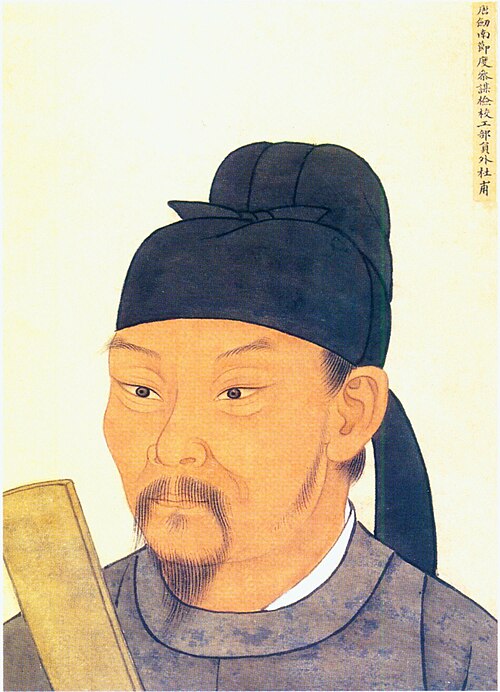
Start at the top for an easy introduction. Go further down for more detail and scholarship.
- Easy
- Intermediate
- Advanced
For young readers
Du Fu lived in China about 1,300 years ago, during the Tang dynasty. Many people in China call him the “Sage of Poetry”, meaning the wisest and best of all poets. He was a friend of another famous poet, Li Bai.
When Du Fu was in his forties, a general named An Lushan started a huge rebellion. Armies marched across the country, cities were captured, and millions of families were forced to run from their homes. Du Fu and his family became refugees too. At one point his baby son died because there was not enough food.
Du Fu wrote about all of this in his poems. He wrote about soldiers taken from their families, about old people left alone, about his own hunger and worry, and about how much he missed his wife and children when they were apart. Because his poems record what happened in those years, people call him the “poet-historian”.
He also wrote about small, happy things: rain falling softly at night in spring, swallows flying into his little house, children playing, and a friend coming to visit. For a few years he lived in a thatched cottage in the city of Chengdu. One stormy autumn the wind blew the roof off! Even then, he wrote that he wished there were a giant house big enough to shelter all the poor people in the world.
Du Fu was not famous during his life and died poor, on a boat on a river. But later readers discovered his poems and loved them. Today his cottage in Chengdu is a museum and park, and children in China, Korea and Japan still read his poems.
At a glance
- Lived
- 712–770; main literary activity c. 735–770
- Born
- Gong County, near Luoyang (modern Gongyi, Henan)
- Dynasty
- Tang, under Emperors Xuanzong, Suzong and Daizong
- Other names
- Courtesy name Zimei (子美); called Du Shaoling (杜少陵) and Du Gongbu (杜工部, after an honorary title)
- Titles of honour
- “Sage of Poetry” (詩聖) and “Poet-Historian” (詩史)
- Surviving poems
- Nearly 1,500
- Famous works
- “Spring View”, “Song of the Wagons”, the “Three Officials” and “Three Partings”, “My Thatched Roof Is Ruined by the Autumn Wind”, “Autumn Meditations”, “Climbing High”
- Died
- Winter 770, on a boat on the Xiang River near Tanzhou (modern Changsha, Hunan)
Easy
Who was Du Fu?
Du Fu (in older books Tu Fu) was a poet of China’s Tang dynasty (618–907). He is usually ranked with Li Bai as one of the two greatest Chinese poets, and many critics since the Song dynasty have placed him first of all. In Chinese he is called the Shisheng, the “Sage of Poetry”.
His life was divided in two by the An Lushan Rebellion (755–763), a civil war that shattered the Tang empire at the height of its power. Before the rebellion Du Fu was a struggling scholar hoping for an official career; during and after it he became a refugee, briefly a minor court official, and finally a wanderer in the south-west.
Nearly 1,500 of his poems survive. They combine a deep concern for the state and for ordinary people with extraordinary technical skill, especially in the strict form called regulated verse. Because they record so many events of his time, they have been called “poetry as history”.
Easy
Early life: a scholar’s family and failed hopes
Du Fu was born in 712 in Gong County, near the eastern capital Luoyang. His family was proud of its scholar-official ancestors: they traced their descent to Du Yu, a famous general and commentator on the classics in the third century, and his grandfather Du Shenyan was a well-known poet at the court of Empress Wu Zetian. His mother died when he was young, and he was partly raised by an aunt.
Like other young men of his class, Du Fu expected to serve the emperor as an official. He studied the classics and began writing poetry early. In his twenties he travelled in the east and south. Around 735–736 he took the imperial examination in Luoyang and failed. In 747 he tried a special examination called by the emperor, but the powerful chief minister Li Linfu had every candidate failed, declaring that no talent had been overlooked.
In 744 he met Li Bai, then already a famous poet who had just left the court. They travelled together, and Du Fu admired him deeply for the rest of his life, writing many poems to or about him. The meeting of the two great poets became one of the best-loved stories in Chinese literary history.
Easy
Years in Chang’an: waiting and watching
For about ten years Du Fu lived in and around the capital, Chang’an, trying to win an appointment. In 751 he presented three rhapsodies (long, ornate prose-poems) on imperial ceremonies to Emperor Xuanzong, who was impressed, but still no post came. He married around 752 and had several children, and the family often lived in poverty.
These years sharpened his eye for injustice. In “Song of the Wagons” (兵車行), written around 750, soldiers march off to the frontier while their families cry by the roadside; an old man explains that villages are empty because men are drafted endlessly for distant wars. In “Ballad of Lovely Women” (麗人行) he describes the luxurious outing of the relatives of the emperor’s favourite, Yang Guifei, with quiet irony.
In late 755 he finally received a minor post. Travelling to visit his family at Fengxian, he passed the emperor’s pleasure palace and then reached home to find that his youngest son had died of hunger. The long poem he wrote about the journey contains a famous couplet contrasting wealth and poverty: behind the red gates, wine and meat go bad; on the road lie the bones of the frozen dead. Within weeks the rebellion began.
Intermediate
The rebellion: capture, escape and a court post
In December 755 An Lushan, a powerful frontier general, rebelled. The rebels took Luoyang, and in 756 Chang’an fell; Emperor Xuanzong fled toward Sichuan and his son was proclaimed Emperor Suzong at Lingwu in the north-west. Du Fu moved his family to safety in the north at Fuzhou and set out to join the new emperor, but he was captured by rebels and taken back to occupied Chang’an.
During his months in the captured capital he wrote some of his most famous poems. “Spring View” (春望), written in the spring of 757, begins: 國破山河在,城春草木深 — “The state is broken, yet mountains and rivers remain; / in the city it is spring, and grass and trees grow deep.” In “Moonlit Night” he imagines his wife far away in Fuzhou, gazing at the same moon alone.
In 757 he escaped and reached Suzong’s court, where he was appointed Reminder of the Left (zuo shiyi), a junior post whose holder was supposed to point out the emperor’s errors. He soon got into trouble for defending the dismissed minister Fang Guan. Allowed to visit his family, he wrote the long poem “Journey North” (北征) about the ravaged countryside. After the court returned to Chang’an, he was sent out in 758 to a minor provincial post in Huazhou.
Intermediate
Poems of witness: the “Three Officials” and “Three Partings”
In 759, while travelling between Luoyang and Huazhou, Du Fu wrote two sets of three poems known as the “Three Officials” (三吏) and the “Three Partings” (三別). They describe how the government, desperate for soldiers after a major defeat at Xiangzhou, forced young boys, old men and even old women into service.
In “The Officer at Shihao”, the poet stays overnight in a village and hears an official come to seize men. An old man climbs over the wall and flees; his old wife tells the officer that two of her three sons have just died in battle, and finally offers to go herself to cook for the army. At dawn, the poet says goodbye only to the old man. In “Parting of the Newlyweds”, a bride speaks to her husband, taken away the morning after their wedding.
These poems stand in the tradition of the old yuefu ballads that criticized government through the voices of common people. What is striking is that Du Fu does not simply condemn the war, which he believed had to be won. He shows both the necessity of defending the state and its terrible human cost, and lets the victims speak.
Intermediate
Chengdu and the thatched cottage
In 759 Du Fu gave up his post and took his family west, first to Qinzhou and then over difficult mountain roads via Tonggu to Chengdu in Sichuan, where they arrived at the end of the year. With help from friends and relatives he built a thatched cottage outside the city by the Huanhua stream in 760.
The Chengdu years were among the most peaceful of his life. His friend Yan Wu, who governed the region, supported him and in 764 took him onto his staff, obtaining for him the honorary title of Vice Director in the Ministry of Works; that is why he was later called “Du Gongbu”. He wrote poems about his garden, the river, neighbours, and the pleasures of simple life, such as “Welcome Rain on a Spring Night”, in which rain slips in with the wind by night and nourishes things without a sound.
Hardship did not disappear. In “My Thatched Roof Is Ruined by the Autumn Wind” (茅屋為秋風所破歌), a storm tears off his roof, village boys run off with the thatch and his family lies awake under a leaking roof. The poem ends with a wish for a mansion of ten thousand rooms to shelter all the poor scholars of the world, even if his own hut is destroyed. The site of the cottage is now the Du Fu Thatched Cottage museum and park.
Intermediate
Kuizhou and the last journey
After Yan Wu died in 765, Du Fu left Chengdu and travelled down the Yangtze. From 766 he spent nearly two years at Kuizhou, near the Three Gorges, where he managed a small farm. Despite illness, he wrote about 400 poems there, many in a dense, difficult late style.
The Kuizhou poems include “Autumn Meditations” (秋興八首), a sequence of eight regulated poems in which the autumn gorges lead his mind back to Chang’an and the lost glory of the Tang court; it is often considered the summit of Chinese regulated verse. “Climbing High” (登高), an eight-line poem in which every line is parallel, pictures falling leaves and the endless Yangtze and ends with the poet, old, sick and far from home, setting down his cup of wine.
In 768 he left Kuizhou and wandered through Hubei and Hunan, living largely on a boat. He died in the winter of 770, probably of illness, somewhere on the Xiang River near Tanzhou, at the age of 58. His family could not afford to take his body home; it was reburied in the family cemetery decades later, when the poet Yuan Zhen wrote his epitaph in 813.
Intermediate
Family, friends and everyday life
Du Fu is one of the first Chinese poets to write often and tenderly about his own wife and children. In “Moonlit Night”, written as a captive in Chang’an, he pictures his wife alone in Fuzhou, her hair damp with mist, and pities the small children who are too young to understand why she is sad. Such attention to a wife’s feelings was unusual in the poetry of his day.
When he was finally able to rejoin his family in 757, he wrote the three poems of “Qiang Village”. His wife and children stare at him as if he were a ghost, neighbours crowd over the wall to look, and at night the couple sit facing each other by candlelight as if in a dream. In other poems he describes his hungry children crying, his son’s games, and his worry about brothers scattered by the war, as in “Thinking of My Brothers on a Moonlit Night”.
His poems of friendship are equally important. Besides his famous poems about Li Bai, he wrote for officials, monks, painters, musicians and farmers. In “A Guest Arrives”, from the Chengdu years, he apologizes for the simple food and old wine he can offer and calls over the old neighbour to share a drink. These poems show a world of human relationships that makes his larger poems about history feel personal and concrete.
Intermediate
Du Fu’s art: form, variety and the moral voice
Du Fu was the great master of regulated verse (lüshi), eight-line poems with strict rules of tone, rhyme and parallel couplets. He used this form, often seen as elegant court poetry, for subjects of every kind, from war and politics to his own illness. He also wrote long old-style poems and ballads, and invented “new yuefu” on current events rather than reusing old song titles.
Critics have long noted his range. He could write grand descriptions of mountains and rivers, humorous sketches of friends, intimate lines about his wife and children, and dense historical meditations. He was deeply read and wove allusions to the classics and earlier poets into his lines; the Song poet Huang Tingjian famously claimed that not a single word in Du Fu lacks a source.
Behind his poetry lies a Confucian sense of duty: loyalty to the emperor, concern for good government and compassion for the people. He often called himself a failure and described his poverty and illness frankly. This combination of public conscience and personal honesty is what later readers most admired, and why he came to be seen as a moral model as well as a poet.
Intermediate
Reputation and legacy in East Asia and beyond
Du Fu was not widely recognized in his lifetime; few anthologies of his day included him. Early in the ninth century Yuan Zhen, in his epitaph, and Han Yu, in poems, praised him alongside or even above Li Bai. By the late Tang the critic Meng Qi recorded that people called Du Fu’s poetry a “history in verse”.
The Song dynasty (960–1279) made him the supreme Chinese poet. Scholars collected and annotated his works intensively, and poets such as Wang Anshi, Su Shi and Huang Tingjian took him as their model. The Qing anthology Three Hundred Tang Poems (c. 1763) includes 39 of his poems, more than any other poet.
In Korea, the Joseon court sponsored a vernacular Korean translation and commentary of his complete poems, the Dusi eonhae (杜詩諺解), first printed in 1481, which is also a key source for the history of the Korean language. In Japan, Matsuo Bashō quoted the opening of “Spring View” in his travel diary Oku no Hosomichi at the ruined site of Hiraizumi. In English, translators and scholars including William Hung, David Hawkes and Stephen Owen, whose complete annotated translation appeared in 2016, have made him widely read.
Advanced
Debates: “poet-historian”, sage, and the reading of Du Fu
The label “poet-historian” (shishi) has been both illuminating and limiting. It encouraged generations of commentators to read every poem as a coded record of datable events and political opinions, and to arrange the poems in strict chronological order. Traditional commentaries, especially from the Song and Qing, built elaborate biographical and allegorical readings, some of which modern scholars consider over-interpretation.
Similarly, the image of Du Fu as a Confucian “sage”, endlessly loyal to the emperor, was shaped by Song Neo-Confucian values. Modern critics have drawn attention to other sides of his work: humour, playfulness, interest in Buddhism and Daoism, experiments with difficult diction, and poems on apparently trivial subjects. Stephen Owen and others have emphasized his formal restlessness and range rather than a single moral message.
Twentieth-century politics also shaped his reception. In the People’s Republic of China he was generally celebrated as a “people’s poet”, while during the Cultural Revolution period Guo Moruo’s book Li Bai and Du Fu (1971) notoriously exalted Li Bai and criticized Du Fu as a landlord-class poet, a judgement widely seen as reflecting the political climate of the time.
Advanced
Sources, texts and chronology
Unlike Li Bai, Du Fu left no contemporary collection edited by a relative that survives. His works circulated in manuscript and were gathered by Northern Song scholars, notably Wang Zhu, whose edition of 1039 (published in 1059) forms the basis of all later texts. Hundreds of commentaries followed; the Song claimed to have “a thousand commentators on Du Fu”. Important Qing editions include those of Qiu Zhao’ao and Qian Qianyi.
Biographical information comes mainly from his own poems, Yuan Zhen’s epitaph and the official biographies in the Old and New Books of Tang, which contain some errors, such as a story that he died from overeating after a long fast, which modern scholars reject. Because his poems are unusually rich in dates, places and names, scholars have reconstructed his life in much greater detail than Li Bai’s, but the dating of many individual poems remains a matter of argument.
Owen’s The Poetry of Du Fu (2016), a complete bilingual translation published in open access, and earlier studies such as William Hung’s Tu Fu: China’s Greatest Poet (1952) and David Hawkes’s A Little Primer of Tu Fu (1967), remain standard starting points for readers outside China.
Key ideas
- Poet-historian (shishi)
- The idea that Du Fu’s poems form a record of the An Lushan Rebellion and his times.
- Sage of Poetry (shisheng)
- Du Fu’s traditional title, reflecting both his artistic mastery and his image as a moral, Confucian poet.
- Regulated verse
- Du Fu perfected the eight-line lüshi and used it for every kind of subject, from court life to war and illness.
- Compassion for the people
- His poems give voice to conscripted soldiers, old people, refugees and the poor.
- New yuefu
- Ballads on current events rather than old themes, a practice later developed by Bai Juyi and Yuan Zhen.
- Personal honesty
- He wrote frankly about his failures, poverty, illness and love for his family.
- Every word has a source
- Huang Tingjian’s claim about Du Fu’s learned use of allusion, which shaped Song poetics.
Records
- 712 CE — Du Fu is born in Gong County, near Luoyang.
- c. 735 CE — Fails the imperial examination.
- 744 CE — Meets Li Bai; they travel together.
- 747 CE — A special examination is held; chief minister Li Linfu has all candidates failed.
- 751 CE — Presents three rhapsodies to Emperor Xuanzong.
- 755 CE — Receives a minor post; his infant son dies of hunger; the An Lushan Rebellion begins.
- 756 CE — Captured by rebels and held in Chang’an.
- 757 CE — Writes “Spring View”; escapes to Emperor Suzong and becomes Reminder of the Left.
- 759 CE — Writes the “Three Officials” and “Three Partings”; moves to Chengdu at year’s end.
- 766 CE — Settles at Kuizhou, where he writes about 400 poems in two years.
- 770 CE — Dies on a boat on the Xiang River near Tanzhou.
- 1481 — The Korean vernacular translation Dusi eonhae is printed in Joseon.
Glossary
- An Lushan Rebellion
- The civil war of 755–763 begun by the general An Lushan, which devastated the Tang empire.
- Lüshi (regulated verse)
- Eight-line poems with strict rules of tone, rhyme and parallel middle couplets.
- Yuefu
- Ballad-style poetry, traditionally associated with folk songs and social criticism.
- Rhapsody (fu)
- A long, ornate form mixing poetry and prose, often presented to rulers.
- Reminder of the Left
- A junior court office whose holder was expected to point out the emperor’s mistakes.
- Imperial examination
- The state examinations used to recruit officials, testing knowledge of the classics and literary skill.
- Allusion
- A brief reference to an earlier text, event or person, used to add layers of meaning.
- Parallelism
- The matching of words and grammar between two lines, a key feature of regulated verse.
- Dusi eonhae
- The fifteenth-century Korean translation of Du Fu’s poems, written in the Korean alphabet.
Questions and answers
Why is Du Fu called the “poet-historian”?
Because his poems describe the events of the An Lushan Rebellion and its effects on ordinary people so closely that readers have used them almost like a history of the time.
Were Du Fu and Li Bai really friends?
Yes. They met in 744 and travelled together for a while. Du Fu wrote many poems about Li Bai afterwards, although they only met again once.
Was Du Fu famous in his lifetime?
Not very. He had admirers, but he became the most celebrated Chinese poet only after his death, especially during the Song dynasty.
What happened to his thatched cottage?
The original building did not survive, but the site in Chengdu has been rebuilt many times and is now the Du Fu Thatched Cottage museum and park.
Did Du Fu die from eating too much?
The official Tang histories tell a story that he died after overeating beef and wine following a long fast, but modern scholars regard it as a legend; he probably died of illness.
Why do scholars argue about how to read his poems?
Traditional commentators often read every line as a political message or dated event; modern scholars warn that this can hide the humour, variety and formal experiments in his work.
How did Du Fu reach Korea and Japan?
Through classical Chinese learning. Joseon Korea printed a Korean translation of his poems in 1481, and Japanese writers such as Bashō quoted him.
Sources and further reading
- Du Fu. Wikipedia
- 두보. 위키백과
- An Lushan rebellion. Wikipedia
- Du Fu Thatched Cottage. Wikipedia
- Three Hundred Tang Poems. Wikipedia
- Stephen Owen (translator and editor), The Poetry of Du Fu. De Gruyter, 2016
- William Hung, Tu Fu: China’s Greatest Poet. Harvard University Press, 1952
- David Hawkes, A Little Primer of Tu Fu. Clarendon Press, Oxford, 1967
Related
- Li BaiTang poet celebrated for vivid imagery and poems about friendship, travel, wine and the natural world.
- ConfuciusTeacher from the state of Lu whose sayings, gathered in the Analects, shaped ethics and government across East Asia.
- Oku no HosomichiMatsuo Bashō’s prose-and-verse account of a journey through northern Japan, shaped through years of revision after the journey itself.
- Classic of Poetry (Shijing)China's oldest poetry anthology — folk songs, court odes and temple hymns later counted among the Confucian classics.
- HunminjeongeumThe Korean alphabet promulgated by King Sejong in 1446, and the title of the text explaining it.
Written with AI assistance from the published sources listed above, and revised as new research appears.