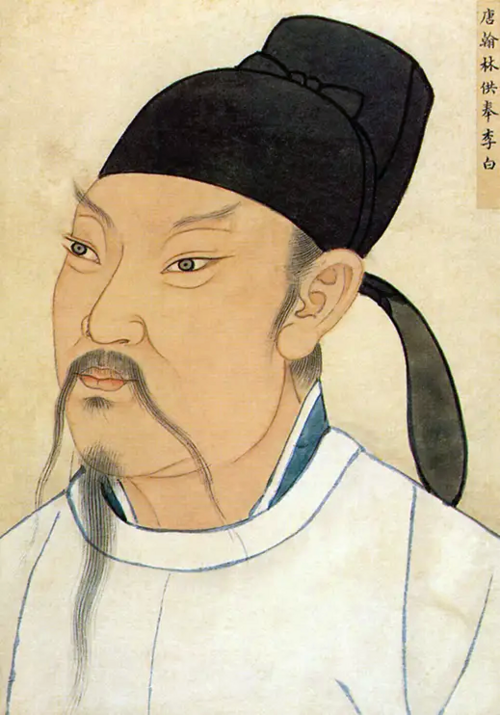
Start at the top for an easy introduction. Go further down for more detail and scholarship.
- Easy
- Intermediate
- Advanced
For young readers
Li Bai lived in China more than 1,300 years ago, at a time when the Tang dynasty ruled a huge and rich empire. He is one of the most famous poets in all of history. In China, many children learn his short poems before they can even read well.
His best-known poem is only four lines long. A traveller wakes up at night far from home. He sees moonlight on the floor and thinks for a moment that it is frost. He lifts his head and looks at the moon, then lowers his head and thinks of home. Almost everyone who has been homesick knows that feeling.
Li Bai loved to travel. He sailed down great rivers, climbed mountains and visited many cities. He made friends everywhere and wrote poems to say hello and goodbye. He also liked wine very much, and many of his poems are about drinking with friends, or even drinking alone with only the moon and his shadow for company.
For a short time the emperor invited Li Bai to his palace in the capital city, Chang'an. But Li Bai was proud and did not fit in well with the rules of court life, so after about two years he left and went back to wandering.
People told many stories about him. One famous legend says he died when he leaned out of a boat to hug the reflection of the moon in the water. Historians think this is just a story, but it shows how people saw him: as a free spirit who loved the moon.
At a glance
- Lived
- 701–762 (birth year generally accepted but not certain); main literary activity c. 725–762
- Birthplace
- Debated: possibly Suyab in Central Asia (near Tokmok, modern Kyrgyzstan) or Sichuan; he grew up near Jiangyou, Sichuan
- Dynasty
- Tang, mainly under Emperor Xuanzong (r. 712–756)
- Other names
- Courtesy name Taibai (太白); self-styled Qinglian Jushi (青蓮居士, “Retired Scholar of the Blue Lotus”); nicknamed the “Banished Immortal” (謫仙人)
- Surviving poems
- About 1,000 poems attributed to him
- Favourite forms
- Yuefu ballads, old-style verse (gushi) and quatrains (jueju)
- Famous works
- “Quiet Night Thought”, “Bring in the Wine”, “The Hard Road to Shu”, “Drinking Alone Under the Moon”
- Died
- 762, at Dangtu (in modern Anhui), where his relative Li Yangbing was magistrate
Easy
Who was Li Bai?
Li Bai (also written Li Po in older English books) was a Chinese poet of the Tang dynasty (618–907). Together with his younger friend Du Fu, he is usually regarded as one of the two greatest poets of classical China. In Chinese the pair are often called simply “Li–Du” (李杜).
He lived during the reign of Emperor Xuanzong, a long period of peace, wealth and cultural brilliance that ended suddenly with a devastating rebellion in 755. Li Bai spent most of his life travelling rather than holding office. He wrote poems for friends, patrons and officials, and about landscapes, history, legends, war on the frontier, the lives of women, wine and the moon.
About a thousand poems attributed to him survive. They range from four-line quatrains that children memorize to long, wild ballads full of gods, dragons and mountain spirits. What readers have always admired is his sense of freedom: his poems seem to flow without effort, leap from image to image and speak with a bold, personal voice.
Easy
Childhood and youth: from the Silk Road to Sichuan
Li Bai is generally said to have been born in 701, but where he was born is uncertain. Two early texts, a preface by his relative Li Yangbing and a later tomb inscription by the official Fan Chuanzheng, say that his ancestors had been exiled to the far west at the end of the Sui dynasty and that the family returned to China in the early eighth century. Many scholars therefore think he was born in Suyab, a trading city on the Silk Road near modern Tokmok in Kyrgyzstan; others argue for Sichuan.
When he was about four years old, around 705, his father brought the family to Sichuan in south-west China. Li Bai grew up near Qinglian (“Blue Lotus”) village in what is now Jiangyou. His family seems to have been prosperous, perhaps through trade. He studied the classics and many other books, began writing poems as a child, and practised swordsmanship. Stories say he admired the knights-errant of old, heroic fighters who defended the weak.
As a young man he spent time in the mountains of Sichuan with a Daoist hermit. Daoism, a Chinese tradition that seeks harmony with nature and sometimes long life or immortality, remained important to him all his life. Around 725, in his mid-twenties, he left Sichuan by boat down the Yangtze River. As far as we know, he never went home again.
Easy
Reading a poem: “Quiet Night Thought”
The most famous poem attributed to Li Bai is “Quiet Night Thought” (靜夜思, Jing ye si). It has only twenty characters. In the version most people know, it reads: 床前明月光,疑是地上霜 / 舉頭望明月,低頭思故鄉. A simple translation: “Before my bed, the bright moonlight; I wonder if it is frost on the ground. / I raise my head and gaze at the bright moon; I lower my head and think of home.”
The poem works through contrast and movement. First comes a mistake: white moonlight looks like cold frost. Then the head goes up to the moon and down again, and in that small movement the feeling changes from surprise to longing. The moon matters because everyone, near or far, sees the same moon; in Chinese poetry it often connects separated people.
Interestingly, the earliest printed versions from the Song dynasty are slightly different: they read “I see the moonlight” in the first line and “gaze at the mountain moon” in the third. The familiar wording became standard later, especially through the Qing-dynasty anthology Three Hundred Tang Poems. Scholars also debate what the character 床 means here: most read it as “bed”, but some argue for a well railing or a folding seat. So even this tiny poem has a history of change and interpretation.
Easy
At the emperor’s court
After leaving Sichuan, Li Bai travelled along the Yangtze and to many cities of central and eastern China. In 727 he married a granddaughter of a former chief minister from the Xu family in Anlu (in modern Hubei) and lived there for about ten years. Like most educated men, he hoped for an official career, but he did not take the imperial examinations; instead he tried to win the attention of powerful patrons with his writing.
His fame grew. The older poet He Zhizhang, on reading his work, is said to have called him a “banished immortal”, a heavenly being sent down to earth for some fault. In 742 Emperor Xuanzong summoned him to the capital, Chang’an, and gave him a post in the Hanlin Academy, a group of literary men who served the emperor. He wrote poems for court occasions, including some about the emperor’s favourite, Yang Guifei.
Court life did not suit him. Anecdotes, which may be exaggerated, tell of Li Bai arriving drunk and ordering the powerful eunuch Gao Lishi to pull off his boots, and of courtiers turning the emperor against him. In 744 he left court with gifts from the emperor. It was a turning point: the rest of his life was spent wandering again, and he formally received Daoist ordination around this time.
Intermediate
Friendship with Du Fu
In the autumn of 744, shortly after leaving court, Li Bai met Du Fu, who was eleven years younger and not yet famous. They travelled together in the region of modern Henan and Shandong, hunting, drinking and writing, and met again the following year. After that they never met again.
The friendship is famous partly because it was unequal in the surviving record. Du Fu wrote at least a dozen poems about or to Li Bai, including two poems “Dreaming of Li Bai” written when he feared his friend had died in exile, and a humorous portrait in “Song of the Eight Immortals of the Wine Cup”, in which Li Bai, given a jug of wine, produces a hundred poems and refuses even the emperor’s summons. Only a few poems by Li Bai addressed to Du Fu survive.
Later critics made the two poets into a pair of opposites: Li Bai the spontaneous, Daoist-inspired genius, Du Fu the careful, Confucian craftsman. The contrast is useful but too simple. Both were highly skilled, both wrote about politics and suffering, and both drew on the whole earlier tradition.
Intermediate
Poems of friendship and farewell
Because travel was slow and dangerous, parting from a friend in Tang China could mean years of separation or a final goodbye. Farewell poems were a social ritual as well as an art, often written at a banquet or riverside as the traveller set off. Li Bai wrote a great many of them, and several are among his most loved works.
In “Seeing Off Meng Haoran to Guangling at Yellow Crane Tower”, he watches the older poet’s boat sail east in spring: the lone sail grows smaller until it vanishes into the blue sky, and all that is left is the Yangtze flowing to the edge of heaven. The poem says nothing directly about sadness; the feeling is carried entirely by the empty river. In “To Wang Lun”, written when a villager came to the shore singing to see him off, Li Bai says that Peach Blossom Pool may be a thousand feet deep, but it is not as deep as Wang Lun’s feeling for him.
These poems show a side of Li Bai that balances the image of the lonely genius. Much of his poetry was written for other people, to thank, flatter, console or remember them, and it depended on a wide network of friends, patrons, monks, Daoist masters and officials across the empire.
Intermediate
Rebellion, prison and exile
At the end of 755 the general An Lushan rebelled. The rebels captured Luoyang and then Chang’an; Emperor Xuanzong fled to Sichuan and abdicated, and his son became Emperor Suzong. The An Lushan Rebellion lasted until 763 and was one of the great catastrophes of Chinese history.
Li Bai, then in his fifties and living in the south, joined the staff of Prince Yong (Li Lin), another son of Xuanzong, who was raising an army along the Yangtze. The court of Suzong regarded the prince’s actions as a revolt, and in 757 his forces were destroyed. Li Bai was arrested, imprisoned at Xunyang (Jiujiang) and at first sentenced to death. According to tradition, the great general Guo Ziyi, whom Li Bai had once helped, intervened, and the sentence was reduced to exile in Yelang, in remote Guizhou.
He travelled slowly up the Yangtze toward exile, but in 759, near the Three Gorges, he received news of a general amnesty. The quatrain “Setting Out Early from Baidi City”, describing a boat racing down the gorges past the cries of monkeys, is traditionally connected with his joyful return, although the dating is not certain.
Intermediate
Last years, death and legends
In his last years Li Bai lived mostly around Nanjing and in Anhui. In 762 he stayed with his relative Li Yangbing, who was magistrate of Dangtu, and died there that year. The exact date and cause of death are unknown; illness is the most likely explanation. Before he died he is said to have handed his manuscripts to Li Yangbing, who wrote a preface for the collection.
Legend soon improved on the facts. The best-known story says that Li Bai, drunk in a boat on the river, leaned over to embrace the reflection of the moon and drowned. Other legends made him an immortal who rode away on a whale. These tales are not history, but they show how quickly Li Bai became a symbol of the poet as free spirit.
His tomb is at Mount Qingshan near Dangtu, in modern Ma’anshan; according to Fan Chuanzheng’s inscription, his remains were moved there in the early ninth century in keeping with his love of the local landscape.
Intermediate
Themes and technique
Li Bai wrote in many forms. About a sixth of his poems are yuefu, ballads that reworked old folk-song titles and themes; famous examples are “Bring in the Wine” (將進酒), with its refrain-like cries to drink while life lasts, and “The Hard Road to Shu” (蜀道難), a torrent of irregular lines about the terrifying mountain road into Sichuan. He also excelled in gushi (“old-style verse”), which allowed lines of varying length and freer rhythm, and in the four-line jueju. He wrote comparatively few poems in the strict eight-line regulated verse (lüshi) that Du Fu perfected.
His recurring subjects include the moon, wine, mountains and rivers, parting from friends, the loneliness of travel, the splendour and decay of history, and Daoist visions of immortals. In “Drinking Alone Under the Moon” he invites the moon and his own shadow to make a party of three. Many poems also deal with war on the frontier, abandoned wives and palace women, and critical comments on court politics, often through historical allusions.
Critics have long praised the apparent spontaneity of his verse, its sudden shifts, hyperbole and imaginative flights. But scholars such as Stephen Owen stress that this “natural” voice was carefully built: Li Bai deliberately adopted the persona of an unconventional genius and wrote with a strong sense of his place in the tradition, reworking the ballads of the Han and Six Dynasties and the poetry of earlier masters such as Xie Tiao, whom he admired.
Intermediate
Influence in China, East Asia and the world
Li Bai’s reputation was high in his own lifetime and never really declined. In the Song dynasty some critics came to rank Du Fu higher as a moral model, but Li Bai remained the favourite of many readers. Qing anthologies fixed his place in education: the Three Hundred Tang Poems, compiled by Sun Zhu around 1763, includes thirty-four of his poems, second only to Du Fu’s thirty-nine.
In Korea, Japan and Vietnam, where classical Chinese was the language of learning, Li Bai was read, memorized and imitated for centuries. Korean literati wrote poems in the Tang style and often invoked him as the model of poetic genius, and in Japan he was known as Ri Haku.
In the West, his poems became famous through translation. Ezra Pound’s small book Cathay (1915), based on the notes of the scholar Ernest Fenollosa, contains mostly poems by Li Bai under the Japanese form of his name, “Rihaku”, and helped shape modernist poetry in English. Gustav Mahler set German adaptations of poems attributed to him in Das Lied von der Erde (1908). Later translators include Arthur Waley and Witter Bynner, and his influence reached poets such as Gary Snyder.
Advanced
Biography: sources and their reliability
The earliest biographical sources are Li Bai’s own poems and prose (especially letters seeking patronage, which are self-promotional), Li Yangbing’s preface to his collected works written at the end of Li Bai’s life, and later tomb inscriptions, notably one by Fan Chuanzheng in the early ninth century. The official biographies in the Old Book of Tang (945) and New Book of Tang (1060) were compiled long afterwards and contain errors and anecdotes; for example, the Old Book of Tang gives his origin as Shandong, which most scholars reject.
Several basic facts remain disputed. The birth year of 701 depends on calculations from poems and the inscriptions; some scholars have proposed other dates. The birthplace question (Suyab, elsewhere in Central Asia, or Sichuan) touches on sensitive issues of identity; claims that Li Bai was ethnically non-Han or of Turkic descent have been made but cannot be proved from the evidence. The family’s claim to descend from Li Gao, founder of the Western Liang, and thus to be related to the Tang imperial house, was also a common kind of genealogical claim that is hard to verify.
Many of the most famous stories, such as Gao Lishi pulling off his boots, Yang Guifei turning against him, or his drowning while reaching for the moon, first appear in later anecdotal literature. Modern biographers such as Arthur Waley, in The Poetry and Career of Li Po (1950), have tried to separate documented events from the legend, while acknowledging that Li Bai himself helped create the legend.
Advanced
Textual transmission and attribution problems
Li Bai’s works circulated in manuscript during and after his life. Li Yangbing’s compilation, known from its preface as the Caotang ji, was one early collection, but Li Yangbing himself said much had been lost in the turmoil of the rebellion. The collections that survive were assembled by Song-dynasty editors, who gathered poems from many sources and added some of doubtful authenticity. The great Qing compilation Complete Tang Poems (1705) and later annotated editions form the basis of modern study.
As a result, the authenticity of individual poems is a real problem. Because Li Bai was so famous, poems in his style were attributed to him, and some texts exist in variant versions, as the case of “Quiet Night Thought” shows. Scholars have questioned several poems, and some traditionally attributed works, such as the lyrics (ci) “Pusaman” and “Yi Qin’e”, are widely doubted because that song form was barely established in his time.
For researchers this means that conclusions about Li Bai’s life or views drawn from a single poem should be treated with caution. Dating is also difficult: few poems carry dates, and many biographical reconstructions rely on placing poems by the places and people they mention, which can lead to circular reasoning.
Key ideas
- The “Banished Immortal”
- The nickname given to Li Bai by He Zhizhang, picturing him as a heavenly being exiled to earth; it shaped how later readers saw him.
- Spontaneity as persona
- Li Bai’s poems seem effortless and free, but this voice was a crafted self-image built on deep knowledge of earlier poetry.
- Moon and wine
- His most famous images: the moon links separated people and invites reflection; wine stands for freedom, friendship and the brevity of life.
- Yuefu revival
- He gave new energy to old ballad titles, using them for bold statements about history, war and human feeling.
- Daoist imagination
- Visions of immortals, sacred mountains and escape from the world run through his poetry and life.
- Li–Du pairing
- Li Bai and Du Fu are traditionally treated as the twin summits of Tang poetry, often (too simply) as opposites.
- Legend and history
- Much of what people “know” about Li Bai comes from later anecdotes, so his biography must be read critically.
Records
- c. 701 CE — Li Bai is born, possibly in Suyab in Central Asia.
- c. 705 CE — His family settles in Sichuan, near modern Jiangyou.
- c. 725 CE — He leaves Sichuan and travels down the Yangtze River.
- 727 CE — Marries into the Xu family at Anlu (Hubei).
- 742 CE — Summoned to Chang’an by Emperor Xuanzong and appointed to the Hanlin Academy.
- 744 CE — Leaves the court; meets Du Fu in the autumn.
- 755 CE — The An Lushan Rebellion breaks out.
- 757 CE — Prince Yong’s forces are defeated; Li Bai is imprisoned at Xunyang.
- c. 758 CE — Sentenced to exile in Yelang (Guizhou).
- 759 CE — Pardoned by amnesty near the Three Gorges before reaching exile.
- 762 CE — Dies at Dangtu while staying with his relative Li Yangbing.
- 1915 — Ezra Pound’s Cathay introduces “Rihaku” to modernist English poetry.
Glossary
- Tang dynasty
- The Chinese dynasty that ruled from 618 to 907, often considered the golden age of Chinese poetry.
- Chang’an
- The Tang capital, near modern Xi’an, one of the largest cities in the world at the time.
- Hanlin Academy
- A body of scholars and writers attached to the emperor, drafting documents and writing literature for the court.
- Yuefu
- “Music Bureau” poems: ballads using old song titles and themes, often with irregular line lengths.
- Gushi
- “Old-style verse”, poetry without the strict tonal rules of regulated verse.
- Jueju
- A four-line poem, usually of five or seven characters per line.
- Lüshi
- Regulated verse: eight lines with strict rules of tone and parallelism.
- Daoism
- A Chinese philosophical and religious tradition emphasizing harmony with the Dao (the Way), nature and, in religious forms, immortality.
- Courtesy name
- A name taken in adulthood and used by peers; Li Bai’s was Taibai.
- Suyab
- A Silk Road city near modern Tokmok in Kyrgyzstan, proposed as Li Bai’s birthplace.
Questions and answers
Did Li Bai really drown trying to catch the moon?
Almost certainly not. The official record only says he died in 762 at Dangtu; the drowning story is a later legend that fits his image as a moon-loving poet.
Why is his name sometimes written Li Po?
Li Po is an older romanization (Wade–Giles, reflecting a traditional reading); Li Bai is the modern Pinyin spelling. Japanese readers call him Ri Haku.
Was Li Bai born in China?
Possibly not. Early sources suggest his family lived in Central Asia, and many scholars think he was born in Suyab (modern Kyrgyzstan), but others argue for Sichuan. The question cannot be settled with the evidence we have.
How many poems did he write?
About 1,000 poems attributed to him survive, but some are doubtful and many others were lost during the An Lushan Rebellion.
Who was the better poet, Li Bai or Du Fu?
Chinese critics have debated this for over a thousand years. Most today treat them as equals with different strengths: Li Bai’s freedom and imagination, Du Fu’s depth and formal mastery.
Why was Li Bai put in prison?
During the An Lushan Rebellion he served Prince Yong, whose independent military campaign was treated as rebellion by Emperor Suzong. After the prince’s defeat in 757, Li Bai was arrested.
What sources do historians use for his life?
His own poems and letters, Li Yangbing’s preface, later tomb inscriptions, and the official biographies in the Old and New Books of Tang, which were written much later and include legends.
Sources and further reading
- Li Bai. Wikipedia
- 이백. 위키백과
- Quiet Night Thought. Wikipedia
- Three Hundred Tang Poems. Wikipedia
- Tang poetry. Wikipedia
- Du Fu. Wikipedia
- An Lushan rebellion. Wikipedia
- Arthur Waley, The Poetry and Career of Li Po, 701–762 A.D.. George Allen & Unwin, 1950
- Stephen Owen, The Great Age of Chinese Poetry: The High T’ang. Yale University Press, 1981
Related
- Du FuTang poet whose writing records personal hardship and the human effects of rebellion and displacement.
- ZhuangziA Chinese thinker associated with Daoism and with writings that question fixed judgments and conventional ambitions.
- LaoziTraditionally named author of the Daodejing. Whether he was a single historical person is still debated.
- Battle of TalasBattle in 751 between forces of the Abbasid Caliphate and Tang China, with Central Asian groups taking part.
- The Tale of GenjiEarly eleventh-century Japanese narrative, generally attributed to the court writer Murasaki Shikibu.
Written with AI assistance from the published sources listed above, and revised as new research appears.