Start at the top for an easy introduction. Go further down for more detail and scholarship.
- Easy
- Intermediate
- Advanced
For young readers
The Kojiki is the oldest book in Japan that we still have. It was finished in the year 712, about 1,300 years ago. Its name means “Record of Ancient Matters”. It is full of stories about gods, heroes and kings.
It begins at the very start of the world. Two gods, a brother and sister named Izanagi and Izanami, stand on a floating bridge in the sky and stir the sea with a jewelled spear. Drops fall from the spear and become the first island. Then they give birth to the islands of Japan and to many gods of nature: gods of the sea, the mountains, the wind and trees.
One of the most famous stories is about Amaterasu, the goddess of the sun. Her wild brother Susanoo, the storm god, behaves so badly that she hides in a cave and shuts the door with a rock. The whole world goes dark! The other gods have a party outside, with a funny dance and loud laughter. Amaterasu peeks out to see what is happening, and they pull her out, bringing back the light.
Susanoo later becomes a hero when he defeats a giant snake with eight heads and eight tails and finds a magic sword inside its tail. Another god, Ōkuninushi, helps a poor rabbit whose fur has been stripped off, and the rabbit helps him in return.
The book says that Amaterasu’s grandson came down from heaven, and that his great-grandson became the first emperor of Japan. The later chapters tell stories of emperors and princes. Today historians read these stories as myths and legends, not as exact history, but they are a treasure of Japanese language, religion and storytelling.
At a glance
- Completed
- Presented to Empress Genmei on the 28th day of the 1st month of Wadō 5 (712 CE)
- Compiler
- Ō no Yasumaro (d. 723), from material recited by Hieda no Are at the order of Emperor Tenmu (r. 673–686)
- Place
- The imperial court at Heijō-kyō (Nara), Japan
- Language
- Chinese characters used in a hybrid way: a Chinese-style preface, a main text in Japanized Chinese, and songs written phonetically in Old Japanese (man’yōgana)
- Structure
- Three books: the Age of the Gods; Emperor Jimmu to Ōjin; Emperor Nintoku to Empress Suiko (d. 628)
- Content
- Creation myths, genealogies of gods and rulers, legends of heroes, and more than a hundred songs
- Oldest manuscript
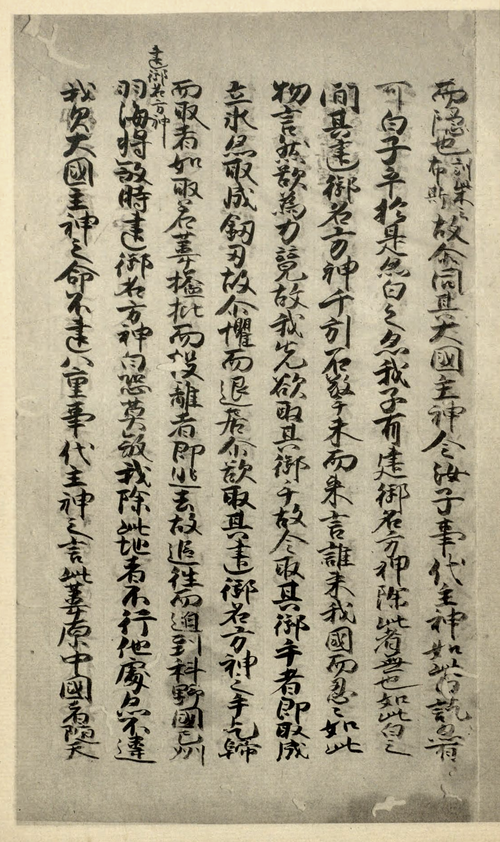
- Shinpukuji-bon, copied 1371–1372 (a National Treasure)
- Significance
- Japan’s oldest extant book; foundational for Shinto mythology, early Japanese language and literature, and debates about national identity
Easy
What is the Kojiki?
The Kojiki (古事記), usually translated “Record of Ancient Matters” or “An Account of Ancient Matters”, is a collection of myths, legends, songs and genealogies compiled at the Japanese imperial court. According to its preface, it was written down by the courtier Ō no Yasumaro and presented to Empress Genmei early in 712. It is generally regarded as the oldest surviving book written in Japan.
The Kojiki tells a single, continuous story. It begins with the appearance of the first gods when heaven and earth separated, describes the creation of the Japanese islands and the adventures of many deities (kami), and then follows the descendants of the sun goddess Amaterasu as they come down to earth and become the rulers of Japan. The last parts list emperors and empresses up to Empress Suiko, who died in 628.
The book was not meant to be a neutral history. It was made to explain why the imperial family had the right to rule and how other powerful clans were related to it. Its stories are nevertheless much more than propaganda: they preserve ancient beliefs, local traditions, poetry and ways of speaking that would otherwise be lost.
Easy
The Age of the Gods: creation, death and the sun
The first book begins: “When heaven and earth first began, the gods who came into being in the Plain of High Heaven were…”, followed by a list of deities who appear and vanish. After several generations come Izanagi (“He who invites”) and Izanami (“She who invites”). Standing on the Floating Bridge of Heaven, they stir the ocean with a jewelled spear; brine dripping from its tip forms the island of Onogoro. There they marry and give birth to the islands of Japan and to gods of the sea, rivers, mountains, wind and fire.
Giving birth to the fire god burns Izanami, and she dies and goes to Yomi, the land of the dead. Izanagi follows her, but when he breaks her command not to look at her, he sees her rotting body and flees. He blocks the path to Yomi with a great boulder. Afterwards he washes himself in a river to remove the pollution of death. From his left eye is born Amaterasu, the sun goddess; from his right eye Tsukuyomi, the moon god; and from his nose Susanoo, the storm god. This story is often linked to the importance of purification (misogi, harae) in Shinto.
Susanoo grieves, rages and runs riot in his sister’s heavenly realm, destroying rice fields and defiling her weaving hall. Frightened and offended, Amaterasu hides in the Heavenly Rock Cave, and the world falls into darkness. The gods gather outside, hang a mirror and jewels on a sacred tree, and the goddess Ame-no-Uzume performs a wild dance that makes them roar with laughter. Curious, Amaterasu peeks out, sees her own light in the mirror, and is drawn out; the light returns. Susanoo is expelled from heaven.
On earth, in Izumo, Susanoo slays the eight-headed serpent Yamata-no-Orochi and finds a sword in its tail, which he offers to Amaterasu. His descendant Ōkuninushi (“Great Lord of the Land”) helps the skinned White Hare of Inaba, survives trials set by Susanoo in the underworld, and builds up the land. Finally the heavenly gods demand that Ōkuninushi hand over the land to Amaterasu’s descendants. He agrees in return for a great shrine, a story often connected with Izumo Taisha.
Easy
From heaven to earth: the first emperors and heroes
Amaterasu sends her grandson Ninigi down to earth, giving him three treasures: a mirror, a curved jewel and the sword from the serpent’s tail. These became the imperial regalia of Japan. Ninigi descends on a mountain peak in Himuka (Kyūshū). His son Hoori, the “Luck of the Mountain”, loses his brother’s fishhook, visits the palace of the sea god and marries the sea god’s daughter; their grandson is Kamu-Yamato-Iwarebiko, known after his death as Emperor Jimmu.
The second book begins with Jimmu’s long campaign from Kyūshū to the Yamato region, where, according to the story, he founded the imperial line. After brief entries for several rulers, the most memorable figures are the prince Yamato Takeru, a tragic warrior who conquers enemies in the west and east but dies far from home and turns into a white bird, and Empress Jingū, who, possessed by the gods, leads an expedition across the sea to the Korean kingdom of Silla. The book ends with Emperor Ōjin.
The third book covers rulers from Nintoku to Suiko. It contains fewer encounters with the gods and more court stories, love affairs, succession struggles and songs. For the last rulers it gives little more than names, palaces, marriages and burial places. The Kojiki thus moves from cosmic myth to legendary history and finally to a bare genealogy that stops a few decades before its own time.
Intermediate
How it was made: Tenmu, Hieda no Are and Ō no Yasumaro
Everything we know about the Kojiki’s origins comes from its preface. It says that Emperor Tenmu, who seized the throne after the Jinshin War of 672, was concerned that the imperial chronicles (Teiki) and ancient tales (Kyūji or Honji) kept by various families had become full of errors. He therefore had them examined and corrected, and ordered a court attendant named Hieda no Are, then 28 years old, to learn them by heart. Are was said to be able to recite anything after reading it once and remember anything after hearing it once.
Tenmu died before the project was finished. Decades later, on the 18th day of the 9th month of 711, Empress Genmei ordered Ō no Yasumaro to write down what Are had memorized. He finished in about four months and presented the work in three books on the 28th day of the 1st month of 712.
The Kojiki was part of a larger effort by the new centralized state, modelled on Tang China, to define itself through law codes, a capital city at Nara and official histories. In 720, only eight years later, the court completed the Nihon shoki (Chronicles of Japan), a much longer history in thirty books. Yasumaro himself probably helped compile it. Why two such works were produced so close together is a central question in Kojiki studies.
Very little is known about Hieda no Are. The title toneri (attendant) was usually held by men, but some scholars, including the folklorist Yanagita Kunio and the literary scholar Saigō Nobutsuna, have suggested that Are was a woman, perhaps of the Sarume family of court ritual dancers who traced their ancestry to Ame-no-Uzume. The question remains open.
Intermediate
Writing Japanese in Chinese characters
In the early eighth century Japanese had no writing system of its own. Educated officials wrote in Classical Chinese. Yasumaro faced the problem of how to record stories and names that were Japanese in language and spirit. In the preface, written in elegant Chinese parallel prose, he explains his solution: sometimes he used Chinese characters for their meaning, sometimes for their sound, and sometimes he mixed the two in one sentence, adding notes where the reading might be unclear.
The result is a hybrid text. The main narrative is written in a Japanized form of Chinese (often called hentai kanbun), which follows Chinese grammar only loosely and is meant to be read in Japanese. Names of gods and more than a hundred songs are written phonetically, one character per syllable, in the system later called man’yōgana, after the eighth-century poetry anthology Man’yōshū. These phonetic passages are among the most important evidence for Old Japanese pronunciation.
Because the text can be read in more than one way, how the Kojiki should be “read aloud” in Japanese has been debated for centuries. Every modern edition involves scholarly reconstruction, and different translations reflect different decisions about the underlying language.
Intermediate
Key ideas: kami, lineage, purity and song
Kami. The Kojiki presents a world alive with kami, divine beings who may be ancestors, forces of nature, places or objects. They are powerful but not all-knowing or morally perfect: they quarrel, grieve, make mistakes and are sometimes comic. This picture differs sharply from the transcendent creator god of the Abrahamic religions.
Lineage and legitimacy. Genealogy is the backbone of the book. By tracing the imperial house to Amaterasu and connecting many clans to gods or princes, the Kojiki placed every lineage in a hierarchy centred on the ruler. The story of Ōkuninushi handing over the land presents the incorporation of Izumo, a region with strong traditions of its own, as a voluntary submission to the heavenly line.
Purity and pollution. The contrast between the clean and the defiled, seen in Izanagi’s washing after Yomi and in Susanoo’s offences, runs through the myths and connects with later Shinto ritual.
Song and emotion. The songs, many of them love songs, laments, drinking songs or war chants, give the Kojiki a strongly emotional and poetic character. Some scholars read the work more as literature than as history, emphasizing its narrative art. Notably, the Kojiki contains no reference to Buddhism, even though Buddhism was flourishing at court when it was compiled.
Intermediate
Manuscripts, neglect and rediscovery
Unlike the Nihon shoki, which was lectured on at court and studied throughout the Heian period, the Kojiki was treated as a secondary text for many centuries. No manuscript from the Nara or Heian periods survives. The oldest complete copy is the Shinpukuji manuscript, made by the monk Ken’yu in 1371–1372 and now designated a National Treasure. Other manuscripts belong to a line associated with the Urabe family of Shinto scholars.
The first printed edition appeared in Kyoto in 1644, making the text widely available for the first time. In the eighteenth century scholars of the “national learning” movement (kokugaku), who sought an authentic Japanese culture free of Chinese and Buddhist influence, turned to the Kojiki as the purest record of the ancient language and way of life.
The greatest of them, Motoori Norinaga (1730–1801), spent about thirty-five years (1764–1798) writing the Kojiki-den, a commentary in 44 books that reconstructed how every line should be read in Old Japanese and interpreted the myths as true accounts of the age of the gods. Norinaga raised the Kojiki above the Nihon shoki, which he thought was distorted by a “Chinese mind”. His work remains the foundation of Kojiki philology, though his religious and nationalist interpretations are no longer accepted as scholarship.
Intermediate
The Kojiki in modern Japan and East Asia
After the Meiji Restoration of 1868, the myths of the Kojiki and Nihon shoki were taught in schools as national history under State Shinto. The descent of the emperor from Amaterasu and the founding of the state by Jimmu, dated by the Nihon shoki to 660 BCE, became official doctrine. The historian Tsuda Sōkichi, who argued from 1913 onward that the Age of the Gods and early reigns were political creations of the court, saw several of his books banned in 1940 and was prosecuted.
These myths also served imperial expansion. The story of Empress Jingū’s conquest of Silla was used to suggest that Korea had anciently been subordinate to Japan and to justify Japanese rule in Korea (1910–1945). Historians in Korea and Japan today regard the Jingū episode as legend; Korean scholars in particular have criticized its use as a colonial myth. Episodes such as the scholar Wani from Baekje bringing Chinese books to Japan are, on the other hand, read as memories of real cultural transmission from the Korean peninsula, even if their details are anachronistic.
After 1945 the myths were removed from history teaching as fact, and scholars were free to study the Kojiki as myth, literature and ideology. Today it is read in many translations, from Basil Hall Chamberlain’s English version of 1882 to Donald Philippi’s of 1968 and Gustav Heldt’s of 2014, and its gods and stories inspire novels, manga, anime, games and the celebrations at shrines such as Ise and Izumo. The 1300th anniversary of its completion was marked in 2012.
Advanced
Scholarly debates and open questions
Authenticity. Because the Kojiki is not mentioned in the Shoku Nihongi, the official chronicle covering 712, and because its preface is the only account of its making, some scholars since the early modern period have suspected that the preface, or even the whole work, was written later, perhaps in the ninth century. Most specialists reject the forgery thesis. The text preserves archaic spelling distinctions of Old Japanese, including a distinction between two kinds of the syllable mo that disappeared soon after 712, and in 1979 the bronze epitaph of Ō no Yasumaro was discovered in a tea field in Nara, confirming that he was a real official who died in 723.
Two mythologies or one? The Kojiki and the Nihon shoki tell overlapping stories in different ways; the Nihon shoki often gives several variant versions (“one book says…”). Older scholarship tended to combine them into a single “Japanese mythology”. Scholars such as Kōnoshi Takamitsu have argued instead that each text builds its own coherent mythic world for different purposes, so they should be read separately.
History or myth? After Tsuda, most historians treat the Age of the Gods and the earliest emperors as political myth. How far the later reigns preserve genuine memory is debated. Comparisons with Chinese and Korean records, archaeological evidence from the great burial mounds (kofun), and inscriptions such as those on fifth-century swords help historians judge which parts may contain historical information.
Sources and comparison. Scholars have compared Kojiki myths with those of Korea, China, Southeast Asia, the Pacific and Eurasia, for example Izanagi’s journey to the underworld with the Greek story of Orpheus. Such parallels raise questions about diffusion, shared origins or common human patterns that remain unresolved.
Advanced
Evidence and methods
Philology. Studying the Kojiki begins with its text: comparing manuscripts, reconstructing readings of the hybrid script, and using the phonetic songs and names to reconstruct Old Japanese. The discovery of the eight-vowel system of Old Japanese, reflected in consistent spelling differences, was crucial for dating and interpreting the text.
Historical context. Researchers read the Kojiki against the political world of Tenmu, Jitō and Genmei: the building of a Chinese-style state, rivalry among clans, and relations with Silla and Tang China. Wooden tablets (mokkan) excavated at Nara and Fujiwara palace sites show how officials actually wrote Japanese in the late seventh century and help explain the Kojiki’s script.
Religious studies and anthropology. Scholars compare the myths with Shinto rituals, shrine traditions and folklore, while taking care not to assume that modern Shinto simply continues eighth-century belief.
Reception history. Finally, much research now concerns how the Kojiki has been read: by medieval Shinto thinkers, by Norinaga, by the modern state and by postwar scholars. The book’s meaning has always depended on its readers, which is itself an important lesson about how ancient texts become national classics.
Key ideas
- Kami
- Divine beings of nature, ancestry and place; powerful but fallible actors in the myths.
- Divine descent
- The claim that the imperial house descends from the sun goddess Amaterasu through Ninigi and Jimmu.
- Genealogy as order
- Linking clans to gods and princes placed every lineage in a hierarchy centred on the ruler.
- Purification
- Washing away the pollution of death and wrongdoing, a theme connected with Shinto ritual.
- Hybrid writing
- Chinese characters used for both meaning and sound to record Japanese, before kana existed.
- Myth and ideology
- The Kojiki served the legitimacy of the eighth-century state and was reused by modern nationalism.
- Oral to written
- The preface presents the book as the written form of traditions memorized and recited by Hieda no Are.
Records
- 672 CE — Tenmu wins the Jinshin War and takes the throne; he later orders the correction of chronicles and tales.
- c. 681 CE — Tenmu’s court begins historical compilation work, later completed in the Nihon shoki.
- 710 CE — The capital moves to Heijō-kyō (Nara).
- 711 CE — Empress Genmei orders Ō no Yasumaro to record what Hieda no Are memorized.
- 712 CE — Yasumaro presents the Kojiki in three books to Empress Genmei.
- 720 CE — The Nihon shoki is completed.
- 723 CE — Ō no Yasumaro dies, according to his epitaph.
- 1371 — The monk Ken’yu copies the Shinpukuji manuscript (to 1372), the oldest surviving copy.
- 1644 — The first printed edition is published in Kyoto.
- 1798 — Motoori Norinaga completes the Kojiki-den.
- 1882 — Basil Hall Chamberlain publishes the first complete English translation.
- 1979 — Ō no Yasumaro’s bronze epitaph is discovered in Nara.
Glossary
- Kami
- Gods or spirits in Japanese religion, including nature spirits, ancestors and deified people.
- Takamagahara
- The Plain of High Heaven, the realm of the heavenly gods.
- Yomi
- The land of the dead in the Kojiki.
- Imperial regalia
- The mirror, jewel and sword said to have been given by Amaterasu to Ninigi.
- Man’yōgana
- The use of Chinese characters for their sounds to write Japanese syllables.
- Nihon shoki
- The official history “Chronicles of Japan”, completed in 720.
- Kokugaku
- “National learning”, an Edo-period movement to study ancient Japanese texts and recover native culture.
- Toneri
- An attendant serving at the imperial court.
- Teiki and Kyūji
- The imperial genealogies and ancient tales that, according to the preface, formed the basis of the Kojiki.
- State Shinto
- The modern Japanese state’s use of Shinto and imperial myths as national ideology, 1868–1945.
Questions and answers
Is the Kojiki a religious scripture?
Not exactly. It has no commandments or teachings, but its myths are central to Shinto and many of its gods are worshipped at shrines.
Who wrote the Kojiki?
According to its preface, Ō no Yasumaro wrote it down in 711–712 from traditions memorized by Hieda no Are at the order of Emperor Tenmu.
Is the Kojiki true history?
Historians treat the Age of the Gods and the earliest emperors as myth and legend created or shaped for political purposes. Later sections may contain some historical memory.
What is the difference between the Kojiki and the Nihon shoki?
The Kojiki (712) is shorter, focuses on the imperial line, and is written in a more Japanese style. The Nihon shoki (720) is a longer official history in Chinese, arranged by year, often giving several versions of each myth.
Why does the sun goddess hide in a cave?
She is frightened and offended by the violent behaviour of her brother Susanoo. The story explains the return of light and may reflect rituals for renewing the sun’s power.
Could the Kojiki be a later forgery?
A minority of scholars have argued so, but archaic features of its language and the discovery of Yasumaro’s epitaph in 1979 lead most specialists to accept it as a work of the early eighth century.
Why is the Kojiki controversial in Korea?
Its legend of Empress Jingū conquering Silla was used in modern times to justify Japanese colonial rule over Korea, although historians regard it as legend.
Why is the Kojiki important for linguists?
Its phonetically written songs and names are some of the best evidence for how Japanese was pronounced 1,300 years ago.
Sources and further reading
- Kojiki. Wikipedia
- 고사기. 위키백과
- Ō no Yasumaro. Wikipedia
- Hieda no Are. Wikipedia
- Nihon Shoki. Wikipedia
- Motoori Norinaga. Wikipedia
- Man'yōgana. Wikipedia
- Mark Cartwright, Kojiki: Japan’s Oldest Book. World History Encyclopedia, 2017
- Donald L. Philippi, Kojiki (translated with an introduction and notes). University of Tokyo Press, 1968
- Gustav Heldt (trans.), The Kojiki: An Account of Ancient Matters. Columbia University Press, 2014
Related
- Hōryū-jiA Buddhist temple complex in Japan traditionally founded in 607 CE and home to some of the world's oldest surviving wooden buildings.
- The Tale of GenjiEarly eleventh-century Japanese narrative, generally attributed to the court writer Murasaki Shikibu.
- Samguk sagiHistory of Korea's Three Kingdoms compiled under Kim Busik and presented to the Goryeo court in 1145.
- Meiji RestorationThe political transfer of authority to the Meiji emperor in 1868 began a far-reaching transformation of Japan’s government and society.
- Popol VuhK'iche' Maya narrative of origins, divine figures and ancestral history.
Written with AI assistance from the published sources listed above, and revised as new research appears.