Start at the top for an easy introduction. Go further down for more detail and scholarship.
- Easy
- Intermediate
- Advanced
For young readers
Most wooden houses do not last more than a hundred years or so. Rain, insects and fire destroy them. But at Hōryū-ji, a temple in Japan, there are wooden buildings that have been standing for about 1,300 years. That is older than almost any other wooden building on Earth.
The temple was started, people say, by Prince Shōtoku, a wise prince who helped rule Japan about 1,400 years ago. He loved Buddhism, a religion that had come to Japan from Korea and China. He is remembered for building temples and for writing rules that told officials to live in harmony.
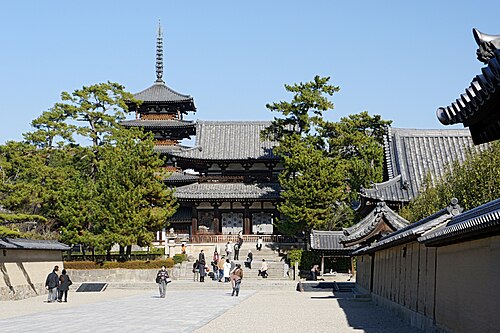
Inside the temple walls stand two special buildings side by side. One is the Golden Hall, where statues of the Buddha sit. The other is a tall, thin tower with five roofs stacked on top of each other, called a pagoda. Inside the pagoda is a single giant tree trunk standing up in the middle like a spine. The wood of this pillar comes from a tree that was cut down in the year 594.
An old history book says the first temple burned down after being struck by lightning in 670, and the temple was built again. For a long time scholars argued about whether today’s buildings were the first ones or rebuilt ones. Archaeologists dug in the ground and found the burned remains of the first temple nearby, which helped solve the mystery.
The builders used Japanese cypress wood, called hinoki, which is strong and resists rot. Carpenters have kept repairing the buildings, piece by piece, for centuries. In 1993 Hōryū-ji became the first place in Japan to be put on the World Heritage List.
At a glance
- Founded
- Traditionally 607, by Prince Shōtoku and Empress Suiko; present western precinct rebuilt in the late 7th to early 8th century after a fire recorded in 670
- Place
- Ikaruga, Nara Prefecture (ancient Yamato Province), Japan
- Oldest buildings
- Kondō (Golden Hall), five-storey pagoda, middle gate and parts of the cloister in the Western Precinct (Sai-in)
- Pagoda
- About 32.5 m tall; its central pillar comes from a tree felled in 594 (tree-ring dating)
- Famous works
- Shaka Triad by Tori Busshi (623), Kudara Kannon, Tamamushi Shrine, Yumedono Kannon, Kondō wall paintings
- Material
- Mainly hinoki (Japanese cypress) timber on stone foundations, with clay-tiled roofs
- Affiliation
- Head temple of the Shōtoku school of Buddhism (formerly Hossō)
- Status
- UNESCO World Heritage “Buddhist Monuments in the Hōryū-ji Area” (1993, Japan’s first, with Hokki-ji)
Easy
What is Hōryū-ji?
Hōryū-ji, “Temple of the Flourishing Dharma”, is a Buddhist monastery in the town of Ikaruga, about 12 km south-west of the old capital Nara. Its full name, Hōryū Gakumonji, means “Learning Temple of the Flourishing Law”, a reminder that it was a place for studying Buddhist teaching as well as for worship. It was one of the Seven Great Temples of the Nara region.
The temple is associated with Prince Shōtoku (574–622), a member of the royal family who, according to the official histories, served as regent for his aunt Empress Suiko and promoted Buddhism. Tradition dates the founding to 607. The buildings that survive in the Western Precinct were built after a fire that the court chronicle Nihon shoki dates to 670, but they still preserve the style of the Asuka period, the era when Buddhism first took root in Japan.
Hōryū-ji is famous for two things. First, its Golden Hall (Kondō) and five-storey pagoda are among the oldest surviving wooden buildings in the world. Second, it is a treasure house of early Buddhist art, holding sculptures, paintings and craftworks from the seventh and eighth centuries that have few surviving parallels anywhere in East Asia. The temple holds more than 180 designated National Treasures and Important Cultural Properties.
Easy
How to “read” the temple: two precincts and a side-by-side plan
Hōryū-ji is divided into two parts. The Western Precinct (Sai-in) is the main monastery; the Eastern Precinct (Tō-in), about 120 m to the east, is built on the site of Prince Shōtoku’s palace, Ikaruga-no-miya, and centres on an octagonal hall called the Yumedono (Hall of Dreams).
Visitors approach the Western Precinct from the south through the Great South Gate and then reach the Middle Gate (Chūmon). This gate is unusual: it has four bays instead of the usual odd number, so a pillar stands right in the centre of the entrance. Why the builders did this is not known. The gate opens onto a courtyard enclosed by a roofed corridor (the cloister). Inside the cloister, the Kondō stands on the east and the pagoda on the west, side by side. In many other early temples the pagoda and main hall were lined up one behind the other; the side-by-side “Hōryū-ji style” layout lets a visitor see both at once and balances a tall, narrow building against a broad, low one. The Great Lecture Hall, where monks studied, closes the courtyard to the north.
The Kondō is a two-storey hall on a stone platform, about 18.5 by 15.2 m. Only the ground floor is usable; the upper storey gives the building height and dignity. Inside is a raised altar with the main statues. The pagoda, about 32.5 m tall, has five roofs that become smaller toward the top. A pagoda is a Buddhist monument that houses relics of the Buddha rather than a building to enter. At the base of its central pillar, relics are enshrined, and around the pillar on the ground floor are clay sculptures of scenes from the Buddha’s life, completed in 711.
Look closely at the details. The columns swell slightly in the middle, a feature often compared with the entasis of Greek temples. The brackets under the eaves are carved in curling “cloud” shapes, and the railings of the upper storeys have a pattern based on the swastika (manji), an ancient Buddhist symbol of good fortune. These features are characteristic of Asuka-period architecture and are hardly found in later Japanese buildings.
Easy
Treasures of early Buddhist art
The main image in the Kondō is the Shaka Triad, a gilt-bronze statue of the historical Buddha Shakyamuni flanked by two attendants. An inscription on its halo says it was made in 623 by Tori Busshi, a sculptor from an immigrant family, in connection with the illness and death of Prince Shōtoku in 622. Its elongated faces, “archaic smile” and flat, pattern-like drapery follow the style of Chinese sculpture of the Northern Wei dynasty, as transmitted through Korea.
Other celebrated works include the Kudara Kannon, a tall and slender wooden bodhisattva whose name means “Baekje Kannon” (Baekje was a kingdom in south-western Korea), although modern research suggests it was carved in Japan; the Yumedono Kannon (Guze Kannon), a gilded wooden statue that was kept wrapped in cloth as a secret image for centuries; and the Four Heavenly Kings in the Kondō, the oldest images of these guardian gods in Japan.
The Tamamushi Shrine is a miniature building on a tall pedestal, about 2.3 m high, once decorated with the iridescent wings of jewel beetles (tamamushi). Its painted panels show scenes such as a previous life of the Buddha in which he gave his body to feed a starving tigress and her cubs. Because almost no Asuka-period buildings survive apart from Hōryū-ji itself, the shrine is also valuable as a model of how early architecture looked.
The Kondō walls were painted at the end of the seventh century with Buddhist paradises, showing influences from Tang China and ultimately from India. They were among the most important early paintings in East Asia until a fire in 1949 badly damaged them; the paintings seen today are reproductions.
Intermediate
Historical context: Buddhism arrives in Yamato
Buddhism reached the Japanese court from the Korean kingdom of Baekje in the mid-sixth century; the Nihon shoki dates the official transmission to 552, while other early sources give 538. The new religion brought with it writing, scriptures, temple architecture, sculpture and craftsmen. The Nihon shoki records that in 577 Baekje sent temple carpenters and an image maker, and in 588 more craftsmen, including roof-tile makers, came to build Asuka-dera, Japan’s first full-scale temple, for the powerful Soga clan.
Adopting Buddhism was a political as well as religious choice. The Soga clan supported it; rival clans such as the Mononobe opposed it, and the conflict ended in a Soga victory in 587. Under Empress Suiko (r. 592–628), with Soga no Umako and Prince Shōtoku in leading roles, the court embraced Buddhism and Chinese-style government. The Nihon shoki credits Shōtoku with a system of court ranks (603), the Seventeen-Article Constitution (604), and embassies to Sui China, and it records 46 temples existing in 624.
Hōryū-ji belongs to this world of intense exchange across the sea. Its building techniques and art styles derive from Baekje and from China of the Northern and Southern Dynasties and Sui, adapted by craftsmen in Japan, many of whom came from immigrant families. The temple therefore illustrates not an isolated “Japanese” culture but a shared East Asian Buddhist civilization. Because so little early wooden architecture survives in China and Korea, Hōryū-ji is also a key to understanding the lost buildings of the mainland.
Intermediate
Founding, fire and rebuilding
Two inscriptions support the traditional founding date. The halo of the Yakushi (Healing Buddha) statue in the Kondō states that Emperor Yōmei, Shōtoku’s father, vowed to build a temple and a statue when he fell ill in 586, and that after his death Empress Suiko and the prince completed them in 607. The halo of the Shaka Triad gives the date 623. Many scholars, however, judge that the Yakushi inscription and statue were made later than the date they claim, so 607 is best treated as the temple’s traditional date.
The Nihon shoki records that on the 30th day of the 4th month of 670, Hōryū-ji caught fire in the night and “not a single building remained”. The temple was rebuilt on a slightly different site. Temple records state that the clay sculptures in the pagoda and the guardian figures in the Middle Gate were made in 711, by which time the Western Precinct was essentially complete.
In the Eastern Precinct, the Yumedono was built in 739 on the ruins of Shōtoku’s palace, with the monk Gyōshin traditionally credited with the project, to honour the prince’s memory. As the cult of Shōtoku grew over the following centuries, the prince came to be venerated as an incarnation of the bodhisattva Kannon and as the founder of Japanese Buddhism, and Hōryū-ji became a major pilgrimage site devoted to him. The Great Lecture Hall was rebuilt in 990, and other halls were added or rebuilt in the Heian, Kamakura and later periods.
Intermediate
How it was built and how it survived
The buildings are timber frames resting on stone bases, with no nails in the main structure; members are joined by carefully cut joints and held down by the weight of the heavy tiled roofs. The builders used hinoki, a fragrant cypress that grows straight and tall and resists decay; some master carpenters have said that good hinoki becomes stronger for centuries after it is cut.
Why has a wooden pagoda survived 1,300 years in a country of earthquakes and typhoons? The five storeys are not rigidly fixed to one another; each can move slightly, and the joints absorb energy. The central pillar (shinbashira) rises through the middle without carrying the floors directly. Engineers still debate exactly how much each feature contributes, but the flexible design, the broad eaves that keep rain off the walls, and continuous maintenance all play a part.
Maintenance was essential. Over the centuries the buildings were repaired many times, and damaged pieces were replaced while original timbers were kept wherever possible. The largest campaign, the Shōwa Great Repair, lasted from 1934 to 1985. Buildings were dismantled, studied and reassembled; during the Second World War some parts were taken down and stored for safety. The master carpenter Nishioka Tsunekazu, who worked at Hōryū-ji for decades, became famous for keeping alive traditional techniques and knowledge of timber.
Intermediate
Modern history: treasures, fire and a new law
After the Meiji Restoration of 1868, government policies separating Shinto from Buddhism deprived many temples of land and income. In 1878 Hōryū-ji presented more than 300 of its treasures to the Imperial Household, receiving money in return that helped it survive. These objects, including early banners, masks and sculptures, are now in the Gallery of Hōryū-ji Treasures at the Tokyo National Museum.
In the 1880s the American scholar Ernest Fenollosa and the Japanese critic Okakura Kakuzō, surveying Japan’s art treasures for the government, persuaded the monks to unwrap the secret Yumedono Kannon, which had not been seen for centuries. Its excellent condition astonished them, and the event became part of the story of how Japanese Buddhist art was “discovered” as fine art in the modern era.
On 26 January 1949, during the dismantling of the Kondō for repair, a fire broke out and severely damaged the ground floor and its wall paintings. The shock helped lead to the Law for the Protection of Cultural Properties of 1950, the basis of Japan’s modern heritage system, and 26 January is still observed as Cultural Property Fire Prevention Day. The Kondō was restored by 1954; it is estimated that around 15–20 percent of its seventh-century material survives. The charred original members and the damaged paintings are preserved in a separate storehouse for research.
In 1993, 47 buildings of Hōryū-ji and the pagoda of nearby Hokki-ji, 48 monuments in all, were inscribed on the World Heritage List as the Buddhist Monuments in the Hōryū-ji Area, Japan’s first World Heritage Site. In 1950 the temple left the Hossō school to become the head of its own Shōtoku school.
Intermediate
Religious meaning and legacy
For Buddhists, Hōryū-ji is first of all a living temple. The pagoda enshrines relics and represents the presence of the Buddha; the Kondō houses the images before which rituals are performed. The annual Shōryō-e memorial service for Prince Shōtoku, held since at least the twelfth century, shows how the temple became a centre of devotion to the prince, whom many Japanese have venerated as a sage and bodhisattva.
For art historians and architects, Hōryū-ji is a “time capsule” of the seventh century. Its buildings and objects preserve styles of the Asian mainland that have almost entirely disappeared there, making it a reference point for the study of East Asian art as a whole. Modern histories of Japanese architecture have used it as their starting point.
Prince Shōtoku himself became a national symbol: his portrait appeared on Japanese banknotes for much of the twentieth century, and his call for “harmony” (wa) in the first article of the Seventeen-Article Constitution has often been quoted as a Japanese ideal. The temple’s image thus reflects not only ancient history but also how modern Japan has chosen to remember its origins.
Advanced
The rebuilding debate and other open questions
Rebuilt or original? From the late nineteenth century until 1939 Japanese scholars fought one of their most famous academic debates, the “Hōryū-ji rebuilding controversy” (saiken–hisaiken ronsō). Historians such as Kita Sadakichi trusted the Nihon shoki’s record of a total fire in 670 and argued that the present buildings were rebuilt. Architectural historians such as Sekino Tadashi argued that their style and the unit of measurement used in their design (the so-called Koma shaku, an older foot) proved that they belonged to the time of Shōtoku and had escaped the fire.
Archaeology largely settled the question. In 1939 excavations led by Ishida Mosaku south-east of the present Western Precinct uncovered the foundations of an earlier temple, now called the Wakakusa-garan, with its pagoda and hall arranged one behind the other and aligned at a noticeably different angle from the present buildings. Later excavations found burnt wall-painting fragments and roof tiles. Most scholars now accept that the Wakakusa-garan was Shōtoku’s original temple and that it burned, and that the present Western Precinct was built afterward.
New puzzles. Tree-ring dating in 2001 showed that the pagoda’s central pillar came from a tree felled in 594, decades before the fire. Was the timber stored for a long time, reused from another building, or taken from an older structure? Some timbers from the Kondō were felled shortly before 670, suggesting that construction of the present Kondō may have begun even before the fire of 670, or that rebuilding started very soon after it. Scholars still debate the exact sequence and the relationship between the Wakakusa-garan and the new complex.
The historical Shōtoku. Some historians argue that much of the Shōtoku tradition, including the attribution of the Seventeen-Article Constitution, was created or embellished by compilers of the Nihon shoki a century later, and that the prince’s real role may have been smaller. Others defend a substantial historical core. Because the inscriptions on the Yakushi and Shaka images are central evidence in this debate, their dating is also contested.
Advanced
Evidence and methods
Written sources. The Nihon shoki (720) is the earliest official history, but it was written with political aims and its accounts of the Shōtoku era must be used critically. Temple documents such as the Hōryū-ji garan engi narabi ni ruki shizaichō (an inventory of the temple’s property compiled in 747) record buildings and objects in the eighth century. Inscriptions on statues and halos are precious but must themselves be dated.
Archaeology. Excavations of the Wakakusa-garan, of the palace site under the Eastern Precinct, and of nearby temples such as Hokki-ji and Chūgū-ji provide foundations, tiles and fragments that can be dated by style and stratigraphy. Roof-tile patterns are especially important, because their designs can be traced to workshops associated with Baekje and with other early Japanese temples.
Scientific dating. Dendrochronology, the matching of tree-ring patterns against a reference chronology, has transformed the study of Hōryū-ji by giving felling dates for individual timbers. It tells when a tree was cut, not when it was used, so results must be combined with architectural analysis. Material analysis of pigments, metals and lacquer has clarified how statues and paintings were made.
Architectural surveys. The Shōwa Great Repair produced detailed records of every building, including marks left by earlier repairs, changes to roof structures and replaced members. The carefully preserved burned members of the Kondō remain a resource for future research. Hōryū-ji teaches that repair history is part of a building’s history: understanding what is original requires knowing what generations of carpenters have done.
Key ideas
- Oldest wooden buildings
- The Kondō and pagoda, rebuilt in the late seventh century, are among the oldest surviving timber buildings in the world.
- Side-by-side layout
- The Kondō and pagoda stand next to each other inside the cloister, a distinctive arrangement known as the Hōryū-ji style.
- Asuka style
- Swelling columns, cloud-shaped brackets and swastika-pattern railings preserve architecture and art of the earliest Buddhist period in Japan.
- East Asian exchange
- Techniques and styles came from Baekje and China and were adapted by craftsmen in Japan, many from immigrant families.
- Cult of Shōtoku
- Veneration of Prince Shōtoku as a sage and bodhisattva shaped the temple’s later history and his modern image.
- Rebuilding controversy
- A long debate over whether the buildings survived the fire of 670, largely resolved by excavation of the Wakakusa-garan in 1939.
- Repair as preservation
- Continuous repair by skilled carpenters, rather than leaving buildings untouched, is how wooden heritage survives.
Records
- 552 CE — According to the Nihon shoki, Buddhism is officially transmitted to Japan from Baekje (other sources give 538).
- 594 CE — A tree is felled that later becomes the central pillar of the pagoda (tree-ring dating).
- 607 CE — Traditional founding date of Hōryū-ji by Empress Suiko and Prince Shōtoku.
- 622 CE — Prince Shōtoku dies.
- 623 CE — Tori Busshi completes the Shaka Triad, according to its halo inscription.
- 670 CE — The Nihon shoki records that the temple burns down completely.
- 711 CE — Clay sculptures in the pagoda and Middle Gate guardians are completed; the Western Precinct is essentially rebuilt.
- 739 CE — The Yumedono is built on the site of Shōtoku’s palace in the Eastern Precinct.
- 1878 — More than 300 treasures are presented to the Imperial Household (now in the Tokyo National Museum).
- 1939 — Excavation of the Wakakusa-garan reveals the original temple’s foundations.
- 1949 — Fire damages the Kondō and its wall paintings, leading to the 1950 cultural properties law.
- 1993 — The Buddhist Monuments in the Hōryū-ji Area become Japan’s first World Heritage Site.
Glossary
- Asuka period
- The era of Japanese history from the late sixth century to 710, when Buddhism and Chinese-style government were adopted.
- Kondō
- “Golden Hall”, the main image hall of an early Japanese Buddhist temple.
- Pagoda
- A multi-storey tower that enshrines relics of the Buddha.
- Shinbashira
- The central pillar that rises through the middle of a Japanese pagoda.
- Garan
- The main buildings of a Buddhist monastery and their arrangement.
- Hinoki
- Japanese cypress, a durable timber used for temples and shrines.
- Bodhisattva
- In Mahayana Buddhism, a being who seeks enlightenment and helps others reach it; Kannon is the bodhisattva of compassion.
- Nihon shoki
- “Chronicles of Japan”, an official history completed in 720.
- Dendrochronology
- Dating wood by comparing its pattern of annual tree rings with a reference record.
- Entasis
- A slight swelling in the middle of a column.
Questions and answers
Is Hōryū-ji really the oldest wooden building in the world?
Its Kondō and pagoda, built in the late seventh century, are generally described as the oldest surviving wooden buildings in the world, though some parts have been replaced during repairs.
Who was Prince Shōtoku?
A member of the royal family (574–622) who, according to the Nihon shoki, helped govern under Empress Suiko, promoted Buddhism and wrote the Seventeen-Article Constitution. Historians debate how much of this tradition is accurate.
Did the temple burn down?
The Nihon shoki says it burned completely in 670. Excavations of the Wakakusa-garan in 1939 found the remains of an earlier temple, so most scholars agree the present buildings are a rebuilding.
Why is the pagoda’s pillar older than the fire?
Tree rings show the tree was cut in 594. The wood may have been stored or reused; scholars are still discussing the reason.
How has a wooden pagoda survived earthquakes?
Its storeys can move slightly and its joints absorb shaking; wide eaves protect it from rain; and carpenters have repaired it continuously.
Why is there a pillar in the middle of the Middle Gate?
The gate has an even number of bays, so a pillar stands in the centre. No one knows for certain why; many explanations have been proposed, none proven.
What happened to the Kondō wall paintings?
A fire in 1949 during repairs badly damaged them. The originals are kept in storage, and reproductions are shown in the hall.
How is Hōryū-ji connected to Korea?
Buddhism and temple-building skills reached Japan from Baekje, and Hōryū-ji’s architecture and art show strong Baekje and Chinese influence. The name of the Kudara (Baekje) Kannon reflects this link.
Sources and further reading
- Buddhist Monuments in the Horyu-ji Area. UNESCO World Heritage Centre
- Hōryū-ji. Wikipedia
- Buddhist Monuments in the Hōryū-ji Area. Wikipedia
- Tamamushi Shrine. Wikipedia
- Prince Shōtoku. Wikipedia
- Mark Cartwright, Horyuji. World History Encyclopedia, 2017
- 호류사. 위키백과
- Mizuno Seiichi, Asuka Buddhist Art: Horyu-ji. Weatherhill / Heibonsha, 1974
Related
- SeokguramEighth-century Buddhist grotto near Gyeongju, known for its granite Buddha and surrounding sculptures.
- KojikiA Japanese compilation completed in 712 CE that brings together accounts of deities, origins and early rulers.
- Siddhartha Gautama (the Buddha)Founder of Buddhism, who taught a path to liberation from suffering on the Ganges plain. His dates are disputed.
- The Tale of GenjiEarly eleventh-century Japanese narrative, generally attributed to the court writer Murasaki Shikibu.
- BorobudurLarge Buddhist monument in Central Java, built around the eighth and ninth centuries.
- Ajanta CavesA group of Buddhist rock-cut caves in western India, known for monasteries, shrines and paintings.
Written with AI assistance from the published sources listed above, and revised as new research appears.