Start at the top for an easy introduction. Go further down for more detail and scholarship.
- Easy
- Intermediate
- Advanced
For young readers
Imagine a whole ship, longer than two buses end to end, pulled out of a river and up a hill, then buried under a giant pile of earth. That is what people did at Sutton Hoo in England about 1,400 years ago.
In the middle of the ship they built a little wooden room, like a cabin. It was probably made for a very important person, perhaps a king, although no body or name has survived. Around the place where he would have lain they put the most precious things: a helmet with a face mask, a sword decorated with gold and red garnet stones, a shield, drinking horns, silver bowls, a harp-like instrument called a lyre, and a purse full of gold coins.
Over hundreds of years the wood of the ship rotted away, and even the man’s body disappeared in the sandy, acidic soil. But the iron rivets that had held the ship together stayed in their places, so when archaeologists dug carefully in 1939 they found the “ghost” of the ship: a perfect ship shape printed in the sand.
The things in the grave came from many lands. Some silver came from the Eastern Roman Empire, a bronze bowl came from the eastern Mediterranean, and the coins came from the kingdom of the Franks in what is now France. It shows that even people living on a small, rainy island were connected to a big world.
Nobody wrote the man’s name in the grave. Many experts think he was Rædwald, a king of the East Angles who died around the year 624, but it is still a mystery that scientists and historians keep investigating.
At a glance
- What
- An early medieval royal cemetery of about 20 burial mounds, including the Mound 1 ship burial
- Place
- Near Woodbridge, Suffolk, England, above the estuary of the River Deben
- Date of the ship burial
- Early 7th century; the coins point to about 610–635, and about 625 is often quoted
- Kingdom
- East Anglia, ruled by the Wuffing dynasty
- Possible occupant
- Most often identified with King Rædwald (died c. 624); other candidates have been proposed
- The ship
- About 27 m long and 4.4 m wide, clinker-built, with places for around 40 rowers
- Discovered
- 1938–1939, excavated by Basil Brown for landowner Edith Pretty; later campaigns 1965–1971 and 1983–1992
- Where the finds are
- The British Museum (a gift from Edith Pretty); the site belongs to the National Trust
Easy
What is Sutton Hoo?
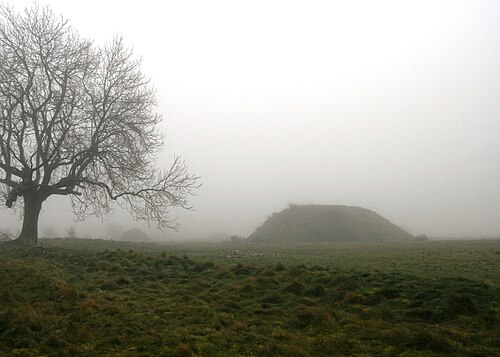
Sutton Hoo is a cemetery of about twenty low earthen mounds on a sandy ridge in Suffolk, in the east of England. The ridge looks down on the River Deben, which flows out to the North Sea. “Hoo” comes from an Old English word for a spur of high ground, so the name means something like “the hill-spur near Sutton”.
The mounds were raised in the late 6th and early 7th centuries, when this part of England formed the kingdom of the East Angles, or East Anglia. The largest, called Mound 1, covered one of the richest burials ever found in northern Europe: a complete wooden ship with a burial chamber in its middle, packed with weapons, feasting equipment, jewellery and imported silver.
Sutton Hoo is important for three reasons. It gives us objects of astonishing quality from a period with very few written records. It shows how a small kingdom on the edge of Europe was linked to the Frankish world, Scandinavia and the Byzantine Empire. And it changed how people imagined the centuries after Roman rule in Britain, once called the “Dark Ages”, revealing a society of skilled craftsmen and wide-ranging contacts.
Today the site is cared for by the National Trust, and most of the treasures are displayed at the British Museum in London, which received them as a gift from the landowner, Edith Pretty, soon after the discovery.
Easy
Reading the ship and the burial chamber
The Mound 1 ship was about 27 metres long and 4.4 metres wide at its middle. It was built in the clinker style used around the North Sea: overlapping oak planks, nine on each side, joined by iron rivets and stiffened inside by 26 wooden ribs. Oar-rests show room for about 40 rowers. There is no clear evidence of a mast, so it was probably a rowing ship.
To bury it, people must have hauled the ship out of the river and up the steep slope to the ridge, then lowered it into a trench. In the middle they built a wooden chamber like a small house with a pitched roof. After the burial goods were arranged inside, the trench was filled and a great mound of earth was heaped over the top.
Over time the chamber roof collapsed and the wood decayed. In the sandy soil the planks left only dark stains, while the rusted rivets stayed in their rows. When the excavators brushed away the sand in 1939, they could see the shape of every plank. Photographs of this “ghost ship” are among the most famous images in British archaeology.
Reading the chamber is like reading a room laid out for a feast and a ceremony. Along one side lay weapons and war gear; in the centre, where a body would have been, were the belt fittings and personal jewellery; at one end were cauldrons, buckets and a great iron chain for hanging a cauldron. The arrangement suggests people who wanted to show the dead person as war leader, host of the hall and ruler all at once.
Easy
The treasures and what they tell us
The helmet is the best-known object. It is made of iron covered with decorated sheets of tinned bronze, with a face mask, cheek guards and a neck guard. On the front, the eyebrows, nose and moustache together form a flying dragon whose wings are the eyebrows and whose tail is the nose. Small panels show dancing warriors and a horseman riding down a fallen enemy. It was found crushed into hundreds of pieces and has been reconstructed twice.
The gold objects show extraordinary skill. A great gold belt buckle, hollow inside with a hidden locking mechanism, is covered in knotwork of interlaced animals. A pair of curved shoulder clasps, inlaid with garnets and colourful glass, imitates the shoulder fastenings of Roman ceremonial armour. The lid of a purse held 37 gold coins from different Frankish mints. Hundreds of thin garnets were cut and set in little gold cells, a technique called cloisonné.
There were also objects of power and hospitality: a pattern-welded sword, a shield, a coat of mail, drinking horns made from the horns of aurochs (a huge wild ox), a six-stringed lyre in a beaver-skin bag, and a long carved whetstone with faces at both ends, topped by a bronze stag. Many scholars think the whetstone was a sceptre, a symbol of royal authority rather than a tool.
Some things came from very far away. A large silver dish bears the control stamps of the Byzantine emperor Anastasius I (reigned 491–518). A nest of ten silver bowls also came from the Eastern Roman world, along with two silver spoons inscribed “Saulos” and “Paulos” in Greek letters, which may refer to Saint Paul’s conversion. A bronze bowl came from the eastern Mediterranean, and the National Trust notes that finds in the grave came from as far as Sri Lanka, the Byzantine Empire and Egypt.
Easy
The discovery of 1939
In the 1930s the land belonged to Edith Pretty, who was curious about the mounds on her estate. In 1938 she asked Basil Brown, a self-taught local archaeologist, to open some of them. He found that several had been robbed long ago, although they still held fragments of rich burials, including a small boat burial in Mound 2.
In May 1939 Brown turned to the biggest mound. Soon he found an iron rivet, then row after row of them: the outline of a huge ship. As news spread, experts arrived, and a team led by the Cambridge archaeologist Charles Phillips took over the excavation of the burial chamber in the summer of 1939.
The work was a race against time, because Britain was on the edge of war. The finds were taken to safety, and the ship impression was covered over. A legal inquest in 1939 decided that because the treasure had been buried with no intention of recovering it, it was not “treasure trove” belonging to the Crown but the property of the landowner. Edith Pretty then gave it to the nation, one of the most generous gifts ever made to a British museum.
During the Second World War the site was used for military training, and the finds were stored safely away from the bombing. Serious study only resumed after the war. The story of the excavation became widely known again through the 2021 film The Dig.
Intermediate
Who was buried here? East Anglia and King Rædwald
No inscription names the person in Mound 1. The best clue is the coins: 37 Frankish gold coins, each from a different mint. Studies of these coins place the burial roughly between 610 and 635. Written sources for this period are few, but the English monk Bede, who completed his Ecclesiastical History of the English People around 731, tells us about the kings of East Anglia.
The strongest candidate is Rædwald, a king of the Wuffing dynasty who ruled from about 599 to about 624. According to Bede, Rædwald sheltered the exiled prince Edwin of Northumbria and, around 616 or 617, defeated Edwin’s enemy King Æthelfrith at the Battle of the River Idle, placing Edwin on the Northumbrian throne. Bede lists Rædwald among the few kings who held a kind of overlordship over the English south of the Humber, later called bretwalda.
Such power fits the wealth of Mound 1, including objects that look like symbols of rule: the sceptre-like whetstone, the iron stand interpreted by some as a standard, and shoulder clasps imitating Roman imperial armour. Rendlesham, only about 6.4 km away, has been identified as an East Anglian royal centre, which places Sutton Hoo close to the heart of royal power.
Still, the identification is a strong hypothesis, not a proven fact. Rædwald’s sons and successors, Eorpwald and Sigeberht, have also been suggested, and in 2025 the historian Helen Gittos argued that the grave might belong to a local elite soldier who had served in the Byzantine army. The on-site museum presents Rædwald as the likely occupant, while the British Museum describes the dead more cautiously as a king of East Anglia.
Intermediate
Between old gods and the new faith
Sutton Hoo was built at a moment of religious change. In 597 a mission sent by Pope Gregory the Great and led by Augustine arrived in Kent, where King Æthelberht accepted Christianity. Rædwald was baptised at Æthelberht’s court, probably around 604 or a little later, becoming the first East Anglian king to accept the new faith.
Bede disapproved of what happened next. He says that when Rædwald returned home, influenced by his wife and advisers, he kept in the same temple one altar for Christ and a smaller altar for sacrifices to the old gods. This “two altars” story is a precious glimpse of a ruler trying to keep both the new foreign religion and the traditional gods of his people.
The Mound 1 burial mirrors this ambiguity. A ship burial under a mound, with weapons and feasting gear, belongs to a tradition shared with pre-Christian Scandinavia. Yet the grave also contained the “Saulos” and “Paulos” spoons and silver bowls decorated with crosses, which some scholars read as Christian objects, perhaps even baptismal gifts. Others think they were valued simply as luxurious imported silver.
Only in the next generation did Christianity become firmly established in East Anglia, under Rædwald’s successors. Seen this way, Sutton Hoo may be one of the last great statements of an older way of honouring kings, made just as the kingdom was turning toward the Church.
Intermediate
A small kingdom in a wide world
The finds show that East Anglia lay at the meeting point of several networks. The gold coins link it to the Frankish kingdoms across the Channel. The helmet, shield and the idea of a ship burial have their closest parallels in the Vendel and Valsgärde cemeteries of eastern Sweden, suggesting close ties, perhaps even family links, between the East Anglian elite and Scandinavian rulers.
The silver points further south and east. The Anastasius dish was already about a century old when it was buried, which suggests it had passed through several hands as a diplomatic gift, an heirloom or loot before reaching Suffolk. The Byzantine silver bowls and spoons, the eastern Mediterranean bronze bowl and garnets that probably came ultimately from South Asia reveal long chains of exchange stretching across Europe and beyond.
Precious objects in this world were not traded like ordinary goods in a market. They moved as gifts between rulers, as rewards to loyal warriors, as dowries and as tribute. A king who could hand out gold and silver bound followers to himself. Burying such wealth in the ground was itself a display of power: it showed that the new ruler and his community could afford to give up these treasures in honour of the dead.
The workshops that made the gold buckle and clasps were probably local, working for the East Anglian court. Their mastery of garnet cloisonné and interlaced animal ornament places them among the finest goldsmiths of early medieval Europe.
Intermediate
Meanwhile in the world
The years around 625, when Mound 1 was raised, were a turning point across Eurasia. In Constantinople, the emperor Heraclius was fighting a long, exhausting war against the Sasanian Persian empire, the successor of Khosrow I’s realm. The Byzantine silver in the grave came from that eastern Roman world, whose capital was crowned by Justinian’s Hagia Sophia and whose law had been gathered in the Corpus Juris Civilis a century earlier.
In Arabia, in 622, the Prophet Muhammad and his followers moved from Mecca to Medina, the event that begins the Islamic calendar. Within a generation of the Sutton Hoo burial, Arab armies would defeat both Byzantium and Persia and transform the Mediterranean world whose silver had reached Suffolk.
In East Asia, the Sui dynasty had exhausted itself in its campaigns against Goguryeo (598–614) and fell in 618; the new Tang dynasty soon built one of the largest empires in the world. On the Korean peninsula, Goguryeo, Baekje and Silla were locked in rivalry that would end with Silla’s unification wars later in the century.
The closest parallel may lie in Japan. There, the powerful Soga clan had championed Buddhism, a foreign religion introduced from Baekje, and founded Asuka-dera in the 590s; Hōryū-ji followed in the early 7th century, associated with Prince Shōtoku (died 622). Like Rædwald keeping two altars, Japanese rulers were deciding how a new universal religion would fit alongside the gods of their ancestors, and in both places the change was bound up with royal power and foreign alliances.
Most useful of all, the Sutton Hoo finds let historians trace East Anglia’s real connections: gold and garnet work comparable to Frankish and Scandinavian craft, coins from Merovingian Gaul, and silver from the eastern Mediterranean. They show a small kingdom on the North Sea that was far from isolated.
Intermediate
Later history and new excavations
Sutton Hoo did not stop being used after the great burials. Later excavations found groups of bodies buried in shallow graves, some with signs of hanging or beheading. These execution burials, dated from about the 8th century onwards, suggest that the former royal cemetery later became a place of judicial killing, perhaps a gallows site near a boundary. The dead were placed at a site associated with the old pagan elite, which may have been intended as a further punishment.
From 1965 to 1971 a British Museum team led by Rupert Bruce-Mitford re-excavated Mound 1. They recorded the ship impression in detail, made a plaster cast of it, and carried out chemical tests. Traces of phosphate in the chamber supported the view that a body had been present but had dissolved in the acid soil, though the evidence is not conclusive. Bruce-Mitford’s three-volume publication (1975–1983) remains the fundamental study of the finds.
Between 1983 and 1992 Martin Carver directed a new campaign that deliberately excavated only part of the cemetery, leaving the rest for future methods. It uncovered the execution burials and the undisturbed Mound 17, the grave of a young man buried with his weapons, next to which his horse lay in its own grave. In 2000, work before building a visitor centre found another early Anglo-Saxon cemetery nearby, including a bronze bucket from the eastern Mediterranean with a Greek inscription wishing its owner good health.
Since 2021 volunteers have been building a full-size replica of the Mound 1 ship with oak planks and iron rivets, to learn how such a vessel was built and how it handled on the water.
Intermediate
Sutton Hoo and Beowulf
Almost from the moment of discovery, Sutton Hoo was compared to Beowulf, the Old English poem that begins with the ship funeral of the Danish king Scyld Scefing, laid in a ship with treasures heaped around him and sent out to sea. The poem also describes helmets with boar crests, gold-adorned halls, lyres played at feasts and the gift-giving between lords and warriors.
The parallel should not be pushed too far. Beowulf survives in a single manuscript written around the year 1000, and scholars disagree about when the poem was first composed. The poem’s ship is sent out to sea, not buried. Yet the grave and the poem clearly share a world of values: loyalty, generosity, glory and the memory of great men.
The helmet in particular has become an icon, used on book covers, stamps and posters as a face for early English history. Through museum displays, television and film, Sutton Hoo has become one of the best-known archaeological sites in Britain.
Advanced
Different perspectives
Who lies in Mound 1? The Rædwald identification, argued strongly by Bruce-Mitford and widely accepted, rests on combining the coin date with Bede’s portrait of a powerful East Anglian overlord. Critics point out that this is a circular risk: we know of Rædwald mainly because Bede wrote about him, and other members of the dynasty could have been buried with similar splendour. Helen Gittos’s 2025 proposal that the dead man was a local aristocrat who had served as a Byzantine allied cavalryman reads the Byzantine silver and military gear as souvenirs of a personal career rather than royal gifts. The debate turns on how much the objects can say about identity when no name survives.
Pagan or Christian? Some scholars see the burial as a defiant pagan statement, perhaps even a reaction against the Christian mission backed by Kent and the Franks. Others stress the Christian-looking spoons and bowls and argue that the burial reflects a period when Christian and traditional practices mixed, as Bede’s two-altars story suggests. Martin Carver has suggested that the Sutton Hoo mounds may express a political choice: an assertion of East Anglian, North Sea and pagan identity at a time when Christianity came packaged with the influence of Kent and Francia.
Whose heritage? In the 20th century Sutton Hoo was often presented as the treasure of the “English nation’s” ancestors, and the term “Anglo-Saxon” was used to describe a unified people. Many historians now emphasise instead that 7th-century East Anglia was a small, multi-connected kingdom, with close ties to Scandinavia, Francia and the Mediterranean, and that its population included descendants of Romano-British people as well as incomers from the continent. Some scholars also question the modern use of “Anglo-Saxon” as an ethnic label, while others defend it as an established historical term for the period.
Swedish connections are also read in different ways. For some, the similarities with Vendel and Valsgärde show that the Wuffing dynasty had Scandinavian origins. For others, they show shared elite fashions across the North Sea without implying descent. The evidence of objects alone cannot decide between these explanations.
Advanced
Evidence and method: how archaeologists read an empty grave
Mound 1 is famous for what it lacked: no bones were found. Archaeologists therefore had to reason from indirect evidence. The layout of the objects leaves a space where a body would have lain, and the phosphate analysis of the 1960s found traces consistent with a decayed body. Still, some argued in the past that it might be a cenotaph, a memorial without a body; most scholars today favour a real burial, but the question shows how cautious interpretation must be.
The dating is similarly indirect. Coins give only the earliest possible date of burial (the date after which it must have happened), and experts have refined the date range of the Frankish coins several times. The long survival of the Anastasius dish shows that objects could be old when they were buried. For this reason, archaeologists prefer to say “about 610–635” rather than give a single year.
The 1939 excavation was done quickly and with limited recording by modern standards, although the photographs and plans made at the time remain invaluable. Later teams have re-examined the original records, re-excavated the mound and re-studied the objects with new scientific techniques. Carver’s project was designed around the idea of leaving much of the site unexcavated for future researchers, a principle that is now common in heritage management.
Finally, the helmet shows how reconstruction itself is an interpretation. The first reconstruction, made in 1945–46, was later dismantled because the arrangement of fragments was found to be wrong; the second, completed in 1970–71, is the one displayed today. Even this is a modern assembly of hundreds of rusted fragments, which is why museums also show a replica of how the helmet may have looked when new.
Key ideas
- Ship burial
- Burying a person in or with a boat or ship, a practice known around the North Sea and especially in Scandinavia; at Sutton Hoo a whole seagoing ship was placed in a trench under a mound.
- Grave goods as a message
- The objects chosen for the burial presented the dead as warrior, generous host and ruler, and showed the power of those who organised the funeral.
- Gift exchange
- Precious objects moved between rulers and followers as gifts, rewards and tribute, which explains how Byzantine silver could reach a Suffolk hill.
- Religious transition
- The burial sits at the moment when East Anglia’s kings were adopting Christianity while keeping older customs, as in Bede’s story of Rædwald’s two altars.
- North Sea world
- East Anglia shared styles and customs with Scandinavia and Francia, so the sea connected rather than divided these regions.
- Absence as evidence
- With no surviving bones or timber, archaeologists read the ship from rivet rows and the body from chemical traces and the layout of objects.
- Preservation for the future
- Recent excavators left parts of the cemetery untouched so that future researchers with better methods can study them.
Records
- 597 CE — Augustine’s mission from Rome arrives in Kent; King Æthelberht accepts Christianity.
- c. 599 CE — Rædwald becomes king of the East Angles.
- c. 604 CE — Rædwald is baptised in Kent but, according to Bede, later keeps altars to both Christ and the old gods.
- c. 616 CE — Rædwald defeats Æthelfrith of Northumbria at the River Idle and makes Edwin king (616 or 617).
- c. 624 CE — Death of Rædwald.
- c. 625 CE — Mound 1 ship burial; the coins suggest a date between about 610 and 635.
- c. 731 CE — Bede completes his Ecclesiastical History, the main written source for Rædwald.
- 1938 — Basil Brown begins excavating mounds for landowner Edith Pretty.
- 1939 — The Mound 1 ship and chamber are excavated; the finds are declared Pretty’s property and given to the nation.
- 1965 — British Museum re-excavation of Mound 1 under Rupert Bruce-Mitford begins (to 1971).
- 1983 — Martin Carver’s campaign begins (to 1992), revealing execution burials and the horse burial of Mound 17.
- 2021 — Work begins on a full-size replica of the Mound 1 ship.
Glossary
- Mound (barrow)
- A heap of earth raised over a grave.
- Clinker-built
- A way of building boats with overlapping planks fastened together, usual in northern Europe.
- Rivet
- A metal pin used to join two planks; at Sutton Hoo the rivets survived after the wood rotted.
- Cloisonné
- Jewellery in which small cells of gold are filled with cut stones such as garnet or with glass.
- Tremissis
- A small gold coin, one third of a solidus, minted by the Franks in this period.
- Wuffingas
- The ruling dynasty of the East Angles, named after a legendary ancestor, Wuffa.
- Bretwalda
- An Old English term for a king recognised as overlord of other English kingdoms.
- Treasure trove
- Under the law of the time, gold or silver hidden with the intention of recovery, which belonged to the Crown.
- Cenotaph
- A monument to a dead person whose body is buried elsewhere.
Questions and answers
Was there really a body in the ship?
No bones survived, but chemical traces and the layout of the objects suggest that a body lay in the chamber and dissolved in the acidic, sandy soil.
How did they get the ship up the hill?
Nobody recorded it, but people must have dragged it from the River Deben, probably using ropes, rollers and many hands, and lowered it into a trench.
Is it certain that the grave belonged to King Rædwald?
No. The coin date fits his death around 624, and the grave’s wealth fits a powerful king, but no name was found, and scholars have suggested other candidates.
Why is there Byzantine silver in an English grave?
Precious silver moved over generations as gifts, heirlooms, payments or loot. The Anastasius dish was already old when buried, which shows how far and long such objects travelled.
Who owns the treasure?
Edith Pretty, the landowner, was ruled to be the owner in 1939, and she gave the finds to the nation. They are in the British Museum.
Is Sutton Hoo connected to Beowulf?
They share a world of kings, halls, helmets and gift-giving, and Beowulf opens with a ship funeral, but the poem is not a description of Sutton Hoo.
What do the execution burials tell us?
They show that in later centuries the old royal cemetery was reused as a place for executed people, possibly because of its association with a pagan past.
Sources and further reading
- Sutton Hoo. Wikipedia
- History of Sutton Hoo. National Trust
- Rædwald of East Anglia. Wikipedia
- Sutton Hoo helmet. Wikipedia
- Bede, Historia ecclesiastica gentis Anglorum (Ecclesiastical History of the English People), book II, c. 731
- Rupert Bruce-Mitford, The Sutton Hoo Ship-Burial (3 vols.). British Museum Publications, 1975–1983
- Martin Carver, Sutton Hoo: Burial Ground of Kings?. British Museum Press, 1998
Related
- BeowulfAnonymous Old English heroic poem of 3,182 lines about a Geatish hero who kills the monster Grendel, Grendel’s mother and, in old age, a dragon.
- Hagia SophiaA monumental church built for the Byzantine emperor Justinian I in Constantinople between 532 and 537 CE.
- Corpus Juris CivilisThe body of Roman law compiled in 529–534 on the orders of Emperor Justinian I, later the foundation of the civil-law tradition in Europe and far beyond.
- Asuka-deraJapan’s first full-scale Buddhist temple, built in 588–596 by Soga no Umako with craftsmen sent from Baekje; its bronze Great Buddha still sits on the original spot.
- MuhammadThe Prophet of Islam, whom Muslims believe to be the last messenger of God. Born in Mecca, he founded the Muslim community in Medina after the Hijra of 622.
- TikalOne of the greatest Classic Maya cities, whose kings raised temple-pyramids up to 70 m high and fought a centuries-long rivalry with Calakmul.
Written with AI assistance from the published sources listed above, and revised as new research appears.