Start at the top for an easy introduction. Go further down for more detail and scholarship.
- Easy
- Intermediate
- Advanced
For young readers
Imagine a library with thousands of old books full of rules, written over hundreds of years, and many of them disagree with each other. Judges get confused and people argue about which rule is right. About 1,500 years ago the Roman emperor Justinian, who ruled from the city of Constantinople (today’s Istanbul), decided to fix this.
He asked a clever lawyer named Tribonian and teams of experts to read everything, throw away the old and contradicting parts, and keep the best. In just a few years they made a set of law books: a book of the emperors’ laws, a giant collection of wise lawyers’ opinions, and a short textbook for law students.
The textbook begins with a famous idea: justice means giving everyone what they are owed. It also says the basic rules of law are to live honestly, to harm no one, and to give each person their due.
Later, people in western Europe forgot these books for hundreds of years. Then, around the year 1070, scholars in Italy found them again. Students came from all over Europe to the city of Bologna to study them, and this helped start the first universities.
Many countries today, from France and Germany to Japan, Korea and Brazil, have laws that grew from these old Roman books. So when a judge today talks about contracts, property or inheritance, some of the ideas go back to Justinian’s team.
At a glance
- Made
- 529–534 (with new laws, the Novels, issued until Justinian’s death in 565)
- Place
- Constantinople, capital of the Eastern Roman (Byzantine) Empire
- Commissioned by
- Emperor Justinian I (r. 527–565)
- Chief editor
- Tribonian, the imperial quaestor, with commissions of officials, law professors and advocates
- Parts
- Codex (imperial laws, 12 books), Digest or Pandects (jurists’ writings, 50 books), Institutes (textbook, 4 books), Novels (new laws)
- Language
- Mainly Latin; most of the Novels in Greek
- Name
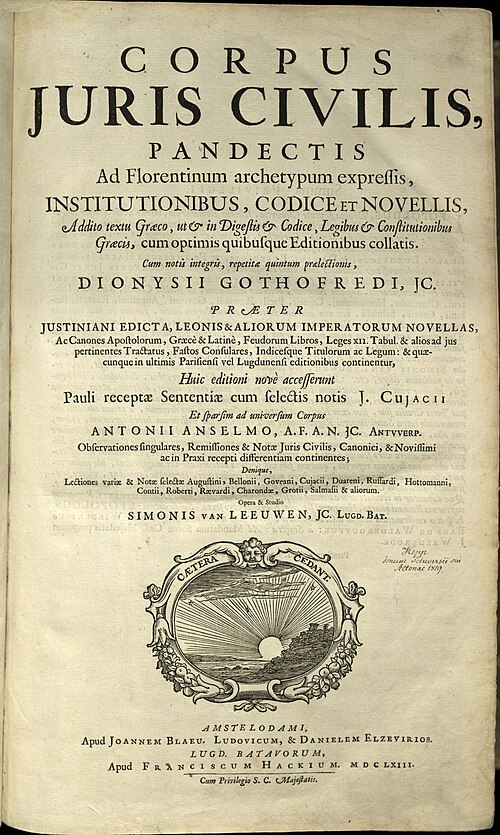
- “Corpus Iuris Civilis” (“body of civil law”) became standard after Dionysius Gothofredus’s edition of 1583
- Legacy
- Basis of the civil-law tradition in continental Europe, Latin America, East Asia and elsewhere; also shaped canon law and international law
Easy
What is the Corpus Juris Civilis?
The Corpus Juris Civilis, “Body of Civil Law”, is the name modern scholars give to the collection of legal works produced under Emperor Justinian I in Constantinople. It was not written as a single book. It consists of four parts made for different purposes: a Code of imperial laws, a Digest of the writings of classical Roman jurists, the Institutes, a textbook for first-year law students, and the Novels, new laws that Justinian issued after the Code was finished.
Justinian himself did not use the title Corpus Juris Civilis. It became standard after 1583, when the French jurist Dionysius Gothofredus (Denis Godefroy) published the four parts together under that name. The phrase “civil law” here means the law of the Roman citizen community (ius civile), as distinct from church (canon) law.
The purpose of the project was to put an enormous and confusing body of Roman law into order. Roman law had been growing for about a thousand years. Imperial decisions contradicted one another, and the writings of the great jurists filled hundreds of books that few people could read in full. Justinian ordered his experts to collect, cut, harmonise and update this material, and then declared that only the new books had legal force.
Easy
The four parts, one by one
The Code (Codex Justinianus) collected the laws of the emperors from the time of Hadrian in the second century onward. Justinian set up a ten-member commission in February 528. It worked from three earlier collections, the unofficial Gregorian and Hermogenian Codes and the official Theodosian Code of 438, and from later laws. The first Code was issued in April 529. It was replaced in 534 by a revised second edition, divided into twelve books: book 1 on church law, sources of law and high offices; books 2–8 on private law; book 9 on crimes; books 10–12 on administration. Only the second edition survives; of the first, almost nothing is left except a fragment of a table of contents on an Egyptian papyrus.
The Digest, also called the Pandects (from a Greek word meaning “all-containing”), is the largest and, for lawyers, the most valuable part. In December 530 Justinian ordered Tribonian to compile extracts from the writings of the classical jurists, who had worked mainly in the first to third centuries. Tribonian formed a commission of sixteen: one official, four professors and eleven advocates. They finished in three years. The Digest is arranged in fifty books, each divided into titles on particular subjects, and each extract is labelled with its author and original work. About two-fifths of the text comes from Ulpian and about one-sixth from Paul.
The Institutes are a short introduction for students, organised in four books on persons, things, and actions (with succession and obligations covered under things). They were modelled closely on the Institutes of the second-century jurist Gaius. Unusually, this textbook was also given the full force of law. It opens with a definition that has been repeated for centuries: justice is the constant and perpetual will to give each person what is theirs.
The Novels (Novellae constitutiones, “new laws”) are the laws Justinian issued after 534. They were never gathered into an official collection by the emperor himself; they survive in several private collections. Most were written in Greek, the everyday language of the eastern empire, which shows how the legal world was changing even as the compilation was completed.
Easy
Justinian and Tribonian: who made it?
Justinian was born around 482 in the Balkans, in a Latin-speaking family of modest origins, and came to power through his uncle, Emperor Justin I. He ruled from 527 to 565 with ambitions to restore the greatness of the Roman Empire: his generals reconquered North Africa and Italy, and he rebuilt the church of Hagia Sophia in Constantinople. His wife, the empress Theodora, was an influential partner in government until her death in 548.
The legal work was directed by Tribonian, a lawyer of great learning who served as quaestor, the minister responsible for drafting laws. Contemporary writers praised his knowledge and criticised his supposed greed. He worked with teams of officials, professors from the law schools of Constantinople and Berytus (Beirut), and practising advocates. Two professors, Theophilus and Dorotheus, helped him write the Institutes.
The emperor presented the project as his own, and the introductory laws that promulgated each part speak in his voice. But the actual reading, cutting and editing of thousands of texts was the achievement of these teams, who completed in a few years what earlier emperors had not managed at all.
Intermediate
How the compilers worked
The compilers were not simply copying. They were authorised to shorten, combine and change the old texts so that the result would be consistent and fit for the law of their own day. Obsolete institutions were removed, contradictions resolved and some rules altered. Justinian also issued a series of rulings known as the Fifty Decisions (529–531) to settle long-standing disputes among the jurists before the Digest was finished. Changes made by the compilers to the original texts are called interpolations.
According to Justinian’s own account in the law announcing the Digest, the commissioners read almost two thousand books containing about three million lines and reduced them to around 150,000. Whatever the exact figures, the scale of the reduction was enormous, and much of classical legal literature survives today only in the extracts chosen for the Digest.
Once the books were finished, Justinian forbade judges and lawyers to cite the old works directly and prohibited commentaries on the Digest, allowing only literal Greek translations and short summaries. His aim was a closed, authoritative body of law. In practice, Greek summaries and commentaries soon appeared, because most lawyers in the East did not read Latin easily.
Intermediate
How to read a reference to Roman law
Lawyers and historians refer to the Corpus with a compact system of numbers. A reference such as D. 1.1.10 means the Digest, book 1, title 1, fragment 10; a longer reference may add a paragraph number. C. stands for the Code, Inst. (or I.) for the Institutes, and Nov. for the Novels. Medieval lawyers used a different system, citing the first words of a title and a fragment instead of numbers, so older books can look puzzling to modern readers.
Each fragment of the Digest begins with an inscription naming the jurist and the work from which it was taken, for example a book of Ulpian’s commentary on the praetor’s edict. This labelling is what allows scholars to reconstruct lost works of the classical jurists by gathering all the fragments of one book, and it is also the evidence on which theories about the commission’s working method are based.
Reading the Corpus is therefore a little like reading a carefully edited anthology. The voice of a second-century jurist and the voice of a sixth-century editor can sit in the same sentence, and part of the skill of Roman legal history lies in hearing both.
Intermediate
What the law says: persons, property, contracts and crime
Much of the Corpus deals with private law: the status of persons (free and slave, citizens, children under a father’s power), marriage and dowry, property and possession, inheritance and wills, and obligations arising from contracts and from wrongs. Roman jurists had developed precise concepts here, such as the difference between ownership and possession, the types of contract formed by consent, and the idea of fault in causing damage. These concepts are what later European lawyers found most useful.
The Corpus also reflects its own society. Slavery was fully part of the legal order, although Justinian’s laws made manumission easier. Book 1 of the Code begins with laws on the Holy Trinity and the Catholic faith and includes laws restricting heretics, pagans, Jews and Samaritans. Some Novels, often linked with Theodora’s influence, improved the legal position of women in matters such as dowry and inheritance, and protected actresses and women forced into prostitution.
Public and criminal law take up less space than private law, but the Digest and Code include rules on crimes, punishments, the duties of officials and taxation. Principles such as “what touches all must be approved by all” and the idea that the emperor is not bound by the laws were both drawn from the Corpus by later political thinkers, who used them for very different purposes.
Intermediate
Meanwhile in the world
The compilation was carried out in years of crisis and ambition. In January 532, while the Digest commission was at work, the Nika riots broke out in Constantinople. Rioters demanded the dismissal of unpopular ministers, including Tribonian, and much of the city centre was burned. Justinian’s troops crushed the revolt with great bloodshed, and within weeks he began rebuilding Hagia Sophia, completed in 537. That same year, 532, Justinian made the Eternal Peace with the new Persian king Khosrow I, paying gold so that he could turn his armies west. The peace broke down in 540, when Khosrow sacked Antioch.
At the other end of Eurasia, states were also building legal and religious order. In Korea, the Samguk sagi records that King Beopheung of Silla promulgated a law code in 520 and that Buddhism was accepted at the Silla court after the martyrdom of Ichadon around 527. King Seong of Baekje, reigning 523–554, moved his capital to Sabi in 538 and maintained close ties with the Liang dynasty in southern China, whose Emperor Wu was a great patron of Buddhism. Baekje transmitted Buddhism to Japan in the same decades, in 538 or 552 depending on the source.
A century later, China’s Tang dynasty produced its own comprehensive codes, which Silla and Japan studied and adapted, as in Japan’s Taika Reform of 645. Roman law and Chinese law developed without influencing each other, but comparing Justinian’s Corpus with the Tang Code shows two very different answers to the same problem: how to turn the scattered rules of a vast empire into a single authoritative text.
Intermediate
Lost and found: from Constantinople to Bologna
In the East, Justinian’s law remained in force but was increasingly used through Greek summaries. Around 900, under Emperor Leo VI, it was reworked into a large Greek legal collection known as the Basilica, which served Byzantine courts until the empire’s end.
In the West, the situation was different. After Justinian’s reconquest, his law was introduced in Italy, but the Lombard invasions soon cut most of the peninsula off from Constantinople. The Code and the Institutes were known in fragments, but the Digest almost disappeared from use for about five centuries. Almost all later knowledge of its original text depends on one manuscript, the Littera Florentina, copied in the sixth century not long after 533. It was probably in southern Italy by the late sixth century, was held in Pisa by the twelfth century, and was taken to Florence as war booty in 1406. It is kept today in the Biblioteca Medicea Laurenziana.
Around 1070 the Digest reappeared in northern Italy. At Bologna, a teacher named Irnerius began lecturing on Justinian’s texts, explaining them with short notes (glosses) written between the lines and in the margins. His school, the glossators, attracted students from across Europe and contributed to the rise of the University of Bologna. In the thirteenth century Accursius gathered the glosses into a standard commentary, the Glossa ordinaria, which was printed alongside the text for centuries.
Intermediate
The long afterlife: the civil-law tradition
From Bologna, the study of Roman law spread to universities in France, Spain, Germany and beyond. Combined with church law and local customs, it formed the ius commune, the common legal learning of medieval and early modern Europe. Lawyers trained in it served kings, cities and the church, and its concepts shaped legal argument everywhere.
Humanist scholars of the sixteenth century began to study the Corpus historically, trying to recover the original Roman law behind Justinian’s edits. In the nineteenth century, the German Pandectist school built a highly systematic legal science on the Digest. The great national codes, especially the French Civil Code of 1804 and the German Civil Code (BGB) of 1900, drew heavily on this tradition. Through them Roman-law concepts reached Latin America, Japan, Korea, Turkey and many other countries.
Even in common-law countries such as England, which did not adopt Roman law as a system, the Corpus influenced legal thinking, church courts, admiralty law and the vocabulary of jurisprudence. International law also borrowed Roman ideas, such as the ius gentium, the “law of nations”. Today the standard scholarly text is the critical edition prepared in the nineteenth century by Theodor Mommsen, Paul Krüger and others.
Advanced
Scholarly debates: interpolations and the working method
Because the compilers were allowed to alter texts, historians of classical Roman law must ask of every Digest passage how much of it reflects the original jurist and how much the sixth-century editors. In the late nineteenth and early twentieth centuries, many scholars hunted for interpolations with great enthusiasm, marking suspicious words and phrases as later insertions. Catalogues of suspected interpolations were compiled. Since the mid-twentieth century this approach has been widely criticised as excessive; many supposed interpolations are now thought to reflect changes already made in late antique editions of the jurists, or simply to be genuine classical language. Most scholars now judge each case more cautiously.
A second debate concerns how the Digest commission actually worked in only three years. In 1820 the German scholar Friedrich Bluhme noticed that within most titles the extracts fall into recurring sequences of works. He proposed that the commissioners divided the material into several groups (“masses”), each handled by a subcommittee, and then merged the results. Bluhme’s “mass theory” is still broadly accepted, though its details continue to be refined.
Scholars also debate how to understand the whole project. Some emphasise its conservative, classicising character: Justinian looked back to the golden age of the jurists and preserved it. Others stress its innovation: the compilers changed the law, imposed a single authoritative text, and created something closer to a modern code than anything before it.
Advanced
Different perspectives
Roman or Byzantine? Justinian and his subjects called themselves Romans, and their state the Roman Empire. The word “Byzantine” is a later label. Historians who stress continuity present the Corpus as the culmination of Roman law; others emphasise that it belongs to a Christian, Greek-speaking East with its own priorities, visible in the Novels and in the religious laws of the Code. How one frames the Corpus shapes whether it is seen as an ending or a beginning.
A European inheritance? Traditional accounts describe the Corpus as the foundation of “Western” law. More recent work points out that it was compiled in a city between Europe and Asia, drew on jurists from across the Mediterranean (Ulpian, for example, came from Tyre in modern Lebanon), and was later received in very different ways in Byzantium, western Europe, the Slavic world and, through modern codes, in East Asia and Latin America. Japanese and Korean civil codes, for example, reached Roman concepts through German and French models rather than directly.
Justice for whom? The Corpus is admired for its reasoning, but it also legalised slavery, reinforced the power of fathers over families, and restricted the rights of religious minorities. Justinian’s laws against pagan teachers are often linked with the end of the Neoplatonic school in Athens around 529, although scholars disagree about how direct that connection was. Some historians celebrate Theodora’s role in laws protecting women; others warn that this picture relies partly on hostile or idealising sources. A balanced reading keeps both the intellectual achievement and the social limits of the law in view.
Key ideas
- Codification
- Turning scattered rules into one authoritative written collection; Justinian’s project was the most ambitious attempt of the ancient world.
- Jurists’ law
- Much Roman law was developed by expert jurists whose opinions carried authority; the Digest preserves their reasoning.
- Interpolation
- A change the compilers made to an older text; detecting them is a central problem of Roman legal history.
- Justice as giving each their due
- The definition that opens the Institutes and became a classic formula of legal philosophy.
- Reception
- The adoption of Roman law in medieval and modern Europe, beginning with the Bologna glossators.
- Civil-law tradition
- Legal systems based on comprehensive codes and Roman legal concepts, as opposed to the case-based common law.
Records
- 438 CE — The Theodosian Code is issued, an earlier official collection of imperial laws.
- 527 CE — Justinian becomes emperor.
- 528 CE — A ten-member commission is appointed to compile a new Code (February).
- 529 CE — The first Code of Justinian is issued (April).
- 530 CE — Justinian orders Tribonian to compile the Digest (December).
- 532 CE — Nika riots in Constantinople; Eternal Peace with Khosrow I of Persia.
- 533 CE — The Institutes and the Digest are promulgated and take effect at the end of December.
- 534 CE — The revised second edition of the Code is issued (November).
- 565 CE — Death of Justinian; the Novels had continued to be issued until then.
- c. 900 CE — The Basilica, a Greek reworking of Justinian’s law, is compiled under Leo VI.
- c. 1070 — The Digest reappears in northern Italy; soon after, Irnerius teaches at Bologna.
- 1406 — The Littera Florentina manuscript of the Digest is taken from Pisa to Florence.
- 1583 — Dionysius Gothofredus publishes the collection as the “Corpus Iuris Civilis”.
- 1804 — The French Civil Code, strongly shaped by the Roman-law tradition, is enacted.
Glossary
- Codex
- The part of the Corpus containing imperial laws; also the Latin word for a bound book.
- Digest / Pandects
- The fifty-book collection of extracts from classical Roman jurists.
- Institutes
- An introductory legal textbook in four books, given the force of law.
- Novels
- New laws issued by Justinian after 534, mostly in Greek.
- Jurist
- A Roman legal expert whose written opinions shaped the law.
- Quaestor
- In Justinian’s time, the minister responsible for drafting laws.
- Gloss
- A short explanatory note written between the lines or in the margin of a text.
- Ius commune
- The shared learned law of medieval and early modern Europe, built on Roman and canon law.
- Interpolation
- An alteration made by later editors to an earlier text.
- Civil law
- Here, the Roman-derived legal tradition based on codes; also the law of private relations.
Questions and answers
Did Justinian write these laws himself?
No. He ordered and approved the work, and the laws speak in his name, but the compiling was done by teams led by his minister Tribonian.
Why is it called “civil” law?
“Civil” comes from the Latin civis, citizen. Ius civile meant the law of the Roman citizen community, distinct from church law. The title Corpus Juris Civilis was given much later, in 1583.
What is the most famous sentence in it?
The opening of the Institutes: justice is the constant and perpetual will to give everyone their due. It also lists three basic precepts: live honestly, harm no one, give each their due.
How did it survive?
In the East it stayed in use and was reworked in Greek. In the West the Digest nearly vanished and survived mainly through one sixth-century manuscript, the Littera Florentina, before it was rediscovered in Italy around 1070.
Does it still matter today?
Yes. Civil codes in France, Germany, Italy, Spain, Latin America, Japan, Korea and many other countries are built on concepts taken from it, and law students still study Roman law.
How much did the compilers change the old texts?
They were allowed to edit freely. Early twentieth-century scholars thought changes (interpolations) were everywhere; most scholars today are more cautious and judge each passage individually.
What does the Corpus say about religion?
The Code opens with laws on the Christian faith and contains measures against heretics, pagans, Jews and Samaritans, reflecting Justinian’s vision of a Christian empire.
Sources and further reading
- Corpus Juris Civilis. Wikipedia
- Code of Justinian. Wikipedia
- Digest (Roman law). Wikipedia
- The Institutes of Justinian (excerpts, English translation). Internet History Sourcebooks, Fordham University
- Yves Lassard and Alexandr Koptev, The Roman Law Library (Latin texts of the Codex, Digest, Institutes and Novels). Université Grenoble Alpes
- Littera Florentina. Wikipedia
- Irnerius. Wikipedia
- Justinian I. Wikipedia
- Eternal Peace (532). Wikipedia
- Damascius. Wikipedia
Related
- Hagia SophiaA monumental church built for the Byzantine emperor Justinian I in Constantinople between 532 and 537 CE.
- Khosrow ISasanian king of Persia (r. 531–579), called Anushirvan, who reformed taxation and the army, rivalled Justinian, and was later remembered as the model of a just king.
- Fall of the Western Roman EmpireThe removal of the western emperor Romulus Augustulus in 476 CE, often used as a marker for the end of the Western Roman Empire.
- Code of HammurabiA collection of legal judgments issued under Hammurabi, king of Babylon, in the eighteenth century BCE.
- King Seong of BaekjeThe 26th king of Baekje (r. 523–554), who moved the capital to Sabi, made Baekje a bridge between Liang China and Japan, and died in battle against Silla.
- Taika ReformA programme of political reforms launched after the palace coup of 645, which aimed to turn Japan’s alliance of powerful clans into a centralised state on the model of Tang China.
Written with AI assistance from the published sources listed above, and revised as new research appears.