Start at the top for an easy introduction. Go further down for more detail and scholarship.
- Easy
- Intermediate
- Advanced
For young readers
About 1,400 years ago, in a desert town called Mecca in Arabia, a boy named Muhammad was born. His father died before he was born and his mother died when he was six, so his grandfather and then his uncle took care of him. When he grew up he worked as a trader, travelling with camel caravans, and people called him “al-Amin”, which means “the trustworthy one”.
When he was about 40, Muhammad liked to go alone to a cave on a mountain near Mecca to think and pray. Muslims believe that one night the angel Gabriel came to him there with a message from God. Over the next 23 years many more messages came. His followers learned them by heart and wrote them down, and together they became the Quran, the holy book of Islam.
Muhammad taught that there is only one God, that people should be kind to orphans and the poor, and that everyone will one day answer for what they have done. Many powerful people in Mecca did not like this, because the town earned money from pilgrims who came to worship many gods. So Muhammad and his followers moved to another town, Medina. That journey, in the year 622, is so important that the Islamic calendar starts counting from it.
In Medina, Muhammad became the leader of a new community. After years of struggle he returned to Mecca peacefully in 630 and forgave most of his old enemies. He died in Medina in 632.
Muslims love and respect Muhammad very much. Many say “peace be upon him” after his name. Most Muslims do not draw pictures of him, so books and museums usually show his name in beautiful Arabic writing instead of a picture. We will do the same here.
At a glance
- Lived
- c. 570 – 8 June 632 CE (traditional dates; the birth year is approximate)
- Places
- Born in Mecca; from 622 lived in Medina (then Yathrib), in the Hijaz region of western Arabia (today Saudi Arabia)
- Family
- Banu Hashim clan of the Quraysh tribe; first wife Khadija; daughter Fatima, whose descendants are honoured by many Muslims
- Role in Islam
- Regarded by Muslims as the Messenger of God and the “Seal of the Prophets”, the last in a line that includes Abraham, Moses and Jesus
- Revelation
- From 610 until his death, recited what Muslims believe are revelations from God, later collected as the Quran
- Turning point
- The Hijra (emigration) from Mecca to Medina in 622, year 1 of the Islamic calendar
- Main sources
- The Quran; the sira (biographies) from the 8th–9th centuries, especially Ibn Ishaq as edited by Ibn Hisham; hadith collections; a few early non-Muslim reports
- Legacy
- Founder of the Muslim community (umma); his example (sunna) shapes Islamic law, worship and ethics for about two billion people
Easy
Who was Muhammad?
Muhammad ibn Abd Allah was born in Mecca, a trading and pilgrimage town in western Arabia, around the year 570 and died in Medina in 632. For Muslims he is the Prophet and Messenger of God (Allah is simply the Arabic word for God, used also by Arabic-speaking Christians and Jews). They believe that God spoke to him through the angel Gabriel and that the words he recited are preserved in the Quran.
Muslims do not worship Muhammad. They regard him as a human being chosen by God, the last of a long series of prophets that includes Noah, Abraham, Moses, David and Jesus. The Quran calls him the “Seal of the Prophets” (33:40), which Muslims understand to mean that no prophet comes after him. Out of respect, many Muslims add a blessing after his name, such as “peace be upon him” or its Arabic form, ṣallā llāhu ʿalayhi wa-sallam.
Historians of every background agree that Muhammad was a real person who founded a religious community and, by the end of his life, united much of Arabia under its leadership. Within a century of his death, states ruled in the name of Islam stretched from Spain to Central Asia. Few individuals in history have shaped as many lives.
This page describes both how Muslim tradition remembers Muhammad and how modern historians study him. The two perspectives overlap a great deal, but they ask different questions: believers ask what Muhammad’s life teaches, while historians ask what the surviving sources can prove. Following the practice of most Muslims, this page does not describe or show his physical appearance.
Easy
The world Muhammad was born into
Sixth-century Arabia lay between two great empires: the Christian Byzantine (Eastern Roman) Empire to the north-west and the Zoroastrian Sasanian Persian Empire to the north-east. South Arabia (Yemen) had old kingdoms and had recently been ruled by Christian Ethiopians from Aksum. Across the peninsula lived Jewish and Christian communities as well as people who worshipped many gods.
Most people in the Hijaz, the western region of Arabia, belonged to tribes and clans. A clan protected its members; a person without clan protection was in real danger. There was no king or state. Poetry was the most admired art, and poets could make or break a tribe’s reputation.
Mecca stood in a dry valley. According to Islamic tradition, its central shrine, the Kaaba, had been built by Abraham and his son Ishmael for the worship of the one God, but by Muhammad’s time it held idols of many deities. Pilgrims visited it in sacred months, when fighting was forbidden, and this made Mecca a safe place for markets. The ruling tribe, the Quraysh, profited from both pilgrimage and trade. Historians still debate how large Meccan trade really was; Patricia Crone argued in the 1980s that it has been exaggerated, while others see Mecca as a regional hub.
Easy
Early life in Mecca
Muhammad belonged to the clan of Hashim, a respected but not wealthy branch of Quraysh. His father, Abd Allah, died before his birth. As was customary among Meccan families, the baby was sent for a time to be nursed among desert Bedouin. His mother, Amina, died when he was about six. His grandfather Abd al-Muttalib cared for him for two years, and after the grandfather’s death his uncle Abu Talib, head of the clan, raised him and protected him for the rest of Abu Talib’s life.
As a young man Muhammad worked in the caravan trade that linked Mecca with Syria. Tradition says he was known for honesty and was nicknamed al-Amin, “the trustworthy”. At about 25 he married Khadija bint Khuwaylid, a widowed merchant who had employed him and who, according to the sources, was some fifteen years older. The marriage lasted about 25 years, until her death, and Muhammad married no one else while she lived. They had several children; their daughters Zaynab, Ruqayya, Umm Kulthum and Fatima survived infancy, while their sons died young.
The sources tell of Muhammad’s growing habit, in his late thirties, of retreating to a cave called Hira on a mountain outside Mecca for days of solitary reflection. Similar practices of devotion are reported of other Arabians at the time who were searching for a purer faith; the sources call such people ḥanīf.
Easy
The first revelation and the message
According to Muslim tradition, in 610, during the month of Ramadan, the angel Gabriel appeared to Muhammad in the cave of Hira and commanded him, “Recite!” The first words revealed are traditionally identified as the opening of sura 96: “Recite in the name of your Lord who created — created the human being from a clinging clot.” Shaken, Muhammad returned home, and Khadija comforted him; she is remembered as the first person to accept his message.
The early preaching was simple and urgent. There is one God, the creator, who is merciful and just. Idols are powerless. A Day of Judgment is coming, when every person will be raised and held accountable. Gratitude to God must show itself in prayer and in generosity: feeding the hungry, freeing slaves, caring for orphans and widows, and not hoarding wealth. Muhammad presented this as the same message that earlier prophets had brought to their peoples.
The first believers included Khadija, Muhammad’s young cousin Ali ibn Abi Talib, his freed slave and adopted son Zayd ibn Haritha, and his friend Abu Bakr, a merchant. Sunni and Shia Muslims emphasise these figures differently, and the question of who believed first has itself been discussed for centuries.
Intermediate
Opposition in Mecca and the emigration to Medina
Around 613 Muhammad began to preach publicly. His criticism of the gods of the Kaaba and of the selfishness of the rich threatened the religious prestige and economic interests of the Quraysh leaders. Believers without strong clan protection, including slaves such as Bilal, suffered harassment and even torture. In about 615 Muhammad sent a group of followers to take refuge with the Christian ruler of Aksum in Ethiopia, who, according to the sources, received them kindly.
The Quraysh then organised a boycott of Muhammad’s clan, refusing to trade or intermarry with them (traditionally dated c. 616–619). Soon after it ended came what later writers called the “Year of Sorrow” (619): both Khadija and Abu Talib died. Without his uncle’s protection Muhammad’s position became precarious. An attempt to find support in the nearby town of Ta’if failed, and tradition says he was driven out with stones. Muslim tradition places the Night Journey and Ascension (al-isrāʾ wa-l-miʿrāj), when Muhammad was taken to Jerusalem and through the heavens, in this difficult period; Muslims hold differing views on whether it was a bodily or spiritual journey.
Help came from Yathrib, an oasis about 350 km to the north whose Arab tribes were locked in feuds and which also had Jewish clans. Pilgrims from Yathrib met Muhammad and, at two meetings at al-Aqaba near Mecca, pledged to accept him and to protect him. In 622 his followers slipped out of Mecca in small groups; Muhammad left last, accompanied by Abu Bakr, and reached Yathrib, which became known as Madinat al-Nabi, “the City of the Prophet”, or simply Medina.
This emigration, the Hijra, marks the start of the Islamic (hijri) calendar, fixed under the second caliph, Umar. Its choice is revealing: Muslims dated their era not from Muhammad’s birth or first revelation but from the moment the believers became a community living under their own order.
Intermediate
Medina: building a community
In Medina Muhammad was both religious teacher and arbiter among the tribes. A mosque was built beside his house, serving as a place of prayer, meeting and government. The emigrants from Mecca (muhājirūn) were paired with the Medinan “helpers” (anṣār) in bonds of brotherhood.
An early document known as the Constitution (or Charter) of Medina, preserved in Ibn Ishaq’s biography and in Abu Ubayd’s Kitab al-Amwal, sets out mutual obligations among the believers and allied groups, including Jewish groups, who are to keep their own religion. It describes them as one umma, a community defined by a shared allegiance rather than kinship, and makes Muhammad the final arbiter of disputes. Most historians accept that the text is genuinely early, though they disagree about whether it is one agreement or several, and whether it dates from 622 or a few years later.
Many of the Quran’s longer passages about law, family, inheritance, fasting, almsgiving and war are associated with the Medinan years. The direction of prayer (qibla), at first towards Jerusalem, was changed to the Kaaba in Mecca around 624. Relations with the major Jewish clans of Medina deteriorated over the following years, a painful and much-studied part of the story.
Intermediate
War, truce and return to Mecca
Conflict with Mecca began with raids on Quraysh caravans, a familiar tactic in Arabian tribal warfare that struck at Mecca’s economic lifeline. In 624 a small Muslim force defeated a much larger Meccan army at Badr, a victory Muslims interpreted as a sign of divine support. In 625 the Meccans won a battle at Uhud, where Muhammad himself was wounded. In 627 a large coalition besieged Medina, but a defensive trench dug around the exposed side of the oasis frustrated the attack (the Battle of the Trench).
Each of these crises was followed by action against one of the three main Jewish clans of Medina, whom the sources accuse of breaking agreements or siding with Mecca. The Banu Qaynuqa and then the Banu Nadir were expelled. After the siege of 627, the men of the Banu Qurayza were executed and the women and children enslaved, according to the traditional accounts. This episode is among the most discussed in modern writing about Muhammad: historians debate the numbers given, the reliability of the later reports, and how to judge the event by the norms of seventh-century warfare, while Muslim writers have offered a range of explanations and some have questioned details of the account.
In 628 Muhammad led a large group towards Mecca to perform pilgrimage. Stopped at al-Hudaybiyya, he agreed to a ten-year truce, to the dismay of some companions; the Quran (sura 48) calls it a “clear victory”. The truce allowed Islam to spread rapidly among the tribes. When allies of Quraysh attacked allies of the Muslims, Muhammad marched on Mecca in 630 with a large army. The city surrendered with little fighting, and he granted a general amnesty to almost all his former opponents. The idols of the Kaaba were destroyed, and the shrine was rededicated to the worship of the one God.
After victory over the Hawazin tribes at Hunayn and a campaign northward to Tabuk, delegations came to Medina from across Arabia to pledge allegiance. By 632 much of the peninsula was linked to Medina, though sometimes loosely.
Intermediate
The final pilgrimage, death and the question of succession
In early 632 Muhammad made his only pilgrimage (hajj) as leader of the community, the Farewell Pilgrimage. The rites he performed became the model for the hajj that millions of Muslims perform today. In a sermon at Arafat, reported in several versions, he is remembered as stressing the sanctity of life and property, the rights of women, and the equality of believers.
Soon after returning to Medina he fell ill and died on 8 June 632 (12 Rabiʿ al-Awwal 11 AH, according to the common Sunni reckoning), in the apartment of his wife Aisha, next to the mosque. He was buried there; the site now lies beneath the Green Dome of the Prophet’s Mosque, one of the holiest places in Islam. After Khadija’s death he had married several wives, many of them widows, and some of the marriages sealed political alliances; all his children except Fatima died before him.
Muhammad’s death raised the question of who should lead the community. A group of companions chose Abu Bakr as the first caliph (khalīfa, “successor”). Others believed that Muhammad had designated Ali, his cousin and Fatima’s husband, notably at a place called Ghadir Khumm on the way back from the pilgrimage. This disagreement lies at the root of the division between Sunni and Shia Islam. Sunnis honour the first four caliphs as the “rightly guided”; Shia Muslims regard Ali and his descendants, the Imams, as the rightful leaders.
Intermediate
Muhammad in Muslim faith and life
For Muslims, Muhammad is the model of how to live. His words and deeds, reported in thousands of short narrations called hadith, make up the sunna (“custom” or “way”), the second source of Islamic law after the Quran. Scholars developed an elaborate science to judge hadith by examining their chains of transmitters (isnād). Great Sunni collections such as those of al-Bukhari and Muslim ibn al-Hajjaj date from the 9th century; Shia Muslims rely on their own collections, which give weight to reports transmitted through the Imams.
Everyday practice echoes his example: the five daily prayers, the manner of washing before prayer, the fast of Ramadan, the pilgrimage, greetings and table manners. The declaration of faith (shahāda), “There is no god but God, and Muhammad is the Messenger of God”, names him alongside God. Devotional poetry in praise of the Prophet flourished in Arabic, Persian, Turkish, Urdu, Swahili, Malay and many other languages. Many Muslims celebrate his birthday (mawlid), while some, particularly in reformist movements, reject the celebration as a later innovation.
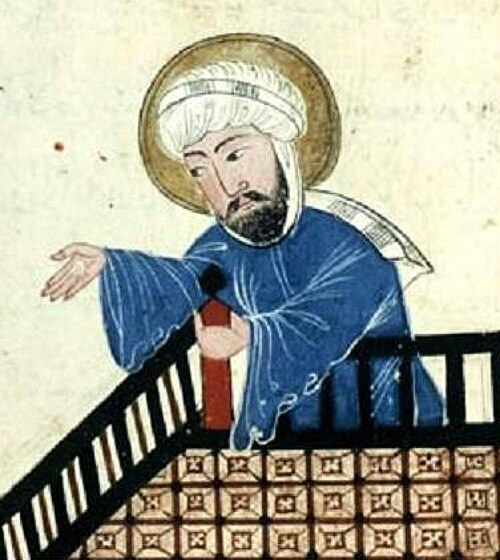
Islamic tradition generally discourages depicting Muhammad, out of concern about idolatry and reverence for his person. Practice has varied: some Persian and Ottoman manuscript paintings show him with his face veiled or as a flame, but the dominant art form of devotion is calligraphy, including the hilye, a panel that sets out a written description of his qualities. Most Muslims today regard images of him as deeply disrespectful, and this page follows that sensitivity.
Advanced
How do we know? The sources and their problems
The Quran is the earliest and, by broad scholarly consensus, a largely contemporary witness to Muhammad’s preaching (see the Quran page on manuscript dating). But it rarely names people or places and does not narrate a biography: Muhammad is named only four times, and events such as Badr or Hudaybiyya appear through allusion. The narrative of his life comes from later genres. The maghāzī (“campaigns”) and sīra (“way of life”, biography) literature grew from reports collected by scholars such as Urwa ibn al-Zubayr (d. 713) and Ibn Shihab al-Zuhri (d. c. 742). The most influential biography, by Ibn Ishaq (d. c. 767), survives mainly in the recension of Ibn Hisham (d. 833) and in extracts by al-Tabari. Al-Waqidi (d. 823) wrote on the campaigns, and his secretary Ibn Sa’d (d. 845) compiled a vast biographical dictionary.
Thus the fullest accounts were written down some 120 to 200 years after Muhammad’s death, drawing on oral transmission. They contain contradictions, miraculous stories, and material shaped by later disputes (for example, over the relative merits of the Umayyads, the Abbasids and the family of Ali). Muslim scholars were well aware of such problems and developed criteria for evaluating reports; modern historians apply different tools, looking at the political interests behind reports and at how stories developed over time.
A handful of non-Muslim sources offer independent, if fragmentary, evidence. A Syriac note usually dated to the 630s–640s mentions a battle involving “the Arabs of Muhammad” near Gaza in 634; the Greek Doctrina Jacobi, set in 634, refers to a prophet appearing among the Saracens; the Armenian history attributed to Sebeos, written in the 660s, describes Muhammad as a merchant who preached to the Arabs the religion of Abraham. These texts confirm that a prophet named Muhammad led the Arabs at the time of the conquests, though they present him from outside and sometimes with hostility. Material evidence naming Muhammad, such as coins from the 680s and the inscriptions of the Dome of the Rock in Jerusalem (691–692), appears some decades after his death.
Advanced
Scholarly debates: from trust to scepticism and back
Nineteenth-century European scholars such as William Muir and Aloys Sprenger used the sira critically but broadly trusted its outline. In the mid-20th century W. Montgomery Watt, in Muhammad at Mecca (1953) and Muhammad at Medina (1956), offered an influential socio-economic reading: Muhammad’s message answered a moral crisis caused by the rise of a merchant economy that weakened tribal solidarity. Joseph Schacht, meanwhile, argued that most legal hadith were fabricated in the 8th and 9th centuries, casting doubt on the historical value of transmission chains.
In the 1970s a “revisionist” or sceptical approach emerged. John Wansbrough treated the Islamic tradition as the product of a later sectarian milieu, and Patricia Crone and Michael Cook, in Hagarism (1977), experimentally reconstructed early Islam from non-Muslim sources alone, arriving at a picture very different from the tradition. These works stimulated fresh questions about geography, chronology and the formation of Islamic identity, though both Crone and Cook later distanced themselves from Hagarism’s specific thesis, and no revisionist reconstruction has won general acceptance. The claim that Muhammad never existed is a fringe view among specialists.
More recent research has sought a middle path. Harald Motzki, Gregor Schoeler and Andreas Görke developed the “isnad-cum-matn” method, comparing the chains and wording of variant reports to trace them back to their earliest common transmitters; they argue that some material can be traced to the late 7th century, including reports going back to Urwa ibn al-Zubayr. Fred Donner, in Muhammad and the Believers (2010), proposed that the early movement understood itself as an inclusive community of “Believers” focused on piety and the approaching Last Judgment, with a sharply distinct “Muslim” identity crystallising only around the 690s. Other scholars stress the Late Antique setting, reading the Quran alongside Jewish, Christian and Arabian traditions of the period.
Muslim scholarship, for its part, continues its own long tradition of sira and hadith criticism and increasingly engages with academic methods. The result is a field in which the basic framework of Muhammad’s life — Meccan origin, prophetic preaching, emigration, leadership in Medina, conquest of Mecca, death around 632 — is widely accepted, while many details and their interpretation remain open.
Advanced
Legacy and images across history
Muhammad’s immediate legacy was a community with a scripture, a set of ritual practices and a political centre. Within a decade of his death Arab armies had taken Syria, Iraq and Egypt; within a century Islamic rule reached from the Iberian peninsula to the Indus. Over the following centuries Islam spread far beyond these conquests through trade, scholarship and Sufi networks, into West and East Africa, Central Asia, India, China and Southeast Asia. Indonesia, not Arabia, is now the country with the largest Muslim population.
Outside Islam, perceptions of Muhammad have changed greatly. Medieval Christian polemic often portrayed him as a false prophet or heretic, and such images long shaped European views. From the Enlightenment onward some writers, such as Thomas Carlyle in his 1840 lecture on “the hero as prophet”, presented him more sympathetically, and modern academic study has aimed at historical understanding rather than judgment. In the 20th and 21st centuries, depictions and insults of Muhammad in Western media have provoked widespread protest and sometimes violence, raising debates about freedom of expression and respect for religious belief.
Muhammad is also acknowledged in some later religions: the Bahá’í Faith regards him as a Manifestation of God, and the Druze honour him among the prophets. For Muslims, however, his significance is unique: he is the one through whom, they believe, God’s final revelation came, and whose example shows how to live it.
Key ideas
- Tawhid (divine oneness)
- The central teaching of Muhammad’s preaching: there is one God, without partner or equal, who alone deserves worship.
- Prophethood (nubuwwa)
- Muslims believe God sent many prophets to humankind, from Adam through Abraham, Moses and Jesus, and that Muhammad is the last, the “Seal of the Prophets”.
- Revelation
- Muslims hold that the Quran is God’s own word, brought by the angel Gabriel and recited by Muhammad; his personal sayings (hadith) are distinct from it.
- Umma (community)
- A community defined by faith and shared allegiance rather than kinship, first organised in Medina; the word now refers to Muslims worldwide.
- Sunna (the Prophet’s example)
- Muhammad’s practice and teaching, known through hadith, which guides Islamic law, worship and manners as the second source after the Quran.
- Social justice
- The early message joined faith in God with duties to the poor, orphans and slaves, and condemned greed; almsgiving (zakat) became one of the pillars of Islam.
- Judgment and accountability
- Every person will be raised on the Last Day and judged by God for belief and deeds, a theme especially prominent in the Meccan preaching.
Records
- c. 570 CE — Traditional date of Muhammad’s birth in Mecca (some sources and calculations suggest a slightly different year).
- c. 595 CE — Marriage to Khadija bint Khuwaylid.
- c. 610 CE — According to tradition, first revelation in the cave of Hira during Ramadan.
- c. 613 CE — Beginning of public preaching in Mecca.
- c. 615 CE — A group of Muslims seeks refuge in the Christian kingdom of Aksum (Ethiopia).
- c. 619 CE — The “Year of Sorrow”: deaths of Khadija and Abu Talib.
- 622 CE — The Hijra: emigration from Mecca to Yathrib (Medina); year 1 of the Islamic calendar.
- 624 CE — Battle of Badr; the direction of prayer is turned towards Mecca around this time.
- 627 CE — Siege of Medina (Battle of the Trench).
- 628 CE — Truce of al-Hudaybiyya with the Quraysh.
- 630 CE — Mecca surrenders; general amnesty and cleansing of the Kaaba of idols.
- 632 CE — Farewell Pilgrimage; Muhammad dies in Medina on 8 June; Abu Bakr becomes the first caliph.
Glossary
- Hijra
- The emigration of Muhammad and his followers from Mecca to Medina in 622; the start of the Islamic calendar.
- Quraysh
- The tribe that dominated Mecca and guarded the Kaaba; Muhammad belonged to it, as did many of his early opponents.
- Kaaba
- The cube-shaped shrine in Mecca, which Muslims believe Abraham and Ishmael built; the direction of Muslim prayer.
- Sira
- The genre of traditional biography of Muhammad, the most famous being that of Ibn Ishaq as edited by Ibn Hisham.
- Hadith
- A report of something Muhammad said or did, consisting of a chain of transmitters (isnad) and a text (matn).
- Isnad
- The chain of named people through whom a report was passed down; examined by Muslim scholars and modern historians alike.
- Ansar and Muhajirun
- The “helpers” of Medina who welcomed Muhammad, and the “emigrants” who came with him from Mecca.
- Caliph (khalifa)
- “Successor”: the leader of the Muslim community after Muhammad; the first was Abu Bakr.
- Sunni and Shia
- The two main branches of Islam, which divided originally over who should lead the community after Muhammad.
- Hilye
- A calligraphic panel, especially in Ottoman art, that describes the Prophet in words rather than showing him in an image.
Questions and answers
Do Muslims worship Muhammad?
No. Muslims worship only God. They love and honour Muhammad as God’s messenger and try to follow his example, but they regard him as a human being.
Why are there no pictures of Muhammad on this page?
Most Muslims consider images of the Prophet disrespectful, and many Islamic traditions forbid them. Islamic art usually honours him with calligraphy instead, and this page follows that practice.
Could Muhammad read and write?
Muslim tradition describes him as al-nabī al-ummī, usually understood as “the unlettered prophet”, which believers see as emphasising that the Quran did not come from his own learning. Some modern scholars interpret the word ummī differently, for example as “belonging to a people without a scripture”.
Why does the Islamic calendar start in 622 rather than at his birth?
Under the caliph Umar, the community chose the Hijra, the emigration to Medina, because it marked the founding of the Muslim community as an independent society.
Is Muhammad mentioned outside Islamic sources?
Yes. A few Christian texts in Syriac, Greek and Armenian from the 630s to the 660s mention a prophet or leader of the Arabs named Muhammad, confirming his role at the time of the early conquests.
How reliable are the early biographies?
They were written down more than a century after his death from oral reports. Historians agree on the broad outline of his life but debate many details; methods range from sceptical rejection to careful reconstruction of the oldest layers of transmission.
What caused the Sunni–Shia split?
It began with disagreement over leadership after Muhammad’s death in 632: most accepted Abu Bakr as caliph, while a party (shīʿa) held that Ali had been designated. Theology and law developed differently over later centuries.
Sources and further reading
- Muhammad. Wikipedia
- Prophetic biography. Wikipedia
- Historiography of early Islam. Wikipedia
- Historicity of Muhammad. Wikipedia
- Constitution of Medina. Wikipedia
- Depictions of Muhammad. Wikipedia
- History of the Quran. Wikipedia
- W. Montgomery Watt, Muhammad at Mecca. Clarendon Press, Oxford, 1953
- Fred M. Donner, Muhammad and the Believers: At the Origins of Islam. Belknap Press of Harvard University Press, 2010
- Jonathan A. C. Brown, Muhammad: A Very Short Introduction. Oxford University Press, 2011
Related
- QuranThe holy book of Islam, which Muslims believe is the word of God revealed in Arabic to Muhammad between about 610 and 632.
- House of WisdomName associated with Abbasid scholarly collections and translation activity in Baghdad.
- Obelisk of AxumA carved stone funerary monument from the ancient kingdom of Aksum in present-day Ethiopia.
- RumiPersian-language poet and Sufi teacher whose verse explores love and spiritual transformation.
- Ibn KhaldunNorth African historian and thinker whose Muqaddimah examines how societies and states change.
Written with AI assistance from the published sources listed above, and revised as new research appears.