Start at the top for an easy introduction. Go further down for more detail and scholarship.
- Easy
- Intermediate
- Advanced
For young readers
Ibn Khaldun was born in the city of Tunis, in North Africa, in 1332. His family had come from Seville in Spain, and they were proud, educated people. As a boy he studied the Qur’an, poetry, law and mathematics with his father and with famous teachers.
When he was a teenager, a terrible disease called the Black Death swept across the world. It killed his mother and father and many of his teachers. Ibn Khaldun never forgot how quickly a busy, crowded world could become empty.
When he grew up, he worked for kings and sultans. He wrote their letters, carried their messages, and sometimes got into trouble and was even put in prison. Kings came and went very quickly in his time, and he watched it happen up close.
In his forties he went to live quietly in a small castle in the hills of what is now Algeria. There he asked a big question: why do some groups of people become strong enough to build a kingdom, and why do those kingdoms grow weak after a few generations? His answer was a book called the Muqaddimah, which means “The Introduction”.
He said that people who live hard lives in the desert stick together like a strong rope. That togetherness, which he called asabiyyah, helps them win power. But after they move into cities and grow rich and comfortable, the rope slowly comes loose, and another, tougher group takes over. It is like a wheel that keeps turning.
Later he moved to Cairo in Egypt, where he became a judge and a teacher. When he was nearly seventy, he even met the fearsome conqueror Timur outside the city of Damascus. He died in Cairo in 1406.
At a glance
- Lived
- 27 May 1332 – 17 March 1406
- Born
- Tunis, in the Hafsid sultanate (modern Tunisia)
- Died
- Cairo, in the Mamluk sultanate (modern Egypt)
- Family
- Banu Khaldun, an Arab family long settled in Seville (al-Andalus) before moving to North Africa in the 13th century
- Roles
- Court secretary, diplomat, minister, teacher, and Maliki chief judge (qadi) in Cairo
- Main work
- Kitab al-ʿIbar, a universal history, and its introduction, the Muqaddimah (first draft completed 1377 at Qalʿat Ibn Salama, in modern Algeria)
- Language
- Arabic
- Key idea
- ʿAsabiyya (group solidarity) and the rise and decline of dynasties over roughly three generations
Easy
Who was Ibn Khaldun?
ʿAbd al-Rahman ibn Muhammad ibn Khaldun was born in Tunis on 27 May 1332 and died in Cairo on 17 March 1406. He lived in the western part of the Islamic world, the Maghrib (North Africa) and al-Andalus (Muslim Spain), at a time when many small dynasties competed for power there. He was at once a scholar, a writer of official letters, a diplomat, a teacher and a judge.
He is remembered above all for the Muqaddimah (“Introduction”), the opening part of a very large history of the world that he called Kitab al-ʿIbar, the “Book of Lessons”. In the Muqaddimah he tried to explain history not as a list of battles and rulers, but as the result of patterns in human society: how people live together, earn their living, form groups, build states and cities, and lose power again.
Because of this, modern writers have often called him a forerunner of sociology, economics or the philosophy of history. Those labels are useful for showing how original he was, but they can also be misleading: Ibn Khaldun was a man of the fourteenth century, a Muslim jurist and thinker working inside the scholarly traditions of his own time.
Easy
Growing up in Tunis and the shock of the Black Death
Ibn Khaldun’s family, the Banu Khaldun, traced their origins to an Arab lineage from Hadramawt in southern Arabia. For centuries they had lived in Seville, where they held important positions. When Christian Castile conquered Seville in the thirteenth century, the family moved to North Africa and served the Hafsid rulers of Tunis.
As a boy he received a traditional education. His father taught him, and he studied the Qur’an, Arabic language and poetry, Hadith (reports of the Prophet’s sayings) and Maliki law, the school of Islamic law that was dominant in North Africa. He also studied logic, mathematics and philosophy with the scholar Muhammad ibn Ibrahim al-Abili, whom he later praised as the greatest master of the rational sciences of his time.
In 1348–49, when Ibn Khaldun was about sixteen, the Black Death reached Tunis. His parents and many of his teachers died. In the Muqaddimah he later wrote about the plague as an event that emptied cities and changed the whole face of the world. Many historians think this experience helped shape his interest in why civilisations flourish and decline.
Easy
A life at royal courts: success, prison and danger
At about twenty Ibn Khaldun began working in the chancery of Tunis, writing official documents. In the following twenty years he moved between the courts of rival rulers: the Marinids in Fez, the Nasrids in Granada, and the rulers of Bejaia and Tlemcen. He wrote letters, served as a minister and chamberlain, and travelled among Arab and Berber tribes to recruit soldiers and collect taxes.
It was a dangerous life. In Fez he was accused of plotting and spent almost two years in prison (from 1357). In 1364 the Nasrid sultan of Granada, Muhammad V, sent him as an ambassador to King Pedro of Castile in Seville, the city his ancestors had left. According to Ibn Khaldun’s own account, Pedro offered to return his family’s old estates if he would stay in his service; he declined.
Again and again, he saw rulers fall, ministers lose their heads, and tribes switch sides. By his forties he was tired of politics. In 1375 he withdrew with his family to Qalʿat Ibn Salama, a fortress in the hills of what is now western Algeria, under the protection of the Awlad ʿArif tribe. There, in quiet, he began to write.
Easy
The Muqaddimah: a book about the rules behind history
Ibn Khaldun planned a history of the Arabs, the Berbers and the other peoples of his time. Before telling that story, he wanted to explain how to judge historical reports. Many earlier historians, he complained, simply copied what they had read, even when it was impossible. One of his examples was the report that the Israelites had an army of 600,000 men under Moses: he argued that the land and its resources could not have supported such numbers.
To test reports like this, he said, a historian must understand the nature of human society, which he called ʿumran (roughly “civilisation” or “social organisation”). He believed he was founding a new science devoted to it. The Muqaddimah is his attempt to set out that science.
He wrote the first draft very quickly, finishing it, by his own account, in about five months in 1377. He continued to revise and add to it for the rest of his life, in Tunis and later in Cairo.
Intermediate
How the Muqaddimah is organised
After a foreword and an introduction on the value of history and the errors of historians, the Muqaddimah is divided into six chapters. The first deals with human society in general and its geographical setting, including the influence of climate on human beings. The second treats “Bedouin” (badawa) civilisation, that is, the life of nomadic and rural peoples. The third, the longest, is about dynasties, royal authority, the caliphate and government offices.
The fourth chapter treats sedentary (hadara) civilisation, cities and buildings. The fifth discusses the ways people make a living: agriculture, trade, crafts and the value of labour. The sixth surveys the sciences and education of his day, from Qur’anic studies, Hadith and law to philosophy, mathematics, medicine, alchemy and the teaching of language and poetry.
The order is deliberate. It moves from the simplest forms of human life to the most complex: from the desert to the dynasty, from the dynasty to the city, from the city to its crafts, and finally to the sciences, which he regarded as the highest products of settled civilisation.
Intermediate
ʿAsabiyya and the cycle of dynasties
The key idea of the Muqaddimah is ʿasabiyya, which Franz Rosenthal translated as “group feeling”. It is the sense of solidarity that binds a group together, originally based on real or imagined kinship. Ibn Khaldun argued that it is strongest among people who live hard lives in the desert or the mountains, because they must depend on one another to survive. A group with strong ʿasabiyya, especially when united by religion, can conquer settled lands and found a dynasty.
Once in power, however, the ruling group settles in cities and enjoys luxury. The ruler begins to rely on paid soldiers and clients rather than on his kinsmen, and the old solidarity weakens. Ibn Khaldun suggested that a dynasty usually lasts about three generations, or roughly 120 years: the first generation keeps the toughness of desert life, the second enjoys the fruits of power, and the third has forgotten the old virtues. Eventually a new group with stronger ʿasabiyya comes from the margins and takes over.
This model fitted what he saw in North Africa, where Berber dynasties such as the Almoravids, the Almohads and their successors followed one another. It is a model of social forces, not of individual heroes, and it treats religion as a powerful amplifier of group solidarity rather than as the only cause of success.
Intermediate
Cities, labour and taxes: Ibn Khaldun’s economic thought
Ibn Khaldun paid close attention to economic life. He argued that human labour is the source of wealth and profit: the value of goods largely reflects the work put into them. Large cities, he noted, allow people to specialise and cooperate, so they produce far more than they need, which creates luxury, crafts and the sciences.
One of his most quoted observations is about taxation. At the beginning of a dynasty, he wrote, tax rates are low but revenue is high, because people are willing to work and trade. Later, as rulers become used to luxury, they raise taxes and create new ones; people lose the incentive to work, and total revenue falls. Modern economists have compared this to the “Laffer curve”, although that is a modern analogy rather than a direct influence.
He was also critical of rulers who engaged in trade themselves or seized private property, because such actions discourage enterprise and ultimately ruin the prosperity on which the state depends.
Intermediate
Cairo, the judge and the meeting with Timur
In 1378 Ibn Khaldun returned to Tunis, where he completed a version of his history. Court rivalries soon made his position uncomfortable, and in 1382 he left for Egypt, officially to make the pilgrimage to Mecca. He spent the rest of his life in Cairo, then the largest and richest city of the Islamic world, under the Mamluk sultans.
In 1384 Sultan Barquq appointed him chief judge (qadi) of the Maliki school. The same year, his wife and children drowned in a shipwreck while sailing from Tunis to join him. He taught at madrasas, including lectures at al-Azhar, and made the pilgrimage in 1387. His strict and outsider style as a judge made enemies; he was dismissed and reappointed several times, holding the office six times in total.
In 1400–01 he accompanied the Mamluk army to Syria against the Central Asian conqueror Timur (Tamerlane). While Damascus was besieged, he was let down from the city walls and spent several weeks in Timur’s camp. In his autobiography he describes their conversations about history and rulers, and he wrote for Timur a description of North Africa. He returned to Cairo and died there in 1406, shortly after his sixth appointment as judge.
Intermediate
His writings
Ibn Khaldun’s great work is Kitab al-ʿIbar wa-diwan al-mubtadaʾ wa-l-khabar fi ayyam al-ʿArab wa-l-ʿAjam wa-l-Barbar, usually shortened to Kitab al-ʿIbar. It has three parts: the Muqaddimah; a history of the Arabs and neighbouring peoples, including Persians, Byzantines and others; and a detailed history of the Berbers and the dynasties of the Maghrib. The last part is still one of the most important sources for North African history in the Middle Ages.
He also wrote an autobiography, known as al-Taʿrif, which he kept adding to until shortly before his death. It is one of the fullest autobiographies in medieval Arabic literature. Earlier in life he wrote a summary of a theological work by Fakhr al-Din al-Razi and, around 1373, a treatise on Sufism, Shifaʾ al-saʾil, which discusses whether a spiritual seeker needs a teacher.
Manuscripts of the Muqaddimah copied during his lifetime survive, including a copy in the Atif Efendi Library in Istanbul that carries his own notes. These show that the text grew over time as he revised it.
Intermediate
Influence and rediscovery
In Mamluk Egypt, Ibn Khaldun had students, among them the historian al-Maqrizi, but his theory did not immediately create a school. The strongest early response came from the Ottoman Empire. From the seventeenth century, Ottoman writers such as Katip Çelebi and the historian Naima used his ideas about the life-cycle of states to think about their own empire. The Muqaddimah was partly translated into Ottoman Turkish by Pirizade Mehmed Sahib in the eighteenth century, and Ahmed Cevdet Pasha completed the translation in the nineteenth.
European scholars learned of him in the nineteenth century. The French orientalist William McGuckin de Slane published a French translation of the Muqaddimah in 1862–68, and Franz Rosenthal’s complete English translation appeared in 1958. Twentieth-century writers compared him with Machiavelli, Vico, Montesquieu, Comte and Marx; the historian Arnold J. Toynbee praised the Muqaddimah as one of the greatest works of its kind.
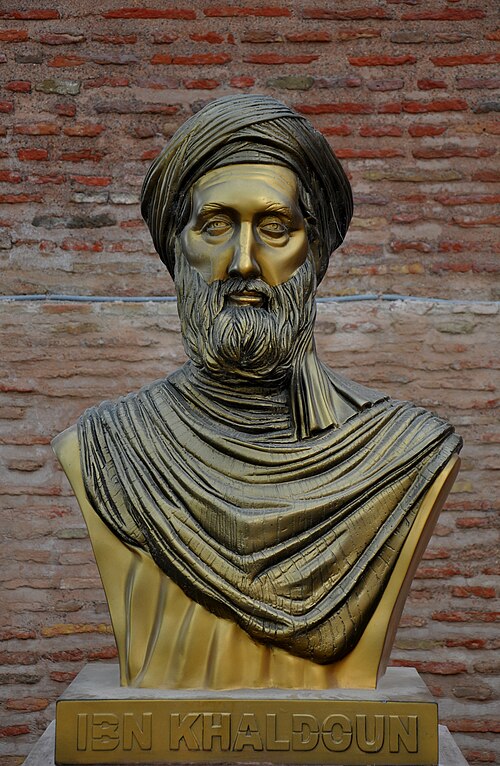
Today Ibn Khaldun is a national symbol in Tunisia, where his statue stands in the centre of Tunis, and he is widely studied in sociology, history, economics and political science across the Arab world, Turkey, Europe and beyond.
Advanced
Interpretive debates: a modern social scientist or a medieval thinker?
The most basic debate is about how to read him. One tradition, strong in the twentieth century, presented Ibn Khaldun as a secular, empirical “father of sociology” who was centuries ahead of his time. Other scholars, including Robert Irwin in his intellectual biography (2018), stress that he must be read as a Maliki jurist, a man with Sufi interests and an Ashʿari theologian who believed in the supernatural, magic and prophecy, and who framed his new science within a religious worldview. On this reading, his originality lies in how he combined inherited ideas, not in anticipating modern disciplines.
A second debate concerns key terms. The word ʿarab in the Muqaddimah often refers to Bedouin nomads rather than to Arabs as an ethnic group, and his harsh remarks about the destructiveness of the ʿarab are about a way of life. Early translations sometimes rendered these passages in ethnic or racial terms. The historian Abdelmajid Hannoum has argued that de Slane’s translation introduced a racial reading of the distinction between Arabs and Berbers that shaped colonial French views of North Africa.
A third debate concerns his remarks about sub-Saharan Africans and other peoples. Some passages repeat prejudices common in medieval geography, and critics rightly point to them. At the same time, Ibn Khaldun explicitly rejected the idea that dark skin was caused by a curse on the descendants of Noah and instead attributed human differences to climate and environment, a view that was itself later used in problematic ways. Scholars continue to discuss how to weigh these elements.
Finally, historians debate how far his model of ʿasabiyya applies beyond the Maghrib. Some find it illuminating for many societies; others think it describes the specific world of tribal dynasties in North Africa and should not be turned into a universal law. Modern researchers of historical cycles, such as Peter Turchin, have explicitly drawn on the concept.
Advanced
Sources for his life and the text of the Muqaddimah
Our main source for Ibn Khaldun’s life is his own autobiography, al-Taʿrif. It is detailed and vivid, but it is also self-justifying: he presents his changes of allegiance and his conflicts in Cairo in the best possible light. Mamluk biographical dictionaries and the writings of contemporaries such as al-Maqrizi and Ibn Hajar al-ʿAsqalani add other views, some admiring and some hostile.
His account of the meeting with Timur is a famous example. It is the only detailed eyewitness description of a conversation with the conqueror by a scholar of this rank, but it is written by a man who needed to explain why he had dealt with an enemy of his sultan. Historians use it with care.
The text of the Muqaddimah also poses problems. Because Ibn Khaldun revised it for nearly thirty years, manuscripts preserve different stages. Nineteenth-century printed editions (Paris, edited by Étienne Quatremère, and Bulaq in Cairo) were based on different manuscripts, and modern critical work compares autograph and authorised copies to trace how his thinking developed. Readers of translations should know which version and which translator’s choices they are relying on.
Key ideas
- ʿAsabiyya (group feeling)
- The solidarity that binds a group together and gives it the strength to seize and hold power; strongest among hardy nomadic or rural peoples.
- Cycle of dynasties
- Dynasties typically rise, flourish and decline over about three generations (roughly 120 years) as luxury weakens their group feeling.
- ʿUmran (civilisation)
- Human social organisation as a whole; Ibn Khaldun claimed to found a new science devoted to studying it.
- Badawa and hadara
- The contrast between nomadic or rural life and settled urban civilisation, each with its own character and virtues.
- Critical history
- Historical reports must be tested against what is possible in human society, not simply copied from earlier authorities.
- Labour and value
- Human work is the source of wealth; cities multiply wealth through specialisation and cooperation.
- Taxation and decline
- Low taxes early in a dynasty bring high revenue; rising taxes later discourage work and reduce revenue.
Records
- 1332 — Ibn Khaldun is born in Tunis on 27 May.
- 1348 — The Black Death reaches Tunis (1348–49); his parents and many teachers die.
- 1352 — Leaves Tunis and enters the service of the Marinid court in Fez.
- 1357 — Imprisoned in Fez for almost two years on suspicion of plotting.
- 1364 — Sent by Muhammad V of Granada as ambassador to Pedro of Castile in Seville.
- 1375 — Withdraws to Qalʿat Ibn Salama in modern Algeria.
- 1377 — Completes the first draft of the Muqaddimah.
- 1378 — Returns to Tunis and works on Kitab al-ʿIbar.
- 1382 — Leaves for Egypt and settles in Cairo.
- 1384 — Appointed Maliki chief judge; his family dies in a shipwreck.
- 1401 — Meets Timur outside besieged Damascus.
- 1406 — Dies in Cairo on 17 March.
Glossary
- Maghrib
- Arabic for “the West”: North Africa west of Egypt, roughly modern Libya, Tunisia, Algeria and Morocco.
- Al-Andalus
- The parts of the Iberian Peninsula under Muslim rule in the Middle Ages.
- Muqaddimah
- “Introduction”; the first part of Ibn Khaldun’s universal history, often read as a separate book.
- Qadi
- A judge who applies Islamic law.
- Maliki school
- One of the four main Sunni schools of Islamic law, dominant in North and West Africa.
- Chancery
- The office that writes a ruler’s official letters and documents.
- Mamluks
- A military elite of slave origin that ruled Egypt and Syria from 1250 to 1517.
- Hafsids
- The dynasty that ruled Tunis and eastern North Africa from the 13th to the 16th century.
- Bedouin
- Nomadic or semi-nomadic peoples of the desert; in the Muqaddimah, rural and nomadic life in general.
- Madrasa
- A college for teaching Islamic law and related sciences.
Questions and answers
What does “Muqaddimah” mean?
It means “Introduction”. It was written as the introduction to a much longer history, but it is so rich that people usually read it as a book on its own.
Was Ibn Khaldun a king?
No. He worked for kings as a secretary, minister and ambassador, and later became a judge in Cairo. That gave him a close view of how power works.
What is ʿasabiyya in simple words?
It is the feeling of “we stick together” that makes a group strong. Ibn Khaldun thought it was strongest in hard living conditions and weakest in luxury.
Did Ibn Khaldun really meet Timur?
Yes. In 1401, during the siege of Damascus, he spent several weeks in Timur’s camp and later described their conversations in his autobiography.
Is it right to call him the “father of sociology”?
The label highlights his originality in studying society systematically, but many historians consider it anachronistic because he worked within medieval Islamic scholarship, not modern social science.
Why did the Ottomans read him?
From the seventeenth century Ottoman thinkers used his theory of the rise and decline of states to reflect on the problems of their own empire.
Where was the Muqaddimah written?
The first draft was written in 1377 at Qalʿat Ibn Salama, a fortress in the hills of western Algeria, not in Tunis; he later revised it in Tunis and Cairo.
Sources and further reading
- Ibn Khaldun. Wikipedia
- Muqaddimah. Wikipedia
- Asabiyyah. Wikipedia
- Kitab al-Ibar. Wikipedia
- 이븐 할둔. 위키백과 (Korean Wikipedia)
- Ibn Khaldun, translated by Franz Rosenthal, The Muqaddimah: An Introduction to History. Princeton University Press (Bollingen Series), 1958
- Robert Irwin, Ibn Khaldun: An Intellectual Biography. Princeton University Press, 2018
Related
- Ibn BattutaMoroccan traveler whose account describes journeys across Africa, Asia and parts of Europe.
- AverroesAndalusian philosopher, jurist and physician renowned for his commentaries on Aristotle.
- AvicennaPhysician and philosopher whose writings shaped medicine and philosophy across the Islamic world and Europe.
- Al-FarabiPhilosopher of the Islamic world known for works on logic, political thought and music.
- House of WisdomName associated with Abbasid scholarly collections and translation activity in Baghdad.
- Mansa MusaRuler of the Mali Empire remembered for its wealth, his pilgrimage to Mecca and support for Islamic learning.
Written with AI assistance from the published sources listed above, and revised as new research appears.