Start at the top for an easy introduction. Go further down for more detail and scholarship.
- Easy
- Intermediate
- Advanced
For young readers
Far out in the Pacific Ocean, thousands of kilometres from any continent, there is a small triangle-shaped island called Rapa Nui. Many people also call it Easter Island. About 800 years ago, Polynesian sailors reached it in big double canoes, steering by the stars, the waves and the flight of birds.
The people who settled there, the Rapa Nui, carved huge figures out of the rock of an old volcano. These figures are called moai. They have large heads, long noses, heavy eyebrows and tight lips. Most of them are taller than a house, and the biggest one that was ever stood up weighed about as much as twelve elephants.
A moai was not just a statue. The Rapa Nui believed it held the power of an important ancestor. Most moai stood on stone platforms near the sea, but they faced inland, toward the villages, as if they were watching over their families and keeping them safe.
How did people move such heavy stones without wheels, cranes or big animals? Old Rapa Nui stories say the moai “walked” to their places. Scientists have tested this idea: a team tied ropes to a copy of a moai and rocked it from side to side, and it shuffled forward, step by step, like someone moving a heavy fridge.
Later, almost all the moai were pushed over, and the island suffered terrible hardship after sailors from far away arrived. Today many moai have been stood up again. The Rapa Nui people still care for them, and they are protected as a World Heritage site for everyone.
At a glance
- Made
- Mainly c. 1250–1500 CE; some monument building may have continued later (dates debated)
- Place
- Rapa Nui (Easter Island), a Polynesian island in the south-eastern Pacific, today part of Chile
- Makers
- The Rapa Nui people, descendants of Polynesian voyagers who settled the island around the 12th–13th century
- Number
- Close to 1,000 known moai; nearly half remain at the Rano Raraku quarry
- Material
- Almost all carved from volcanic tuff (compressed ash) from Rano Raraku; red scoria topknots from Puna Pau
- Largest
- Paro, the tallest ever erected, almost 10 m high and about 82 tonnes; an unfinished figure in the quarry is about 21 m long
- Meaning
- Embodiments of deified ancestors that channelled mana (sacred power) to their descendants
- Status
- Rapa Nui National Park, UNESCO World Heritage Site since 1995
Easy
What are the moai?
Moai are monolithic stone figures, each carved from a single block of rock, made by the Rapa Nui people of Easter Island. The island lies in the south-eastern Pacific about 3,500 km west of the coast of Chile and more than 2,000 km from the nearest inhabited island, Pitcairn. It covers only about 164 square kilometres, yet close to 1,000 moai are known there, making it one of the densest landscapes of monumental sculpture in the world.
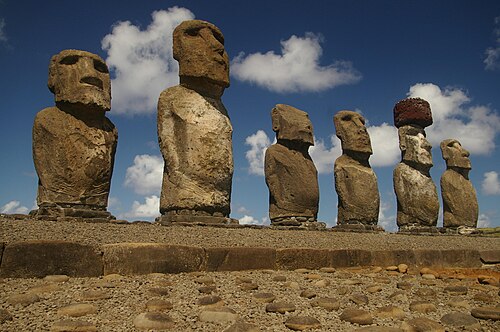
A typical moai shows a stylised human figure from the head down to the hips or thighs. The head is very large in proportion to the body, with a heavy brow, a long straight nose, deep-set eyes, a jutting chin and thin, pouting lips. The arms lie close to the sides and the long-fingered hands meet over the belly. Most moai have no legs; the base of the figure was set into the ground or onto a platform.
Sizes vary widely. Many are 3–6 m tall and weigh a few tonnes to a few dozen tonnes. The tallest moai ever raised onto a platform, known as Paro, was almost 10 m high and weighed about 82 tonnes. In the quarry lies an unfinished giant, often called El Gigante, about 21 m long, which could probably never have been moved.
The word moai simply means “statue” or “figure” in the Rapa Nui language. Many individual moai also had their own names, and they were understood as the living faces of ancestors rather than as portraits made for decoration.
Easy
Who made them? Polynesian voyagers at the edge of the ocean
The Rapa Nui are Polynesians. Their ancestors belonged to one of the greatest seafaring traditions in history: over many centuries, Polynesian navigators in double-hulled voyaging canoes settled almost every habitable island in a vast triangle of the Pacific, from Hawaii in the north to Aotearoa (New Zealand) in the south-west and Rapa Nui in the south-east. They found their way without instruments, reading stars, swells, winds, clouds and birds.
When the first settlers reached Rapa Nui is debated. Older estimates ranged from the 4th to the 9th century CE, but radiocarbon dates from carefully selected samples, especially from the beach of Anakena, point to arrival around the 12th or 13th century. They probably came from eastern Polynesia; the Gambier Islands (Mangareva) and the Marquesas are often suggested. Rapa Nui oral tradition tells of a founding chief, Hotu Matu‘a, who landed at Anakena with his family and followers.
The settlers brought Polynesian crops and animals, such as taro, yams, bananas, chickens and (probably unintentionally) the Polynesian rat. They also grew sweet potatoes, a plant of South American origin, which many scholars take as evidence that Polynesians reached South America and returned before Europeans arrived in the Pacific.
Society was organised into kin groups (mata) that controlled different parts of the island, broadly grouped into two confederations. Each group had its own ceremonial sites near the coast, and it was at these sites that most moai were erected.
Easy
How to “read” a moai site
A finished moai was usually set up on an ahu, a stone platform built along the coast. An ahu had a carefully fitted retaining wall facing the sea, a flat top on which one or more moai stood, and a paved ramp and plaza on the landward side. Some ahu supported a single figure; the largest, Ahu Tongariki on the south-east coast, carries fifteen moai today. Ahu were also places of burial and gathering, and the plaza in front of them was the setting for ceremonies.
Most moai on ahu stand with their backs to the sea, facing inland over the plaza and the villages of their kin group. This orientation fits the idea that they were watching over and protecting their descendants. A well-known exception is Ahu Akivi, inland, where seven moai look toward the coast.
Many moai on ahu once wore a pukao, a large cylinder of red volcanic scoria from the quarry at Puna Pau, placed on the head. Pukao are usually interpreted as topknots of hair or as headdresses, and red was a sacred colour in Polynesia. Some pukao weigh several tonnes, and how they were lifted onto the heads is itself a research question.
Moai on ahu were also given eyes. Their eye sockets were carved only after the figure reached its platform, and at least some were fitted with inlaid eyes of white coral with pupils of obsidian or red scoria. In the late 1970s archaeologists working at Anakena found a coral eye; replicas have since been placed on one restored moai there. Many Rapa Nui people and scholars describe the eyes as the moment when the figure became an aringa ora, a “living face” of the ancestor.
Intermediate
Rano Raraku: the quarry where moai were born
All but a few dozen moai were carved from the tuff of Rano Raraku, an extinct volcanic crater in the east of the island. Tuff is compressed volcanic ash: fairly soft when freshly exposed, it can be worked with stone tools, then hardens somewhat on the surface. The quarry was used for several centuries, and it is extraordinary today because it preserves every stage of production.
Carvers worked directly on the rock face with hand-held picks called toki, made of hard basalt. They outlined the figure, cut channels around it, and shaped the front and sides while the back remained attached to the bedrock by a narrow keel. When the figure was nearly complete, the keel was cut through and the moai was lowered down the slope, often into pits where it was stood upright so that the back could be finished. Hundreds of discarded toki have been found around the quarry.
Nearly half of all known moai are still at Rano Raraku, many of them standing on the inner and outer slopes, buried up to their shoulders or chests by centuries of eroded soil. These are the famous “heads” of Easter Island photographs, but excavations have shown that they have complete bodies below ground. Others lie unfinished in the rock, including the giant El Gigante. The standing figures on the slopes have no eye sockets and no pukao, and unlike those on ahu, they were not deliberately toppled.
Why so many moai remained at the quarry is debated. Some were perhaps abandoned because of flaws in the stone or breakage; others may have been waiting to be moved. Some scholars suggest that the moai standing on the slopes were meant to stay there, as a gallery of figures marking the sacred source of the stone.
Intermediate
How did the moai move?
Moving statues weighing many tonnes over kilometres of rough ground, without wheels, draught animals or metal, is the problem that has fascinated visitors most. Rapa Nui oral tradition answers that the moai walked, moved by mana, the sacred power held by certain chiefs and priests.
Researchers have tested several practical methods. The archaeologist Jo Anne Van Tilburg modelled moving statues lying on wooden sledges pulled over rails or ladders, which would have required many ropes and much timber. In the 1950s the Norwegian adventurer Thor Heyerdahl raised a moai with levers and stones, and later experiments by the Czech engineer Pavel Pavel with Heyerdahl showed that an upright statue could be “walked” by rocking it with ropes.
In 2012 the archaeologists Terry Hunt and Carl Lipo published an experiment in which a team of 18 people moved a concrete replica of about 4.35 tonnes upright over a short distance, pulling ropes attached to its head from both sides and one from behind, so that it rocked and pivoted forward. They pointed out that moai abandoned along the ancient roads tend to have wide, D-shaped bases and a forward lean, features that would make such “walking” easier, and that the roads themselves are slightly concave, which would steady a rocking statue. This hypothesis now has wide support, although it remains unproven for the largest figures and other methods may have been used in different periods.
The pukao posed a separate problem. Studies of the pukao and the ramps at the ahu suggest that the cylinders may have been rolled up earthen ramps and levered onto the statues’ heads, but the details remain uncertain.
Intermediate
Religious and social meaning: ancestors, mana and competition
In Polynesian religion, mana is sacred power or efficacy, inherited through descent and displayed in successful leadership, fertility and prosperity. The moai are generally understood as embodiments of important ancestors, perhaps deified chiefs, placed on ahu so that their mana would flow to the living community. When Captain James Cook visited in 1774, he was told that the statues commemorated former chiefs, and later testimony from Rapa Nui elders recorded names for many figures.
Monuments also expressed the status of the kin groups that built them. Carving, moving and raising a moai required the cooperation of many people, surplus food to feed the workers, and specialists in carving and ritual. A larger or more impressive moai signalled the power of its group and its chief. Some scholars therefore see moai building as a form of competitive display; others emphasise cooperation, since the quarry and the pukao source were shared resources used by all groups.
The style of moai changed over time. Earlier figures were smaller and more varied, some made of other stones such as basalt and red scoria; later figures carved from Rano Raraku tuff became larger and more standardised. Radiocarbon dating and excavation have allowed archaeologists to build only an approximate chronology, and the exact sequence remains a subject of research.
Intermediate
After the moai: toppling, the Birdman and colonial catastrophe
When the Dutch navigator Jacob Roggeveen reached the island on Easter Sunday 1722, giving it its European name, his crew saw standing statues. Spanish visitors in 1770 and Cook in 1774 also saw them, but Cook reported that many had fallen. Over the following decades more were brought down, and by the second half of the nineteenth century no moai remained standing on an ahu. Rapa Nui tradition remembers this as the huri mo‘ai, the “statue toppling”. Many figures were pulled forward onto their faces, and some had their necks broken.
The causes of the toppling are debated. Explanations include conflict between kin groups, a shift in religious and political authority, and the upheaval that followed contact with Europeans. In roughly the same period a new ceremonial system rose to prominence: the cult of the tangata manu, or Birdman, centred on the cliff-top village of Orongo. Each year competitors raced to bring back the first egg of the sooty tern from a small islet, and the winner’s patron became the Birdman, a sacred leader for the year.
The greatest catastrophe came from outside. In 1862–63 slave raiders from Peru abducted around 1,500 people, perhaps half the population, to work in Peru. Most died; a few survivors who were returned brought smallpox, which spread on the island. Tuberculosis, missionary pressure, emigration and the use of the island as a sheep ranch followed. By 1877 only 111 Rapa Nui were recorded on the island. Much knowledge held by priests and elders, including that of the rongorongo script, was lost. Chile annexed the island in 1888, and for decades the Rapa Nui were confined to the village of Hanga Roa while most of the land was leased to a ranching company.
In 1868 the crew of the British ship HMS Topaze removed a moai called Hoa Hakananai‘a from Orongo. Carved from dark grey-brown lava rather than tuff and about 2.4 m tall, it bears Birdman carvings on its back, added after the statue was made. It was presented to Queen Victoria and has been in the British Museum since 1869. In 2018 a delegation from Rapa Nui, led by the island’s governor, formally requested its return; the case remains a prominent example in debates about restitution.
Intermediate
Excavation, restoration and living heritage
Scientific work began with surveys in the late nineteenth and early twentieth centuries, including the Mana expedition led by Katherine Routledge in 1914–15, which recorded oral traditions from elders. The Norwegian expedition of Thor Heyerdahl in 1955–56 carried out excavations, including at Rano Raraku, and re-erected a moai. Heyerdahl’s theory that the island’s culture came from South America has been rejected by archaeology, linguistics and genetics, which all point to Polynesian origins, but his team’s fieldwork remains useful.
From 1960 the American archaeologist William Mulloy led restorations, beginning with Ahu Akivi and continuing at Tahai near Hanga Roa, often working with Rapa Nui colleagues. The largest project was the restoration of Ahu Tongariki in 1992–96, led by the Chilean archaeologists Claudio Cristino and Patricia Vargas, with a crane and funding from the Japanese company Tadano. The platform and its fifteen moai had been scattered inland by a tsunami caused by the great Chilean earthquake of 1960.
Chile declared much of the island a national park in 1935, and Rapa Nui National Park was inscribed on the UNESCO World Heritage List in 1995. Since 2017 the park has been managed by Ma‘u Henua, an indigenous Rapa Nui community organisation. Conservation challenges include weathering of the soft tuff by rain, salt and lichen, erosion, grazing animals, the pressure of tourism, and fire: in October 2022 a wildfire around Rano Raraku damaged a number of moai.
For the Rapa Nui, the moai are not relics of a lost civilisation but the ancestors of a living people. The language, carving traditions and ceremonies such as the annual Tapati festival continue, and Rapa Nui voices increasingly shape how the monuments are studied, presented and cared for.
Advanced
Debate: “ecocide” or resilience?
Pollen cores show that Rapa Nui was once covered by forest dominated by a giant palm related to the Chilean wine palm, and that the forest had largely disappeared by the time Europeans arrived. In an influential popular account, Jared Diamond’s Collapse (2005) presented the island as a parable of ecological suicide: competing chiefs cut down the forest to move ever larger moai, leading to soil erosion, famine, warfare, cannibalism and population crash before European contact.
This “ecocide” narrative has been strongly challenged. Terry Hunt and Carl Lipo argue that settlement was later than once believed (around 1200), that the Polynesian rat, which ate palm nuts, played a major role in deforestation, and that the islanders adapted successfully, for example by building thousands of rock gardens and stone mulches to protect crops. They and others emphasise that the demographic collapse is securely documented only after contact, from slave raids and introduced diseases. Some critics also point out that the ecocide story shifted blame for the population’s decline from colonial violence onto the Rapa Nui themselves.
The debate is not fully settled. Researchers disagree on the size of the pre-contact population, on how much conflict there was (studies of obsidian blades called mata‘a suggest they were mostly tools rather than weapons, and skeletal studies show relatively little lethal trauma), and on the timing of deforestation. A 2020 study using radiocarbon dates and statistical modelling argued that construction at ahu continued after 1722, which would mean that the monument tradition was still active at contact rather than having collapsed earlier.
Advanced
Evidence and methods
Inventory and survey. Systematic mapping, notably the statue inventory begun by Jo Anne Van Tilburg and the long-running Easter Island Statue Project, has recorded close to 1,000 moai, their dimensions, stone types and locations. Excavations of standing figures at Rano Raraku have revealed their buried bodies, carved backs and, in some cases, petroglyph designs, as well as the pits and supports used to stand them upright.
Dating. Moai themselves cannot be radiocarbon dated, so dates come from associated charcoal, bone and other organic material in quarry debris, ahu construction layers and habitation sites, as well as from obsidian hydration. Because older samples of long-lived wood and marine material can distort results, recent chronologies rely on carefully screened samples and Bayesian statistical models. These methods underlie the shift toward a later settlement date and a debate about when moai production peaked and ended.
Oral tradition and early accounts. Rapa Nui oral histories, recorded by Routledge, by the priest Sebastian Englert and by later researchers, preserve names, genealogies and stories, but they were collected after the catastrophe of the 1860s and must be interpreted with care. European ship logs from 1722, 1770 and 1774 offer brief outsider snapshots whose descriptions of statues and population are valuable but partial.
Experimental archaeology and landscape study. Experiments with replicas, analysis of the road network and the shape of abandoned moai, geochemical sourcing of stone and studies of rock gardens and soil nutrients connect the monuments to the everyday economy that supported them. Increasingly, research is carried out in partnership with the Rapa Nui community, whose knowledge and priorities shape the questions asked.
Key ideas
- Ancestors made present
- Moai were understood as embodiments of important ancestors whose sacred power protected and nourished their descendants.
- Mana
- The Polynesian concept of sacred power or efficacy, inherited through descent; oral tradition says mana made the moai walk.
- Ahu and plaza
- Coastal stone platforms where moai stood facing inland over a ceremonial plaza and the lands of their kin group.
- Quarry as archive
- Rano Raraku preserves every stage of carving, from outlines in the rock to finished figures standing on the slopes.
- Walking hypothesis
- The idea, supported by experiments, that upright moai were rocked forward with ropes, matching the tradition that they walked.
- Collapse versus resilience
- A continuing debate over whether the islanders destroyed their own environment or adapted until colonial violence devastated them.
- Living heritage
- The moai belong to a living Polynesian people who now co-manage the park and seek the return of removed statues.
Records
- c. 1200 — Polynesian voyagers settle Rapa Nui, probably landing at Anakena (date debated; 12th–13th century is the current best estimate).
- c. 1250 — Main period of moai carving at Rano Raraku begins, lasting roughly until 1500 or later.
- 1722 — Jacob Roggeveen reaches the island on Easter Sunday; his crew sees standing moai.
- c. 1760 — The Birdman (tangata manu) ceremonies at Orongo become prominent, continuing into the 1860s–70s.
- 1774 — James Cook visits and reports that many statues have fallen; he is told they commemorate former chiefs.
- 1862 — Peruvian slave raids (to 1863) abduct around 1,500 islanders; returning survivors bring smallpox.
- 1868 — HMS Topaze removes the moai Hoa Hakananai‘a from Orongo; it enters the British Museum in 1869.
- 1877 — Only 111 Rapa Nui are recorded living on the island.
- 1888 — Chile annexes the island.
- 1960 — William Mulloy restores Ahu Akivi; a tsunami from the Chilean earthquake scatters Ahu Tongariki.
- 1995 — Rapa Nui National Park is inscribed on the UNESCO World Heritage List (Ahu Tongariki restored 1992–96).
- 2017 — The Rapa Nui community organisation Ma‘u Henua takes over management of the national park.
Glossary
- Rapa Nui
- The Polynesian name of Easter Island, of its people and of their language.
- Moai
- A monolithic stone figure representing an ancestor; the word means statue or figure.
- Ahu
- A stone ceremonial platform, usually on the coast, on which moai were erected.
- Pukao
- A cylinder of red scoria placed on a moai’s head, interpreted as a topknot or headdress.
- Tuff
- Rock formed from compressed volcanic ash; the main material of the moai.
- Toki
- A hand-held basalt pick or adze used to carve the moai.
- Mana
- Sacred power or efficacy in Polynesian belief.
- Huri mo‘ai
- “Statue toppling”: the period when the moai on ahu were pulled down.
- Tangata manu
- The Birdman, winner of the annual egg race in the ceremonies at Orongo.
- Rongorongo
- Glyphs carved on wooden tablets from Rapa Nui, still undeciphered.
Questions and answers
Are the moai just heads?
No. The famous “heads” at Rano Raraku are full figures buried up to their shoulders by eroded soil. Excavations show bodies with arms and hands underneath.
Why do most moai face away from the sea?
They stand on coastal platforms facing inland, toward the villages of the kin group, as ancestors watching over their descendants.
How were the moai moved?
No one knows for certain. Experiments show that upright moai could be “walked” by rocking them with ropes, which matches Rapa Nui tradition; sledges and other methods have also been proposed.
Did building moai destroy the island’s forest and society?
This was a popular theory, but many archaeologists now argue that rats played a large role in deforestation, that the islanders adapted, and that the population collapse was mainly caused by slave raids and disease after contact.
Why were the moai knocked down?
Rapa Nui tradition remembers a period of statue toppling. Suggested causes include conflict between groups, religious change and the disruption caused by European contact; the relative weight of these factors is debated.
Did people from South America build the moai?
No. Archaeology, language and genetics show that the Rapa Nui are Polynesians. There is evidence of some contact with South America, such as the sweet potato, but the moai are a Polynesian tradition.
Can I see a moai outside Easter Island?
Yes, a few were removed in the nineteenth and twentieth centuries. The best known, Hoa Hakananai‘a, is in the British Museum, and the Rapa Nui have asked for its return.
Sources and further reading
- Rapa Nui National Park. UNESCO World Heritage Centre
- Moai. Wikipedia
- Easter Island. Wikipedia
- Rano Raraku. Wikipedia
- Ahu Tongariki. Wikipedia
- Hoa Hakananai'a. Wikipedia
- Rapa Nui National Park. Wikipedia
- Terry Hunt and Carl Lipo, The Statues That Walked: Unraveling the Mystery of Easter Island. Free Press, 2011
- Jo Anne Van Tilburg, Easter Island: Archaeology, Ecology and Culture. British Museum Press, 1994
- Jared Diamond, Collapse: How Societies Choose to Fail or Succeed. Viking, 2005
Related
- Olmec Colossal HeadsMonumental basalt heads made by Olmec communities on Mexico's Gulf Coast, probably depicting rulers.
- StonehengeA prehistoric monument of earthworks and standing stones in southern Britain, built and altered over many centuries.
- Nazca LinesLarge ground drawings and lines made by ancient communities in the desert of southern Peru.
- Great ZimbabweRemains of a major southern African city built and occupied by ancestors of the Shona people.
- Machu PicchuInca settlement in the Andes, probably established in the fifteenth century.
Written with AI assistance from the published sources listed above, and revised as new research appears.