Start at the top for an easy introduction. Go further down for more detail and scholarship.
- Easy
- Intermediate
- Advanced
For young readers
About 650 years ago, on the island of Java, there was a rich kingdom called Majapahit. A poet named Tantular, who followed the teachings of the Buddha, wrote a very long poem there about a prince called Sutasoma.
Sutasoma did not want to be a king who fights wars. He ran away from the palace to think and pray in the mountains. On the way he met a monster with an elephant’s head, a great snake and a hungry tigress. He did not kill any of them. With his special spiritual power, his protection and his kindness, he won them over, and they became his followers. He even offered his own body to the tigress so that she would not eat her cubs.
The scariest character in the story is King Purusada, who eats people. He has promised a fierce god a feast of one hundred kings, but the god refuses them and demands Sutasoma instead. In a great battle, the anger that has filled the man-eater leaves him. Then Sutasoma offers his own life so that the captured kings can go free. His courage and kindness are so great that even the fierce god gives in, and the prisoners go home.
In one famous verse, the gods say that Shiva and the Buddha seem different but are really one: “different, yet one.” In Old Javanese that is “bhinneka tunggal ika”. Hundreds of years later, Indonesia chose these words as its national motto. Today they mean that people of many islands, languages and religions belong to one country.
The poem survived because people on the island of Bali kept copying it by hand onto strips of palm leaf, and they still sing it today.
At a glance
- Also called
- Puruṣādaśānta, “Purusada pacified”
- Author
- Mpu Tantular, a Buddhist poet of the Majapahit court
- Date
- Not dated in the poem; usually placed between 1365 and 1389, in the reign of Hayam Wuruk (Rājasanagara), and probably after Tantular’s Arjunawijaya
- Language and form
- Old Javanese kakawin: four-line stanzas in metres of Indian origin based on long and short syllables
- Length
- 148 cantos with about 1,210 stanzas
- Story
- Prince Sutasoma, an incarnation of the Buddha, converts the man-eating king Purusada and his patron deity Kāla through compassion
- Famous line
- Canto 139, stanza 5: “bhinnêka tunggal ika, tan hana dharma mangrwa”, source of Indonesia’s national motto
- Survival
- Copied mainly in Bali on palm-leaf (lontar) and later paper manuscripts
Easy
What is the Kakawin Sutasoma?
The Sutasoma is an Old Javanese narrative poem composed in the second half of the fourteenth century by a poet who called himself Mpu Tantular. He belonged to the court of Majapahit, the kingdom based in the Brantas valley of East Java that was then at the height of its power under King Hayam Wuruk. The poem is a kakawin, a genre of long court poems written in Old Javanese but built on the rules of Sanskrit metre.
Its hero is Sutasoma, a prince of Hastina who is presented as an incarnation of the Buddha. Its great antagonist is Purusada, a king who has become a man-eating demon. The work is also known by a second title, Puruṣādaśānta, which means “Purusada pacified” and points to the climax of the story: the man-eater is not killed but tamed by the prince’s compassion.
The poem is long, with 148 cantos and roughly 1,210 stanzas, and is one of the few kakawin with an openly Buddhist hero. It mixes adventure, love, battle and religious teaching, but it is best known for one line in canto 139, where the truths of Shiva and the Buddha are called “different, yet one”: bhinnêka tunggal ika, now Indonesia’s national motto.
Easy
The story: a prince who would rather give than fight
Sutasoma is born to King Mahaketu of Hastina in answer to the king’s prayers; he is the Jina, the Buddha, himself. Everyone expects him to become king, but he longs only for enlightenment, and one night he slips away from the palace. On the road to the mountains he meets three dangerous creatures: Gajawaktra, a demon with an elephant’s head; a great serpent; and a starving tigress about to eat her own cubs. He subdues the demon by spiritual power, saves the serpent, and offers his own body to the tigress, dying and then being restored to life. All three become his followers and receive his teaching. When the god Indra, disguised as a beautiful goddess, tries to lure him back to worldly life, Sutasoma reveals himself in the form of the cosmic Buddha Vairocana.
Sutasoma later meets his cousin Dasabahu, king of Kāśi, who gives him his sister Candrawati in marriage, and he returns to rule Hastina. Meanwhile the story of Purusada unfolds. He was once a king, but after tasting human flesh he became addicted to it and turned into a demon. Seriously ill from a wound in his leg, he vowed to offer one hundred kings to Kāla, the fearsome god of time and death, if he recovered. Restored to health, he captures the kings of the world one by one until he has a hundred. But Kāla rejects them and demands Sutasoma instead, so Purusada marches on Hastina.
Sutasoma is ready to give himself up, but his allies insist on fighting. In a two-day battle Purusada, who has become an embodiment of Rudra, the wrathful form of Shiva, crushes the army of Hastina. When Sutasoma himself faces Rudra, the flames hurled at him turn into the nectar of immortality and revive the fallen, and the enraged god turns into the fire that ends the world. The gods intervene, reminding Rudra that Sutasoma is the Buddha and that the Buddha and Shiva are not different. This is the context of the famous stanza. Through the power of Sutasoma’s meditation Rudra leaves Purusada’s body, and the man-eater, himself again, asks for peace.
Sutasoma then goes to Kāla and offers his own life in exchange for the release of the hundred captive kings. Kāla’s attacks on him fail, and in the end the god too submits. Sutasoma returns to Hastina; later he and his queen ascend to heaven through the power of their asceticism, while their son rules a prosperous kingdom. Throughout, the lesson is that compassion is stronger than force.
Easy
A poem built like music: the kakawin form
A kakawin is to Javanese literature what the kāvya is to Sanskrit: refined court poetry. Every stanza has four lines, and every line follows a fixed pattern of long (guru) and short (laghu) syllables taken from Indian prosody. Some metres have lines of nineteen syllables, such as the demanding śārdūlavikrīḍita. A canto keeps one metre throughout, and the poet changes metre from canto to canto to suit the mood.
Fitting Old Javanese into these patterns took great skill. Old Javanese is an Austronesian language, related to Malay and Balinese rather than to Sanskrit, but it absorbed a great many Sanskrit words. Poets valued these loanwords partly because they offered synonyms of different lengths and syllable weights, which made the metrical puzzle easier to solve.
Kakawin were composed in Java from about the ninth century; the Old Javanese Ramayana, usually dated to around 870, is the oldest great example. They were meant to be chanted aloud, and in Bali they still are. Tantular was a master of the craft: the Sutasoma uses many different metres, including some of the most complex ones in the repertoire.
Intermediate
Hayam Wuruk’s court and the date of the poem
Majapahit was founded in 1293, in the aftermath of a failed Mongol expedition sent by the Yuan emperor Kublai Khan. Its capital lay near present-day Trowulan in East Java. Hayam Wuruk, who took the royal name Rājasanagara, came to the throne in 1350 at the age of sixteen and ruled until his death in 1389, assisted until 1364 by the chief minister Gajah Mada. In these decades of Majapahit’s greatest power the court patronised poets, priests and temple builders of both the Shaiva and the Buddhist traditions.
Tantular composed two known kakawin at this court: the Arjunawijaya, a story from the Rāma cycle, and the Sutasoma. Recent scholarship describes the Sutasoma as produced under the patronage of Rājasanagara, the great-grandson of the Singhasari king Kṛtanagara. Tantular was a Buddhist. Near its beginning the poem declares that in the present dark age, the Kali yuga, the Lord of the Jinas has come down to destroy evil, and in its closing cantos it calls itself a Buddhist tale (bauddha-carita).
The exact date is not known. No date of completion has been reported from the poem itself, so scholars infer one. The handbook range of 1365 to 1389, given by P. J. Zoetmulder and followed by many others, treats the Sutasoma as younger than the Nagarakretagama (finished in 1365) and older than the death of Hayam Wuruk. The Indonesian philologist S. Supomo dated the Arjunawijaya to about 1374–1379, and the Japanese scholar Toru Aoyama reads the two poems as a sequence, from the Arjunawijaya to the Sutasoma. If both views are right, the Sutasoma probably belongs to the late 1370s or the 1380s. That is a reasonable inference, not a fact, and the circa dating of 1365–1389 reflects that uncertainty.
The court was soon to change. After Hayam Wuruk’s death his nephew Wikramawardhana succeeded him, and a son of Hayam Wuruk by a lesser wife, Bhre Wirabhumi, contested the succession; the two branches of the royal family fought the Regreg war of 1405–1406. Aoyama has argued that the Sutasoma, with its ideal of reconciliation, may be read against this growing tension inside the royal family.
Intermediate
Two Buddhist poets at one court: the Sutasoma and the Nagarakretagama
The Sutasoma is the closest literary neighbour of the Nagarakretagama, which its author called the Deśawarṇana, “Description of the Districts”. That poem was completed in 1365 by Mpu Prapañca, another Buddhist connected with Hayam Wuruk’s court. Both poems were written in the same language and the same metrical form, for the same royal family, within a few decades of each other.
Yet they could hardly be more different. Prapañca describes real places and events: the capital, the king’s tours, ancestral rites and the lands said to honour Majapahit. Tantular retells an old Buddhist legend set in a mythical India. Read together, they show two sides of the same court culture: one poet turned the kakawin toward history and praise, the other toward a religious and political ideal. Neither poem mentions the other.
They also share a religious vocabulary. The Nagarakretagama presents the late king Kṛtanagara, Hayam Wuruk’s great-grandfather, as having been deified in several forms, among them a combined Shiva-Buddha. The Sutasoma states in poetic form the idea that the highest truths of Shiva and the Buddha are one. Historians therefore read the two texts side by side as evidence for how the Majapahit elite thought about the two religions. The usual view that the Sutasoma is the younger work is widely held but rests on inference.
Intermediate
Shiva and the Buddha at Majapahit
Shaivism and Buddhism had existed side by side in Java for many centuries before Tantular. In Central Java the Shaiva temples of Prambanan and the Buddhist monument of Borobudur stand only a short distance apart. A Sanskrit inscription from Kelurak, dated 782, already placed the Hindu trinity of Brahma, Vishnu and Shiva inside a Buddhist frame of reference.
In East Java the relationship grew closer. Kṛtanagara, the last king of Singhasari (d. 1292), cultivated an esoteric Buddhism centred on fierce deities, and after his death he was commemorated as both Shiva and Buddha. At Majapahit, the state supported Shaiva and Buddhist clergy alongside each other. According to the archaeologist Edy Sedyawati, temples such as Candi Jago combined Buddhist cult images with relief cycles drawn from both traditions.
The Sutasoma gives this relationship its most famous expression. In canto 139 the frightened gods address Rudra, who has entered Purusada’s body. They remind him that Sutasoma is the Buddha and that the Buddha is no different from Shiva; in the next stanzas they match the cosmic Buddhas with Shaiva gods (Akṣobhya with Īśwara, Amoghasiddhi with Wiṣṇu, and so on) and beg him to return to the gentle, compassionate truth of Shiva-Buddha. Stanza 5 ends with two lines (translated here):
“Thus the truth of the Jina and the truth of Śiwa are one: / different, yet one; there is no duality in dharma.” (mangka ng Jinatwa kalawan Śiwatatwa tunggal / bhinnêka tunggal ika, tan hana dharma mangrwa)
The word dharma here means teaching or ultimate truth. The point is theological: Buddhists and Shaivas worship under different names, but at the highest level what they seek is one and the same. Whether this amounted to a single fused religion or to two traditions that agreed on a shared summit is a question scholars still debate (see “Different perspectives”).
Intermediate
From a battle scene to a national motto
For about five centuries the line was known only to readers of the poem, mainly in Bali. In the colonial period Dutch philologists, among them Hendrik Kern, published parts of the text. The Indonesian nationalist Mohammad Yamin took up the phrase and proposed it during the debates of the committee preparing for independence in 1945.
After independence the words were placed on the ribbon held in the claws of the Garuda Pancasila, the state emblem designed by Sultan Hamid II. Government Regulation No. 66 of 1951 on the state emblem, which took effect retroactively from 17 August 1950, describes this ribbon with the motto. In 2000 the second amendment to the 1945 Constitution added Article 36A: the state emblem is the Garuda Pancasila with the motto Bhinneka Tunggal Ika.
The meaning shifted on the way. In the poem the phrase refers to two religious paths, Shaiva and Buddhist, and to their identity at the level of ultimate truth. As a national motto it is usually rendered “Unity in Diversity” and applied to all the differences of a vast archipelago: ethnic groups, languages, regions and religions. Indonesian schools teach it as a principle of everyday tolerance, from the family to the nation. A fourteenth-century reflection on the unity of Shiva and the Buddha thus became a twentieth-century promise that a new nation could hold many peoples together.
Intermediate
An old Buddhist story across Asia
Tantular did not invent his hero. The story of Sutasoma and the man-eater, called Kalmāṣapāda or Saudāsa in Indian sources, was told across the Buddhist world. It appears in the Pāli Jātaka collection as the Mahāsutasoma Jātaka (no. 537), as story 31 of Āryaśūra’s Sanskrit Jātakamālā, and in several Chinese translations; the Belgian scholar Étienne Lamotte also listed depictions at Ajanta and on glazed bricks at Pagan. In these versions the bodhisattva’s chief virtue is truthfulness: he keeps his promise to return to the man-eater, and this integrity converts him.
The story was known in Java centuries before Tantular. The Jātakamālā reliefs on the first gallery of Borobudur, carved around 800, include four panels of the Sutasoma tale; one shows the man-eater carrying the prince away on his back.
The story survives in more than twenty Indian texts and Chinese translations. Comparing eleven of them closely with the Old Javanese versions, Toru Aoyama concluded that Tantular took the basic plot from the Pāli Jātaka but rebuilt it with motifs from other Buddhist texts and from Hindu epics. The result is, in effect, a new Javanese work. Its hero is not only a bodhisattva but an incarnation of the cosmic Buddha Vairocana, and by making the man-eater a devotee of Kāla, a deity linked with Shiva, Tantular brought the Shaiva world into the heart of the story.
A later Javanese encyclopedia of mythology, the Cantakaparwa, compiled perhaps in the fifteenth or sixteenth century, contains a shortened prose retelling. Aoyama noted that it simplifies the story into a straight sequence of episodes and replaces abstract doctrine with plain moral advice, perhaps to suit shadow-puppet performance.
Intermediate
Palm leaves in Bali: manuscripts, editions and readers
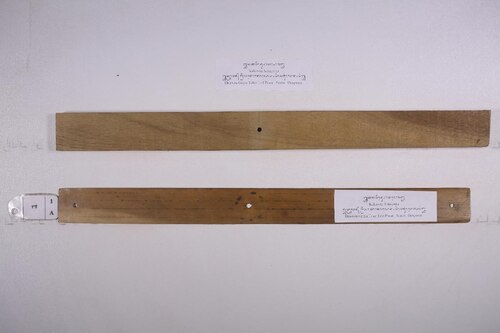
No manuscript from Tantular’s own time survives. Like most Old Javanese literature, the Sutasoma reached us through Bali, which kept close cultural ties with Majapahit and continued to copy its literature after Java’s courts became Muslim. Nearly all known copies are Balinese, written in Balinese script on strips of lontar palm leaf and, in more recent times, on paper. Because palm leaves decay in the tropics, the text survived only by being copied again and again. One Balinese-script lontar of the Sutasoma, for example, is kept in the Sonobudoyo Museum in Yogyakarta.
In Bali the Sutasoma is still regarded as one of the major kakawin. It is chanted, translated line by line into Balinese and discussed in reading clubs (sekaa bebasan), and episodes from it are performed in the shadow-puppet theatre. The philologist Stuart Robson observed that Balinese readers chose the Ramayana for the beauty of its language and the Sutasoma as the most significant from a religious point of view.
A landmark of modern scholarship was Soewito Santoso’s edition with English translation, Sutasoma: A Study in Javanese Wajrayana (1975). Kate O’Brien published a new English translation and study in 2008, and Dwi Woro Retno Mastuti and Hastho Bramantyo an Indonesian translation in 2009. Jacob Ensink studied both the Cantakaparwa version (1967) and Sutasoma’s teaching to the three creatures (1974), and Zoetmulder’s Kalangwan (1974) remains the standard survey.
Modern editions and translations rest on different selections of Balinese manuscripts, so many details of wording, and therefore of interpretation, remain open.
Intermediate
Meanwhile in the world
Majapahit was born out of an encounter with China. In 1289 Kublai Khan’s envoy Meng Qi demanded submission from Kṛtanagara, who had him disfigured and sent back. The Yuan fleet of 1292–1293 found Kṛtanagara already dead; his son-in-law Raden Wijaya used it against his rival, then drove it out and founded Majapahit. Historians have also noted that Kṛtanagara and Kublai patronised similar forms of tantric Buddhism. Kate O’Brien even proposed reading the Sutasoma as an allegory in which Sutasoma stands for Kṛtanagara and Purusada for Kublai Khan, an intriguing but unproven hypothesis.
During the years when Tantular was probably writing, Majapahit was dealing with a new Chinese dynasty. The Ming Veritable Records note envoys from the king of Java presenting tribute in October 1370. In November 1380 the Hongwu emperor sent home a Javanese envoy with a proclamation rebuking the kings of Java and San-fo-qi (Palembang in Sumatra) for having lured a Chinese envoy away and killed him, an episode connected with Majapahit’s assertion of power over Palembang in the late 1370s. Hayam Wuruk’s court, so inward-looking in its poetry, was part of a maritime world reaching to China.
The Sutasoma story itself links Java to the wider Buddhist world. It is attested in Pāli and Sanskrit texts, in Chinese translations and in images at Ajanta, at Pagan in Burma and at Borobudur. How these versions are connected is not documented, but by choosing a tale told across Buddhist Asia and reshaping it, so that the Indian bodhisattva who keeps his word became a cosmic Buddha who reconciles Shiva and the Buddha, Tantular placed his poem within that shared tradition.
The Javanese idea of two religions sharing one summit also lived on. In Bali, Shaiva and Buddhist priests still serve the same Hindu community today, an arrangement with roots in the Hindu-Buddhist courts of Java.
Advanced
Different perspectives
Syncretism or coexistence? Older scholarship often spoke of a single “Shiva-Buddha religion” in which the two faiths merged, and some art historians describe the equation of the five Buddhas with the forms of Shiva as the merging of Hinduism and Buddhism into one religious system. Other specialists disagree. The Indologist Jan Gonda and the Indonesian scholar Haryati Soebadio described a “coalition”: the two traditions identified their highest principles but kept separate priests, rituals and temples. Thomas Hunter argued that Kṛtanagara’s identification as Shiva-Buddha aimed at politico-religious hegemony rather than a fused religion, and Andrea Acri has challenged the whole notion of “Javanese syncretism”, stressing a long coexistence in which Shaivism remained dominant.
Equality or Buddhist superiority? The poem calls itself a Buddhist story, its hero is the Buddha, and the Shaiva powers, Rudra and Kāla, are the ones who submit. Zoetmulder and later Zuriati saw this as a Buddhist victory, even while explaining the famous stanza as a statement that the two paths lead to the same goal. Others read the ending as reconciliation rather than conquest: Shiva’s fury is calmed, not destroyed. The poem may combine inclusiveness with a ranking that puts its own tradition first.
Political readings. Aoyama interprets the move from the Arjunawijaya, a story of royal force, to the Sutasoma, a story of mercy and royal intermarriage, as the poet’s proposal for peace at a time of growing rivalry in the royal family. O’Brien’s allegory linking Purusada with Kublai Khan is another political reading. Popular and educational writing sometimes goes further, saying that Hayam Wuruk commissioned the poem to stop open conflict between Hindus and Buddhists. That story is not drawn from the poem or from the specialist studies cited here, and it should be treated as a modern interpretation.
The nationalist reading of the motto. For the founders of Indonesia the phrase expressed a vision of a plural nation, and the state has taught it in that broad sense. Read in context, the stanza is plainly theological, and the education scholar Mohammad Imam Farisi notes that the modern motto also serves the state’s cultural policy. Edy Sedyawati, on the other hand, saw the Majapahit formulations themselves as creative answers to the problem of managing religious diversity in a state, so that the modern use can be seen as extending the poem’s spirit rather than betraying it. Interviews in Bali and Java show that ordinary readers, priests and puppeteers still interpret both the story and the motto in many different ways.
Advanced
Evidence and method: reading an undated poem
The text is known mainly from Balinese copies made centuries after its composition, so every edition must choose between variant readings; even the famous stanza is quoted with slightly different readings in modern publications. Translators differ, too: in “tan hana dharma mangrwa”, dharma can be understood as truth, teaching or religion. Santoso rendered the phrase “there is no duality in Truth”, and Indonesian versions often say “there is no truth that is two”. Both express non-duality, but the choice of word for dharma can colour how readers understand the passage.
Dating depends on a chain of inferences. The upper limit of 1389 comes from the king’s death, the lower limit of 1365 from the assumed priority of the Nagarakretagama, and a tighter range in the late 1370s or 1380s from Supomo’s dating of the Arjunawijaya together with the assumption that it came first. Each link can be questioned.
Source criticism is a second method: Aoyama’s comparison of Indian, Chinese and Javanese versions showed how the Pāli plot became a Javanese story, while Ensink and others have studied the doctrinal passages and their tantric Buddhist ideas of non-duality.
Finally, the poem must be read alongside inscriptions, temple reliefs, the Nagarakretagama and later Balinese practice, each with its own point of view. Kakawin represent the outlook of royal and priestly elites; they cannot tell us how ordinary people in fourteenth-century Java lived their religion.
Key ideas
- Compassion over force
- Sutasoma wins by spiritual power, mercy and self-sacrifice rather than by killing; even the man-eater and the god Kāla are converted, not destroyed.
- Non-duality
- A tantric Buddhist idea that apparent opposites are ultimately one; the poem applies it to Shiva and the Buddha, and to the roles of Buddha and king.
- Bhinneka tunggal ika
- “Different, yet one”: in the poem, the identity of Shaiva and Buddhist truth; in modern Indonesia, the unity of a diverse nation.
- The Buddha as king
- Sutasoma is both an incarnation of the Buddha and a ruler, an ideal that joined spiritual authority and kingship at the Majapahit court.
- Javanization
- Tantular took an Indian Jātaka plot and rebuilt it with new episodes, Shaiva figures and Javanese court values, creating an essentially new work.
- Poetry as court culture
- Like the Nagarakretagama, the Sutasoma was written by a Buddhist for a royal patron and reflects the ideals of the elite rather than everyday life.
Records
- c. 800 CE — Borobudur is built in Central Java; its Jātakamālā reliefs include the Sutasoma story.
- 1293 — Raden Wijaya founds Majapahit after defeating his rival with, and then expelling, a Yuan expedition.
- 1350 — Hayam Wuruk becomes king with the regnal name Rājasanagara.
- 1364 — Death of the chief minister Gajah Mada.
- 1365 — Prapañca completes the Nagarakretagama (Deśawarṇana); the usual lower limit for dating the Sutasoma.
- 1370 — Envoys from the king of Java present tribute at the Ming court.
- c. 1374 — Tantular composes the Arjunawijaya (dated c. 1374–1379 by S. Supomo), probably before the Sutasoma.
- 1389 — Death of Hayam Wuruk; the latest likely date for the Sutasoma.
- 1405 — The Regreg war between branches of the royal family begins (1405–1406).
- 1945 — Mohammad Yamin brings the phrase Bhinneka Tunggal Ika into the debates on Indonesian independence.
- 1975 — Soewito Santoso publishes his edition of the poem with an English translation.
- 2000 — Article 36A of the amended Constitution names Bhinneka Tunggal Ika as the motto on the state emblem.
Glossary
- Kakawin
- Old Javanese court poetry in four-line stanzas using Indian metres of long and short syllables.
- Guru and laghu
- Heavy (long) and light (short) syllables, the building blocks of kakawin metre.
- Canto (pupuh)
- A section of a kakawin written in a single metre; the Sutasoma has 148.
- Lontar
- A manuscript written on strips of dried leaf of the lontar palm, the usual book form in Bali.
- Bodhisattva
- A being on the path to becoming a Buddha who acts out of compassion for others.
- Jātaka
- A story of one of the Buddha’s former lives; the Sutasoma tale is Jātaka no. 537 in the Pāli collection.
- Jina
- “Victor”, a title of the Buddha; Jinatwa means the truth or nature of the Buddha.
- Kāla
- A fearsome god of time and death associated with Shiva; Purusada vows to offer him a hundred kings, but Kāla demands Sutasoma instead.
- Dharma
- Teaching, law or ultimate truth; “tan hana dharma mangrwa” says this truth is not two.
- Cantakaparwa
- A later Old Javanese compendium of myths and lore that contains an abridged prose version of the Sutasoma story.
Questions and answers
Is Sutasoma a real person?
No. He is a legendary hero from Buddhist stories about the Buddha’s former lives. The poet Tantular and the kings he served were real.
Was Purusada a real king?
No. He is a character from the old Indian Buddhist tale, where the man-eater is called Kalmāṣapāda or Saudāsa. One modern scholar has suggested he might also hint at Kublai Khan, but that is only a hypothesis.
Does “Bhinneka Tunggal Ika” really mean “Unity in Diversity”?
Word for word it means “different, it is one”, or “different, yet one”. In the poem it says that Shiva and the Buddha are one at the level of ultimate truth. “Unity in Diversity” is the modern national rendering.
When exactly was the poem written?
We do not know the year. It was written under Hayam Wuruk, who died in 1389, and is usually dated between 1365 and 1389; if it came after Tantular’s Arjunawijaya, it probably dates from the late 1370s or 1380s.
Is the Sutasoma a Hindu or a Buddhist text?
It calls itself a Buddhist story and its hero is the Buddha, but it is full of Hindu gods and argues that Shaiva and Buddhist truth are one. Scholars disagree on how far this means equality or a Buddhist hierarchy.
How does it relate to the Nagarakretagama?
Both are Old Javanese kakawin by Buddhist poets of Hayam Wuruk’s court. The Nagarakretagama (1365) describes real events and places, while the Sutasoma retells a legend; both express the idea of a combined Shiva-Buddha.
Sources and further reading
- Kakawin Sutasoma. Wikipedia
- Toru Aoyama, The Reception and Transformation of the Sutasoma Story in Old Javanese Literature (古ジャワ文学におけるスタソーマ物語の受容と変容). Southeast Asian Studies (Tōnan Ajia Kenkyū) 24(1): 3–17, Kyoto University, 1986
- Toru Aoyama, From the Arjunawijaya to the Sutasoma: Two Old Javanese Texts in their Historical Context. The Toyo Gakuho 77(1–2): 1–33, Toyo Bunko, 1995
- Andrea Acri, Review of Kate O’Brien, Sutasoma: The Ancient Tale of a Buddha-Prince from 14th Century Java (2008). Archipel 86 (via Persée), 2013
- Edy Sedyawati, Bhinneka Tunggal Ika Tan Hana Dharma Mangrwa. Warta Hindu Dharma no. 529 (Parisada Hindu Dharma Indonesia), 2011
- Andrea Acri and Aleksandra Wenta, A Buddhist Bhairava? Kṛtanagara’s Tantric Buddhism in Transregional Perspective. Entangled Religions 13(7), 2022
- Thomas M. Hunter, The Body of the King: Reappraising Singhasari Period Syncretism. Journal of Southeast Asian Studies 38(1): 27–53, 2007
- Andrea Acri, Revisiting the Cult of “Śiva-Buddha” in Java and Bali. In D. C. Lammerts (ed.), Buddhist Dynamics in Premodern and Early Modern Southeast Asia, ISEAS, pp. 261–282, 2015
- A. H. Aghababian, The Kakawin Sutasoma: A Look at “Bhinneka Tunggal Ika” and Perceptions of the Text’s Religious Implications. Inquiries Journal 7(9), 2015
- Mohammad Imam Farisi, Bhinneka Tunggal Ika [Unity in Diversity]: From Dynastic Policy to Classroom Practice. Journal of Social Science Education 13(1), 2014
- Bhinneka Tunggal Ika. Wikipedia
- Pasal Bhinneka Tunggal Ika dalam UUD 1945. Hukumonline
- Peraturan Pemerintah Nomor 66 Tahun 1951 tentang Lambang Negara. Jaringan Dokumentasi dan Informasi Hukum Nasional (BPHN)
- Mahāsutasoma-jātaka (story of Sutasoma and Kalmāṣapāda), from Lamotte’s Traité de la grande vertu de sagesse, English translation. Wisdom Library
- Ānandajoti Bhikkhu, Jātaka, the Buddha’s past birth-stories: Level 1 balustrade, top, at Borobudur (panels 116–119, Sutasoma). Photo Dharma
- Jatakamala. Wikipedia
- Ānandajoti Bhikkhu, Old Javanese Metres. Ancient Buddhist Texts
- Majapahit. Wikipedia
- Mongol invasion of Java. Wikipedia
- Geoff Wade (trans.), Ming Shi-lu, Hong-wu year 3, month 9, day 17 (6 October 1370): envoys from the king of Java. Southeast Asia in the Ming Shi-lu, NUS Press
- Geoff Wade (trans.), Ming Shi-lu, Hong-wu year 13, month 10, day 20 (23 November 1380): proclamation to the kings of Java and San-fo-qi. Southeast Asia in the Ming Shi-lu, NUS Press
- The Lontar Manuscript of Sutasoma. Museum Sonobudoyo, Yogyakarta
- Soewito Santoso (ed. and trans.), Sutasoma: A Study in Javanese Wajrayana (Śata-piṭaka Series 213). International Academy of Indian Culture, New Delhi, 1975
- P. J. Zoetmulder, Kalangwan: A Survey of Old Javanese Literature. Martinus Nijhoff, The Hague, 1974
- Kate O’Brien (trans.), Sutasoma: The Ancient Tale of a Buddha-Prince from 14th Century Java by the Poet Mpu Tantular. Orchid Press, Bangkok, 2008
- J. Ensink, Sutasoma’s Teaching to Gajavaktra, the Snake and the Tigress (Tantular, Sutasoma Kakavin 38.1–42.4). Bijdragen tot de Taal-, Land- en Volkenkunde 130(2/3): 195–226, 1974
- Kakawin. Wikipedia
- Nagarakretagama. Wikipedia
- Kelurak inscription. Wikipedia
- Zuriati, Review of Mpu Tantular, Kakawin Sutasoma, trans. Dwi Woro Retno Mastuti and Hastho Bramantyo (2009), and Cok Sawitri, Sutasoma (2009). Wacana, Journal of the Humanities of Indonesia 12(2), 2010
- J. Ensink, On the Old-Javanese Cantakaparwa and its Tale of Sutasoma. Martinus Nijhoff, The Hague, 1967
Related
- Nagarakretagama (Desawarnana)Old Javanese kakawin poem completed in 1365 by the Buddhist poet Prapañca, praising King Hayam Wuruk and describing the Majapahit court, royal tours and realm.
- BorobudurLarge Buddhist monument in Central Java, built around the eighth and ninth centuries.
- PrambananNinth-century Hindu temple complex dedicated to Shiva, Vishnu and Brahma, the largest of ancient Java, famous for its 47-metre central tower and Ramayana reliefs.
- Siddhartha Gautama (the Buddha)Founder of Buddhism, who taught a path to liberation from suffering on the Ganges plain. His dates are disputed.
- RamayanaA Sanskrit epic about Rama, Sita and their exile, preserved in many versions across South and Southeast Asia.
- MahabharataA vast Sanskrit epic centered on a conflict between related royal families, with the Bhagavad Gita among its parts.
Written with AI assistance from the published sources listed above, and revised as new research appears.