Start at the top for an easy introduction. Go further down for more detail and scholarship.
- Easy
- Intermediate
- Advanced
For young readers
Imagine a storybook so big that it is about ten times longer than the Iliad and the Odyssey put together. That is the Mahabharata, one of the longest poems ever made. People in India have been telling it for more than two thousand years.
The story is about two groups of cousins. The five Pandava brothers are brave, clever and good at different things: one is honest, one is super strong, and one is the best archer in the world. Their hundred cousins, the Kauravas, are jealous and want the whole kingdom for themselves.
The Kauravas trick the Pandavas in a game of dice, and the brothers have to leave home and live in the forest for thirteen years. When they come back and ask for their land, the cousins refuse. So a huge war begins on a field called Kurukshetra, and it lasts eighteen days.
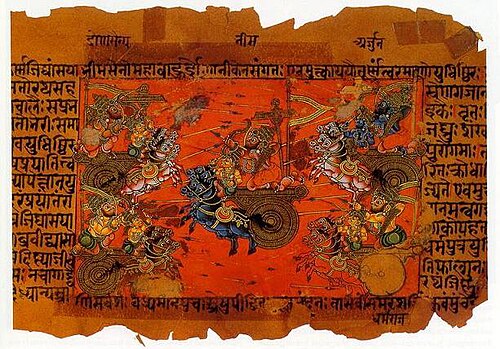
Just before the battle, the archer Arjuna feels sick with sadness, because he does not want to fight his own family and teachers. His friend Krishna, who is really a god, talks with him about duty, courage and what really matters in life. That conversation is called the Bhagavad Gita, and many people still read it today.
The Mahabharata does not have a simple happy ending. Even the winners feel sad about everything they lost. That is why people keep thinking about it: it asks big questions about fairness, friendship and making good choices.
At a glance
- Period of formation
- c. 400 BCE – c. 400 CE (mostly c. 200 BCE – 200 CE); exact dates debated
- Region
- Northern South Asia; the story is set around the Ganges–Yamuna region and the plain of Kurukshetra (Haryana, India)
- Language
- Sanskrit (epic Sanskrit, mostly in the śloka verse meter)
- Form
- Epic poem (itihāsa) in 18 books (parvans), with a supplement, the Harivaṃśa
- Length
- Traditionally ‘100,000 verses’; the Pune Critical Edition prints roughly 89,000 verse units counted with some prose
- Attributed author
- The sage Vyāsa (Kṛṣṇa Dvaipāyana) in tradition; scholars see many generations of composers and editors
- Famous part
- The Bhagavad Gītā (Book 6, chapters 23–40 of the Critical Edition)
- Significance
- A foundational text of Hindu traditions and a shared story-world across South and Southeast Asia
Easy
What is the Mahabharata?
The Mahabharata (Sanskrit Mahābhārata, often explained as ‘the great story of the descendants of Bharata’) is an epic poem composed in Sanskrit, the classical language of ancient India. It tells how a royal family, the Kurus, split into two rival branches and destroyed itself in a catastrophic war. Around this main story it gathers hundreds of other tales, sermons, dialogues on law and ethics, genealogies and descriptions of holy places.
Indian tradition classifies it as itihāsa, a word usually translated as ‘history’ or ‘so it was’: a narrative of the past that is also a guide for the present. The epic says about itself that ‘what is found here may be found elsewhere, but what is not here is nowhere’, a boast that expresses its ambition to contain the whole world of human experience.
Traditionally the poem is said to have 100,000 verses, which makes it several times longer than the Greek Iliad and Odyssey combined. Most verses are in the śloka, a flexible meter of two lines of sixteen syllables each. Its best-known portion, the Bhagavad Gītā (‘Song of the Lord’), is a dialogue of about 700 verses that became one of the most influential religious and philosophical texts in the world.
Easy
The story: cousins, a dice game and an eighteen-day war
The Kuru king Pāṇḍu and his blind elder brother Dhṛtarāṣṭra have very different families. Pāṇḍu’s five sons, the Pāṇḍavas, are fathered by gods through his wives Kuntī and Mādrī: righteous Yudhiṣṭhira, mighty Bhīma, the archer Arjuna, and the twins Nakula and Sahadeva. Dhṛtarāṣṭra and his wife Gāndhārī have a hundred sons, the Kauravas, led by Duryodhana. Their great-uncle Bhīṣma, who has sworn never to marry or claim the throne, and their teacher Droṇa try to hold the family together.
Rivalry grows into hatred. Duryodhana tries to burn the Pāṇḍavas alive in a house of lacquer; they escape, and Arjuna wins the princess Draupadī in an archery contest, after which she becomes the shared wife of all five brothers. The Pāṇḍavas build a splendid capital, Indraprastha. Then Duryodhana’s uncle Śakuni challenges Yudhiṣṭhira to a rigged game of dice. Yudhiṣṭhira gambles away his wealth, his kingdom, his brothers, himself and finally Draupadī, who is dragged into the assembly hall and humiliated. Her question — could a man who had already lost himself still stake his wife? — is left painfully unresolved by the elders present.
The Pāṇḍavas are sent into exile for twelve years in the forest and a thirteenth year in disguise. When they return, Duryodhana refuses to give back even five villages. Kṛṣṇa, the prince of the Yādavas and a divine figure, tries to negotiate peace and fails. The armies meet on the plain of Kurukshetra, and for eighteen days almost every warrior of the age is killed. Bhīṣma falls pierced by arrows; Droṇa is tricked into laying down his weapons by a half-truth about his son’s death; Karṇa — secretly the Pāṇḍavas’ elder half-brother — dies when his chariot wheel sticks in the mud; Duryodhana is struck on the thigh against the rules of fair combat.
The victory is bitter. On the last night Droṇa’s son Aśvatthāman massacres the sleeping Pāṇḍava camp. Yudhiṣṭhira becomes king, but grief overwhelms him, and the dying Bhīṣma instructs him at great length on kingship, law and liberation. Decades later Kṛṣṇa’s own clan destroys itself, and the Pāṇḍavas walk towards the Himalayas on their final journey. Only Yudhiṣṭhira, accompanied by a faithful dog, reaches heaven alive — where one last test awaits him.
Easy
How the epic is built: eighteen books and stories inside stories
The poem is divided into eighteen parvans (books): Ādi (Beginning), Sabhā (Assembly Hall), Āraṇyaka or Vana (Forest), Virāṭa, Udyoga (Preparations), Bhīṣma, Droṇa, Karṇa, Śalya, Sauptika (Night Attack), Strī (Women), Śānti (Peace), Anuśāsana (Instruction), Āśvamedhika (Horse Sacrifice), Āśramavāsika (Hermitage), Mausala (Clubs), Mahāprasthānika (Great Departure) and Svargārohaṇa (Ascent to Heaven). A long appendix, the Harivaṃśa, tells the life of Kṛṣṇa.
The epic is also a frame story, a narrative that contains other narratives. The bard Ugraśravas recites it to sages in the Naimiṣa forest; he repeats what Vaiśampāyana, a pupil of Vyāsa, recited to King Janamejaya, the great-grandson of Arjuna, at a snake sacrifice. Inside the main story, characters constantly tell each other stories, so the reader moves through several levels of narration at once.
Many of these embedded tales are famous in their own right: the love of Nala and Damayantī, who is separated from her husband after he loses everything at dice; Sāvitrī, who wins back her husband’s life from Yama, the god of death, by her wisdom; Śakuntalā, later retold by the poet Kālidāsa; and a compact version of the Rāma story. The ‘questions of the Yakṣa’, a riddle contest in which Yudhiṣṭhira saves his brothers by answering a spirit’s questions about life, is still widely quoted.
Intermediate
Historical context: from Kuru chiefdoms to the Gupta age
The world the epic describes looks back to the Kuru realm, a powerful polity of the late Vedic period (roughly the late second to early first millennium BCE) in the upper Ganges–Yamuna region, around modern Delhi and Haryana. Vedic texts mention the Kurus and a king Parikṣit, who in the epic is Arjuna’s grandson. Whether a real war stands behind the story is unknown; tradition dated it to the start of the Kali age, 3102 BCE, but that date comes from later astronomical reckoning, not from historical evidence.
The text as we have it took shape much later, during roughly 400 BCE to 400 CE. This was a period of enormous change: the rise of cities and kingdoms in the Ganges valley, the spread of Buddhism and Jainism, the Maurya empire (c. 320–185 BCE) and the edicts of Aśoka, invasions and kingdoms of Indo-Greeks, Śakas and Kuṣāṇas in the north-west, and finally the Gupta dynasty (from c. 320 CE). Brahmin (priestly) groups were reformulating their tradition in response to renunciant movements and new forms of kingship.
Many scholars therefore read the epic as a response to its own time as much as a memory of an older one. Its long debates on dharma — duty, law and right order — on the proper conduct of kings, and on the relation between action in the world and liberation from it can be seen as a Brahmanical answer to Buddhist and other ideas, and as a way of imagining a righteous kingship after the era of great empires. Its world was not isolated: in the same centuries the Greek writer Dio Chrysostom (c. 40–120 CE) reported that Indians sang a poetry like Homer’s, which may be an early echo of epic recitation.
Intermediate
Key ideas: dharma, fate and the ‘subtlety’ of right action
The central problem of the Mahabharata is dharma, a word that means duty, law, virtue and the order of the world. The epic repeatedly insists that dharma is ‘subtle’ (sūkṣma): good people face situations in which every choice breaks some obligation. Yudhiṣṭhira, called ‘the son of Dharma’, is truthful yet gambles away his family; Karṇa is loyal and generous yet fights for the wrong side; Bhīṣma keeps his vow and thereby stands by while injustice is done. The poem invites readers to argue rather than simply admire.
A related theme is the tension between human effort and fate or time (daiva, kāla). Characters are often told that events were destined, and yet they are held responsible for what they choose. The war itself is presented as the end of an age, and the epic’s mood after the victory is one of grief and exhaustion rather than triumph. The Indian theorist Ānandavardhana (9th century) argued that the dominant aesthetic mood (rasa) of the epic is śānta, peace or tranquillity — the calm that comes from seeing through worldly ambition.
Women’s voices are unusually forceful. Draupadī’s public question in the assembly hall, Gāndhārī’s curse of Kṛṣṇa after the death of her sons, and Kuntī’s hard choices shape the plot and open up questions about power, honour and suffering that many modern readers and writers have taken up. The epic also shows the costs of hierarchy: the tribal archer Ekalavya is made to cut off his thumb so that he cannot rival Arjuna, a scene that is now often read as a critique of caste privilege.
Intermediate
The Bhagavad Gita: a philosophy in the middle of a battlefield
In the sixth book, as the armies stand ready, Arjuna asks Kṛṣṇa, his charioteer, to drive between the lines. Seeing relatives and teachers on the other side, he lays down his bow. Kṛṣṇa’s answer, the Bhagavad Gītā, runs to eighteen chapters (Critical Edition 6.23–40; chapters 25–42 in some older printed editions). It teaches that the self (ātman) is eternal and cannot be killed, that one should perform one’s own duty (svadharma), and that action should be done without attachment to its results.
The Gita brings together several paths or disciplines (yoga): karma yoga, the discipline of action performed without selfish desire; jñāna yoga, the discipline of knowledge; and bhakti yoga, loving devotion to God. In a famous line (2.47) Kṛṣṇa says, in paraphrase, ‘Your concern is with the action alone, never with its fruits.’ In chapter 11 Kṛṣṇa reveals his cosmic form, containing all beings and devouring the warriors, to show Arjuna that time and the divine are working through events.
Because it seems to justify fighting, the Gita has been read in very different ways. Classical commentators such as Śaṅkara (c. 8th century) read it as teaching the non-duality of self and ultimate reality; Rāmānuja (11th–12th century) stressed devotion to a personal God. In modern times Bal Gangadhar Tilak read it as a call to engaged action, while Mohandas Gandhi read the battlefield as an allegory of the inner struggle and drew from it a gospel of selfless, non-violent action. Philosophers today also discuss it as a text about moral reasoning — whether duty and procedure should come before outcomes.
Intermediate
From oral performance to manuscripts and printed editions
The epic was first transmitted orally by bards (sūtas) and reciters, and it presents itself as a performance: someone always tells it to someone else. At some stage — scholars disagree about when — it was also written down, and thereafter it circulated in manuscripts copied by hand on palm leaves, birch bark and later paper, in many different scripts from Kashmir to Kerala. Its own tradition says that it grew in three stages: Jaya (‘Victory’, 8,800 verses), Bhārata (24,000 verses) and Mahābhārata (100,000 verses). Scholars treat this as a traditional account rather than a documented history, but it reflects a real awareness that the text expanded.
No two manuscripts are identical. Broadly they fall into a Northern and a Southern recension (families of manuscripts), each with sub-versions in different scripts. The Southern manuscripts in particular tend to be longer. A well-known story says that the god Gaṇeśa wrote the epic down as Vyāsa dictated; this episode is found only in some manuscripts, and the Critical Edition places it in the notes rather than the main text.
Between 1919 and 1966 the Bhandarkar Oriental Research Institute in Pune produced the Critical Edition, directed first by V. S. Sukthankar. Editors collated 1,259 manuscripts to reconstruct the oldest form of the text that the surviving witnesses allow, and published it in 19 volumes with a detailed critical apparatus listing variants and later additions. It is now the standard reference for scholars, although it is a reconstruction and was never read as such by any historical community.
Intermediate
Influence across Asia and the modern world
The Mahabharata became a shared story-world rather than a single book. It was retold in almost every language of South Asia: the Kannada poet Pampa composed his Vikramārjuna Vijaya in 941; there are Telugu, Tamil, Malayalam, Bengali, Marathi and many other versions, and countless folk and ritual performances such as the Terukkūttu theatre of Tamil Nadu and the Kathakali dance-drama of Kerala. Temples and sculpture across India depict its scenes, and Draupadī is worshipped as a goddess in parts of South India.
The epic travelled with trade, religion and courts. In Java, the Old Javanese Kakawin Bhāratayuddha (1157) retold the war, and Mahabharata characters are still central to the wayang shadow-puppet theatre of Indonesia; versions also reached Bali, Cambodia and Thailand. At the Mughal court, the emperor Akbar ordered a Persian translation, the Razmnāma (‘Book of War’), produced in the 1580s by Hindu and Muslim scholars working together and richly illustrated.
In the modern period the Gita reached Europe in Charles Wilkins’s English translation of 1785, influencing figures from the German Romantics to the American Transcendentalists. Kisari Mohan Ganguli published the first complete English prose translation (1883–1896). B. R. Chopra’s Hindi television series (1988–1990) drew enormous audiences in India, and Peter Brook’s nine-hour stage adaptation (1985) brought the story to international theatre. Novelists, poets, feminist writers and Dalit authors continue to rewrite the epic from the perspectives of Draupadī, Karṇa, Ekalavya and others.
Advanced
Scholarly debates: dating, authorship and how the text grew
Dating is necessarily approximate. The grammarian Pāṇini (usually placed around the 4th century BCE) knows names such as Vāsudeva, Arjuna and Yudhiṣṭhira, which suggests that the heroes were already known; but this does not prove that the epic existed in anything like its present form. At the other end, a copper-plate land grant of the ruler Śarvanātha dated to 533–534 CE refers to the Mahabharata as a ‘collection of 100,000 verses’, so the large text was established by then. Most scholars place the main phase of composition between about the 3rd century BCE and the 3rd or 4th century CE.
How the text grew is the central controversy. Nineteenth- and early twentieth-century European scholars such as E. W. Hopkins followed an ‘analytic’ approach: they tried to peel away didactic and religious layers to reach an original heroic war poem, often assuming a gradual accumulation over many centuries. Others, beginning with Joseph Dahlmann in the 1890s and later Madeleine Biardeau, took a ‘synthetic’ approach, treating the epic as a deliberately integrated work whose teachings are part of its design. Georges Dumézil read its characters in terms of Indo-European mythological structures.
More recently Alf Hiltebeitel has argued that the Sanskrit epic was composed as a written work by a group of Brahmin authors over a relatively short span (he suggests roughly the mid-2nd century BCE to the turn of the Common Era), while James L. Fitzgerald and others have proposed that a major written redaction took place in response to the political situation after the Mauryas and was later expanded. Scholars of oral tradition stress, in contrast, that performance and textual transmission continued to interact for centuries. These positions are not fully reconcilable, and the question remains open.
The attribution to Vyāsa is also a matter of interpretation. Within the story, Vyāsa is both the author and the biological grandfather of the Kauravas and Pāṇḍavas, so the poem folds its author into its own plot. Scholars generally regard ‘Vyāsa’ (a name that can mean ‘arranger’ or ‘compiler’) as a traditional figure standing for a long collective process, while many believers regard him as a historical sage.
Advanced
Primary sources and evidence: manuscripts, inscriptions and archaeology
The textual evidence is almost entirely in manuscripts, and because palm leaf and birch bark decay in South Asia’s climate, most surviving copies are only a few centuries old; a small number of fragments are much earlier. The Critical Edition’s apparatus is therefore the main tool for seeing how passages vary across regions and which episodes appear only in some traditions. Commentaries, above all that of Nīlakaṇṭha Caturdhara (17th century), whose text formed the basis of the widely used ‘vulgate’ printed editions, show how pre-modern readers understood the work.
External evidence includes inscriptions (like the 6th-century Śarvanātha grant), references in other Sanskrit, Buddhist and Jain literature, and translations such as the Persian Razmnāma. Sculptural depictions of epic scenes on temples in South and Southeast Asia show which episodes were popular at particular times and places.
Archaeology can illuminate the setting but not confirm the war. In the 1950s the archaeologist B. B. Lal excavated at Hastinapura and associated Painted Grey Ware sites (an Iron Age culture of the northern plains, c. 1200–600 BCE) with places named in the epic. His interpretation has been influential in India but is contested, since pottery cannot identify people or events described in a text composed centuries later. Claims that the war can be dated precisely from astronomical references in the epic are likewise not accepted by most historians, because the relevant passages are internally inconsistent and may be later insertions.
Advanced
Methodological notes: reading a living text
Readers should distinguish between several ‘Mahabharatas’: the reconstructed Critical Edition, the vulgate of Nīlakaṇṭha, regional recensions in Sanskrit, vernacular retellings, and oral and performance traditions. None is simply the ‘original’. Many modern debates depend on which version one reads: in the Critical Edition, for example, Draupadī’s garments are miraculously renewed during the attempt to disrobe her, but the popular scene in which she calls on Kṛṣṇa to save her is largely absent, and the Gaṇeśa episode is missing altogether.
For the same reason, translations should be chosen with care. J. A. B. van Buitenen began a scholarly translation of the Critical Edition for the University of Chicago Press (books 1–5, 1973–1978), later continued by other scholars; Ganguli’s complete translation follows the vulgate. Abridged retellings are good introductions but often smooth out the ethical ambiguity that is central to the epic.
Finally, the Mahabharata is a sacred and living text for millions of people. Historical-critical study (asking when and how passages were composed) and devotional reading (asking what a passage teaches) are different activities with different aims. Good scholarship can describe both without dismissing either, and recognises that questions about the epic’s history are often politically sensitive in modern South Asia.
Key ideas
- Dharma
- Duty, law, virtue and cosmic order. The epic shows how hard it is to know what dharma requires in a real crisis, calling it ‘subtle’.
- Itihāsa
- The traditional category of the epic: a narrative of ‘how it was’ that is meant to teach about life, kingship and ultimate goals.
- Karma yoga
- The Gita’s teaching that one should act according to one’s duty without clinging to the rewards of action.
- Bhakti
- Loving devotion to God. In the Gita, Kṛṣṇa invites Arjuna to surrender to him, an idea that shaped later devotional movements.
- Fate and time (daiva, kāla)
- The sense that events are driven by destiny and the turning of ages, even as people remain responsible for their choices.
- Frame narrative
- A story told within a story. The epic is recited by one bard to an audience, who heard it from another reciter, and characters tell further tales inside it.
- Śānta rasa
- The aesthetic mood of peace or tranquillity, which the theorist Ānandavardhana considered the epic’s main emotional effect.
Records
- c. 1200 BCE — Kuru polity emerges in the upper Ganges–Yamuna region (c. 1200–900 BCE); later tradition sets the epic’s world here.
- c. 400 BCE — Oldest layers of the epic tradition probably taking shape (c. 400 BCE).
- c. 350 BCE — The grammarian Pāṇini mentions names such as Vāsudeva, Arjuna and Yudhiṣṭhira (c. 4th century BCE).
- c. 200 BCE — Main phase of composition and expansion (c. 200 BCE – 200 CE), in the age after the Maurya empire.
- c. 350 CE — The epic reaches nearly its present scope by the early Gupta period (c. 4th century CE).
- c. 533 CE — Copper-plate grant of Śarvanātha refers to the Mahabharata as a ‘collection of 100,000 verses’ (533–534 CE).
- 941 CE — Pampa composes the Kannada Vikramārjuna Vijaya, an early vernacular retelling.
- 1157 — Old Javanese Kakawin Bhāratayuddha retells the war in Java.
- c. 1584 — Persian translation, the Razmnāma, prepared at Akbar’s court (c. 1584–1586).
- 1785 — Charles Wilkins publishes the first English translation of the Bhagavad Gita.
- 1919 — Bhandarkar Oriental Research Institute in Pune begins the Critical Edition (completed 1966).
- 1988 — B. R. Chopra’s Mahabharat television series begins airing in India (1988–1990).
Glossary
- Sanskrit
- The classical language of ancient and medieval India, used for religious, literary and scholarly texts.
- Parvan
- A ‘book’ or major division of the epic. The Mahabharata has eighteen.
- Śloka
- The most common Sanskrit epic meter: two lines, each of sixteen syllables.
- Pāṇḍavas
- The five sons of King Pāṇḍu: Yudhiṣṭhira, Bhīma, Arjuna, Nakula and Sahadeva.
- Kauravas
- The hundred sons of the blind king Dhṛtarāṣṭra, led by Duryodhana.
- Recension
- A family of manuscripts that share a distinctive version of a text, such as the Northern and Southern recensions of the epic.
- Critical edition
- An edition that compares many manuscripts to reconstruct the earliest recoverable form of a text, and records variants in notes.
- Vulgate
- The commonly used traditional text; for the Mahabharata, usually the version with Nīlakaṇṭha’s 17th-century commentary.
- Harivaṃśa
- ‘The lineage of Hari (Kṛṣṇa)’, an appendix to the epic about Kṛṣṇa’s life and ancestry.
- Wayang
- Indonesian puppet and shadow theatre, which often performs stories from the Mahabharata.
Questions and answers
Who wrote the Mahabharata?
Tradition says the sage Vyāsa composed it, and Vyāsa also appears as a character. Historians think it was composed, expanded and edited by many poets and scholars over several centuries, roughly between 400 BCE and 400 CE.
Is the Mahabharata a true story?
The epic is set in the region of the ancient Kuru kingdom, which really existed, but there is no independent historical or archaeological evidence for the war as described. Many people regard it as sacred history; scholars treat it as a literary and religious work that may preserve distant memories of the Kuru past.
How long is the Mahabharata?
Tradition speaks of 100,000 verses. The Pune Critical Edition, which removes many later additions, is shorter but is still one of the longest poems in the world — far longer than the Iliad and Odyssey together.
What is the difference between the Mahabharata and the Bhagavad Gita?
The Bhagavad Gita is a part of the Mahabharata: an 18-chapter dialogue between Arjuna and Kṛṣṇa in the sixth book, just before the war. It is often printed and read as a separate scripture.
What is the difference between the Mahabharata and the Ramayana?
They are the two great Sanskrit epics. The Ramayana follows the prince Rāma and the rescue of his wife Sītā and presents a clearer ideal of virtue; the Mahabharata is much longer, deals with a family war and is famous for its moral ambiguity. The Mahabharata even contains a short version of the Rāma story.
Why did Draupadī have five husbands?
In the story, Arjuna wins her, but because of a misunderstanding their mother Kuntī tells the brothers to share what they have brought home. The epic gives several further justifications, including stories of earlier lives. Scholars have debated whether this reflects a historical custom, a mythological pattern, or a deliberately provocative narrative choice.
Which edition should researchers cite?
Most scholarly work cites the Critical Edition (Bhandarkar Oriental Research Institute, Pune, 1933–1966 for the main text) by book, chapter and verse, while noting when a passage is only found in the vulgate or in particular manuscripts.
Sources and further reading
- Mahabharata. Wikipedia
- Bhagavad Gita. Wikipedia
- The Bhagavad Gītā. Internet Encyclopedia of Philosophy
- Bhandarkar Oriental Research Institute. Wikipedia
- Kurukshetra War. Wikipedia
- Harivamsa. Wikipedia
- Razmnama. Wikipedia
- J. A. B. van Buitenen, The Mahābhārata (translation, vols. 1–3). University of Chicago Press, 1973–1978
- E. Washburn Hopkins, The Great Epic of India: Its Character and Origin. Charles Scribner’s Sons, 1901
Related
- RamayanaA Sanskrit epic about Rama, Sita and their exile, preserved in many versions across South and Southeast Asia.
- RigvedaThe oldest collection of Vedic Sanskrit hymns, handed down orally for centuries before it was written down.
- Early UpanishadsTexts that ask what the self (ātman) is and how it relates to ultimate reality (brahman) — a foundation of later Indian philosophy.
- HomerThe poet tradition credits with the Iliad and the Odyssey, the founding epics of Greek literature. Whether one person composed both is debated.
- KālidāsaA Sanskrit poet and playwright whose works are landmarks of classical Indian literature.
- Adi ShankaraIndian philosopher associated with Advaita Vedanta, which teaches the ultimate unity of the self and brahman.
Written with AI assistance from the published sources listed above, and revised as new research appears.