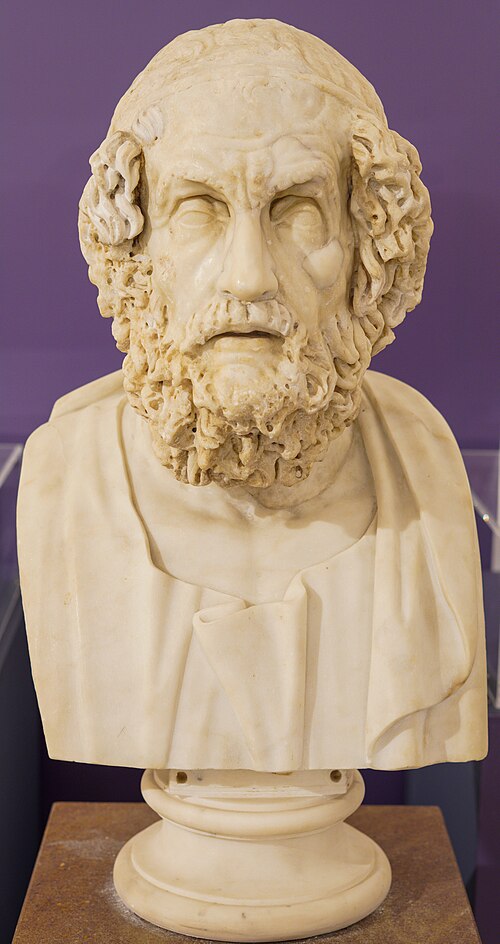
Start at the top for an easy introduction. Go further down for more detail and scholarship.
- Easy
- Intermediate
- Advanced
For young readers
Imagine a time before books, when stories were not read but sung. In ancient Greece, singers travelled from town to town, sat by the fire at feasts, and sang long stories about heroes, gods and battles—all from memory, sometimes for hours or even days.
The most famous of these singers was called Homer. The Greeks said he was blind and came from the eastern shore of the Aegean Sea, where Turkey is today. He was believed to have made two giant poems: the Iliad and the Odyssey. Each is so long that it fills a thick book.
The Iliad is about the Trojan War. The Greeks have been attacking the city of Troy for ten years. Their greatest warrior, Achilles, gets so angry with his own king that he refuses to fight—and terrible things happen because of it. It is a poem about anger, friendship, grief and the question of what makes a hero.
The Odyssey tells what happens after the war. The clever hero Odysseus tries to sail home to his wife Penelope and son Telemachus, but it takes him ten years! He meets a one-eyed giant, a witch who turns men into pigs, singing monsters called Sirens, and much more. Meanwhile, at home, rude men are trying to take over his house.
Here is a mystery: we do not really know who Homer was. Some experts think one great poet made both poems; others think they grew out of the songs of many singers over hundreds of years. Either way, these poems are among the oldest stories in Europe, and people all over the world still read them nearly 3,000 years later.
At a glance
- Dates
- Unknown; the poems probably took roughly their present shape in the late 8th or 7th century BCE
- Place
- Traditionally Ionia, on the Aegean coast of Asia Minor; Smyrna and Chios had the strongest ancient claims
- Language
- Homeric Greek, an artificial literary language mainly Ionic with Aeolic and older forms
- Form
- Epic poetry in dactylic hexameter, originally composed for oral performance
- Works
- Iliad (15,693 lines) and Odyssey (about 12,100 lines), each later divided into 24 books
- Other works once credited
- The Homeric Hymns, the comic Batrachomyomachia (Battle of Frogs and Mice) and others, now considered later works by other poets
- Key debate
- The “Homeric Question”: who composed the poems, how, when, and whether one poet made both
- Significance
- The foundational poems of Greek literature and education, and a model for epic poetry worldwide
Easy
Who was Homer?
For the ancient Greeks, Homer was simply “the poet”. They credited him with the Iliad and the Odyssey, the two oldest and most admired works of Greek literature, and treated these poems as the basis of education, the source of shared stories about gods and heroes, and a model of language and morality.
Yet almost nothing about Homer’s life is known. Ancient “Lives of Homer” were written centuries after the poems and contradict each other. Several cities claimed to be his birthplace, including Smyrna (modern İzmir), Chios, Colophon, Cyme, Argos and Athens. Most accounts say he was blind and that he died on the small island of Ios. On Chios a family or guild of reciters called the Homeridae (“sons of Homer”) claimed to descend from him.
Modern scholars regard these biographies as legend. Some doubt that a single historical Homer ever existed; others think a brilliant poet, or perhaps two, shaped the poems we have out of a long tradition. The name “Homer” is best understood as the label the Greeks attached to the source of their greatest epics.
Easy
The Iliad: the wrath of Achilles
The Iliad is set in the tenth year of the Greek siege of Troy (Ilion, which gives the poem its name). It does not tell the whole war. Instead it focuses on a few weeks and one theme, announced in its first word: mēnis, “wrath”. The opening line may be translated: “Sing, goddess, the wrath of Achilles, son of Peleus.”
The story begins when Agamemnon, leader of the Greek army, takes the captive woman Briseis from Achilles, the greatest Greek warrior. Deeply insulted, Achilles withdraws from the fighting and asks his mother, the sea-goddess Thetis, to persuade Zeus to let the Trojans win until the Greeks realise how much they need him. The Trojans, led by Hector, son of King Priam, drive the Greeks back to their ships.
Achilles’ closest friend, Patroclus, puts on Achilles’ armour and goes into battle, and Hector kills him. Mad with grief, Achilles returns to the fight, kills Hector and drags his body behind his chariot. In the final book, old King Priam goes secretly by night to Achilles’ tent to beg for his son’s body. The two enemies weep together for their losses, and Achilles gives the body back. The poem ends not with the fall of Troy but with Hector’s funeral.
The Iliad is full of battle, but it is not simply a celebration of war. It shows the suffering of both sides with great sympathy: Hector saying goodbye to his wife Andromache and baby son, the grief of parents, and the knowledge that Troy will fall and its women will be enslaved.
Easy
The Odyssey: the long way home
The Odyssey follows Odysseus, king of the island of Ithaca, famous for his cunning (it was he who thought of the Trojan Horse). It opens: “Tell me, Muse, of the man of many turns.” Ten years after the fall of Troy he still has not returned home. His wife Penelope is surrounded by suitors who feast in his palace and press her to remarry, and his son Telemachus sets out to seek news of his father.
The poem is cleverly structured. We first meet Odysseus on the island of the nymph Calypso, who has kept him for seven years. Released at last, he is shipwrecked and reaches the land of the Phaeacians, where he tells the story of his adventures: the Cyclops Polyphemus, the witch-goddess Circe, a journey to the land of the dead, the Sirens, the monsters Scylla and Charybdis, and the loss of all his companions after they eat the sacred cattle of the Sun.
The Phaeacians bring him home to Ithaca. Disguised as a beggar, he tests the loyalty of his household, is recognised by his old dog Argos and his nurse Eurycleia, and with Telemachus and loyal servants kills the suitors. Penelope, as clever as her husband, tests him with the secret of their marriage bed before accepting that he has truly come home.
Where the Iliad is a poem of war and fate, the Odyssey is a poem of survival, hospitality, disguise and homecoming. It is also the ancestor of countless adventure stories.
Intermediate
How the poems were made: oral poetry
Both epics are composed in dactylic hexameter, a six-beat line based on patterns of long and short syllables. They are full of repeated phrases: “rosy-fingered Dawn”, “swift-footed Achilles”, “the wine-dark sea”. These repetitions puzzled readers for centuries.
The American scholar Milman Parry explained them in his doctoral work in Paris in 1928. He showed that the epithets and phrases form a precise system: for each hero or object, in each grammatical case, there is usually one phrase that fits a given part of the line. Such a system could not be the invention of one poet; it had been built up over generations by singers who composed while performing.
To test the idea, Parry and his assistant Albert Lord recorded living oral poets in Yugoslavia in the 1930s. These singers, who performed with a one-stringed instrument called the gusle, could compose long songs in performance using formulas and typical scenes; one of them, Avdo Međedović, produced a song of more than 12,000 lines. Lord later set out the theory in The Singer of Tales (1960).
The oral-formulaic theory transformed the study of Homer. It showed that the Iliad and Odyssey come from a tradition of singers (aoidoi) like Phemius and Demodocus, who appear in the Odyssey itself. It also raised a new question: if the tradition was oral, how and when did these particular poems come to be written down?
Intermediate
The world behind the poems
The poems describe a heroic age of powerful kings, rich palaces and bronze weapons. This picture partly remembers the Mycenaean civilisation of the Late Bronze Age (about 1600–1100 BCE), whose palaces at Mycenae, Pylos and elsewhere collapsed around 1200 BCE. Some details are genuinely old, such as the boar’s-tusk helmet described in the Iliad, which archaeologists have found in Mycenaean graves, and the Catalogue of Ships, which lists places that may reflect an early geography.
But much in the poems belongs to later times. Heroes cremate their dead, as was common in the early Iron Age, and the social world of the poems, with its chieftains, assemblies and gift-exchange, resembles the Greek world of the 10th to 8th centuries BCE. The poems are best seen as a mixture of memories and practices from many periods, blended by generations of singers.
The 8th century BCE, when the poems probably began to take their final form, was a time of rapid change in Greece. Population grew, new city-states formed, Greeks founded settlements across the Mediterranean, the great sanctuaries at Olympia and Delphi flourished, and the Greeks adopted the Phoenician alphabet. Writing made it possible, for the first time, to record long poems.
Was there a Trojan War? The site of Troy is generally identified with the mound of Hisarlik in north-west Turkey, excavated by Heinrich Schliemann from the 1870s and later by Carl Blegen and Manfred Korfmann. It was a substantial city that was destroyed more than once in the Late Bronze Age. Hittite texts mention a place called Wilusa, which many scholars connect with (W)ilios. Whether a real war lies behind the legend remains debated.
Intermediate
Ideas and themes
Honour and mortality. Homeric heroes seek kleos, “glory”, the fame that will be sung after they die. Achilles knows he must choose between a long, obscure life and a short, glorious one. The Iliad asks what glory is worth when set against friendship, love and life itself; in the Odyssey, the ghost of Achilles says he would rather be a poor labourer on earth than king of all the dead.
Gods and humans. The Olympian gods take sides, quarrel and intervene, sometimes comically. Yet fate and the limits of human life remain serious. The poems show a world in which humans are responsible for their choices even while the gods act through them.
Hospitality (xenia). The Odyssey is built around the rules of guest-friendship: how hosts should welcome strangers and how guests should behave. The Cyclops, who eats his guests, and the suitors, who abuse Odysseus’ house, are the great violators of these rules, and both are punished.
Intelligence and identity. Odysseus survives by cunning, disguise and storytelling. The Odyssey is full of lies and tests, and it asks how a person can be recognised: by a scar, a bow, the secret of a bed. The poem’s interest in storytelling itself—Odysseus narrates four books of his own adventures—has made it central to modern discussions of narrative.
Intermediate
From song to book: how the text survived
According to an ancient tradition, the Athenian ruler Peisistratus (d. 528/527 BCE) had the Homeric poems collected and put in order, and the poems were recited in full at the Panathenaic festival in Athens. Scholars debate whether this “Peisistratean recension” was a real event, but Athens clearly played a major role in the poems’ early written history.
In the Hellenistic period, scholars at the Library of Alexandria—Zenodotus of Ephesus, Aristophanes of Byzantium and above all Aristarchus of Samothrace—compared copies, marked lines they suspected, and established a standard text. The division of each poem into 24 books, labelled with the letters of the Greek alphabet, is usually credited to them.
Hundreds of papyrus fragments of Homer, mostly from Roman Egypt, show that the poems were the most copied texts in the Greek world. The most important medieval manuscript of the Iliad is the Venetus A, written in the 10th century and now in Venice, whose margins preserve notes (scholia) from the Alexandrian scholars. It was published by the French scholar Jean-Baptiste-Gaspard d’Ansse de Villoison in 1788.
Knowledge of Greek faded in western Europe during the Middle Ages, although Homer was always read in Byzantium. In the 14th century Petrarch and Boccaccio sponsored a Latin translation, and in 1488 Demetrios Chalkokondyles published the first printed edition (editio princeps) in Florence.
Intermediate
Influence and legacy
In ancient Greece Homer was the foundation of education. Children learned to read with his verses, and his stories provided the shared background for tragedy, vase painting and philosophy. Herodotus said that Homer and Hesiod had given the Greeks their picture of the gods. Philosophers argued with him: Xenophanes criticised the poets for showing gods who steal and deceive, and Plato’s Socrates wanted to banish or censor poetry in his ideal city, while Aristotle in his Poetics treated Homer as the model of unified plot.
The Romans adopted Homer as a classic. The first known Latin literary work was a translation of the Odyssey by Livius Andronicus in the 3rd century BCE, and Virgil’s Aeneid consciously reworks both poems, its first half an Odyssey of wandering and its second half an Iliad of war.
In modern times Homer has been translated into most of the world’s languages. Writers have repeatedly returned to him: James Joyce’s Ulysses (1922) retells the Odyssey as a single day in Dublin; the Caribbean poet Derek Walcott’s Omeros (1990) transposes Homeric themes to St Lucia; recent translators and novelists have given new voice to the women of the poems, such as Penelope and the enslaved Trojan women.
Outside Europe, Homer is often compared with other great epic traditions—the Epic of Gilgamesh, the Mahabharata and Ramayana, the Shahnameh—which share features such as traditional oral composition, heroic codes and the relationship between gods and mortals. Comparing them helps show both what is universal in epic and what is distinctive about the Greek poems.
Advanced
The Homeric Question
The “Homeric Question” is the cluster of problems about who composed the poems, how and when. Already in antiquity some scholars, called the chorizontes (“separators”), argued that the Iliad and Odyssey were by different poets. The modern debate began with Friedrich August Wolf’s Prolegomena ad Homerum (1795), which argued that the poems were assembled from shorter, originally oral songs and that writing came late.
Nineteenth-century “Analysts” tried to separate the poems into layers by different authors, pointing to inconsistencies such as a character killed in one book who reappears later. “Unitarians” replied that such slips are natural in a long work and that the poems show a single controlling design. The debate remained unresolved.
Parry and Lord shifted the terms of the debate: the poems are traditional, oral-derived compositions. But this raised new questions. Albert Lord and later scholars such as Richard Janko proposed that a master singer dictated the poems to a scribe, producing a fixed text around the 8th century. Gregory Nagy proposed an “evolutionary model”, in which the poems gradually became fixed through centuries of performance, with no single moment of composition. Others, such as Martin West, emphasised a literate poet working with writing in the 7th century.
Most scholars today accept that the poems grew from a long oral tradition and that each has a remarkable unity of design. Many think the Odyssey is somewhat later than the Iliad. Whether “Homer” was one person, two, or the name of a tradition remains open.
Advanced
Dating and evidence
Ancient dates for Homer varied widely. Herodotus placed Homer about 400 years before his own time, that is, around the mid-9th century BCE; others made Homer a contemporary of the Trojan War. Modern dating relies on internal and external evidence.
Linguistic evidence: Homeric Greek combines forms from different periods and dialects. Statistical studies of the rate at which certain older forms were replaced by newer ones, such as those by Richard Janko, suggest an order Iliad, Odyssey, then Hesiod, and a date in the 8th century for the Iliad. Critics note that an artificial poetic language can preserve old forms deliberately, so such methods give relative rather than exact dates.
Archaeological and historical evidence: references to objects and practices, such as armour, temples and cult images, have been used to argue for 8th- or 7th-century dates, with Martin West arguing for the mid-7th century for the Iliad. An inscribed clay cup from Pithekoussai in Italy (“Nestor’s Cup”, late 8th century BCE) jokes about “the cup of Nestor”, and some scholars read it as an allusion to a famous cup in the Iliad, though this is debated. Scenes from the Trojan saga in vase painting become common in the 7th century BCE.
Textual evidence: quotations by 5th- and 4th-century authors, early papyri with “wild” extra lines, and the Alexandrian scholia show that the text was still somewhat fluid before the Hellenistic period, which supports models that allow gradual fixation. The honest conclusion is that the poems probably reached something like their current shape between about 750 and 650 BCE, with continuing adjustments afterwards.
Advanced
How reliable are the ancient biographies?
The surviving ancient Lives of Homer, including one falsely attributed to Herodotus and the Contest of Homer and Hesiod, date in their present form to the Roman period, though they draw on older material. They tell of Homer’s birth, travels, blindness, poetry and death, often by inventing episodes from lines in the poems.
Blindness is a good example. In the Odyssey the blind singer Demodocus is loved by the Muse, and the Homeric Hymn to Apollo ends with a “blind man who lives in rocky Chios”; ancient readers took these as self-portraits of Homer. Modern scholars see the blind bard as a traditional image of the inspired poet, not biographical evidence.
The competing birthplace claims also reveal more about later Greek cities than about Homer: claiming Homer brought prestige. The name itself has been explained by ancient and modern writers as meaning “hostage” or connected with a word for “blind”, but these etymologies are uncertain.
Methodologically, the lives are valuable as evidence for how Greeks imagined poets and for the reception of Homer, but they cannot be used to reconstruct a life. What can be said with confidence is only that by the 6th century BCE the Greeks associated the Iliad and Odyssey with a revered poet named Homer, whom they placed in Ionia.
Key ideas
- Epic
- A long narrative poem about heroes and gods, composed in an elevated style; the Iliad and Odyssey are Europe’s oldest surviving examples.
- Oral-formulaic composition
- Composing in performance with traditional phrases and scenes, as Parry and Lord showed for Homer and South Slavic singers.
- Kleos
- Glory or fame “that is heard”, which heroes win through great deeds and which lives on in song.
- Xenia
- Guest-friendship: the sacred duties between host and guest that structure much of the Odyssey.
- Mēnis (wrath)
- The first word of the Iliad; Achilles’ anger and its consequences drive the poem.
- Nostos
- Homecoming, the theme of the Odyssey and of other Greek poems about heroes returning from Troy.
- The Homeric Question
- The long scholarly debate about the authorship, composition, dating and transmission of the poems.
Records
- c. 1200 BCE — Collapse of Mycenaean palace civilisation; Troy (Hisarlik) is destroyed in the Late Bronze Age.
- 1184 BCE — Date calculated by the Hellenistic scholar Eratosthenes for the fall of Troy.
- c. 900 BCE — Greek oral epic tradition develops during the early Iron Age.
- c. 750 BCE — The Greeks adopt the alphabet; the Iliad and Odyssey begin to take their final form (to c. 650 BCE).
- c. 720 BCE — “Nestor’s Cup” at Pithekoussai carries an inscription joking about the cup of Nestor.
- c. 550 BCE — In Athens, the poems are traditionally said to have been organised under Peisistratus and recited at the Panathenaia.
- c. 150 BCE — Aristarchus of Samothrace works on his edition of Homer in Alexandria.
- c. 950 CE — The Venetus A manuscript of the Iliad is copied in Byzantium.
- 1488 — Demetrios Chalkokondyles publishes the first printed edition of Homer in Florence.
- 1795 — Friedrich August Wolf’s Prolegomena ad Homerum opens the modern Homeric Question.
- 1873 — Heinrich Schliemann announces the discovery of “Priam’s Treasure” at Hisarlik.
- 1928 — Milman Parry’s doctoral thesis on the traditional epithet in Homer is published in Paris.
Glossary
- Dactylic hexameter
- The six-foot metre of Greek epic, based on long and short syllables.
- Epithet
- A descriptive word or phrase attached to a name, such as “swift-footed Achilles”.
- Rhapsode
- A professional performer who recited Homeric poetry, often at festivals.
- Aoidos
- A singer-poet who composed and sang epic songs, like Demodocus in the Odyssey.
- Ionia
- The central west coast of Asia Minor and nearby islands, settled by Greeks speaking the Ionic dialect.
- Mycenaean
- The Greek civilisation of the Late Bronze Age, named after the city of Mycenae.
- Scholia
- Ancient and medieval notes written in the margins of manuscripts.
- Editio princeps
- The first printed edition of a text.
- Analysts and Unitarians
- Two 19th- and 20th-century camps: those who divided the poems into layers, and those who defended their unity.
- Hisarlik
- The mound in north-west Turkey generally identified with ancient Troy.
Questions and answers
Was Homer really blind?
We do not know. The ancient stories about his blindness were probably based on blind singers in the poems and on the image of the inspired poet.
Did Homer write the poems down himself?
Possibly not. Some scholars think he dictated them; others think the poems were fixed gradually over generations of performance.
Is the Trojan War real?
Troy was a real city, destroyed in the Late Bronze Age, but whether a war like the one in the poems happened is still debated.
Why are there so many repeated phrases?
They are traditional formulas that helped singers compose long poems in performance, as Milman Parry demonstrated.
Which is older, the Iliad or the Odyssey?
Most scholars think the Iliad is somewhat older, based on language and content, though they may be close in date.
Did the same poet compose both epics?
Opinion is divided. Some ancient and modern scholars see different poets; others see one master behind both.
How do the Iliad and Odyssey compare with other epics?
Like the Epic of Gilgamesh and the Indian epics, they come from long traditions, and they share themes of heroism, mortality and divine power.
Sources and further reading
- Homer. Wikipedia
- Homeric Question. Wikipedia
- Iliad. Wikipedia
- Odyssey. Wikipedia
- Milman Parry. Wikipedia
- Oral-formulaic composition. Wikipedia
- Venetus A. Wikipedia
- Homer, Homer, Iliad (Greek text). Perseus Digital Library, Tufts University
- Homer, Homer, Odyssey (Greek text). Perseus Digital Library, Tufts University
- Albert B. Lord, The Singer of Tales. Harvard University Press, 1960
Related
- VirgilA Roman poet whose Aeneid became one of the most influential works of Latin literature.
- Epic of GilgameshA king's friendship with Enkidu and his search for immortality, assembled from earlier Sumerian poems into a Babylonian epic.
- MahabharataA vast Sanskrit epic centered on a conflict between related royal families, with the Bhagavad Gita among its parts.
- PlatoStudent of Socrates and founder of the Academy. His dialogues remain a cornerstone of Western philosophy.
- UlyssesJames Joyce’s novel follows a day in Dublin through changing styles and the inner lives of its characters.
- Founding of RomeRome's traditional founding is dated to 753 BCE, but the date and the story of Romulus belong to later legend.
Written with AI assistance from the published sources listed above, and revised as new research appears.