Start at the top for an easy introduction. Go further down for more detail and scholarship.
- Easy
- Intermediate
- Advanced
For young readers
Long ago, China was not one country. A royal family called the Zhou was supposed to be in charge, but after they had to move their capital east in 770 BCE, they became weak. Hundreds of lords ruled their own little states, like pieces of a big jigsaw puzzle that nobody could hold together.
At first the strongest lord would act like a team captain, called a hegemon. He called meetings, made the others promise to protect the Zhou king, and led them in war. Two big states, Jin in the north and Chu in the south, took turns being the strongest and fought famous battles.
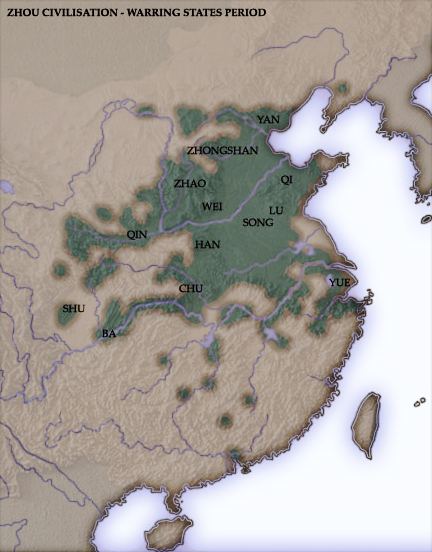
Over time, the big states swallowed the small ones. By about 400 BCE only seven large states were left: Qin, Chu, Qi, Yan, Han, Zhao and Wei. This time is called the Warring States period, because these seven fought almost all the time.
Wars got bigger and bigger. Instead of a few nobles riding in chariots, kings called up huge armies of farmers carrying iron swords and crossbows. Kings also hired clever advisers to make their states richer and stronger, and thinkers such as Confucius, Mozi and Mencius argued about how to stop all the fighting.
In the end, the state of Qin in the far west became the strongest. Between 230 and 221 BCE its king conquered the other six states one after another. He called himself the First Emperor, and from then on people in China came to think that the country should be united under one ruler.
At a glance
- Period
- Spring and Autumn period (c. 770 – c. 481 BCE) and Warring States period (c. 475 – 221 BCE); the dividing line is placed anywhere from 481 to 403 BCE
- Place
- The Yellow River and Yangtze valleys of what is now northern, central and eastern China
- Main powers
- Spring and Autumn: Jin, Chu, Qi, Qin, and later Wu and Yue. Warring States: the ‘seven heroes’ Qin, Chu, Qi, Yan, Han, Zhao and Wei
- Famous battles
- Chengpu (632), Bi (597), Yanling (575), Boju (506), Jinyang (455–453), Guiling (354–353), Maling (342), Yique (293), Changping (262–260), Handan (259–257 BCE)
- Outcome
- Qin conquered Han, Zhao, Yan, Wei, Chu and Qi between 230 and 221 BCE and founded the Qin empire
- Scale
- Armies grew from chariot forces of a few hundred vehicles to reported hosts of hundreds of thousands; ancient casualty figures are traditional and disputed
- Main sources
- Spring and Autumn Annals and the Zuo zhuan; Guoyu; Zhanguo ce (Strategies of the Warring States); Sima Qian's Shiji (c. 100 BCE)
The war day by day
Press play to follow the campaign on the map. Markers are battles and events; arrows are recorded marches.
Phases
After the Zhou court moved east to Luoyi in 771/770 BCE, royal power faded and strong lords led alliances as ‘hegemons’. Duke Huan of Qi was the first; then Jin and Chu fought a century-long rivalry over the small states between them, at Chengpu (632), Bi (597) and Yanling (575), until a truce in 546 BCE. Dates in this campaign are years only.
Spring and Autumn period (English Wikipedia)Battle of Chengpu (English Wikipedia)Battle of Bi (English Wikipedia)Battle of Yanling (English Wikipedia)Partition of Jin (English Wikipedia)
Latest events
Playback shows what the sources confirm up to each date — it does not mean something happened every day. Dates known only to the month or year are shown as periods; dashed arrows only link two confirmed points.
Easy
What were these wars?
“The wars of the Spring and Autumn and Warring States periods” is not the name of one war. It is a way of describing more than five centuries of fighting among the states of ancient China, from the moment the Zhou kings lost their power in 771/770 BCE to the moment the state of Qin conquered its last rival in 221 BCE.
Chinese historians divide this long age into two parts. The Spring and Autumn period takes its name from the Spring and Autumn Annals, a chronicle kept in the state of Lu that covers the years 722 to 481 BCE. The Warring States period takes its name from a later collection of speeches and stories, the Zhanguo ce, or ‘Strategies of the Warring States’. Both names were fixed long after the events, during the Han dynasty.
Across these centuries the political map changed completely. At the start there were well over a hundred states, from great powers to tiny city-states. By around 400 BCE only seven major states remained, and by 221 BCE only one. War was the machine that did this sorting, and it transformed armies, governments and ideas along the way.
This page follows the main line of that story: the age of the hegemons, the wars of Wu and Yue in the southeast, the break-up of the great state of Jin, the reforms that prepared states for total war, the great battles of the third century BCE, and Qin's final wars of unification.
Easy
A king without power and a world of states
Around 1046 BCE the Zhou dynasty had overthrown the Shang and given lands to relatives and allies, who ruled them as lords under the Zhou king. For about two centuries this worked. Then, in 771 BCE, an attack by the Quanrong people together with rebellious lords destroyed the Zhou capital in the west, near modern Xi'an, and killed King You. His son was set up as king at Luoyi, near modern Luoyang, in the east. This began the Eastern Zhou.
The Zhou king kept his title as ‘Son of Heaven’ and his ritual prestige. He kept the calendar and made sacrifices, and nobody dared to replace him for centuries. But he no longer had the land or armies to command the lords. Real power passed to the rulers of the larger states.
Those states sat in a rough ring around the old centre. Jin lay in the north, in modern Shanxi. Qi held the rich coast of modern Shandong. Qin guarded the western valley of the Wei River, the old Zhou homeland. Chu spread across the middle Yangtze and was seen by the northern states as only half part of their world; its rulers called themselves kings from 704 BCE. Later, Wu and Yue rose on the lower Yangtze, and Yan held the far north around modern Beijing.
Between the great powers lay many smaller states, such as Zheng, Song, Lu, Chen and Cai. Much of the fighting of the Spring and Autumn period was really about who would control them.
Easy
How war changed: from chariots to mass armies
In the early Spring and Autumn period, battle was an affair of nobles. Aristocrats fought from horse-drawn chariots, with foot soldiers around them, and campaigns were often short and bound by rules of honour.
By the Warring States period this had changed. States counted and registered their farmers and called them up as infantry. Iron came into wider use for weapons and tools, crossbows and swords spread, and states built long defensive walls along their borders. In 307 BCE King Wuling of Zhao ordered his men to adopt ‘nomadic dress and horse archery’, creating the first official Chinese cavalry.
Campaigns now lasted months or even years. Armies of tens of thousands, and reportedly hundreds of thousands, had to be fed and supplied, which required the new bureaucracies that the states were building. The World History Encyclopedia sums this up: armies of over 200,000 infantry became common, compared with about 10,000 in earlier times.
Commanders also changed. Birth alone was no longer enough; generals were expected to know strategy, and military treatises appeared. The Art of War attributed to Sun Tzu, the Wuzi, the Wei Liaozi and the Methods of the Sima all belong to this age.
Intermediate
The hegemons and the long duel of Jin and Chu
Soon after the move east, a new system appeared. The strongest ruler was recognised as hegemon (ba). He presided over meetings of lords, led joint campaigns against outsiders, and in theory protected the Zhou king. The first was Duke Huan of Qi (r. 685–643 BCE), who with his minister Guan Zhong reorganised his state and rallied others under the slogan of honouring the king and driving off the ‘barbarians’. Tradition lists five hegemons, though the lists differ.
After Qi weakened, the central question became whether Jin or Chu would dominate the small states between the Yellow River and the Yangtze. Duke Wen of Jin, who came to power in 636 BCE after long years in exile, built on his father's reforms, which had centralised Jin and absorbed many small states and neighbouring peoples. In 632 BCE he defeated Chu and its allies at Chengpu, with Qi and Qin contingents fighting on his side, and the Zhou king recognised him as first among the lords.
Chu struck back. King Zhuang of Chu pushed his borders far north of the Yangtze; at one point his army stood outside the royal capital and he asked about the weight of the Nine Cauldrons, the symbols of royal authority, as if he might carry them off. In 597 BCE he defeated a divided Jin army at Bi near the Yellow River and became the leading power. In 575 BCE Jin won again at Yanling, and these battles checked Chu's advance into the north.
Exhausted, the great powers tried diplomacy: a disarmament conference in 579 BCE and a truce between Jin and Chu in 546 BCE. The truces did not last, but the old idea of a single hegemon protecting the Zhou king was fading. Meanwhile, inside Jin, Lu and other states, powerful noble families were taking power from their own rulers.
Intermediate
Wu and Yue: revenge in the southeast
In 584 BCE Jin sent envoys to Wu, a state on the lower Yangtze outside the old Zhou cultural world, and supplied it with chariots and military training so that it would attack Chu from the east. The plan worked beyond expectation. In 506 BCE King Helü of Wu, with the Chu exile Wu Zixu and his brother Fugai, sailed up the Huai River, marched overland and routed the Chu army at Boju. Wu won five battles in a row and captured the Chu capital, Ying. Only when Qin sent an army to help Chu in 505 BCE did Wu withdraw.
Wu then turned on its southern neighbour, Yue. At Zuili in 496 BCE Yue defeated Wu and Helü died of his wounds. His son Fuchai took revenge at Fujiao in 494 BCE, trapped King Goujian of Yue on Mount Kuaiji, and accepted his surrender against the advice of Wu Zixu, who warned that Yue should be destroyed.
Fuchai looked north instead. He defeated Qi at Ailing in 484 BCE and in 482 BCE led his best troops to a meeting of lords at Huangchi to claim leadership. While he was away, Goujian attacked Wu, killed the crown prince and took the capital. Yue won again at Lize in 478 BCE, besieged the Wu capital for about three years, and in 473 BCE destroyed Wu; Fuchai killed himself. Goujian was recognised as the last hegemon.
The story of Goujian, who according to legend slept on brushwood and tasted bitter gall so as never to forget his humiliation, became one of the most famous tales of patience and revenge in East Asia.
Intermediate
The partition of Jin and the birth of the Warring States
Jin, the greatest northern power, had a peculiar weakness: its dukes had pushed aside their own relatives and relied on ministerial families, who gradually took over the state. By the late sixth century six families dominated Jin; a civil war from 497 BCE eliminated two of them, leaving the Zhi, Zhao, Han and Wei houses.
The head of the Zhi house demanded land from the others. Han and Wei gave in, but Zhao Xiangzi refused and withdrew to the Jin city of Jinyang, near modern Taiyuan. From 455 BCE the Zhi, Han and Wei armies besieged Jinyang for about two years and diverted its water. Zhao's envoy finally persuaded Han and Wei that they would be next. They switched sides, turned a great stream of water against the Zhi camp, and in 453 BCE the Zhi house was annihilated.
Han, Zhao and Wei then divided Jin between them. In 403 BCE King Weilie of Zhou recognised their rulers as marquises, and the ‘Three Jin’ became states in their own right. At about the same time, in Qi, the Tian family replaced the old ruling house. These events are the usual markers of the start of the Warring States period.
From then on seven large states dominated: Qin in the west, Qi in the east, Chu in the south, Yan in the north, and Han, Zhao and Wei in the centre. Smaller states survived for a while between them, but one by one they were absorbed.
Intermediate
Reforming for war: Wei, Qi and Shang Yang's Qin
In the fourth century BCE the states competed to rebuild themselves. Rulers hired wandering experts, who offered plans for government, diplomacy and war and could be rewarded with high office or punished horribly if their advice failed.
Wei, in the centre, was the first great power of the new age, but its central position meant enemies on every side. In 354 BCE Wei besieged Handan, the capital of Zhao. Qi's commanders Tian Ji and Sun Bin did not march to Handan; they threatened the Wei capital Daliang instead, and when the Wei general Pang Juan hurried home they ambushed him at Guiling. The trick became the proverb ‘besiege Wei to rescue Zhao’. In 342 BCE, when Wei attacked Han, Sun Bin again marched on Daliang, then retreated while lighting fewer cooking fires each day so that Pang Juan believed his army was deserting. Pang Juan chased him into an ambush at Maling and died there. Wei never recovered its leading position.
In the west, Qin had been seen as a backward state. From 359 BCE the minister Shang Yang carried out two rounds of reforms, in 356 and 350 BCE. He imposed a harsh, uniform legal code and made families responsible for one another's crimes; created ranks that ordinary men could earn by success in war; divided the land into counties run by appointed officials; reformed land allocation and taxation; and moved the capital to Xianyang. He was killed in 338 BCE after his patron died, but his system survived.
The result was a state organised for ‘farming and fighting’. Qin gained a strong frontier behind the Hangu Pass and room to expand, taking the rich lands of Shu in the Sichuan Basin in 316 BCE. Its rulers took the title of king in 325 BCE, and the other rulers soon did the same.
Intermediate
Vertical and horizontal alliances
As Qin grew stronger, the other states tried to combine against it in ‘vertical alliances’ (hezong), stretching north to south across the map. Qin answered with ‘horizontal alliances’ (lianheng), drawing individual states to its side. Persuaders such as Su Qin and Zhang Yi are remembered as the architects of these two policies, and their speeches, real or imagined, fill the Zhanguo ce.
The first great alliance attacked Qin in 318 BCE but broke up after failing at the Hangu Pass. Later coalitions fared little better, because each member feared its neighbours as much as it feared Qin. In 293 BCE the Qin general Bai Qi exploited exactly this distrust at Yique, defeating the Han and Wei armies one after the other.
The most dramatic coalition war was aimed not at Qin but at Qi. In 284 BCE Yue Yi of Yan led the armies of Yan, Qin, Zhao, Han and Wei against Qi, won a great battle west of the Ji River and took the Qi capital Linzi. Within months Yan held more than seventy Qi cities; only Ju and Jimo held out. At Jimo the commander Tian Dan resisted for five years and in 279 BCE broke the besiegers and restored Qi, but Qi was left badly weakened.
In 278 BCE Qin forces under Bai Qi captured Ying, the Chu capital, forcing Chu to give up its territories west of the Han River. By the 260s Qin's chief adviser Fan Ju was urging a policy of ‘befriending distant states and attacking nearby ones’.
Intermediate
Changping and Handan: the decisive contest
By the mid-third century only Zhao seemed able to stand up to Qin. The clash came over Shangdang, a Han territory in the Taihang Mountains that Qin had cut off. Rather than surrender to Qin, its governor Feng Ting offered it to Zhao, and Zhao accepted. From 262 BCE Qin and Zhao armies faced each other near Changping, northwest of modern Gaoping.
The Zhao general Lian Po built fortified lines and refused open battle, hoping to wear down Qin's long supply routes. Qin spread rumours that he was old and timid, and the Zhao king replaced him with Zhao Kuo, a young man famous for reciting military texts but without experience. Qin secretly sent Bai Qi to command. When Zhao Kuo attacked in 260 BCE, Bai Qi's forces fell back, cut the Zhao army's supply lines and surrounded it. After weeks of starvation, Zhao Kuo was killed trying to break out and his army surrendered.
According to the Shiji, written about 150 years later, Bai Qi had nearly all the prisoners killed, allegedly buried alive, releasing only 240 young soldiers; it gives about 450,000 Zhao dead in the whole campaign and about 250,000 Qin dead. These are traditional figures, and historians debate them (see below). Scattered bones and mass graves have been found at the site.
Qin followed up by besieging the Zhao capital Handan from 259 BCE, but Zhao had rebuilt its alliances. Lord Pingyuan won help from Chu, and Lord Xinling of Wei, using a stolen tally to seize command of the Wei army, marched to the city's relief. In 257 BCE the relief armies and a sortie from Handan broke the siege, Qin's worst defeat since Shang Yang's reforms. Even so, in 256 BCE Qin took West Zhou and the ritual Nine Cauldrons, ending the Zhou royal line.
Intermediate
Qin conquers the six states (230–221 BCE)
In 238 BCE the young King Zheng of Qin took full power. With advisers such as Li Si he pursued a plan to take the remaining states one at a time. In 230 BCE a Qin army crossed the Yellow River and took Zheng, the capital of Han, the weakest state; Han became a Qin commandery.
Zhao, led by the able general Li Mu, resisted until Qin bribed a Zhao minister to accuse Li Mu of treason. Li Mu was removed and killed, and in 228 BCE Qin took Handan. An attempt by Jing Ke, sent by the crown prince of Yan, to assassinate the King of Qin failed and gave Qin its reason to attack Yan: in 226 BCE Qin won on the Yi River and took the Yan capital Ji, and in 222 BCE it captured the last Yan king in Liaodong. In 225 BCE Wang Ben flooded Daliang, the Wei capital, with water from the Yellow River and a canal, and Wei surrendered.
Chu, the largest state, was the hardest. Li Xin's invasion with 200,000 men was destroyed by the Chu general Xiang Yan. The king then gave the veteran Wang Jian the 600,000 men he had asked for. Wang Jian waited in fortified camps until the Chu army withdrew, routed it at Qinan in 224 BCE, and took the capital Shouchun in 223 BCE. Qi, whose chief minister had been bribed to keep it out of every alliance, surrendered without a fight when a Qin army reached Linzi in 221 BCE.
King Zheng took the title Shi Huangdi, ‘First Emperor’. He abolished the old fiefs, divided the empire into commanderies run by appointed officials, and moved noble families to Xianyang. The Qin dynasty itself lasted only until 206 BCE, but the Han dynasty that followed kept its unified, bureaucratic framework.
Intermediate
Memory, proverbs and ideas
These wars left a deep mark on language. ‘Besiege Wei to rescue Zhao’ (from Guiling) became one of the Thirty-Six Stratagems. Zhao Kuo's failure at Changping gave the idiom ‘talking about war on paper’ for someone good at theory and bad at practice. Goujian's ‘sleeping on brushwood and tasting gall’ is still used for patient determination.
The wars also shaped Chinese thought. The Hundred Schools of Thought, including Confucians such as Mencius and Xunzi, the Mohists, the Daoists and the Legalists, were all responding to a world of endless conflict. Mozi condemned offensive war and helped small states defend themselves; Mencius argued that a ruler who governed with benevolence would win the people without fighting; Legalists such as Shang Yang and Han Fei argued for strict laws and a state geared to agriculture and war.
Later ages read the story in different ways. Han historians, writing under the dynasty that replaced Qin, often portrayed Qin as cruel, while also presenting unification as the natural end of a bloody age. Many writers have linked the misery of these centuries to the lasting preference in Chinese political culture for a single, united state. Outside China, the name travelled too: Japanese historians called their own age of civil wars the Sengoku, ‘Warring States’, period after it.
Advanced
How large were the armies? The problem of numbers
Ancient texts give enormous figures: Qin and Chu each with a million infantry; 240,000 killed at Yique; 100,000 at Maling; about 450,000 Zhao dead at Changping; 890,000 enemy deaths attributed to Bai Qi over his career. Such numbers are repeated in modern popular histories, and even serious summaries often quote them.
Scholars such as Michael Loewe and Edward L. Shaughnessy, as summarised in the English Wikipedia article on the period, consider these figures exaggerated. Their reasons include the poor state of the records, the fact that the numbers are far larger than those of comparable societies, the Qin practice of rewarding soldiers by the number of heads taken, which encouraged inflated counts, and the interest of Han-dynasty writers in stressing the bloodiness of the age before unification. At the same time, the evidence clearly shows that warfare grew dramatically in scale and cost.
Changping is a useful test case. The Shiji figure was written about a century and a half after the battle, and the story of mass burial of prisoners is told in a highly dramatic form. Yet physical remains are real: a Tang emperor built a temple over a collection of bones, and mass graves continue to be found at the site. Archaeology can confirm large-scale killing without confirming the exact number.
Political scientists and sociologists have also used these wars to test general theories. Victoria Tin-bor Hui compared the Warring States system with early modern Europe to ask why China ended in a single empire while Europe remained divided; Edgar Kiser and Yong Cai argued that constant war drove Qin's precocious bureaucratisation, a claim criticised by Zhao Dingxin. These debates depend heavily on how far the traditional numbers and narratives can be trusted.
Advanced
Sources, dates and debates
For the Spring and Autumn period the main narrative source is the Zuo zhuan, a detailed commentary attached to the terse Spring and Autumn Annals of Lu; it was compiled in the fourth century BCE and its account ends with the partition of Jin. The Guoyu covers similar ground state by state. For the Warring States, the Zhanguo ce preserves speeches and anecdotes of persuaders, many of them literary rather than documentary. Sima Qian's Shiji, completed around 100 BCE, weaves these and other materials into a continuous history, and much of what we know about the third century BCE comes from it.
These sources disagree. Sun Tzu is named as the commander at Boju in the Shiji, but the Zuo zhuan, the earliest account, does not mention him at all. Modern summaries also disagree on details such as the year of Li Xin's defeat in Chu (224 or 225 BCE) and the commander who took Qi in 221 BCE (Li Xin in the English Wikipedia account, Wang Ben in the Chinese). Even the partition of Jin has been dated to 481, 475, 468, 453 or 403 BCE, depending on which step a historian treats as decisive; Sima Qian began the Warring States in 475 BCE, while Sima Guang's Zizhi tongjian begins with the recognition of the Three Jin in 403 BCE.
Exact dates are rare. The chronicles give years by the reigns of rulers, and sometimes months and days in local calendars that differed from state to state. Converting such dates to Western calendar months requires assumptions about each state's calendar, so modern works that give dates such as ‘May 8, 453 BC’ should be treated with caution. For this reason Terra Scripta's map of these wars shows years only.
Finally, the story is told mostly from the courts' point of view. The farmers conscripted into mass armies, the civilians of flooded cities such as Jinyang and Daliang, and the peoples of the southern and northern frontiers appear only in passing. Modern historians increasingly use archaeology, excavated texts and comparative study to recover their experience.
Key ideas
- Hegemony (ba)
- In the Spring and Autumn period the strongest lord was recognised as hegemon, leading alliances in the name of the powerless Zhou king. The system faded as the great states built their own spheres.
- Territorial consolidation
- More than a hundred states were reduced to seven and then to one. Conquest turned border lands into counties and commanderies run by appointed officials rather than hereditary lords.
- State-building for war
- Reforms such as Shang Yang's in Qin registered the population, rewarded military success with rank, and tied farming to fighting, creating states able to field and supply huge armies.
- Mass infantry warfare
- Chariot battles of nobles gave way to conscripted armies with iron weapons, crossbows and later cavalry, fighting campaigns that could last years.
- Alliance diplomacy
- Vertical alliances against Qin and Qin's horizontal counter-alliances show a genuine multi-state system, often compared with the European balance of power.
- The ideal of unity
- The suffering of these centuries and Qin's unification helped make a single, centralised empire the normal and desired form of Chinese statehood.
Records
- 771 BCE — The Western Zhou capital is destroyed; the Zhou court re-establishes itself at Luoyi in the east (771/770 BCE).
- 632 BCE — Battle of Chengpu: Jin defeats Chu and Duke Wen becomes hegemon.
- 597 BCE — Battle of Bi: King Zhuang of Chu defeats Jin.
- 506 BCE — Battle of Boju: Wu defeats Chu and captures the Chu capital Ying.
- 473 BCE — Yue destroys Wu after a siege of about three years.
- 453 BCE — The siege of Jinyang ends with the destruction of the Zhi house by Zhao, Han and Wei.
- 403 BCE — The Zhou king recognises Han, Zhao and Wei as states.
- 356 BCE — Shang Yang's first reforms in Qin (the second follow in 350 BCE).
- 342 BCE — Battle of Maling: Qi destroys the Wei army and Pang Juan dies.
- 284 BCE — A Yan-led coalition takes the Qi capital Linzi.
- 260 BCE — Battle of Changping ends with the surrender and mass killing of the Zhao army.
- 221 BCE — Qi surrenders; King Zheng of Qin becomes the First Emperor.
Glossary
- Zhou king / Son of Heaven
- The ruler of the Zhou dynasty, who kept the highest ritual title after 770 BCE but little real power.
- Hegemon (ba 霸)
- A leading lord recognised as head of an alliance of states in the Spring and Autumn period.
- Three Jin (San Jin 三晉)
- Han, Zhao and Wei, the three states formed from the partition of Jin.
- Seven Warring States
- Qin, Chu, Qi, Yan, Han, Zhao and Wei, the major powers of the Warring States period.
- Vertical alliance (hezong 合縱)
- An alliance of eastern states against Qin.
- Horizontal alliance (lianheng 連橫)
- Qin's policy of drawing individual states into alliance with itself to break up coalitions.
- Legalism
- A school of statecraft stressing strict, uniform law, rewards and punishments and a strong ruler; associated with Shang Yang and Han Fei.
- Commandery (jun 郡)
- A territorial unit governed by an official appointed by the ruler; Qin divided its empire into commanderies.
- Zuo zhuan (左傳)
- A narrative commentary on the Spring and Autumn Annals, the main source for the Spring and Autumn period.
- Zhanguo ce (戰國策)
- ‘Strategies of the Warring States’, a Han-era compilation of persuaders' speeches and stories.
- Shiji (史記)
- ‘Records of the Grand Historian’ by Sima Qian, completed around 100 BCE, the main history of the Warring States and Qin.
- Nine Cauldrons
- Bronze vessels symbolising the right to rule; Qin took them from the Zhou in 256 BCE.
Questions and answers
Why is it called the ‘Spring and Autumn’ period?
Because the main chronicle of the time, kept in the state of Lu, was called the Spring and Autumn Annals. ‘Spring and autumn’ was a way of saying ‘the whole year’, so the name means something like ‘annals’.
Who won in the end?
The state of Qin, in the far west. Between 230 and 221 BCE it conquered the other six big states, and its king became China's First Emperor.
Did Sun Tzu really fight in these wars?
The Shiji says Sun Tzu commanded Wu's army at the Battle of Boju in 506 BCE, but the older Zuo zhuan does not mention him. Many scholars doubt the story, and The Art of War itself was probably written down later, in the Warring States period.
Were 400,000 soldiers really killed at Changping?
That is what the Shiji reports, written about 150 years later. Mass graves have been found at the site, so a great massacre is likely, but many historians think the exact number is exaggerated.
Why did Qin win and not another state?
Historians point to several factors: Shang Yang's reforms, which made Qin very good at raising and supplying armies; its protected position behind mountain passes; new farmland such as Shu; skilful diplomacy that kept its enemies divided; and able generals. Luck and the mistakes of its rivals also mattered.
When exactly did the Warring States period begin?
There is no single agreed date. Sima Qian used 475 BCE; others use 403 BCE, when the Three Jin were recognised, or other steps in the partition of Jin such as 453 BCE.
Why does the map show only years and not exact dates?
The sources usually give years by rulers' reigns and months in local calendars. Turning those into Western months needs guesses about each state's calendar, so we show years and keep the original months in the notes.
Sources and further reading
- Warring States period. Wikipedia
- Spring and Autumn period. Wikipedia
- Qin's wars of unification. Wikipedia
- Battle of Changping. Wikipedia
- Battle of Handan. Wikipedia
- Partition of Jin. Wikipedia
- Battle of Boju. Wikipedia
- Battle of Guiling. Wikipedia
- Battle of Maling. Wikipedia
- Shang Yang. Wikipedia
- 越灭吴之战 (Yue's conquest of Wu). Chinese Wikipedia
- 即墨之戰 (Siege of Jimo). Chinese Wikipedia
- Mark Cartwright, Warring States Period. World History Encyclopedia, 2017
Related
- Qin's Wars of UnificationA series of Qin campaigns that conquered six rival states between 230 and 221 BCE.
- The Art of WarAn early Chinese treatise on warfare traditionally attributed to Sunzi; its authorship and date are debated.
- ConfuciusTeacher from the state of Lu whose sayings, gathered in the Analects, shaped ethics and government across East Asia.
- MenciusA Confucian thinker who argued that people have the beginnings of moral goodness and that rulers must care for their subjects.
- MoziAn early Chinese thinker associated with Mohism, which advocated impartial concern and opposed aggressive war.
- Sima QianA Han dynasty historian who compiled the Records of the Grand Historian, a broad history of the ancient Chinese world.
Written with AI assistance from the published sources listed above, and revised as new research appears.