Start at the top for an easy introduction. Go further down for more detail and scholarship.
- Easy
- Intermediate
- Advanced
For young readers
About 2,500 years ago, the biggest empire in the world was Persia. Its king, Darius, ruled lands from Egypt to India. Athens was just one Greek city, much smaller than the empire, but it had helped some Greek cities that were fighting against Persian rule. Darius was angry and sent ships full of soldiers across the sea.
The Persian soldiers landed on a beach near a place called Marathon, a flat plain between mountains and the sea, about 40 kilometres from Athens. The Athenians marched out to meet them, and a small neighbouring city called Plataea sent its soldiers to help. The Greeks wore heavy armour, big round shields and long spears.
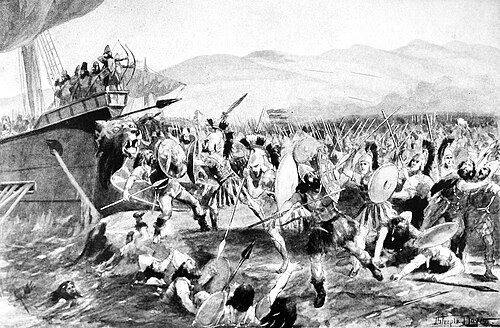
For several days the two armies watched each other. Then the Greeks suddenly moved forward, the last part at a run, and crashed into the Persian line. The middle of the Greek line was pushed back, but the two ends won and then closed in like a pair of arms giving a very hard hug. The Persians fled to their ships.
Afterwards, people told a story about a messenger who ran all the way from Marathon to Athens to shout “We won!” and then fell down dead. The oldest history of the battle does not tell this story, so it may not be true. But in 1896 it inspired a new race at the first modern Olympic Games: the marathon.
For the Athenians, Marathon became like a family treasure. They buried their fallen soldiers right on the battlefield under a big mound of earth, painted pictures of the battle, and told the story again and again. You can still see the mound today.
At a glance
- Date
- 490 BCE, late summer; usually dated to about 12 September, though August has also been argued
- Place
- Plain of Marathon, northeastern Attica, Greece, about 40 km from Athens
- Sides
- Athens and Plataea against an expeditionary force of the Achaemenid Persian Empire
- Commanders
- Greek: the polemarch Callimachus and ten Athenian generals, including Miltiades; Persian: Datis and Artaphernes
- Forces
- About 9,000–10,000 Athenians and about 1,000 Plataeans; Persian numbers unknown, modern estimates often around 20,000–25,000 infantry
- Losses (Herodotus)
- 192 Athenians and about 6,400 Persians killed
- Result
- Greek victory; the Persian expedition withdrew to Asia
- Main source
- Herodotus, Histories, Book 6, written about two generations later
Easy
What was the Battle of Marathon?
The Battle of Marathon was fought in the summer of 490 BCE between the city-state of Athens, helped by its small ally Plataea, and an army sent by Darius I, the king of the Persian Achaemenid Empire. It took place on the plain of Marathon, a strip of flat land on the east coast of Attica, the region around Athens.
The Persian force had crossed the Aegean Sea by ship, attacked islands on the way, destroyed the city of Eretria on the island of Euboea, and then landed at Marathon. The Athenian army, made up of citizen soldiers, marched out and camped facing them. After several days of waiting, the Greeks attacked and won a clear victory. The Persians escaped to their ships and eventually sailed home.
It was the first time that an army of mainland Greeks had beaten a Persian army in a large pitched battle. The battle was not the end of the wars between Greeks and Persians: ten years later Darius’s son Xerxes invaded Greece with a much larger army. But Marathon showed that Persian forces could be defeated, and it became one of the proudest memories of Athens.
Easy
Why did Persia come to Greece?
In the middle of the sixth century BCE, the Persian king Cyrus the Great conquered a huge area, including the Greek cities along the coast of Asia Minor (today western Turkey), a region the Greeks called Ionia. These cities were ruled through local Greek tyrants who were loyal to Persia.
Around 499 BCE the Ionian cities rebelled. Athens and Eretria sent ships to help, and in 498 BCE the rebels and their allies burned Sardis, an important Persian regional capital. The revolt was crushed by 494 BCE, when the Persians defeated the Ionian fleet at Lade and sacked Miletus. Herodotus says that Darius never forgot the part Athens had played.
There was also a personal and political reason. Hippias, the last tyrant of Athens, had been driven out in 510 BCE and had gone to the Persian court. He hoped that the Persians would put him back in power. According to Herodotus, it was Hippias, now an old man, who guided the Persians to Marathon, perhaps because his family had supporters in that part of Attica and because his father Peisistratus had landed there decades earlier on his way to seizing power.
Before the invasion, Darius sent messengers to Greek cities asking for “earth and water”, the traditional sign of submission. Many cities agreed. Athens and Sparta refused; Herodotus even says they killed the messengers.
Easy
Who fought, and how?
The Athenian army was made up of hoplites: citizens who could afford a bronze helmet, a breastplate, greaves (shin guards), a large round shield and a long thrusting spear. They fought shoulder to shoulder in a deep formation called a phalanx, where each man’s shield partly protected the man beside him. Hoplites were not full-time soldiers; they were farmers, craftsmen and landowners who served when the city called.
Athens could field roughly 9,000–10,000 hoplites. Plataea, a small city in neighbouring Boeotia that had long been friendly to Athens, sent its whole army, about 1,000 men. Sparta, the strongest military power in Greece, promised help but did not arrive in time.
The Persian army was more varied. It included soldiers from many peoples of the empire, often more lightly armoured than Greek hoplites, with wicker shields, and it relied heavily on archers and on cavalry. Herodotus says the fleet had 600 triremes (warships), though this number may be exaggerated or traditional. He gives no figure for the soldiers. Later ancient writers claimed hundreds of thousands, which is impossible; modern historians usually estimate somewhere around 20,000–25,000 fighting men and a smaller cavalry force, but any figure is a guess.
The Persians were commanded by Datis, a Mede, and Artaphernes, a nephew of Darius. On the Athenian side, command was shared: there were ten generals, one from each of the ten tribes of Athens, together with the polemarch (war archon) Callimachus. The most famous of the generals was Miltiades, a member of a powerful Athenian family who had once ruled in the Thracian Chersonese (Gallipoli) under Persian overlordship and knew Persian ways of war.
Intermediate
The campaign of 490 BCE
The Persian expedition of 490 BCE was the second attempt to reach Greece. In 492 BCE a force under Mardonius had advanced through Thrace and Macedonia, but its fleet was wrecked in a storm off Mount Athos. This time the Persians sailed directly across the Aegean. They captured Naxos, which had resisted them ten years before, and received the submission of other islands. The sanctuary of Delos, sacred to Apollo, was treated with respect, which suggests a deliberate policy of honouring Greek gods.
The fleet then attacked Eretria on Euboea. After a siege of six days, according to Herodotus, two leading Eretrians betrayed the city. The Persians burned its temples in revenge for Sardis and deported its people. Herodotus later reports that the Eretrian captives were settled by Darius in Cissia, in the Persian heartland, where they still spoke Greek in his own day.
From Euboea the Persians crossed to Marathon. The Athenians sent a runner, Philippides (later sources call him Pheidippides), to Sparta to ask for help; Herodotus says he reached Sparta on the day after he set out, a distance of about 240 km. The Spartans answered that they could not march until the full moon because of a religious festival, usually identified as the Carneia. Meanwhile the Athenian army marched out to Marathon and camped near a sanctuary of Heracles, blocking the roads to Athens. The Plataeans joined them there.
For several days neither side attacked. The Greeks held a strong position; the Persians may have been waiting for Athenians inside the city to rise up in their favour, or for a chance to move part of their force by sea. Herodotus describes a debate among the ten generals: half wanted to wait for the Spartans, half wanted to fight. Miltiades persuaded Callimachus to cast his vote for battle. Herodotus adds that the generals whose turn it was to command handed over their days to Miltiades, but he waited until his own day came before attacking.
Intermediate
The battle
To avoid being outflanked by the larger Persian line, the Athenians stretched their own line to match its length. They did this by making the centre thin, only a few ranks deep, while keeping the wings strong. Callimachus as polemarch commanded the right wing, the place of honour; the Plataeans held the left. According to Plutarch, the tribes of Themistocles and Aristides stood in the centre.
Herodotus says the Athenians advanced across about 8 stades (roughly 1.5 km) and charged “at a run”, and that they were the first Greeks known to him to do so, and the first to face the sight of Median clothing without fear. Modern writers doubt that heavily armoured men could run the whole distance; a common view is that they walked most of it and ran the last stretch, when they came within range of the Persian archers.
In the long fight that followed, the best Persian troops, the Persians themselves and the Sakas, who stood in the centre, broke through the Greek centre and pursued it inland. But on both wings the Greeks were victorious. Instead of chasing the defeated enemies, the two wings turned inward and attacked the Persian centre from both sides. The Persians fled toward the shore and the ships, and the Greeks pursued them into the sea. Near the ships there was heavy fighting; the Athenians captured seven ships, but the rest got away.
Herodotus gives the dead as 192 Athenians and about 6,400 Persians. Among the Athenian dead were Callimachus the polemarch, one of the generals named Stesilaus, and Cynegeirus, brother of the playwright Aeschylus, whose hand was cut off by an axe as he grabbed the stern of a Persian ship. Aeschylus himself fought in the battle. The Plataean losses are not recorded, and the number of enslaved people who fought and died is also uncertain; Pausanias, writing centuries later, mentions that slaves were buried at Marathon.
Intermediate
After the battle: the race back to Athens and the Spartans
The battle did not end the danger. The Persian fleet sailed around Cape Sounion toward Phaleron, the old harbour of Athens, perhaps hoping to find the city undefended. Herodotus reports a rumour that someone had flashed a shield signal to the Persians from a mountain, and that people blamed the Alcmaeonid family; he himself rejects the accusation. The Athenian army marched quickly back to the city and camped at another sanctuary of Heracles, at Kynosarges. When the Persian ships arrived and saw the army waiting, they did not land, and soon sailed back to Asia.
Two thousand Spartans arrived after the full moon, having marched from Sparta to Attica in three days. They were too late for the fighting. They asked to see the Persian dead, looked at them on the battlefield, praised the Athenians and went home.
For Persia, Marathon was a setback but not a disaster. The expedition had punished Eretria and brought several islands under Persian control. Darius began to prepare a larger invasion but died in 486 BCE; his son Xerxes led it in 480 BCE. That war brought the battles of Thermopylae, Salamis and Plataea, and ended with the Greek victory at Plataea in 479 BCE.
In Athens, the victory raised the prestige of the hoplite class and of Miltiades, but Miltiades soon fell. In 489 BCE he led a failed expedition against the island of Paros, was prosecuted and fined 50 talents, and died of an infected wound. Meanwhile Themistocles persuaded the Athenians to build a large fleet, and it was this navy, rather than the hoplite army of Marathon, that decided the war at Salamis.
Intermediate
How Athens remembered Marathon
The Athenians did something unusual: instead of bringing their dead home for burial, as became their normal custom, they buried the 192 on the battlefield under a great earth mound, the Soros, which still stands on the plain, still about 9 m high. A separate mound nearby is thought by many to be the burial of the Plataeans. The men who fought, the Marathonomachai (“Marathon fighters”), were honoured for the rest of their lives.
The victory was celebrated in art and religion. A large painting of the battle, showing Miltiades, Callimachus, gods and heroes such as Theseus fighting for Athens, decorated the Painted Stoa (Stoa Poikile) in the Athenian Agora. The Athenians dedicated a treasury at Delphi, which ancient writers linked to Marathon, and a cult of Pan was founded in a cave on the slope of the Acropolis, because Pan was said to have met Philippides on his run and promised help.
Aeschylus, the great tragic poet, is said to have chosen an epitaph that mentioned only his courage at Marathon and not his plays. For later Athenians, “the men of Marathon” became a symbol of old-fashioned virtue, and orators appealed to them again and again, especially when Athens faced new threats from Macedon in the fourth century BCE.
The story of the messenger who ran from Marathon to Athens and died after announcing the victory first appears in writers of the Roman period, such as Plutarch and Lucian, some 500–600 years after the battle. Herodotus mentions only the run to Sparta. When the French scholar Michel Bréal proposed a long-distance race for the first modern Olympic Games in Athens in 1896, he was inspired by the later legend. The distance was later standardised at 42.195 km.
Advanced
Was Marathon a turning point? Greek and Persian perspectives
For a long time, European writers treated Marathon as a decisive moment in world history. In the nineteenth century John Stuart Mill remarked that Marathon was more important for English history than the Battle of Hastings, and Edward Creasy included it among his “fifteen decisive battles of the world” (1851). These views reflected a narrative, inherited from Herodotus’ Greek and later European readers, of free Greeks defending “the West” against an “Oriental” despotism.
Modern scholarship is more cautious. Historians of the Achaemenid Empire point out that no Persian source mentions the battle; for the imperial centre, the expedition of 490 BCE was a relatively limited operation on a distant frontier. Its main goals, punishing Eretria and Athens and perhaps restoring Hippias, were only partly achieved, but the empire lost little. From this angle, Marathon was a local defeat, not a catastrophe. The image of the Persians as effeminate and cowardly, common in later Greek writing, is now recognised as partly a product of Greek self-definition after the wars.
At the same time, the battle had real consequences. It prevented the restoration of tyranny at Athens under Persian protection, strengthened the young democratic institutions created by Cleisthenes in 508/7 BCE, and gave the Athenians enormous confidence. Some historians argue that without Marathon, the later Athenian navy, the Delian League and the cultural achievements of fifth-century Athens, including the Parthenon, are hard to imagine. Others warn that such “what if” arguments are speculative.
It is also worth remembering the people whose stories are hardly told: the Eretrians who were deported to Persia, the Plataeans whose part Athenian memory tended to shrink, the slaves who fought, and the many soldiers of the Persian army who came from Ionia, Egypt, the Levant and Central Asia and did not choose this war.
Advanced
Sources, numbers and unsolved problems
Almost everything we know comes from Herodotus of Halicarnassus, whose Histories were written in the mid- to late fifth century BCE, about 40–60 years after the battle. Herodotus talked to people whose parents and grandparents remembered the war, but his narrative of Marathon is short and leaves out much that a military historian would want: the exact position of the camps, the role of the Persian cavalry, and the timing of events. Later sources, such as Cornelius Nepos, Plutarch and Pausanias, add details, but it is hard to know whether these come from good older sources or from later elaboration.
The cavalry problem is the most famous puzzle. Herodotus never mentions Persian horsemen in the fighting, even though the Persians had brought horses. A Byzantine dictionary, the Suda, preserves the proverb “the cavalry are away” (chōris hippeis) and explains it with a story that Ionian defectors told the Athenians that the Persian cavalry had left, prompting Miltiades to attack. Some historians think the Persians were re-embarking their cavalry to sail for Athens, which would explain why the Athenians finally attacked; others doubt this late source.
The date is also debated. It depends on when the full moon and the Spartan festival fell in 490 BCE. The traditional date of 12 September was calculated by the nineteenth-century scholar August Böckh; if the Spartan calendar ran a month earlier, the battle would fall in August. The size of the armies, the length of the Greek line and whether the Greeks ran the whole 1.5 km are all argued from Herodotus’ few words, topography and the physical limits of armoured men.
Archaeology adds some evidence. The Soros was excavated in the late nineteenth century and revealed burnt remains, ashes and pottery of the right period, supporting its identification as the tomb of the Athenian dead. Another mound near Vrana, excavated in 1970, has been identified by some as the Plataean tomb, though this is not certain. An inscribed casualty list of the tribe Erechtheis, found in 2000 at the villa of Herodes Atticus in the Peloponnese, is thought by several scholars to be a copy or original from a Marathon monument; this identification remains debated. The ancient coastline and the marsh on the plain have changed, which complicates reconstruction of the battlefield.
Key ideas
- Hoplite phalanx
- A tight formation of heavily armed citizen spearmen whose overlapping shields protected one another; the backbone of Greek armies at Marathon.
- Double envelopment
- The Greek wings defeated their opponents and then turned inward to attack the enemy centre from both sides.
- Punitive expedition
- From the Persian point of view, the campaign aimed to punish Eretria and Athens for their role in the Ionian Revolt, rather than to conquer all of Greece.
- Civic memory
- Athens turned the victory into a central part of its identity through burial mounds, paintings, dedications and speeches.
- Legend versus history
- The runner who died after announcing victory appears only in much later writers; Herodotus tells of a different run, to Sparta.
- Grand narratives
- Modern ideas of Marathon as a clash of “East and West” reflect later European interpretations as much as the events of 490 BCE.
Records
- c. 546 BCE — Cyrus the Great conquers Lydia and the Greek cities of Ionia fall under Persian rule.
- 510 BCE — Hippias, tyrant of Athens, is expelled and later goes to the Persian court.
- 508 BCE — Cleisthenes’ reforms lay the foundations of Athenian democracy (508/7 BCE).
- 499 BCE — The Ionian Revolt begins (499 BCE); Athens and Eretria send ships.
- 498 BCE — Ionian rebels and their Athenian and Eretrian allies burn Sardis (498 BCE).
- 494 BCE — Persian victory at Lade and the sack of Miletus end the revolt (494 BCE).
- 492 BCE — Mardonius’ expedition; the Persian fleet is wrecked off Mount Athos (492 BCE).
- 490 BCE — Datis and Artaphernes take Naxos and Eretria and are defeated at Marathon (490 BCE).
- 489 BCE — Miltiades’ failed expedition to Paros; he is fined and dies (489 BCE).
- 480 BCE — Xerxes invades Greece: Thermopylae and Salamis (480 BCE).
- 479 BCE — Greek victory at Plataea ends the Persian invasion (479 BCE).
- 1896 — The first modern marathon race is run at the Athens Olympic Games.
Glossary
- Hoplite
- A Greek citizen soldier armed with a large round shield, helmet, body armour and spear.
- Phalanx
- A close battle formation of hoplites standing in ranks and files.
- Polemarch
- “War leader”: one of the annual archons of Athens, who in 490 BCE still held a formal military command.
- Strategos (general)
- One of ten Athenian generals elected each year, one from each tribe.
- Achaemenid Empire
- The Persian Empire founded by Cyrus the Great, which at its height stretched from Egypt and Anatolia to the Indus.
- Ionia
- The central west coast of Asia Minor, with many Greek cities such as Miletus.
- Trireme
- A fast warship rowed by three banks of oars.
- Earth and water
- Tokens demanded by Persian envoys as a sign that a city accepted the king’s authority.
- Soros
- “Mound”: the burial tumulus of the Athenian dead on the plain of Marathon.
- Carneia
- A Spartan religious festival during which the army was not supposed to march.
Questions and answers
Did a runner really run from Marathon to Athens and die?
Probably not as the legend says. Herodotus, our earliest source, tells of Philippides running to Sparta before the battle. The story of the dying messenger appears only in much later writers.
How far is Marathon from Athens?
About 40 km by road. The modern marathon distance of 42.195 km was fixed in the twentieth century.
Why didn’t the Spartans come in time?
They said religious law did not allow them to march before the full moon, during a festival. Some historians suspect political reasons too, but the ancient sources give the religious one.
How many soldiers were there?
About 10,000 Athenians and 1,000 Plataeans. Persian numbers are unknown; modern guesses are usually around 20,000–25,000, but ancient claims of hundreds of thousands are impossible.
Where was the Persian cavalry?
Nobody knows. Herodotus does not mention it in the battle. A late source says it had left before the fight, which may explain why the Athenians attacked when they did.
Did the Persians see Marathon as a great defeat?
No Persian source mentions it. For the empire it was probably a limited setback on a distant frontier; its great importance comes from Greek, and later European, memory.
Can you visit the battlefield?
Yes. The burial mound of the Athenians still stands on the plain of Marathon, and there is an archaeological museum nearby.
Sources and further reading
- Herodotus, The Histories, Book 6 (Greek text and English translation by A. D. Godley). Perseus Digital Library, Tufts University
- Battle of Marathon. Wikipedia
- 마라톤 전투. 위키백과
- Battle of Marathon. Encyclopaedia Britannica
- Pheidippides. Wikipedia
- Edward Shepherd Creasy, The Fifteen Decisive Battles of the World. Richard Bentley, 1851
Related
- PersepolisA ceremonial and administrative center of the Achaemenid Empire in southwestern Iran, begun under Darius I.
- ParthenonA temple dedicated to Athena on the Athenian Acropolis, built during the fifth century BCE.
- SocratesAthenian philosopher who wrote nothing himself. Known through Plato and Xenophon, he was tried and executed in 399 BCE.
- Battle of GaugamelaA battle in 331 BCE in which Alexander of Macedon's army defeated the forces of the Persian king Darius III.
- HomerThe poet tradition credits with the Iliad and the Odyssey, the founding epics of Greek literature. Whether one person composed both is debated.
Written with AI assistance from the published sources listed above, and revised as new research appears.