Start at the top for an easy introduction. Go further down for more detail and scholarship.
- Easy
- Intermediate
- Advanced
For young readers
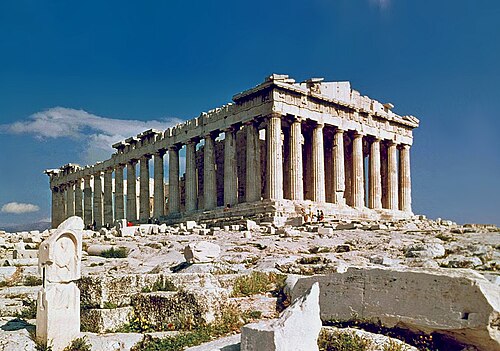
In the middle of Athens, a city in Greece, there is a tall rocky hill called the Acropolis. On top of it stands a huge old building with rows of white stone columns. This is the Parthenon. It was built almost 2,500 years ago as a home for Athena, the goddess of wisdom and the protector of the city.
Inside, there once stood an enormous statue of Athena, as tall as a four-storey building, covered with gold and ivory. The statue is lost now, but people have made copies based on small ancient models and descriptions.
The builders were very clever. The floor of the Parthenon is not perfectly flat: it bulges up a little in the middle. The columns get slightly fatter partway up and lean a tiny bit inward. These small tricks make the building look straight, strong and alive, instead of stiff or saggy.
All around the top of the building were carved stone pictures: gods, heroes, horses, battles with half-horse creatures called centaurs, and a long parade of people. Many of these carvings are now in museums, in Athens and in London, and people still argue about where they should be.
The Parthenon has had many lives. It was a temple, then a Christian church, then a mosque. More than 300 years ago it was blown up in a war, which is why it has no roof today. Now experts are carefully repairing it, stone by stone.
At a glance
- Built
- 447–438 BCE for the main structure; sculpture completed about 432 BCE
- Place
- Acropolis of Athens, Greece
- Dedicated to
- Athena Parthenos (Athena the Maiden)
- Designers
- Architects Iktinos and Kallikrates; sculptor Pheidias oversaw the artistic programme
- Patron
- The Athenian democracy, under the political leadership of Pericles; partly funded from the Delian League treasury
- Style and size
- Doric temple of Pentelic marble, 8 × 17 columns; platform about 69.5 × 30.9 m
- Later uses
- Christian church (late antiquity), Latin cathedral (13th century), mosque (Ottoman period); heavily damaged in 1687
- Status
- Part of the UNESCO World Heritage Site “Acropolis, Athens” (inscribed 1987)
Easy
What is the Parthenon?
The Parthenon is a temple built in the fifth century BCE on the Acropolis, the rocky citadel that rises above the city of Athens. It was dedicated to Athena, the patron goddess of Athens, in her form as Parthenos, “the Maiden”. That title gave the building its name.
It was built during the most confident period in Athenian history, a few decades after the Greeks had defeated the Persian invasions of 490 and 480–479 BCE. The Persians had burned the Acropolis in 480 BCE, including an earlier marble temple still under construction on the same spot. The new building was part of a large programme of rebuilding promoted by the statesman Pericles.
The Parthenon is usually counted among the greatest buildings of the ancient world. For centuries architects in Europe and beyond have copied its columns and proportions, and it has become a symbol of Greece, of ancient Greek civilization and, for many people, of democracy itself. Together with the other monuments of the Acropolis, it was inscribed on the UNESCO World Heritage List in 1987.
Easy
How to “read” the building
Seen from outside, the Parthenon is a rectangle surrounded on all four sides by columns. There are 8 columns across each end and 17 along each side, counting the corner columns twice, making 46 outer columns, each about 10.4 m tall. The columns are in the Doric order: sturdy, fluted shafts without a base, topped by a simple cushion-shaped capital.
Inside the ring of columns was a walled building, the cella. It had two rooms that did not connect. The larger, eastern room housed the colossal statue of Athena, framed by a two-storey colonnade on three sides. The smaller, western room had four tall columns, probably of the more slender Ionic order, and seems to have been used to store treasures; strictly speaking, the name “Parthenon” may originally have belonged to this room alone.
The sculpture was arranged in three zones. High on the outside, above the columns, were 92 square panels called metopes, carved in high relief. In the two triangular gables at the ends, the pediments, stood large free-standing statues. And running around the top of the cella wall, behind the outer columns, was a continuous carved band, the frieze, about 160 m long. A visitor walking around the temple would see the metopes and pediments high above, and glimpse the frieze between the columns.
The building was brightly painted in places. Traces of colour and the holes for attached metal pieces, such as bronze reins and weapons, show that the sculptures were not the pure white we see today.
Easy
The stories in stone
The east pediment, above the main entrance, showed the birth of Athena, who, according to myth, sprang fully armed from the head of her father Zeus. The west pediment, facing visitors as they came up onto the Acropolis, showed the contest between Athena and the sea god Poseidon for the land of Attica: Poseidon offered a salt spring, Athena an olive tree, and Athena won.
The metopes showed four great battles: gods against giants on the east, Greeks against Amazons on the west, Lapiths against centaurs on the south, and the fall of Troy on the north. Each tells of order and civilization defeating chaos, and many scholars see in them a reflection of the recent Greek victory over Persia.
The frieze shows a great procession of horsemen, chariots, elders, musicians, young women carrying vessels, animals led to sacrifice and, over the east entrance, seated gods. The most common interpretation is that it represents the Panathenaic procession, the city’s greatest festival in honour of Athena, when a new robe (peplos) was brought to her ancient statue. If so, it was remarkable for showing ordinary citizens on a temple, a place normally reserved for gods and heroes.
The greatest work of all was the statue of Athena Parthenos by Pheidias, dedicated in 438 BCE. About 11.5 m tall, it was made of a wooden core covered with ivory for the skin and gold for the clothing and armour; the historian Thucydides says the gold weighed 40 talents and could be removed. The statue was lost in late antiquity. We know it from descriptions, small Roman copies and coins.
Intermediate
Building techniques and “refinements”
The temple was built entirely of marble from Mount Pentelikon, about 16 km northeast of Athens. Blocks were cut in the quarries, dragged down the mountain on sledges and wagons, and lifted into place with wooden cranes and ropes. The columns were built of stacked drums, joined by wooden pegs at the centre; the blocks of the walls were held together with iron clamps set in lead, with no mortar. The final fluting of the columns was carved after they were assembled.
What makes the Parthenon famous among architects are its optical refinements. Almost no line in the building is truly straight. The platform (stylobate) rises gently toward the middle of each side, by about 10 cm on the long sides. The columns have entasis, a slight swelling of the profile, and lean slightly inward; the corner columns are a little thicker than the others. The spaces between columns vary. These adjustments required every block to be cut individually.
Why were they made? Ancient writers such as Vitruvius believed they corrected optical illusions, for example the way a long straight horizontal can appear to sag. Modern scholars also suggest that they give the building a sense of tension and life, or that they helped drainage. Whatever their purpose, they show the extraordinary precision of the masons: some joints are accurate to fractions of a millimetre.
The building also used a system of proportions. Many scholars have noted that the ratio of 4 : 9 appears in several of its main dimensions, such as the relation of width to length of the platform. How far the architects consciously planned a single ratio, and how far these are modern measurements, is debated.
Intermediate
Pericles, the empire and the money
After the Persian Wars, Athens led an alliance of Greek city-states, the Delian League, formed in 478/7 BCE to continue the fight against Persia. Members contributed ships or money. Over time Athens turned the alliance into an empire: members could not leave, and in 454 BCE the treasury was moved from the island of Delos to Athens.
Pericles, the leading politician of Athens, persuaded the assembly to use part of this money, together with Athens’ own resources, to rebuild the temples destroyed by the Persians. The Parthenon was followed by the monumental gateway to the Acropolis (the Propylaia), the small temple of Athena Nike and the Erechtheion. Plutarch, writing much later, reports that Pericles’ opponents complained that Athens was decorating itself like a vain woman with jewels paid for by its allies.
Stone inscriptions recording the annual accounts of the building commissioners survive in fragments. They show that the work was organized by the democracy, with elected overseers, and that many workers were paid by the day, including citizens, resident foreigners (metics) and enslaved people. The Parthenon was therefore both an act of religious devotion and a statement of Athenian power, wealth and self-confidence.
It is a paradox often discussed by historians: the building that later became a symbol of democracy and freedom was financed in part by an empire that denied freedom to its allies.
Intermediate
Temple or treasury? Religious meaning
Greek temples were houses for gods, not halls for congregations. Worship, especially sacrifice, took place at altars outside. The Parthenon is unusual because it seems to have had no altar of its own, and the most sacred image of Athena on the Acropolis was not Pheidias’ gold-and-ivory statue but an ancient olive-wood statue of Athena Polias (“of the city”), kept in the older temple and later in the Erechtheion. It was this old statue that received the new robe at the Panathenaia.
For this reason, some scholars have argued that the Parthenon was more a monumental dedication and state treasury than a working temple. The gold on Athena’s statue served as a financial reserve, and inventories of precious offerings kept in the building were inscribed on stone. Others answer that ancient Greeks did not separate religion, civic pride and wealth in the way we do, and that the Parthenon was fully a sacred building.
Either way, the building expressed the special relationship between Athens and its goddess. The pediments showed Athena’s birth and her victory over Poseidon for Attica; the frieze, on the usual reading, showed the citizens honouring her. Temple, city and goddess were bound together.
Intermediate
Church, mosque and ruin
The Parthenon remained a temple for about 900 years. It was damaged by fire at some point in late antiquity, possibly during the Herulian raid of 267 CE or later, and repaired. After the Roman Empire became Christian and pagan sacrifice was banned, the building was converted into a church dedicated to the Virgin Mary; scholars date this to the late fifth or sixth century CE. An apse was built at the east end, and some sculptures, especially metopes, were deliberately defaced.
After the Fourth Crusade (1204), Athens came under Latin (Western European) rulers, and the Parthenon became a Roman Catholic cathedral. The Ottoman Turks took Athens in 1458, and later in the fifteenth century the building was turned into a mosque; a tower built in the Latin period was extended into a minaret. Travellers who saw it in the seventeenth century described the building as largely complete.
Disaster came in 1687. During a war between Venice and the Ottoman Empire, the Venetian commander Francesco Morosini besieged the Acropolis. The Ottoman garrison was using the Parthenon to store gunpowder. On 26 September 1687 a Venetian mortar shell hit the building and the powder exploded, killing around 300 people and blowing out the centre of the temple, including much of the side colonnades, the cella walls and the roof. After taking the Acropolis, Morosini tried to remove sculptures from the west pediment, but some fell and shattered.
In the eighteenth century a small mosque was built inside the ruins. The Parthenon suffered again during the Greek War of Independence in the 1820s, when the Acropolis was besieged more than once.
Intermediate
The Parthenon sculptures in London
Between 1801 and 1812, agents of Thomas Bruce, 7th Earl of Elgin, the British ambassador to the Ottoman Empire, removed about half of the surviving sculptures of the Parthenon, including large parts of the frieze, 15 metopes and many pediment figures, and shipped them to Britain. Elgin said he had permission from the Ottoman authorities. In 1816 the British Parliament bought the collection, and it has been displayed in the British Museum ever since. They are often called the “Elgin Marbles”.
Greece has requested their return for decades, most visibly since the campaign launched in the early 1980s by the Greek culture minister Melina Mercouri. Supporters of return argue that the sculptures were removed under a foreign occupying power, that the legality and meaning of Elgin’s permission are doubtful, and that the frieze and pediments belong together as parts of one monument. The British Museum has argued that the removal was legal at the time, that the sculptures are displayed there in the context of world cultures and seen free of charge by millions, and that British law restricts the museum from giving away its collections.
In 2009 Greece opened the new Acropolis Museum at the foot of the hill. Its top-floor Parthenon Gallery, which looks directly at the temple, displays the surviving frieze in Athens in its original sequence, with plaster casts marking the pieces held in London and elsewhere. Other fragments are in the Louvre and several other museums.
The dispute has become a central case in wider debates about cultural property, colonial-era collecting and the role of “universal museums”. Discussions between the two sides have continued in recent years without a final settlement.
Advanced
Restoration and conservation
After Greek independence, archaeologists cleared the Acropolis of most post-classical buildings, including the small mosque in the Parthenon, to reveal the classical monuments. This “purification” reflected nineteenth-century ideas of what mattered in Greek heritage; many later layers, Byzantine, Frankish and Ottoman, were lost with little documentation, a loss that historians now regret.
Between about 1898 and 1933 the engineer Nikolaos Balanos restored parts of the Parthenon, re-erecting fallen columns of the north colonnade. His work used iron clamps and reinforcements, and he often placed blocks in the wrong positions. The iron later rusted, expanded and cracked the marble, causing serious new damage. Air pollution in twentieth-century Athens also attacked the marble surface.
Since 1975, a Committee for the Conservation of the Acropolis Monuments and later a dedicated restoration service have carried out a long programme of work. Architects and engineers have dismantled earlier restorations, replaced rusting iron with titanium, returned blocks to their correct positions, and added new Pentelic marble only where necessary for stability, carved to fit and distinguishable from the ancient stone. The original sculptures still on the building were moved into the museum and replaced by casts.
The project has been widely praised for its scholarly rigour and its principle of reversibility, but it has also raised debates: how much should be rebuilt, whether visitors should see a ruin or a partly completed temple, and how to balance tourism, which brings millions of visitors a year, with protection of the site.
Advanced
Scholarly debates
What does the frieze show? The Panathenaic interpretation has dominated since the eighteenth century, but problems remain: the procession lacks some elements known from the festival, and the central scene over the entrance, showing adults and children handling a folded cloth, is ambiguous. Joan Breton Connelly, in The Parthenon Enigma (2014), proposed that the frieze shows the mythical king Erechtheus preparing to sacrifice his daughter to save Athens, a foundation myth rather than a contemporary festival. Many specialists have not accepted this, but it has renewed debate about how myth and civic ritual were combined.
How far was the building political? Readings of the Parthenon as Periclean propaganda, or as a monument to democracy, are influenced by modern politics. Some historians stress its religious function, others its imperial funding and message. The word “democracy” appears nowhere on it, and ancient sources say relatively little about how Athenians themselves interpreted the sculptures.
What was Pheidias’ role? Plutarch says that Pheidias oversaw all of Pericles’ building projects. But how much of the sculpture he designed, and how much was carried out by teams of sculptors with different styles, is disputed; stylistic differences among the metopes suggest many hands. Pheidias himself was later accused of embezzlement in Athens, but the details and date of his trial are uncertain.
How did the refinements work? Measurements by the modern restoration teams have given very precise data on curvature and inclination, and have revealed setting-out marks and techniques, but whether the architects had a single theoretical system, or worked by trial and adjustment on site, is still discussed.
Key ideas
- Doric order
- The sturdy style of Greek architecture used for the outer colonnade, with baseless fluted columns and simple capitals.
- Optical refinements
- Deliberate curves and inclinations, such as the rising platform and swelling columns, that make the building look harmonious.
- Sculptural programme
- A planned set of images, pediments, metopes and frieze, that together celebrate Athena and the triumph of order over chaos.
- Periclean building programme
- The rebuilding of the Acropolis after the Persian destruction, funded partly by the tribute of Athens’ allies.
- Layers of history
- The building was a temple, church, cathedral, mosque and ruin; each phase left traces and shaped what survives.
- Cultural property debate
- The question of where the sculptures removed by Elgin should be is a key case in modern debates on museums and restitution.
- Reversible restoration
- Modern conservation aims to repair without falsifying, using documented, removable interventions.
Records
- 480 BCE — The Persian army burns the Acropolis, including an unfinished earlier temple on the site (480 BCE).
- 447 BCE — Construction of the Parthenon begins (447 BCE).
- 438 BCE — The statue of Athena Parthenos is dedicated (438 BCE).
- 432 BCE — Pediment sculptures completed, about the time the Peloponnesian War begins (432 BCE).
- c. 500 CE — The Parthenon is converted into a church of the Virgin Mary (late fifth or sixth century).
- 1458 — The Ottomans take Athens; later in the century the Parthenon is converted into a mosque.
- 1687 — A Venetian shell ignites Ottoman gunpowder inside, and the explosion wrecks the building (26 September).
- 1801 — Elgin’s agents begin removing sculptures (to 1812).
- 1816 — The British Parliament buys the Elgin collection for the British Museum.
- 1975 — The modern programme of Acropolis conservation and restoration begins.
- 1987 — The Acropolis of Athens is inscribed on the UNESCO World Heritage List.
- 2009 — The new Acropolis Museum opens in Athens.
Glossary
- Acropolis
- “High city”: a fortified hilltop; in Athens, the sacred hill of Athena.
- Cella (naos)
- The inner room of a temple where the cult statue stood.
- Colonnade
- A row of columns supporting a roof or beam.
- Pediment
- The triangular gable at each end of a temple, often filled with sculpture.
- Metope
- A square panel between grooved blocks (triglyphs) above the columns of a Doric temple, often carved.
- Frieze
- A continuous horizontal band of relief sculpture.
- Entasis
- The slight swelling in the profile of a column.
- Chryselephantine
- Made of gold (chrysos) and ivory (elephas), like the statue of Athena Parthenos.
- Delian League
- The alliance of Greek states led by Athens after 478 BCE, which became an Athenian empire.
- Panathenaia
- The great Athenian festival for Athena, with a procession and the presentation of a new robe.
- Pentelic marble
- Fine white marble from Mount Pentelikon near Athens, which turns golden with age.
Questions and answers
Why doesn’t the Parthenon have a roof?
Because of an explosion in 1687. Gunpowder stored inside by the Ottoman garrison was hit by a Venetian shell and blew out the middle of the building.
Was the Parthenon always white?
No. Parts of the sculpture and decoration were painted in bright colours and had metal attachments. Time and weather removed most of the paint.
Where is the great statue of Athena?
It is lost. It disappeared in late antiquity. We know what it looked like from ancient descriptions and small Roman copies.
Why are some of the sculptures in London?
Agents of Lord Elgin removed them in 1801–1812 and they were bought by the British Museum in 1816. Greece asks for their return; the British Museum has so far kept them.
Is anything in the Parthenon really straight?
Very little. The platform curves upward, the columns swell and lean inward, and the corner columns are thicker, to make the building look balanced.
Was the Parthenon a temple or a treasury?
Both ideas have supporters. It had no altar of its own and stored treasure, but it was dedicated to Athena and housed her statue. Many scholars think the distinction is too modern.
Who paid for it?
The Athenian state, using its own revenues and money from the tribute paid by the allies of the Delian League, which critics at the time complained about.
Sources and further reading
- Parthenon. Wikipedia
- 파르테논 신전. 위키백과
- Acropolis, Athens. UNESCO World Heritage Centre
- Athena Parthenos. Wikipedia
- Elgin Marbles. Wikipedia
- Acropolis Museum. Acropolis Museum, Athens
- Jenifer Neils (ed.), The Parthenon: From Antiquity to the Present. Cambridge University Press, 2005
- Mary Beard, The Parthenon. Profile Books, 2002
- Joan Breton Connelly, The Parthenon Enigma. Alfred A. Knopf, 2014
Related
- Battle of MarathonA battle in 490 BCE in which an Athenian-led Greek force defeated a Persian expedition at Marathon.
- SocratesAthenian philosopher who wrote nothing himself. Known through Plato and Xenophon, he was tried and executed in 399 BCE.
- PlatoStudent of Socrates and founder of the Academy. His dialogues remain a cornerstone of Western philosophy.
- PantheonA Roman temple rebuilt under Hadrian, celebrated for its vast concrete dome and central opening.
- Hagia SophiaA monumental church built for the Byzantine emperor Justinian I in Constantinople between 532 and 537 CE.
- PersepolisA ceremonial and administrative center of the Achaemenid Empire in southwestern Iran, begun under Darius I.
Written with AI assistance from the published sources listed above, and revised as new research appears.