Start at the top for an easy introduction. Go further down for more detail and scholarship.
- Easy
- Intermediate
- Advanced
For young readers
More than 2,000 years ago, China was divided into many kingdoms that often fought each other. People who could plan well and lead armies wisely were very important. One of them, according to old stories, was a general named Sun Wu. People called him Sunzi, “Master Sun”, and in English he is often called Sun Tzu.
A short book about how to win wars was passed down under his name. It is called the Sunzi or, in English, The Art of War. It has only 13 short chapters, but people all over the world still read it today.
Surprisingly, the book does not say that fighting is great. It says war is dangerous and costly, and a wise leader should think very carefully before starting one. The very best way to win, it says, is to make the other side give up without a battle at all.
One of its most famous ideas is: “Know the other side and know yourself, and you will not be in danger in a hundred battles.” That means you should understand your own strengths and weaknesses, and also your opponent’s, before you act. This is good advice for a sports team, a chess game or even a school project!
The book also compares a good army to water. Water flows around hard rocks and runs into low, empty places. In the same way, a clever leader avoids the enemy’s strong points and moves toward the weak ones. Historians today are not sure exactly who wrote the book or when, but it became one of the most famous books on strategy ever written.
At a glance
- Type
- Military treatise in 13 short chapters (about 6,000 characters in the received text)
- Attributed to
- Sun Wu (Sunzi, “Master Sun”), said by Sima Qian to have served King Helü of Wu (r. 514–496 BCE)
- Date
- Traditionally late 6th century BCE; most modern scholars date the text to the 5th–4th centuries BCE (Warring States period), possibly compiled in stages
- Place
- Traditionally associated with the state of Wu in the lower Yangzi region (around modern Suzhou); Sunzi is said to have come from Qi
- Oldest manuscript
- Bamboo slips from Yinqueshan Han tomb 1, Linyi, Shandong, buried in the 2nd century BCE, found in 1972
- Standard edition
- Based on Cao Cao’s commentary (early 3rd century CE); the lead text of the Song-dynasty Seven Military Classics (1080s)
- Key ideas
- Careful calculation, deception, knowing self and enemy, winning without fighting, strategic advantage (shi), orthodox and unorthodox forces, use of spies
Easy
What is The Art of War?
The Art of War is the most famous ancient Chinese text on warfare and strategy. In Chinese it is usually called simply the Sunzi (“Master Sun”), or the Sunzi bingfa, “Master Sun’s Military Methods”. The English title The Art of War comes from early translations and has stuck.
It is very short: 13 chapters in the received version, about 6,000 Chinese characters, which fit into a few dozen pages of English. Each chapter is a series of compact statements and principles rather than stories about particular battles. Almost no names, dates or places appear, which makes the book easy to apply in many different situations and hard to date.
Although it is about war, the book begins with a warning: “War is a great matter of the state, the ground of life and death, the road to survival or ruin; it must be examined with care.” It is less a manual of weapons and drills than a guide to thinking: how to assess a situation, when to fight, when not to, and how to gain advantage while spending as little as possible.
Easy
Master Sun and the palace women: the traditional story
The oldest life of Sunzi was written by the historian Sima Qian in the Records of the Grand Historian (Shiji), around 100–90 BCE. According to Sima Qian, Sun Wu was a man of the state of Qi who brought his writings on war to King Helü of Wu. The king, curious, asked whether he could test his methods on palace women.
Sun Wu divided 180 women into two companies and made the king’s two favourite concubines their commanders. He explained the drill, but when he beat the drum the women laughed. He explained again; again they laughed. Sun Wu then said that if orders are clear and still not obeyed, the officers are to blame, and he had the two commanders executed despite the king’s protests. After that, the women performed the drill perfectly. The king, though unhappy, made Sun Wu a general, and Sima Qian credits him with helping Wu defeat the powerful state of Chu and enter its capital.
The story is dramatic and memorable, but historians are cautious. The Zuozhuan, a detailed chronicle of the period that describes Wu’s war against Chu in 506 BCE, never mentions Sun Wu. Many scholars therefore treat the Shiji story as legend, and some doubt that Sun Wu existed at all.
Easy
What is in the 13 chapters?
The chapters move roughly from planning before war to action in the field and finally to special topics. Chapter 1, “Calculations”, compares the two sides on five factors: the Way (whether the people are united with their ruler), heaven (weather and seasons), earth (terrain and distance), the commander, and organization and discipline. Chapter 2, “Waging War”, warns about the huge costs of campaigns and states that no state has ever benefited from a long war. Chapter 3, “Planning Attacks”, teaches that the highest skill is to defeat the enemy’s plans, then his alliances, then his army, and only as a last resort to attack walled cities.
Chapters 4 to 6, on “Formation” (xing), “Strategic Advantage” (shi) and “Weak and Strong Points”, deal with how to make one’s own side invulnerable, how to build up momentum like water rushing down a slope, and how to strike where the enemy is empty. Chapters 7 to 9 deal with manoeuvre, adapting to changing situations and moving an army through different landscapes.
Chapters 10 and 11 classify types of terrain and the “nine grounds”, the situations an army can find itself in, from fighting on home soil to being deep in enemy territory with no way back. Chapter 12 discusses attacks with fire, and chapter 13, “Using Spies”, argues that foreknowledge cannot be gained from spirits or calculations of the stars but only from people who know the enemy’s situation.
Intermediate
Core ideas: calculation, deception and winning without fighting
Calculation before battle. The Sunzi insists that victory is decided mostly before the fighting starts, in the ruler’s temple where the two sides are compared. “The victorious army first wins and then seeks battle; the defeated army first fights and then seeks victory.” Careful assessment, not courage alone, determines outcomes.
Deception. “Warfare is the way of deception,” says chapter 1: when able, appear unable; when near, appear far. Because war is so costly, misleading the enemy about one’s strength and intentions is not cheating but a way to reduce loss of life and resources.
Winning without fighting. The book’s most celebrated principle states that to subdue the enemy’s army without battle is “the best of the best”. The ideal is to keep things whole, the enemy state, its army, even its cities, rather than destroy them. This makes the Sunzi a book about limiting violence as much as using it.
Shi and the orthodox and unorthodox. Shi (勢), a word hard to translate, means the strategic advantage or potential energy that comes from position and timing, like a crossbow drawn tight or a boulder rolled down a steep mountain. The general combines zheng (正), “orthodox” or direct forces that engage the enemy, with qi (奇), “unorthodox” or surprise forces that win the battle; their combinations are said to be endless.
Intermediate
Historical context: from chariot nobles to mass armies
In the earlier Zhou period, warfare in China was largely the business of aristocrats fighting from chariots, guided by codes of honour and ritual. During the late Spring and Autumn period (770–481 BCE) and especially the Warring States period (475–221 BCE), this changed dramatically. States organized large infantry armies of conscripted farmers, fought long campaigns, and developed new weapons such as the crossbow.
These changes created a need for professional commanders and for theory. The Sunzi reflects this world: it speaks of armies of 100,000 soldiers, of the general’s independence from the ruler once in the field (“there are commands of the ruler that are not to be obeyed”), of logistics and the burden of war on ordinary people, and of rewards and punishments to control troops.
The Art of War was one of many military texts of the period. Others include the Wuzi, the Sima fa and the book of Sun Bin, a descendant of Sun Wu who served the state of Qi in the 4th century BCE. Military thought also shared ideas with philosophical schools of the time, and some scholars see affinities between the Sunzi’s emphasis on flexibility and formlessness and the Daodejing.
Intermediate
How the text was handed down
The imperial library catalogue preserved in the History of the Han (Hanshu) lists a “Wu Sunzi’s Military Methods” in 82 chapters with 9 scrolls of diagrams, far more than the 13 chapters we have. What those extra chapters contained, and whether they were later additions, is unknown.
The received 13-chapter text owes much to Cao Cao (155–220), the powerful warlord and founder of the Wei state at the end of the Han. He wrote the earliest surviving commentary and says in his preface that he edited the text; how much he changed is uncertain. Later scholars added more commentaries, and a Song-dynasty edition collected the notes of eleven commentators.
In the 1080s, under Emperor Shenzong, the Song court compiled the Seven Military Classics (Wujing qishu) for training officers, with the Sunzi placed first. From then on it was the core text of military examinations in China. In Joseon Korea, too, the Seven Military Classics were used in the military service examination (mugwa), and the book was studied in Japan, where the warlord Takeda Shingen famously took his battle banner motto, “swift as wind, quiet as forest, fierce as fire, immovable as mountain”, from chapter 7.
Intermediate
The Yinqueshan discovery
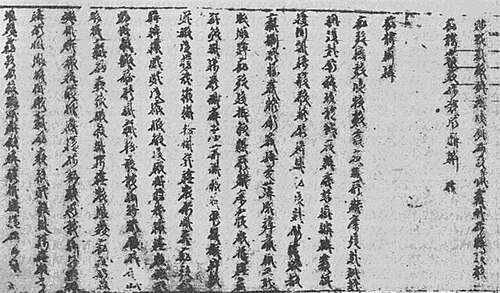
On 10 April 1972, construction workers at Yinqueshan, near Linyi in Shandong province, uncovered two Western Han tombs. Tomb 1, closed in the 2nd century BCE, contained nearly 5,000 inscribed bamboo slips, many damaged. Among them were large parts of the Sunzi’s 13 chapters, some additional passages related to Sunzi not found in the received text, and a long-lost work: the Military Methods of Sun Bin.
The find settled an old question. Because the Hanshu catalogue lists both a “Wu Sunzi” and a “Qi Sunzi”, some scholars had suggested that there was only one Sunzi, and that the book was actually by Sun Bin. Yinqueshan proved that two distinct texts existed in the Han dynasty.
The Yinqueshan version is broadly similar to the received text, with differences in wording and characters. It shows that the 13-chapter core was already established by the early Han. The slips also included other military and philosophical texts, such as parts of the Six Secret Teachings and the Wei Liaozi, and are now held in Shandong.
Intermediate
Translations and global influence
The Jesuit missionary Jean Joseph Marie Amiot, working in Beijing, published a French version in 1772, which introduced the book to Europe. The first English translation, by Everard Ferguson Calthrop, appeared in 1905, and Lionel Giles’s annotated translation of 1910 became the standard English version for decades. Samuel B. Griffith, a U.S. Marine officer, published an influential translation in 1963.
In the 20th century The Art of War influenced revolutionary and military leaders. Mao Zedong quoted Sunzi’s “know the enemy and know yourself” in his writings on strategy, and Vietnamese commanders drew on Chinese military classics. Military academies around the world now study it, often alongside Carl von Clausewitz’s On War.
Since the 1980s the book has also become a bestseller in business, sports, law and self-help, often reduced to lists of maxims. Scholars caution that many popular versions ignore the book’s historical context and its central concern with the costs of war. Its lasting appeal lies in its short, adaptable principles about competition, information and advantage.
Advanced
Interpretive questions: ethics, philosophy and translation
Is the Sunzi amoral? Some readers see it as a cold manual of manipulation, endorsing deception and ruthless discipline. Others stress its insistence that war is a last resort, its concern for the people’s welfare, its hope of taking states “whole”, and its list of the general’s virtues: wisdom, trustworthiness, humaneness, courage and strictness. Confucian scholars in imperial China were often uneasy with its emphasis on deception, but the book was never banned and was studied widely.
How is it related to Chinese philosophy? Scholars have compared its concepts, such as shi, formlessness and adapting like water, with the Daodejing and with Legalist ideas about control and rewards and punishments. Some see the military texts as an important source of broader Chinese strategic thought; others caution against reading a single “Chinese way of war” into a diverse tradition.
Translation matters greatly. Key terms like shi (“strategic advantage”, “configuration”, “energy”, “potential”), xing (“form”, “disposition”) and qi/zheng have no exact English equivalents, and different translations can make the text sound either mystical or practical. The Yinqueshan manuscript has also led editors to revise some readings of the received text. Comparing several translations with the Chinese original is the best way to approach the book seriously.
Advanced
Evidence and method: studying a text without a firm author
Research on the Sunzi draws on three kinds of evidence. The first is transmitted historical writing: the Shiji biography, the Hanshu library catalogue, the silence of the Zuozhuan, and later anecdotes. These tell us how the figure of Sunzi was remembered in the Han and later, but they were written long after the supposed events and cannot be taken at face value.
The second is the text itself. Scholars examine its vocabulary, grammar and style, the kinds of armies and weapons it assumes, and its relationship to other writings. For example, they compare its ideas and phrasing with the Sun Bin text, the Wuzi and philosophical works such as the Daodejing and the Xunzi, asking which texts borrowed from which. Such comparisons can suggest a relative chronology, though conclusions often depend on assumptions about how ideas developed.
The third is excavated manuscripts. The Yinqueshan slips give a firm point: a text very close to the received 13 chapters existed by the 2nd century BCE. Fragments of other military texts found in Han tombs show that such teachings circulated widely among officers and officials. Palaeographers must reconstruct damaged and disordered slips, and different arrangements can change the reading of a passage. Taken together, this evidence has encouraged scholars to treat the Sunzi less as the work of one man and more as the most successful product of a broader culture of military expertise in early China.
Key ideas
- War as a grave matter
- War decides life and death and the survival of states, so it must be entered only after careful assessment.
- Calculation first
- Victory is largely decided before battle by comparing the two sides on key factors.
- Deception
- Misleading the enemy about one’s strength and intentions is central to strategy.
- Winning without fighting
- The highest skill is to make the enemy yield without battle, preserving rather than destroying.
- Know self and enemy
- Accurate knowledge of both sides, gained through intelligence and spies, prevents defeat.
- Shi (strategic advantage)
- The potential power created by position and timing, like water rushing downhill or a drawn crossbow.
- Adapting like water
- An army should have no fixed form, avoiding strength and striking weakness as circumstances change.
Records
- c. 514 BCE — King Helü takes the throne of Wu (514 BCE); according to the Shiji, Sun Wu later presents his book to him.
- 506 BCE — Wu defeats Chu at Boju and occupies its capital (506 BCE); the Shiji credits Sun Wu, but the Zuozhuan does not mention him.
- c. 475 BCE — The Warring States period begins (c. 475 BCE); many scholars place the composition of the Sunzi in this era.
- c. 342 BCE — Sun Bin helps Qi defeat Wei at the Battle of Maling (c. 342 BCE).
- c. 130 BCE — Yinqueshan Han tomb 1 is closed with bamboo slips of the Sunzi and Sun Bin (2nd century BCE).
- c. 94 BCE — Sima Qian completes the Shiji with the biography of Sun Wu.
- c. 200 CE — Cao Cao writes the earliest surviving commentary and edits the 13-chapter text.
- c. 1080 — The Song court compiles the Seven Military Classics with the Sunzi first.
- 1772 — Jean Joseph Marie Amiot publishes a French translation in Paris.
- 1905 — Everard Ferguson Calthrop publishes the first English translation.
- 1910 — Lionel Giles publishes his annotated English translation.
- 1972 — The Yinqueshan bamboo slips are discovered near Linyi, Shandong.
Glossary
- Sunzi (孫子)
- “Master Sun”, the traditional author; also the Chinese name of the book.
- Bingfa (兵法)
- “Military methods”; the genre of Chinese writings on warfare.
- Spring and Autumn period
- 770–481 BCE, when the Zhou kings’ power declined and regional states competed.
- Warring States period
- 475–221 BCE, an era of large-scale warfare that ended with Qin’s unification of China.
- Shi (勢)
- Strategic advantage or potential energy created by position, timing and momentum.
- Xing (形)
- Form or disposition; the visible arrangement of forces.
- Zheng and qi (正奇)
- “Orthodox” direct forces and “unorthodox” surprise forces, combined in endless variations.
- Sun Bin
- A 4th-century BCE strategist of Qi, said to be Sun Wu’s descendant, whose own military text was rediscovered at Yinqueshan.
- Yinqueshan slips
- Bamboo manuscripts found in 1972 in Western Han tombs in Shandong, including the oldest Sunzi text.
- Seven Military Classics
- A Song-dynasty anthology of seven military texts, headed by the Sunzi, used for officer training and examinations.
- Received text
- The version passed down through copying and printing, as opposed to an excavated manuscript.
Questions and answers
Does The Art of War say war is good?
No. It says war is dangerous and costly, should be started only after careful thought, and is best won without fighting at all.
Who was Sun Tzu?
Tradition says he was Sun Wu, a general from Qi who served King Helü of Wu around 500 BCE. But early records of that time do not mention him, so many historians doubt the story.
How old is The Art of War?
Tradition dates it to the late 6th century BCE. Many scholars think it took shape in the 5th–4th centuries BCE. A copy buried in the 2nd century BCE was found in 1972.
What does “know the enemy and know yourself” mean?
It means you should understand both your own strengths and weaknesses and those of your opponent before acting. With that knowledge, you will not be put in danger.
Why is it read by business people today?
Its short principles about planning, information, flexibility and advantage can be applied to any competition, though scholars warn that popular versions often ignore its original context.
What did the Yinqueshan manuscripts prove?
They showed that the 13-chapter Sunzi existed by the early Han, and that Sun Bin’s Military Methods was a separate book, ending the theory that Sun Bin wrote the Sunzi.
Was the Hanshu’s 82-chapter Sunzi a different book?
Nobody knows. The extra chapters may have been later additions or related materials; some passages about Sunzi found at Yinqueshan may come from them.
Sources and further reading
- The Art of War. Wikipedia
- Sun Tzu. Wikipedia
- Yinqueshan Han Slips. Wikipedia
- Sun Bin’s Art of War. Wikipedia
- Seven Military Classics. Wikipedia
- The Art of War (Chinese text with translation). Chinese Text Project
- Samuel B. Griffith (trans.), Sun Tzu: The Art of War. Clarendon Press, Oxford, 1963
- Ralph D. Sawyer (trans.), The Seven Military Classics of Ancient China. Westview Press, 1993
- Victor H. Mair (trans.), The Art of War: Sun Zi’s Military Methods. Columbia University Press, 2007
Related
- LaoziTraditionally named author of the Daodejing. Whether he was a single historical person is still debated.
- ConfuciusTeacher from the state of Lu whose sayings, gathered in the Analects, shaped ethics and government across East Asia.
- MoziAn early Chinese thinker associated with Mohism, which advocated impartial concern and opposed aggressive war.
- Sima QianA Han dynasty historian who compiled the Records of the Grand Historian, a broad history of the ancient Chinese world.
- Qin's Wars of UnificationA series of Qin campaigns that conquered six rival states between 230 and 221 BCE.
- The PrincePolitical treatise written by Niccolò Machiavelli in 1513 and published after his death.
Written with AI assistance from the published sources listed above, and revised as new research appears.