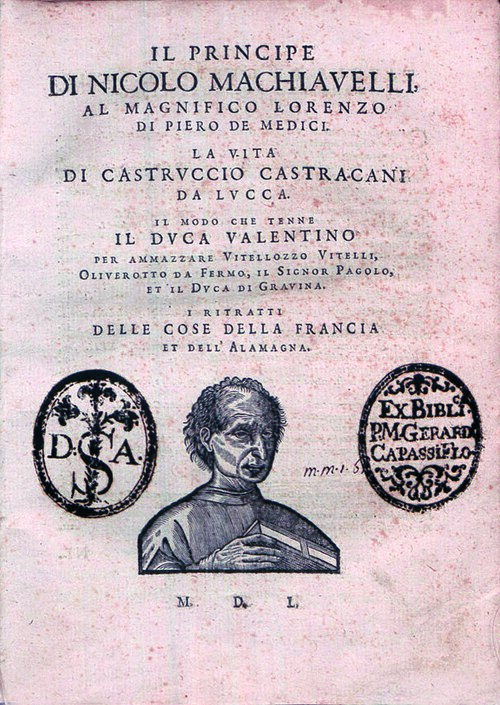
Start at the top for an easy introduction. Go further down for more detail and scholarship.
- Easy
- Intermediate
- Advanced
For young readers
About 500 years ago, Italy was not one country. It was split into many small states: cities like Florence and Venice, the lands of the pope, and kingdoms, often at war with each other and invaded by the big armies of France and Spain.
Niccolò Machiavelli worked for the government of Florence for fourteen years. He travelled to meet kings, popes and generals and watched closely how they behaved. Then, in 1512, the powerful Medici family took control of Florence again. Machiavelli lost his job, was thrown in prison and hurt, and afterwards had to live quietly on his small farm outside the city.
In the evenings he went into his study to read the great history books of the ancient world, and in 1513 he wrote a small book called The Prince. It gives advice to a ruler: how to take over a country, how to keep an army, how to make people respect you, and what to do when luck turns against you.
Some of the advice is shocking. Machiavelli says a ruler should be good when he can, but must learn how to be “not good” when it is necessary to protect the state. He asks whether it is better to be loved or feared, and answers that it is safer to be feared, as long as you are not hated.
For centuries people have argued about the book. Was Machiavelli a wicked teacher of tyrants? A realist who told the truth about politics? Or a lover of freedom who wanted to show everyone how rulers really act? That is why the book is still read in schools and universities today.
At a glance
- Author
- Niccolò Machiavelli (1469–1527), Florentine diplomat, official and writer
- Written
- 1513 (mentioned in a letter of 10 December 1513); revised and dedicated c. 1515–1516
- Published
- 1532, five years after the author’s death (Rome, Antonio Blado; Florence, Bernardo Giunta)
- Language
- Italian (Tuscan), with chapter titles in Latin
- Form
- Short political treatise in 26 chapters with a dedicatory letter
- Dedicatee
- Lorenzo di Piero de’ Medici, later Duke of Urbino (originally meant for Giuliano de’ Medici)
- Key ideas
- Virtù and fortuna, the “effectual truth”, necessity, armed prophets, feared rather than loved, fox and lion
- Reception
- Placed on the Catholic Index of Prohibited Books in 1559; one of the most read and debated works of political thought
Easy
What is The Prince?
The Prince is a short book of advice for rulers, written in Italian by Niccolò Machiavelli in 1513. Machiavelli himself called it a little work (opuscolo) “on principalities” (De principatibus), and the Italian title Il Principe was used when it was printed in 1532. It is only about the length of a long essay, divided into 26 short chapters.
The book asks practical questions. What kinds of states are there? How can someone gain power in a new state, by his own army, with the help of others, by crime, or by the favour of the people? Why do mercenary soldiers fail? Which qualities should a ruler show, and which should he only seem to have? How much of what happens is decided by luck?
Machiavelli answers with examples from recent Italian politics and from ancient history, especially Rome and Greece. His tone is direct and often provocative. That tone, and the advice that a ruler must sometimes act against conventional morality, made the book famous and infamous. In many languages the word “Machiavellian” came to mean cunning, deceitful and ruthless.
Easy
“I enter the ancient courts of ancient men”: how the book was written
We know when The Prince was written thanks to a famous letter Machiavelli sent to his friend Francesco Vettori, the Florentine ambassador in Rome, on 10 December 1513. He describes his days in the country: catching thrushes, arguing and playing cards with local people at the inn. Then, in the evening, he takes off his muddy clothes, puts on formal robes, and enters his study, where he “converses” with the great writers of antiquity by reading them.
In that letter he says he has composed a little work, De principatibus, in which he goes as deeply as he can into the question of what a principality is, what kinds there are, and how they are gained, kept and lost. He hopes it will be welcome to a prince, especially a new one, and thinks of presenting it to Giuliano de’ Medici. His hope was practical: he wanted the Medici to give him work again.
Giuliano died in 1516, and the dedication was addressed instead to his nephew Lorenzo di Piero de’ Medici. There is no evidence that Lorenzo paid much attention to it, and Machiavelli did not receive the post he hoped for. The book circulated in handwritten copies among friends and readers for almost twenty years before it was printed.
Intermediate
What the book says, chapter by chapter
Chapters 1–11 classify principalities. Hereditary states are easy to keep; new ones are hard. Machiavelli distinguishes states won by one’s own arms and virtù (chapter 6, with founders such as Moses, Cyrus, Romulus and Theseus), states won by the arms and fortune of others (chapter 7, with the long case study of Cesare Borgia), states won by crime (chapter 8, with the Sicilian tyrant Agathocles), and “civil” principalities won with the favour of the people (chapter 9). He notes that “all armed prophets conquered, and the unarmed ones came to ruin”, citing Savonarola as an unarmed prophet.
Chapters 12–14 deal with military matters. Mercenaries, Machiavelli argues, are disunited, ambitious and disloyal; auxiliary troops lent by another power are even more dangerous. A prince should rely on his own arms and make the art of war his main study.
Chapters 15–23 concern the prince’s conduct. Here Machiavelli breaks openly with the long tradition of “mirrors for princes” that urged rulers to be generous, merciful and honest. Chapter 15 says he will follow the effectual truth (verità effettuale) of things rather than imagined republics and principalities. Chapter 16 argues that excessive generosity ruins a prince; chapter 17 that it is safer to be feared than loved, if one cannot be both, but that a prince must avoid being hated, above all by not taking his subjects’ property or women; chapter 18 that a prince must know how to use both the beast and the man, the fox to recognize traps and the lion to frighten wolves, and need not keep his word when doing so works against him. Chapters 19–23 cover avoiding contempt and hatred, fortresses, reputation, ministers and flatterers.
Chapters 24–26 turn to Italy. Italian princes lost their states through their own idleness, not bad luck. Chapter 25 compares fortune to a violent river that floods the plain, which can be controlled if people build dykes and embankments in calm times, and says fortune may govern half our actions but leaves the other half to us. Chapter 26 is a passionate exhortation to the Medici to free Italy from the “barbarians”, ending with lines from Petrarch’s patriotic poem Italia mia.
Intermediate
Historical context: the Italian Wars
In 1494 King Charles VIII of France invaded Italy to claim the kingdom of Naples, marching through the peninsula almost unopposed. This began the Italian Wars (1494–1559), in which France, Spain and the Holy Roman Empire fought over Italy. The small Italian states, including Florence, Milan, Venice, the Papal States and Naples, were caught between these great powers, forming and breaking alliances.
Machiavelli had watched states rise and fall at close range. Cesare Borgia, son of Pope Alexander VI, carved out a state in the Romagna in 1499–1503 with French troops and papal money, only to lose it when his father died. Julius II, the warrior pope, fought wars with Venice and France. Florence itself lost Pisa, recovered it in 1509, and then lost its republican government in 1512. The Prince draws on this experience: it is a book written by someone who had seen how quickly power could collapse.
The book also belongs to Renaissance humanism. Machiavelli uses the classical historians, such as Livy, Polybius, Tacitus and Xenophon, as a storehouse of examples, and he writes as a humanist addressing a prince. But he turns humanist conventions around, using classical learning not to praise princely virtue but to analyse political power without illusions.
Intermediate
Key ideas: virtù, fortuna and necessity
Virtù is Machiavelli’s most important and most difficult term. It is related to the Latin virtus, “manliness” or “excellence”, but in The Prince it rarely means moral virtue. It means the energy, skill, courage and flexibility that allow a person to achieve great things and shape events. A ruler with virtù knows when to be cautious and when to be bold, when to be generous and when to be harsh.
Fortuna is chance, luck or circumstance, often personified in Renaissance culture as a goddess turning her wheel. For Machiavelli, fortune is powerful but not all-powerful. The prince who prepares in advance and adapts to changing times can resist it. He adds, in an image that now troubles many readers, that fortune is like a woman who favours the bold and young.
Necessity (necessità) links the two. A prince who wants to maintain his state is often forced by necessity to act in ways that ordinary morality condemns. Machiavelli does not say that cruelty, deceit or breaking promises are good. He says that in politics they are sometimes necessary, and that a prince must learn “to be able not to be good” and use this “according to necessity”. He distinguishes cruelty “well used”, done at once for security and then turned to the subjects’ benefit, from cruelty “badly used”, which grows over time.
Appearances matter. Because most people judge by what they see, a prince should appear merciful, faithful, humane, honest and religious, while being ready to act otherwise. Machiavelli also stresses the people: a prince should build his power on the people rather than the nobles, because the people only want not to be oppressed, while the nobles want to oppress. The popular phrase “the ends justify the means” is not in the book, although chapter 18 says that in the actions of princes people look to the outcome.
Intermediate
Manuscripts, printing and censorship
No manuscript in Machiavelli’s own hand survives. The text is known from a number of sixteenth-century manuscript copies and the printed editions of 1532. That year the Roman printer Antonio Blado published it with papal permission, and the Florentine printer Bernardo Giunta issued another edition. The chapter titles are in Latin, following humanist custom, while the text is in lively Tuscan Italian.
Even before it was printed, the book was being used. In 1523 the philosopher Agostino Nifo published a Latin treatise, De regnandi peritia (“On the Skill of Ruling”), that largely reworked The Prince without naming its author.
During the Counter-Reformation, Machiavelli’s works were placed on the Index of Prohibited Books issued under Pope Paul IV in 1559, a ban confirmed in the 1564 Index. They continued to circulate, sometimes in expurgated editions or under other names. Machiavelli died in Florence on 21 June 1527 and is buried in the church of Santa Croce.
Intermediate
Reception: from “Old Nick” to founder of political science
In the sixteenth and seventeenth centuries Machiavelli became a byword for wickedness. The Huguenot writer Innocent Gentillet’s Anti-Machiavel (1576) blamed Machiavellian ideas for the policies of the French court. In English drama the “Machiavel” became a stock villain: Christopher Marlowe’s The Jew of Malta opens with a speech by “Machevil”, and Shakespeare has the future Richard III boast that he could teach “the murderous Machiavel”. Counter-Reformation writers developed the idea of a Christian “reason of state” to answer him.
Other readers saw him differently. Francis Bacon praised him for describing what men do rather than what they ought to do. Spinoza and Rousseau suggested that The Prince, by exposing the methods of princes, was really a lesson for peoples; Rousseau called it “the book of republicans”. The young Frederick II of Prussia wrote an Anti-Machiavel (1740), edited by Voltaire, and then as king pursued a very hard-headed foreign policy.
In the nineteenth century, during the unification of Italy, Machiavelli was read as a patriot who had dreamed of a united Italy, because of chapter 26. In the twentieth century the Marxist thinker Antonio Gramsci described the revolutionary party as a “modern prince”. Political scientists came to regard Machiavelli as a founder of the realist study of politics, and the book entered business, military and popular culture as a handbook of power.
Advanced
Interpretive debates
Teacher of evil? Leo Strauss, in Thoughts on Machiavelli (1958), argued that Machiavelli was indeed a “teacher of evil”, but a profound one: a deliberate revolutionary who broke with classical and Christian political philosophy and founded modernity by lowering the goals of politics to security and acquisition. Strauss read Machiavelli’s texts closely for hidden intentions, an approach that his students continued and critics have found speculative.
Humanist in context. Quentin Skinner and other historians of the “Cambridge school” placed The Prince in the context of Renaissance advice books and humanist political language. On this view, Machiavelli’s originality lies in how he subverted the mirror-for-princes genre, reinterpreting virtù as whatever qualities enable a prince to maintain his state. J. G. A. Pocock’s The Machiavellian Moment (1975) emphasized Machiavelli’s place in a tradition of civic republicanism that led to the English and American revolutions.
Two moralities? Isaiah Berlin, in his essay “The Originality of Machiavelli”, argued that Machiavelli did not separate politics from morality but set two moralities side by side: a pagan, civic morality of glory and the common good, and a Christian morality of humility and salvation. Their incompatibility, Berlin suggested, was Machiavelli’s disturbing discovery and an early step toward value pluralism.
Satire or sincerity? Following hints in Rousseau, some scholars, including the historian Garrett Mattingly in a 1958 essay, have proposed that The Prince is satire or a trap, perhaps meant to lead the Medici to ruin, given Machiavelli’s republican commitments. Most scholars reject a purely satirical reading, pointing to his letters and to parallels with the Discourses on Livy, but the tension between the apparently monarchical Prince and the republican Discourses remains a central problem. Some see the two works as complementary: The Prince addresses founders and emergencies, the Discourses the lasting health of free states.
Dating and composition. Scholars also debate whether the whole book was completed in 1513 or partly revised later, especially the dedication and chapter 26, and how the composition of The Prince relates to the writing of the Discourses, which Machiavelli may have begun first and interrupted.
Advanced
Sources and how to read them
Primary texts. Besides The Prince itself, the essential sources are Machiavelli’s letters, especially to Francesco Vettori; his diplomatic reports (legazioni) from the chancery years, which contain first versions of many of the book’s examples; and his other works: the Discourses on Livy (published 1531), The Art of War (1521), the Florentine Histories (commissioned by Cardinal Giulio de’ Medici in 1520), and the comedy La Mandragola.
Translation. Key terms such as virtù, fortuna, stato and ordini have no exact English equivalents, and translations differ significantly. Readers should be aware that “virtue”, “state” or “luck” can mislead, and that many modern editions leave virtù untranslated. Older translations such as W. K. Marriott’s (1908), freely available online, are readable but less precise than recent scholarly ones.
Method. Reading The Prince well means asking who Machiavelli was writing for, what he hoped to achieve, and how his examples, often simplified or selected for effect, relate to what historians know of the events. Comparing his account of Cesare Borgia with contemporary reports, for instance, shows how he shaped history into argument.
Key ideas
- Virtù
- The energy, skill and adaptability that let a ruler achieve great things and master circumstances; not the same as moral virtue.
- Fortuna
- Chance or circumstance, which governs perhaps half of human affairs but can be resisted by foresight and bold action.
- Effectual truth
- Machiavelli’s aim to describe politics as it really works rather than as it ought to be.
- Necessity
- The pressure of circumstances that may force a ruler to act against ordinary morality to preserve the state.
- Feared rather than loved
- If a ruler cannot be both, fear is safer than love, provided he is not hated.
- Fox and lion
- A ruler must combine cunning to spot traps with force to deter enemies.
- Own arms
- A state is secure only when defended by its own citizens or subjects, not by mercenaries or borrowed troops.
- Appearance and reality
- Since people judge by appearances, a prince must seem virtuous while being ready to act otherwise.
Records
- 1469 — Niccolò Machiavelli is born in Florence (3 May).
- 1494 — Charles VIII of France invades Italy; the Medici are expelled from Florence.
- 1498 — Savonarola is executed; Machiavelli becomes head of the Second Chancery.
- 1502 — Machiavelli is sent on a mission to Cesare Borgia in the Romagna.
- 1512 — After the sack of Prato the republic falls and the Medici return; Machiavelli is dismissed.
- 1513 — Machiavelli is imprisoned and tortured, released in an amnesty, and writes The Prince; his letter to Vettori dated 10 December describes it.
- c. 1516 — The book is dedicated to Lorenzo di Piero de’ Medici.
- 1523 — Agostino Nifo publishes a Latin reworking of The Prince.
- 1527 — Machiavelli dies in Florence (21 June).
- 1532 — The Prince is first printed in Rome and Florence.
- 1559 — Machiavelli’s works are placed on the Index of Prohibited Books.
- 1740 — Frederick II of Prussia’s Anti-Machiavel is published.
Glossary
- Principality
- A state ruled by a single prince, as opposed to a republic.
- Republic
- A state governed by citizens and their elected councils rather than by a hereditary ruler.
- Chancery
- The government office that handled official correspondence and administration; Machiavelli headed Florence’s Second Chancery.
- Mercenary
- A professional soldier hired for pay rather than serving his own country.
- Mirror for princes
- A traditional genre of books advising rulers how to govern virtuously.
- Humanism
- The Renaissance movement that revived the study of Greek and Latin literature, history and rhetoric.
- Index of Prohibited Books
- The Catholic Church’s list of books that believers were forbidden to read, first issued in 1559.
- Reason of state
- The idea that the survival and interest of the state can justify actions otherwise considered wrong.
- Strappado
- A torture in which a prisoner is lifted by the wrists tied behind the back and dropped.
- Machiavellian
- An adjective meaning cunning and unscrupulous in pursuing power; a popular label that simplifies Machiavelli’s thought.
Questions and answers
Was Machiavelli an evil man?
He was a loyal public servant of a republic who was tortured by its enemies. His book gives harsh advice, but whether it teaches evil or simply describes political reality honestly is still argued.
Did Machiavelli say “the end justifies the means”?
Not in those words. Chapter 18 says that in judging princes people look at the result, which is close in spirit, but the famous slogan is a later paraphrase.
Who was the book written for?
For the Medici, the family that had taken over Florence. Machiavelli first thought of Giuliano de’ Medici and then dedicated it to Lorenzo, hoping to be given a job.
Why was it published only after his death?
It circulated in handwritten copies among readers during his life. It was printed in 1532, five years after he died, with papal permission.
Is The Prince against democracy?
Not simply. It is about principalities, but Machiavelli’s longer Discourses on Livy praise republics, and The Prince itself advises rulers to rely on the people rather than the nobles.
Who was Cesare Borgia and why does Machiavelli praise him?
The son of Pope Alexander VI, who built a state in central Italy quickly and ruthlessly. Machiavelli holds up his methods as a model for a new prince, while noting that he failed through bad fortune and a crucial mistake after his father’s death.
How do scholars reconcile The Prince with Machiavelli’s republicanism?
Views differ: some see the two as complementary works for different situations, some see The Prince as opportunistic, and a minority read it as satire or a warning to the people.
Sources and further reading
- Niccolò Machiavelli. Stanford Encyclopedia of Philosophy
- The Prince. Wikipedia
- Niccolò Machiavelli. Wikipedia
- Discourses on Livy. Wikipedia
- Cesare Borgia. Wikipedia
- Niccolò Machiavelli, The Prince (trans. W. K. Marriott). Project Gutenberg
- Quentin Skinner, Machiavelli. Oxford University Press, 1981
- Leo Strauss, Thoughts on Machiavelli. Free Press, 1958
Related
- The Art of WarAn early Chinese treatise on warfare traditionally attributed to Sunzi; its authorship and date are debated.
- Ibn KhaldunNorth African historian and thinker whose Muqaddimah examines how societies and states change.
- PlatoStudent of Socrates and founder of the Academy. His dialogues remain a cornerstone of Western philosophy.
- AristotlePlato's student and Alexander's tutor. He founded the Lyceum and wrote on logic, ethics, politics and the natural world.
- Mona LisaPortrait by Leonardo da Vinci, generally identified as Lisa Gherardini.
- Sistine Chapel ceilingCeiling frescoes painted by Michelangelo in the Sistine Chapel between 1508 and 1512.
Written with AI assistance from the published sources listed above, and revised as new research appears.