Start at the top for an easy introduction. Go further down for more detail and scholarship.
- Easy
- Intermediate
- Advanced
For young readers
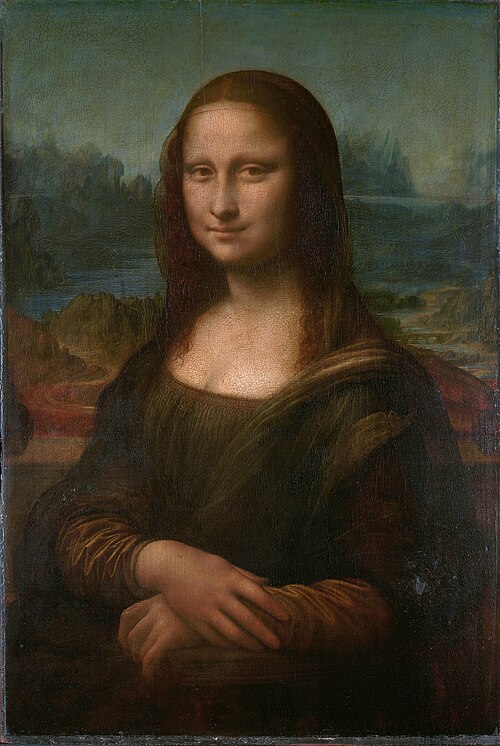
More than 500 years ago, in the Italian city of Florence, a silk merchant named Francesco del Giocondo asked the painter Leonardo da Vinci to paint his wife, Lisa. Leonardo started the picture, but he never gave it to the family. He carried it with him for the rest of his life and kept adding tiny touches.
The painting is not very big: about the size of a large school poster folded in half. It is painted with oil paint on a thin board made of poplar wood, not on canvas.
Look closely at Lisa’s face. There are no hard lines around her mouth or eyes. Leonardo blended the colours so softly, like smoke drifting, that her smile seems to change when you look at different parts of the picture. Artists call this soft blending “sfumato”, from the Italian word for smoke.
Behind Lisa is a strange, dreamy landscape with winding roads, a bridge, rocky mountains and water that fades into blue mist. Leonardo noticed that faraway things look paler and bluer, and he painted them that way to make the scene feel deep.
Today the Mona Lisa hangs in the Louvre Museum in Paris behind thick protective glass. In 1911 a man stole it, and it was missing for more than two years before it was found in Florence. Millions of people visit it every year, and it has been copied, joked about and printed on almost everything you can imagine.
At a glance
- Artist
- Leonardo da Vinci (1452–1519)
- Date
- Begun c. 1503 in Florence; worked on over many years, possibly until c. 1517 or later; no certain completion date
- Sitter
- Generally identified as Lisa Gherardini (1479–1542), wife of the Florentine merchant Francesco del Giocondo
- Medium
- Oil on a poplar-wood panel
- Size
- About 77 × 53 cm (the Louvre catalogue gives 79.4 × 53.4 cm)
- Location
- Musée du Louvre, Paris (inv. 779); in the French royal collection from the 16th century
- Other names
- La Gioconda (Italian), La Joconde (French); “Mona” is short for Madonna, “my lady”
- Known for
- Sfumato modelling, the ambiguous smile, the atmospheric landscape, and its unmatched modern fame
Easy
What is the Mona Lisa?
The Mona Lisa is a half-length portrait of a seated woman, painted in oil on a wooden panel by the Italian artist Leonardo da Vinci. It shows her from the waist up, turned slightly toward us, with her hands resting one on top of the other. She wears a dark dress and a very thin, transparent veil over her hair, and she looks directly at the viewer with a faint smile.
The name comes from Giorgio Vasari, a sixteenth-century painter and writer who wrote biographies of Italian artists. He called the picture a portrait of “Mona Lisa”, the wife of Francesco del Giocondo. “Mona” is a shortened form of “Madonna”, meaning “my lady”. In Italian the painting is called La Gioconda, and in French La Joconde, both playing on the family name Giocondo, which also means “cheerful” or “joyful”.
The painting now belongs to the French state and hangs in the Louvre Museum in Paris. Because it is so famous and so fragile, it is displayed behind bulletproof glass in a climate-controlled case, and visitors often have only a short moment to see it in the crowd.
Easy
How to look at the painting
Start with the face. Leonardo did not outline the lips or the corners of the eyes with sharp edges. Instead he built up the shadows in many very thin, almost transparent layers of paint, so that light turns gently into shadow. Because the corners of the mouth and eyes are left soft and uncertain, the expression seems to shift: when you look straight at the mouth the smile can seem to fade, and when you look at the eyes it can seem to return.
Next look at the pose. The woman sits in a chair whose armrest is visible at the lower left, with her body turned at an angle and her head turned more toward us. This twisting, relaxed pose, with the hands shown in full, was new for portraits in Florence and was soon copied by other painters, including the young Raphael. The figure forms a stable pyramid shape, from the hands at the base to the head at the top.
Then look behind her. She sits on a loggia, a covered balcony; the bases of two columns can be seen at the left and right edges. Beyond the parapet a wild landscape opens up: a winding road, a bridge with several arches on the right, rocky crags and lakes. The horizon on the left seems lower than the one on the right, which adds to the unsettled, dreamlike feeling. The distant hills fade into blue-green haze, an effect called aerial (or atmospheric) perspective, which Leonardo studied carefully in his notebooks.
Finally, notice what is missing. She wears no jewellery, and there is no coat of arms or inscription telling us who she is. Scholars have also noticed that she appears to have no visible eyebrows or eyelashes; some technical studies suggest they were painted very delicately and later lost through cleaning, but this is uncertain.
Easy
Who was Leonardo da Vinci?
Leonardo was born on 15 April 1452 in or near the small town of Vinci in Tuscany. As a teenager he trained in the Florentine workshop of the sculptor and painter Andrea del Verrocchio. He later worked for the Duke of Milan (roughly 1482–1499), where he painted The Last Supper, then returned to Florence, where he began the Mona Lisa.
Leonardo was curious about almost everything. His notebooks, thousands of pages long, contain studies of anatomy, water, flight, plants, machines, light and shadow. He dissected human bodies to understand muscles and bones, and he studied how light falls on round objects. All of this shows up in the Mona Lisa: in the soft modelling of the face, the structure of the hands, and the geology and water of the landscape.
He was also famous for leaving work unfinished. He finished only a small number of paintings, and he often kept them with him for years. The Mona Lisa is an example: instead of delivering it to the Giocondo family, he took it to Milan, Rome and finally France, where he died on 2 May 1519 at Clos Lucé near Amboise, as a guest of King Francis I.
Intermediate
The sitter: Lisa Gherardini and her family
Lisa Gherardini was born in Florence on 15 June 1479, into an old family that had lost much of its former wealth and influence. In 1495, at about fifteen, she married Francesco del Giocondo, a successful merchant in silk and cloth who was considerably older and had been married before. They had several children, and Lisa also helped raise her stepson. Archival research, notably by the Italian scholar Giuseppe Pallanti, has reconstructed many details of her life from tax records, contracts and church documents.
Why would Francesco commission a portrait around 1503? Historians have suggested two occasions: the birth of their son Andrea in December 1502 and the family’s purchase of a new house around the same time. A portrait of a wife was a way for a prosperous merchant family to display its respectability and good fortune. The thin veil and dark clothes fit the dress of a respectable Florentine married woman, although some writers have tried to read them as signs of mourning or pregnancy; these readings are not generally accepted.
Lisa outlived her husband, who died in 1538 or 1539, and spent her last years connected with the convent of Sant’Orsola in Florence, where two of her daughters had become nuns. She died on 15 July 1542 (some sources give 14 July). The family never received the portrait; there is no record that any Giocondo ever saw it finished.
Intermediate
How and when it was painted
The start date is unusually well documented for a Renaissance painting. In 2005 a librarian at Heidelberg University Library, Armin Schlechter, identified a handwritten note in the margin of a printed edition of Cicero. It was written in October 1503 by Agostino Vespucci, an assistant in the Florentine chancery, who compared Leonardo to the ancient painter Apelles and mentioned that Leonardo was working on a head of Lisa del Giocondo. This confirmed that the portrait was under way in 1503, when Leonardo was also working on the huge Battle of Anghiari mural for Florence’s government.
The end date is much less certain. Vasari wrote that Leonardo worked on it for four years and left it unfinished. In 1517 the secretary Antonio de Beatis visited Leonardo in France and recorded seeing a portrait of “a certain Florentine lady, painted from life” at the request of Giuliano de’ Medici. Many scholars think this was the Mona Lisa, which suggests that Leonardo was still adding to it in Rome and France. The Louvre therefore dates the work broadly between 1503 and 1519.
Leonardo painted on a single plank of poplar, a common support in Florence, prepared with a white ground. He used oil paint in extremely thin glazes, some only a few micrometres thick, adding layer after layer to create depth and soft transitions. Technical examination, such as infrared and X-ray studies, has revealed changes of mind (pentimenti), for example in the position of the fingers and the veil. Over time the old varnish has yellowed, so the painting now looks warmer and darker than Leonardo intended; the Louvre has so far chosen not to clean it because of the risks involved.
There is a long-standing belief that the panel was cut down at the sides, removing columns. Close examination of the edges suggests that the panel has not been trimmed significantly and that the column bases at the edges were always meant to be only partly visible, though the question was debated for a long time.
Intermediate
Florence and the High Renaissance
Around 1500 Florence was a republic. The Medici family, who had dominated the city for most of the fifteenth century, had been expelled in 1494, and the preacher Girolamo Savonarola had been executed in 1498. Niccolò Machiavelli worked in the city’s chancery at this time, and Michelangelo was carving his David (1501–1504). Leonardo and Michelangelo were even commissioned to paint rival battle scenes on the walls of the same council hall.
Portraiture was changing. Earlier Florentine portraits of women were often in strict profile, like figures on a coin, showing status through jewellery and fine clothing. Flemish painters had introduced three-quarter views and landscape backgrounds, which Italian artists admired. Leonardo combined these ideas with his own science of light and anatomy to create a portrait that feels like a living person thinking and looking back at us.
The Mona Lisa quickly influenced other artists. Raphael, who was in Florence around 1504–1508, made a drawing based on it and used its pose in portraits such as that of Maddalena Doni. Copies were made by Leonardo’s circle; a version in the Museo del Prado in Madrid, cleaned in 2012, is thought to have been painted in Leonardo’s workshop at the same time as the original, perhaps by one of his pupils, and shows what the colours may have looked like before the varnish darkened.
Intermediate
From Leonardo’s studio to the Louvre
After Leonardo’s death the painting entered the collection of the French king Francis I. How exactly this happened is debated. Leonardo’s long-time assistant Salaì seems to have owned the painting, or a version of it, at some point; an inventory of his estate made in 1525 lists a picture called “La Gioconda”. Some historians think Francis I bought the original from Salaì during Leonardo’s lifetime; the Louvre’s own catalogue says the king acquired it in 1518.
For almost three centuries the painting belonged to the French kings and was kept at the palace of Fontainebleau and later at Versailles. After the French Revolution the royal collections became national property, and the painting was assigned to the new public museum in the Louvre. Napoleon Bonaparte had it hung in his bedroom in the Tuileries Palace for a few years around 1800 before it returned to the museum.
During wars the painting was moved for safety: in 1870–71 and during both World Wars it was sent away from Paris, and in the Second World War it was hidden in several châteaux in the French countryside, including Chambord, to protect it from bombing and looting.
Intermediate
The 1911 theft and the making of an icon
Until the nineteenth century the Mona Lisa was admired by artists and connoisseurs but was not more famous than many other Renaissance paintings. Romantic writers began to describe the woman as a mysterious and seductive figure, and the English critic Walter Pater’s famous passage of 1869 helped to make her smile a symbol of enigma.
On 21 August 1911 the painting disappeared from the Louvre. The thief was Vincenzo Peruggia, an Italian worker who had helped install protective glass at the museum; on a day when the museum was closed he took the panel off the wall, removed its frame and left the building with it hidden under a workman’s smock. For more than two years it was missing. The poet Guillaume Apollinaire was briefly arrested, and Pablo Picasso was questioned. In December 1913 Peruggia tried to sell the painting to the Florentine art dealer Alfredo Geri, who alerted the authorities. Peruggia claimed he wanted to return it to Italy. After being shown in Florence, Rome and Milan, the painting returned to Paris in January 1914.
Newspapers around the world covered the theft and its recovery, and the painting became a household name. In the twentieth century artists used it as a symbol of high art to be questioned or mocked: in 1919 Marcel Duchamp drew a moustache and goatee on a postcard reproduction (L.H.O.O.Q.), and in 1963 Andy Warhol repeated it in a silkscreen titled Thirty Are Better Than One. The painting travelled to the United States in 1962–63, where well over a million people saw it, and to Tokyo and Moscow in 1974.
It has also been attacked. In 1956 a visitor threw a stone that damaged a small area of paint near the left elbow, and since then it has been displayed behind protective glass. More recent incidents, such as a cake smeared on the glass in 2022 and soup thrown at it in 2024, did not harm the painting itself.
Advanced
Scholarly debates: identity, commission and completion
Identity. Vasari’s identification of the sitter as Lisa del Giocondo was published in 1550, decades after the event and by an author who never saw the painting, so for a long time it was treated with caution. Alternative identities were proposed, including Isabella d’Este, Costanza d’Avalos, a mistress of Giuliano de’ Medici, an idealized woman, or even a disguised self-portrait of Leonardo. The Vespucci note of 1503 is now generally regarded as strong confirmation that Leonardo was painting Lisa del Giocondo at that date. What remains debated is whether the Louvre painting is exactly that portrait, and how much it was transformed later.
The de Beatis problem. De Beatis’s 1517 description links the Florentine lady’s portrait to Giuliano de’ Medici, not to Francesco del Giocondo. Scholars have explained this in different ways: Giuliano, who lived in Rome while Leonardo worked there under his patronage, may have encouraged Leonardo to continue the portrait; de Beatis or his informant may have been confused; or the painting seen in France may have been a different work. The existence of two portraits, one for the Giocondo family and another later version, has been proposed, but most specialists regard the Louvre picture as the single original begun in 1503.
The Isleworth Mona Lisa and other versions. A painting known as the Isleworth Mona Lisa, which shows a younger-looking woman with columns at the sides, has been promoted since the early twentieth century as an earlier version by Leonardo. Most Leonardo specialists do not accept this attribution. The Prado copy, by contrast, is widely accepted as a workshop replica made alongside the original, and it is valuable evidence of how the Louvre painting looked before its varnish aged.
Meaning. Art historians disagree about how far to read symbolism into the painting. Some interpret the landscape as an image of the living earth and the passage of time, in line with Leonardo’s notes comparing the body of the earth to the human body; others stress conventional elements of a Florentine marriage or family portrait. The famous smile has attracted explanations from optics and neuroscience, which argue that the effect depends on how peripheral vision perceives low-contrast shadows. These explanations can describe how the illusion works but not what Leonardo intended.
Advanced
Evidence, science and conservation
Documents. The main written sources are Vespucci’s 1503 marginal note, de Beatis’s 1517 travel diary, Vasari’s Lives of the Artists (1550, revised 1568), the 1525 inventory of Salaì’s estate, and later French royal inventories. Florentine archives on the Giocondo family, examined by Pallanti and others, provide context but do not mention the painting directly.
Scientific study. Since the twentieth century the painting has been examined with X-radiography, infrared reflectography, multispectral imaging and other methods. Studies have measured the thin glazes of Leonardo’s sfumato and revealed underdrawing and alterations. In 2004–2005 the Louvre organized an extensive technical campaign with the French national museum laboratory (C2RMF). Claims based on newer imaging methods, such as the engineer Pascal Cotte’s proposal that a different portrait lies beneath the visible one, have attracted wide media attention but are not accepted by many experts, who warn that multispectral images of layered paint are easy to over-interpret.
Conservation. The poplar panel has a crack at the top, which was stabilized long ago, and the wood reacts to humidity. The painting is kept in a sealed case at controlled humidity and temperature, and it is not usually lent abroad. Any cleaning of the discoloured varnish is highly controversial: supporters argue it would reveal Leonardo’s colours, while opponents fear damaging glazes that are only micrometres thick.
Display. The painting has hung in the Salle des États since 2005, where visitor numbers of up to about ten million a year have made viewing conditions notoriously difficult. In 2025 the French government announced plans for a new dedicated space for the Mona Lisa as part of a larger renovation of the Louvre; the details and timetable of such projects may change.
Key ideas
- Sfumato
- Leonardo’s technique of blending tones so softly, without lines or borders, that forms seem to emerge from shadow like smoke.
- Aerial perspective
- Showing distance by making far-off objects paler, bluer and less distinct, as in the landscape behind Lisa.
- The ambiguous smile
- Soft, undefined corners of the mouth and eyes make the expression seem to change depending on where the viewer looks.
- A new kind of portrait
- The three-quarter half-length pose with visible hands and a landscape background became a model for Renaissance portraiture.
- The unfinished masterpiece
- Leonardo kept and reworked the painting for years instead of delivering it, blurring the line between commission and personal project.
- Fame as history
- The painting’s status as the world’s most famous artwork owes much to nineteenth-century writing, the 1911 theft and modern mass media.
- Conservation dilemma
- The fragile panel and yellowed varnish raise the question of whether to preserve the painting as it is or attempt to recover its original look.
Records
- 1452 — Leonardo da Vinci is born in or near Vinci, Tuscany (15 April).
- 1479 — Lisa Gherardini is born in Florence (15 June).
- 1495 — Lisa marries the merchant Francesco del Giocondo.
- 1503 — Agostino Vespucci notes in October that Leonardo is painting a head of Lisa del Giocondo.
- 1517 — Antonio de Beatis sees a portrait of a Florentine lady in Leonardo’s studio in France.
- 1519 — Leonardo dies at Clos Lucé near Amboise (2 May); the painting passes into the French royal collection.
- 1550 — Giorgio Vasari publishes his Lives, naming the sitter as Mona Lisa, wife of Francesco del Giocondo.
- c. 1797 — After the Revolution the painting is placed in the new public museum at the Louvre.
- 1911 — Vincenzo Peruggia steals the painting from the Louvre (21 August).
- 1913 — The painting is recovered in Florence in December and returns to Paris in January 1914.
- 1963 — The painting is shown in Washington and New York during its tour of the United States (1962–63).
- 2005 — The Vespucci note is identified at Heidelberg; the painting moves to the renovated Salle des États.
Glossary
- Panel painting
- A painting made on a flat board of wood rather than on canvas or a wall.
- Oil glaze
- A very thin, transparent layer of oil paint laid over another layer to change its colour or depth.
- Sfumato
- From Italian fumo, smoke: a way of painting soft transitions between light and shadow.
- Loggia
- A roofed gallery or balcony open on one or more sides, supported by columns.
- Pentimento
- A visible or detectable trace of an artist’s change of mind beneath the final paint surface (plural pentimenti).
- Varnish
- A clear protective coating over a painting; old varnish often turns yellow or brown.
- Infrared reflectography
- An imaging technique that can reveal drawing and changes hidden under paint layers.
- Workshop copy
- A version of a painting made in the artist’s studio, often by assistants, sometimes alongside the original.
- High Renaissance
- The period around 1490–1520 associated with Leonardo, Michelangelo and Raphael.
Questions and answers
Why is she smiling?
Nobody knows what Lisa was thinking. Vasari claimed Leonardo hired musicians and jesters to keep her cheerful, but that story may be invented. The effect of the smile comes mostly from Leonardo’s soft shading around the mouth and eyes.
Why is the painting so small?
It was made as a private portrait for a family home, not for a church or palace wall. At about 77 × 53 cm, it was a normal size for such a portrait.
Is the Mona Lisa really Lisa Gherardini?
Most scholars think so. Vasari said so in 1550, and a note written in October 1503 by Agostino Vespucci, found in 2005, confirms that Leonardo was then painting Lisa del Giocondo.
Why didn’t Leonardo give the painting to Lisa’s husband?
We do not know for sure. Leonardo often kept works to perfect them, he left Florence for Milan in 1506, and he may have come to value the painting as a work of his own art rather than a commission.
Why does it look so yellow and dark?
Old varnish layers have yellowed over five centuries. The Louvre has decided not to remove them because Leonardo’s glazes are extremely thin and could be damaged.
How did the 1911 theft make it more famous?
The story filled newspapers around the world for over two years, and the empty space on the Louvre wall itself drew crowds. When it was found, the painting had become a global celebrity.
Why do scholars date it so broadly, 1503–1519?
The start is documented in 1503, but a visitor saw it in Leonardo’s studio in 1517 and technical evidence suggests later reworking, so no single completion year can be proved.
Sources and further reading
- Portrait de Lisa Gherardini, épouse de Francesco del Giocondo, dite La Joconde ou Monna Lisa (INV 779). Musée du Louvre, Collections
- Mona Lisa. Wikipedia
- Lisa del Giocondo. Wikipedia
- Leonardo da Vinci. Wikipedia
- Sfumato. Wikipedia
- Martin Kemp and Giuseppe Pallanti, Mona Lisa: The People and the Painting. Oxford University Press, 2017
- Donald Sassoon, Mona Lisa: The History of the World’s Most Famous Painting. HarperCollins, 2001
Related
- Sistine Chapel ceilingCeiling frescoes painted by Michelangelo in the Sistine Chapel between 1508 and 1512.
- The PrincePolitical treatise written by Niccolò Machiavelli in 1513 and published after his death.
- Divine ComedyItalian narrative poem by Dante Alighieri describing a journey through Hell, Purgatory and Paradise.
- The Starry NightVincent van Gogh’s 1889 painting presents a night sky in sweeping, rhythmic strokes above a village.
- The Great Wave off KanagawaHokusai’s woodblock print sets a towering wave above boats, with Mount Fuji small in the distance.
Written with AI assistance from the published sources listed above, and revised as new research appears.