Start at the top for an easy introduction. Go further down for more detail and scholarship.
- Easy
- Intermediate
- Advanced
For young readers
Imagine lying on your back on a wooden platform about 20 metres above the floor, as high as a six-storey building, and painting on the ceiling above your face for four years. That is roughly what the artist Michelangelo did in the Sistine Chapel in Rome. Actually he painted mostly standing and bending backwards, which he said hurt his neck and back terribly.
Michelangelo thought of himself as a sculptor, not a painter. But Pope Julius II insisted that he paint the chapel’s ceiling. At first the pope wanted just twelve apostles. Michelangelo said that plan was “a poor thing” and designed something much bigger.
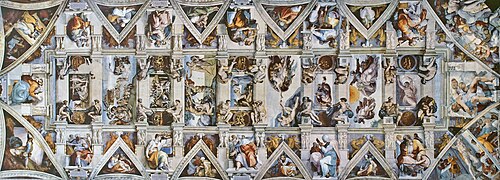
Down the middle of the ceiling run nine pictures from the first book of the Bible, Genesis: God separating light from darkness, making the sun and moon, creating Adam and Eve, the first people, and the story of Noah and the great flood. The most famous picture shows God reaching out to touch Adam’s finger to give him life.
Around those pictures sit giant prophets and sibyls, wise men and women who were believed to have foretold the coming of Christ. There are also young men without clothes sitting on blocks, painted stone decorations, and families in the curved spaces above the windows.
Michelangelo painted in fresco. This means he painted on fresh, wet plaster, so the colours soaked in and became part of the wall when it dried. He had to finish each patch before the plaster dried, working fast and carefully.
At a glance
- Artist
- Michelangelo Buonarroti (1475–1564), with assistants for preparation and some execution
- Date
- Contract signed May 1508; painting c. 1508/09–1512; unveiled 31 October 1512
- Patron
- Pope Julius II (r. 1503–1513), nephew of Sixtus IV, who built the chapel
- Place
- Sistine Chapel, Apostolic Palace, Vatican City (Rome)
- Technique
- Buon fresco (painting on wet lime plaster), with some finishing on dry plaster
- Size
- More than 500 m² of painted vault, about 20 m above the floor
- Content
- Nine Genesis scenes, 7 prophets and 5 sibyls, 20 ignudi, 4 corner pendentives, ancestors of Christ in spandrels and lunettes; over 300 figures
- Later history
- Michelangelo’s Last Judgment added on the altar wall 1536–1541; ceiling cleaned 1980–1989 in a much-debated restoration
Easy
What is the Sistine Chapel ceiling?
The Sistine Chapel is the main chapel of the Apostolic Palace, the pope’s residence in the Vatican. It was built between 1477 and 1480 for Pope Sixtus IV, from whom it takes its name. It is a tall, plain rectangular hall covered by a shallow barrel vault. Popes hold ceremonies there, and it is where cardinals meet in secret, in a conclave, to elect a new pope.
When the chapel was built, its ceiling was painted blue with gold stars, a common design, by the painter Pier Matteo d’Amelia. The side walls were decorated in the early 1480s by famous painters including Perugino, Botticelli, Ghirlandaio and Cosimo Rosselli with scenes from the life of Moses and the life of Christ.
In 1508 Pope Julius II, Sixtus IV’s nephew, asked Michelangelo to repaint the ceiling. The Vatican Museums note that structural problems, including cracks in the vault, probably contributed to the decision to renew the decoration. Over the next four years Michelangelo created one of the most ambitious paintings ever made: a single architectural and narrative scheme covering the whole vault, with more than 300 figures.
Easy
How to read the ceiling
Michelangelo divided the curved vault with painted architecture: fake stone ribs, cornices and thrones that look carved but are only paint. This imaginary framework organizes the different parts, like the pages and margins of a huge book.
Along the centre run nine rectangular scenes from Genesis, in three groups of three. Starting above the altar and moving toward the entrance, they show: God separating light from darkness; the creation of the sun, moon and plants; God separating the waters from the land; the Creation of Adam; the Creation of Eve; the Temptation and the Expulsion from the Garden of Eden; the Sacrifice of Noah; the Flood; and the Drunkenness of Noah. The five smaller scenes alternate with four larger ones.
At the corners of each smaller scene sit the ignudi, twenty muscular nude young men, who hold ribbons attached to painted bronze medallions showing stories from the books of Kings. Around the edges, on large painted thrones, sit twelve seers: seven Hebrew prophets (Zechariah, Joel, Isaiah, Ezekiel, Daniel, Jeremiah and Jonah) and five sibyls from the Greek and Roman world (the Delphic, Erythraean, Cumaean, Persian and Libyan). Christians believed the sibyls, too, had foretold the coming of Christ, so they stand here as witnesses from the non-Jewish world.
In the triangular spandrels and the half-moon lunettes above the windows are the ancestors of Christ, the families listed at the beginning of the Gospel of Matthew, shown as ordinary people waiting, resting and caring for children. In the four large corner pendentives are dramatic stories of Israel being saved: David and Goliath, Judith and Holofernes, the Brazen Serpent, and the Punishment of Haman.
Easy
The Creation of Adam and other famous images
The Creation of Adam is one of the most reproduced images in the world. On the left, Adam lies on a bare green hillside, his body perfect but still limp. On the right, God, shown as a powerful old man with a flowing beard, rushes forward in a billowing cloak, surrounded by angels. Their outstretched fingers almost touch. The small gap between them is the moment just before life passes into the first human.
Other figures are equally admired. The Libyan Sibyl twists to close a huge book, her body turned in a complex pose that Michelangelo studied in a famous red-chalk drawing of a male model. The prophet Jonah, above the altar, leans backwards so strongly that, although he is painted on a surface curving toward the viewer, he seems to lean away. Jonah’s three days inside the great fish were understood by Christians as a sign of Christ’s resurrection, fitting his place above the altar.
The Flood, one of the first scenes painted, is full of small figures struggling to reach high ground. Later scenes, such as the Creation of Adam and God separating light from darkness, have fewer and much larger figures. Seen from the floor, this change is striking: as Michelangelo gained experience of how the ceiling looked from below, his figures became bigger, bolder and simpler.
Intermediate
How it was made: scaffolding, cartoons and fresco
Michelangelo signed the contract on 8 May 1508. First a scaffold had to be built. According to his biographer Ascanio Condivi, the architect Donato Bramante proposed a scaffold hung from ropes through holes in the ceiling, which Michelangelo rejected because it would leave holes. The scaffold actually used was a wooden bridge-like platform supported on beams set into the walls high above the windows, leaving the floor below free for ceremonies. It covered only part of the chapel at a time and was moved when half the ceiling was finished.
Michelangelo made many drawings and full-size cartoons, large paper designs whose outlines were transferred to the plaster by pressing lines into it or by pouncing charcoal dust through pricked holes. Traces of both methods are visible up close.
Fresco requires the painter to apply fresh lime plaster only over the area that can be painted in one day, called a giornata (a “day’s work”). The pigments, mixed with water, bond chemically with the plaster as it dries. Mistakes cannot easily be corrected except by chipping off the plaster and starting again. Early in the work, mould appeared on the Flood; Michelangelo’s biographers report that he feared the project had failed until he learned how to adjust the plaster.
Michelangelo was not entirely alone, as legend sometimes claims. He called several painters from Florence, including Francesco Granacci and Giuliano Bugiardini, and many helpers ground pigments, prepared plaster and transferred designs. He seems to have dismissed some of the Florentine painters early on, and he executed the main figures himself. Art historians continue to debate how much the assistants painted.
Intermediate
Four years of work, war and money
Michelangelo began painting at the entrance end with the Noah scenes, probably late in 1508 or early in 1509, and moved toward the altar, so he painted the Bible story backwards. By around 1510 the first half was finished, and it was unveiled in August 1511. The second half, including the Creation of Adam and the scenes of God creating the world, was completed more quickly and with greater confidence. The full ceiling was unveiled on 31 October 1512, and a Mass was celebrated in the chapel on All Saints’ Day, 1 November.
These years were turbulent. Julius II was a warrior pope who led armies to restore papal control over cities such as Bologna, and he was often away from Rome. Payments to Michelangelo were sometimes delayed, and his letters to his family complain of exhaustion, lack of money and worries about his brothers and father. A famous comic sonnet he wrote to a friend, Giovanni da Pistoia, describes his beard pointing to heaven, his belly pushed up under his chin and his brush dripping paint onto his face, alongside a small sketch of himself painting.
The pause between the two halves had artistic consequences. When the scaffold was taken down in 1511, Michelangelo could see his work from the floor for the first time as a whole. The figures of the second half are generally larger, the compositions simpler, and the brushwork freer; in some late scenes, such as God separating light from darkness, the figure seems to have been painted in a single day with few preparatory marks on the plaster. Many art historians see in this a visible record of an artist learning a new medium on a monumental scale.
Julius II died in February 1513, only a few months after the ceiling was completed. The della Rovere family symbol, the oak tree with its leaves and acorns, appears throughout the ceiling, especially in the garlands held by the ignudi, as a reminder of the patron.
Intermediate
Rome, Julius II and the High Renaissance
Julius II set out to make Rome a new imperial capital of Christianity. In the same years he ordered the rebuilding of St Peter’s Basilica, under Bramante, and commissioned the young Raphael to paint rooms in the papal apartments a few steps away from the chapel, including the School of Athens. He had first called Michelangelo to Rome in 1505 to carve a gigantic tomb for himself; the tomb project was repeatedly interrupted, including by the ceiling commission, and caused Michelangelo decades of frustration.
Michelangelo, born in 1475 at Caprese in Tuscany and trained in Florence, was already celebrated for his marble Pietà in St Peter’s and his David in Florence. He had never painted a large fresco before. His knowledge of sculpture and anatomy shaped the ceiling: many figures look like statues brought to life, and the ignudi recall ancient sculpture such as the Belvedere Torso, which Michelangelo admired in the papal collections.
The ceiling also belongs to the chapel as a whole. The fifteenth-century wall paintings show the time of the Law of Moses and the time of Grace under Christ. The ceiling adds the time before the Law, from creation to Noah, together with the prophets and sibyls who pointed toward Christ, so the whole chapel presents a Christian history of salvation.
Intermediate
Influence and the Last Judgment
Artists flocked to study the ceiling as soon as it was visible. Its muscular, twisting figures, bold foreshortening and heroic scale set a new standard for representing the human body. Raphael’s later style shows its impact, and the generation of painters called Mannerists, such as Pontormo and Rosso Fiorentino, developed its elongated and contorted poses further. Giorgio Vasari, in his Lives of the Artists (1550, revised 1568), presented the ceiling as proof that Michelangelo had surpassed both the ancients and nature.
More than twenty years later, Michelangelo returned to the chapel. Commissioned under Pope Clement VII and completed under Paul III, he painted the Last Judgment on the altar wall between 1536 and 1541. To make room, earlier frescoes and two of his own lunettes were destroyed. The Last Judgment’s nudity provoked criticism during the Counter-Reformation, and after Michelangelo’s death draperies were painted over some figures.
Over the centuries, prints, copies and later photographs spread the ceiling’s images across the world. Today several million people a year visit the chapel as part of the Vatican Museums, and it continues to be used for the conclave that elects each new pope. The meeting fingers of God and Adam in particular have become a worldwide visual shorthand for creation and the spark of life, endlessly reused in advertising, films and cartoons.
Intermediate
The 1980–1989 restoration and its critics
Over the centuries the ceiling was darkened by candle and lamp smoke, dust, salt deposits from water leaks, and layers of animal glue and varnish that earlier restorers, including Annibale Mazzuoli in the early eighteenth century, had applied to brighten it. By the twentieth century many people thought of Michelangelo as a painter of sombre, shadowy colours.
A major restoration was carried out by the Vatican, led by the conservator Gianluigi Colalucci and financed by Nippon Television, which received exclusive photographic rights. The lunettes were cleaned from 1980 to 1984 and the ceiling was completed in 1989; work on the Last Judgment followed. Cleaning revealed startlingly bright colours: pinks, pale greens, oranges and clear blues.
The results were fiercely debated. Critics, notably the American art historian James Beck, argued that Michelangelo had added final shadows and glazes a secco (on dry plaster) with glue-based paint, and that the restorers had removed these along with the dirt, flattening the figures. The restorers replied that Michelangelo worked almost entirely in true fresco, that what they removed was later grime and glue, and that the bright colours were consistent with Florentine painting of the time and with the later Mannerist palette. Most specialists now accept the cleaned ceiling as closer to Michelangelo’s intentions, though some losses of subtle detail remain a subject of discussion.
Advanced
Scholarly debates: who designed the programme, and what does it mean?
The programme. The ceiling’s theological scheme is complex, combining Genesis, prophecy, genealogy and typology (the reading of Old Testament events as foreshadowing Christ). Michelangelo later wrote in a letter that the pope gave him a free hand, and Condivi’s biography repeats this. Many scholars doubt that a sculptor designed such a learned scheme without theological advice, and candidates have been proposed from the papal court, such as the Augustinian preacher Egidio da Viterbo. Others take Michelangelo’s claim more seriously, noting his deep knowledge of the Bible and of Dante. No document naming an adviser has been found.
Interpretations. Twentieth-century art historians offered competing readings. Charles de Tolnay, in his multi-volume study of Michelangelo, interpreted the ceiling in Neoplatonic terms as the soul’s ascent from bodily bondage, reading from the entrance (Noah) toward the altar (God alone). Esther Gordon Dotson proposed an Augustinian reading based on the theology of the City of God. Others emphasize papal and della Rovere politics, or liturgical meaning connected with the chapel’s ceremonies. These approaches are not mutually exclusive, and the ceiling’s layered structure invites several kinds of reading.
The ignudi. The twenty nude youths have no clear textual source. They have been explained as angels, as ideal human beauty in the tradition of ancient sculpture, as bearers of the della Rovere oak garlands, or as figures between the human and divine realms. Their nudity, like that of the Last Judgment, was criticized in the sixteenth century.
Modern claims. Some modern writers have proposed hidden anatomical images, most famously the physician Frank Meshberger’s 1990 argument that God and the angels in the Creation of Adam form the outline of a human brain. Such readings are intriguing but remain speculative; most art historians treat them with caution, since Michelangelo’s well-documented anatomical study does not by itself prove intended symbolism.
Advanced
Sources and methods
Written sources. The contract and payment records, Michelangelo’s own letters and poems, and the two early biographies, Vasari’s Lives (1550 and 1568) and Condivi’s Life of Michelangelo (1553), are the main texts. The biographies were written in Michelangelo’s lifetime and partly shaped by him, so they are valuable but self-promoting; stories such as Bramante plotting to make Michelangelo fail by pushing him into painting are now treated sceptically.
Drawings. Several hundred sheets connected with the ceiling survive in collections such as the British Museum, the Uffizi, the Casa Buonarroti and the Metropolitan Museum of Art, including studies for the Libyan Sibyl, Adam and the ignudi. They show how Michelangelo developed poses from live models, usually male, even for female figures.
Physical evidence. The restoration of the 1980s allowed close study of the plaster surface: the boundaries of each giornata, incised and pounced lines, and the way Michelangelo’s speed increased. Counting the giornate gives an estimate of the working pace and supports the view that the second half was painted much faster than the first. The restoration reports and photographs are now themselves primary sources for understanding what was changed.
Popular history. Accessible books, such as Ross King’s Michelangelo and the Pope’s Ceiling (2003), have made this documentation widely known, while specialized studies continue to debate the division of labour, the chronology of individual sections, and the role of theological advisers.
Key ideas
- Fresco
- Painting on wet lime plaster so that the colours become part of the wall, requiring speed and precise planning.
- Painted architecture
- Illusionistic ribs, cornices and thrones that organize the vault into a clear, readable system.
- History of salvation
- Together with the wall frescoes, the ceiling presents Christian history from creation, through the Law, to Christ.
- Typology
- Reading Old Testament figures and events, such as Jonah or the Brazen Serpent, as foreshadowing Christ.
- The heroic human body
- Michelangelo’s sculptural, muscular figures set a new standard for depicting the human form.
- Prophets and sibyls
- Hebrew prophets and pagan seers side by side express the idea that all humanity awaited Christ.
- Restoration debate
- The 1980s cleaning revealed bright colours but raised the question of what had been lost, a key case in conservation ethics.
Records
- 1477 — Construction of the Sistine Chapel begins under Pope Sixtus IV (to 1480).
- c. 1482 — Perugino, Botticelli, Ghirlandaio and others complete the wall frescoes of Moses and Christ.
- 1503 — Giuliano della Rovere is elected Pope Julius II.
- 1508 — Michelangelo signs the contract for the ceiling (8 May).
- 1511 — The first half of the ceiling is unveiled (August).
- 1512 — The completed ceiling is unveiled (31 October).
- 1513 — Julius II dies (February).
- 1536 — Michelangelo begins the Last Judgment on the altar wall (completed 1541).
- 1553 — Ascanio Condivi publishes his Life of Michelangelo.
- 1564 — Michelangelo dies in Rome (18 February).
- 1980 — The modern restoration begins with the lunettes.
- 1989 — Cleaning of the ceiling is completed.
Glossary
- Buon fresco
- “True fresco”: painting with water-based pigments on fresh, wet lime plaster.
- A secco
- Painting on dry plaster, with pigments mixed with a binder such as glue; less durable than true fresco.
- Giornata
- The patch of plaster laid and painted in one day; seams between giornate can be traced.
- Cartoon
- A full-size drawing used to transfer a design to the wall.
- Barrel vault
- A ceiling shaped like half a cylinder or a shallow curve running the length of a room.
- Spandrel
- A roughly triangular surface between the curves of arches or vault sections.
- Lunette
- A half-moon-shaped wall area, here above each window.
- Pendentive
- A curved triangular section at a corner of a vault.
- Ignudi
- Italian for “nudes”: the twenty seated male figures framing the smaller Genesis scenes.
- Sibyl
- A prophetess of the ancient Greek and Roman world, believed by Christians to have foretold Christ.
- Conclave
- The closed meeting of cardinals that elects a new pope, held in the Sistine Chapel.
Questions and answers
Did Michelangelo paint lying on his back?
Probably not. He designed a scaffold that let him stand and paint above his head, bending backwards. His own comic poem describes the painful strain on his neck and back.
Did he paint the whole thing by himself?
He designed everything and painted the main figures himself, but assistants helped prepare plaster, transfer designs and paint some areas. How much they painted is still debated.
How long did it take?
About four years: the contract was signed in May 1508 and the ceiling was unveiled on 31 October 1512.
Why are there pagan sibyls in a Christian chapel?
Christian tradition held that some sibyls had foretold Christ’s coming. Placing them beside the Hebrew prophets suggests that the whole world, not only Israel, awaited him.
Why did the colours become so bright after the restoration?
The restorers removed centuries of soot and old glue. Critics argue some of Michelangelo’s own final shading was also removed; the restorers and most specialists believe the bright colours are original.
Who decided what the ceiling should show?
Michelangelo claimed the pope gave him a free hand. Many scholars suspect a theologian advised him, but no document names one.
Is the Last Judgment part of the ceiling?
No. It is on the altar wall and was painted by Michelangelo more than twenty years later, in 1536–1541.
Sources and further reading
- Sistine Chapel: The Ceiling. Musei Vaticani
- Sistine Chapel ceiling. Wikipedia
- Michelangelo. Wikipedia
- The Creation of Adam. Wikipedia
- Restoration of the Sistine Chapel frescoes. Wikipedia
- Ross King, Michelangelo and the Pope’s Ceiling. Walker & Company, 2003
Related
- Mona LisaPortrait by Leonardo da Vinci, generally identified as Lisa Gherardini.
- The PrincePolitical treatise written by Niccolò Machiavelli in 1513 and published after his death.
- Divine ComedyItalian narrative poem by Dante Alighieri describing a journey through Hell, Purgatory and Paradise.
- PantheonA Roman temple rebuilt under Hadrian, celebrated for its vast concrete dome and central opening.
- Hagia SophiaA monumental church built for the Byzantine emperor Justinian I in Constantinople between 532 and 537 CE.
- GuernicaPablo Picasso’s large 1937 painting responds to the bombing of the Basque town of Gernika during the Spanish Civil War.
Written with AI assistance from the published sources listed above, and revised as new research appears.