Start at the top for an easy introduction. Go further down for more detail and scholarship.
- Easy
- Intermediate
- Advanced
For young readers
Imagine a painting so big that it would cover a whole wall of your classroom: almost 8 metres long and 3.5 metres high. That is Guernica, painted by the Spanish artist Pablo Picasso.
In April 1937 Spain was fighting a civil war, a war between people of the same country. On a market day, German and Italian warplanes helping one side dropped bombs on Gernika, a small town in the Basque Country in northern Spain. Much of the town burned, and many ordinary people were killed or hurt.
Picasso lived in Paris. When he read about the bombing and saw photographs in the newspapers, he was horrified. He had been asked to make a painting for Spain’s building at a big world fair in Paris, and he decided to paint what had happened to Gernika.
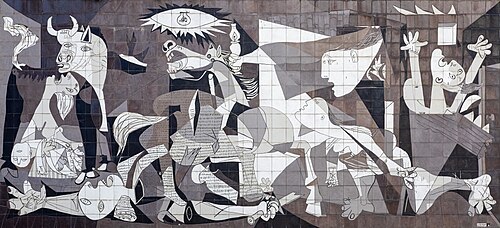
The painting has no colours, only black, white and grey, like a newspaper photo. You can find a screaming horse, a bull, a mother holding her dead baby, a fallen soldier holding a broken sword, people with their arms raised in fear, and a light bulb shining like an eye. The shapes are broken and twisted, as if the whole world has been smashed.
Picasso did not want the painting to go to Spain while the dictator Franco ruled it. So it lived in a museum in New York for more than forty years. It finally went to Spain in 1981, after Spain became a democracy, and today it hangs in the Reina Sofía museum in Madrid.
At a glance
- Artist
- Pablo Picasso (1881–1973), Spanish painter living in Paris
- Painted
- Paris, about 1 May – 4 June 1937, in his studio on the Rue des Grands-Augustins
- Medium and size
- Oil on canvas, 349.3 × 776.6 cm
- Subject
- The bombing of Gernika (Guernica), Basque Country, on 26 April 1937 by the German Condor Legion and the Italian Aviazione Legionaria, supporting Franco’s Nationalists
- First shown
- Spanish Republic’s pavilion at the Paris International Exposition, summer 1937
- Location
- Museo Nacional Centro de Arte Reina Sofía, Madrid (since 1992); at MoMA, New York, 1939–1981
- Style
- Monochrome composition using Cubist fragmentation and traditional symbols
- Significance
- One of the most recognised anti-war images in the world
Easy
What is Guernica?
Guernica is a mural-sized oil painting by Pablo Picasso, one of the most influential artists of the twentieth century. It measures about 3.5 m high and 7.8 m wide. Picasso painted it in Paris in May and early June 1937 for the pavilion of the Spanish Republic at the International Exposition held in Paris that summer.
Picasso was born in Málaga, in southern Spain, in 1881 and moved to Paris as a young man. There, with Georges Braque, he invented Cubism, a way of painting that breaks objects and people into flat, angular pieces seen from several sides at once. By 1937 he was in his mid-fifties and famous across the world, but until the Civil War he had rarely addressed politics directly in his art. Guernica became his most powerful public statement about war, and it changed how people thought about what modern art could do: not only experiment with form, but also speak about injustice in a way that millions could feel.
The painting responds to a real event: on 26 April 1937, during the Spanish Civil War, the Basque town of Gernika (Guernica in Spanish) was bombed from the air for about three hours by German and Italian aircraft fighting on the side of General Francisco Franco. The attack destroyed much of the town and killed and injured civilians.
Picasso did not paint the town, the planes or the bombs. Instead he painted people and animals in agony, twisted and broken, in a dark room that is also a street. Because the painting shows suffering rather than a particular battle, it has come to stand for the horror of war in general, especially war against civilians.
Easy
What happened at Gernika?
The Spanish Civil War began in July 1936, when army officers led by Franco rose against the elected government of the Spanish Republic. Spain split into two sides: the Republicans, who defended the government, and the Nationalists, who supported the rebels. Nazi Germany and Fascist Italy sent aircraft, soldiers and weapons to help Franco; the Soviet Union and volunteers from many countries, the International Brigades, helped the Republic.
Gernika was a small town in the Basque Country of northern Spain, about 30 km from Bilbao. It was special to the Basque people: under an old oak tree there, the Tree of Gernika, Basque assemblies had met for centuries, and it stood as a symbol of Basque freedoms.
Monday 26 April 1937 was market day. In the late afternoon, bombers of the German Condor Legion and the Italian Aviazione Legionaria attacked the town in waves, dropping high-explosive and incendiary bombs, and fighter planes machine-gunned the roads. Around three-quarters of the buildings were destroyed. The oak tree and the Assembly House survived.
How many people died is still debated. The Basque government at the time announced 1,654 dead. Later research by local historians identified about 126 named victims, later revised to 153, and many historians today estimate between about 170 and 300 deaths. Whatever the exact number, most victims were civilians.
Easy
How to “read” the painting
Look at the painting from left to right. On the far left, a bull stands above a mother who screams to the sky, holding her dead child in her arms. The image recalls the Christian Pietà, Mary holding the dead Christ.
In the centre, a horse with a spear wound in its side rears up, its mouth open in a scream. Beneath it lies a fallen soldier, broken into pieces like a statue; his hand still grips a snapped sword, and from it grows a small flower. Above the horse is a lamp shaped like an eye, with a bare electric light bulb as its pupil. Some people see a pun here: in Spanish, “bombilla” means light bulb and sounds like “bomba”, bomb.
From a window on the right, a woman leans out holding a lamp, like a witness bringing light to the scene. Below her, another woman drags herself forward on a bent knee. On the far right, a figure with arms raised screams in a burning building.
Picasso used only black, white and greys. This makes the painting look like a newspaper photograph or a newsreel, which is how most people learned of the bombing. Some areas of the horse’s body are covered with short lines like newsprint.
Intermediate
How Picasso made Guernica
In January 1937 the Republican government asked Picasso, already the most famous Spanish artist alive, to paint a large mural for its pavilion at the Paris Exposition. Picasso had supported the Republic and in 1936 had been named honorary director of the Prado Museum. For months he made little progress; his early sketches explored a favourite theme, the artist and his model in the studio.
News of the bombing reached Paris in the following days. The British journalist George Steer’s report, published in The Times and The New York Times on 28 April, caused international outrage, and French newspapers printed photographs of the ruins. On 1 May Picasso made his first sketches for Guernica. He produced dozens of preparatory drawings, studying the horse, the bull, the mother and child and the weeping woman.
He painted the canvas in a large attic studio at 7 Rue des Grands-Augustins that his partner, the photographer and painter Dora Maar, had helped him find. Maar photographed the painting at several stages. Her photographs, a rare record of a masterpiece in progress, show how Picasso changed his mind: at one point the soldier raised a clenched fist, a Republican salute, which later disappeared; the position of the bull and the horse’s head shifted; and he tried pasting coloured paper onto the figures before returning to monochrome. He finished around 4 June 1937, in roughly five weeks.
Intermediate
The Paris Exposition of 1937
The International Exposition of Art and Technology in Modern Life opened in Paris in May 1937, on both sides of the Seine near the Eiffel Tower. Its most famous image was political: the German pavilion, designed by Albert Speer and topped by an eagle, faced the Soviet pavilion crowned by a giant statue of a worker and a collective farm woman. The fair showed a Europe dividing into hostile camps.
The Spanish pavilion, designed by Josep Lluís Sert and Luis Lacasa, opened in July. It was a modern building of steel and glass meant to show that the Republic stood for culture and modern values while fighting for its survival. Besides Guernica it contained Alexander Calder’s Mercury Fountain, Joan Miró’s mural The Reaper (now lost), Julio González’s sculpture Montserrat and photographs and posters about the war. The poet Paul Éluard’s poem “The Victory of Guernica” was associated with the painting.
The painting’s reception was mixed. Some critics and visitors were impressed; others, including some on the political left, found it too hard to understand and not clearly political enough, preferring realistic propaganda. Only later did it come to be seen as the defining image of the war.
Intermediate
A painting in exile
After the Exposition closed, Guernica travelled to raise awareness and money for Spanish Republican refugees. In 1938 it was shown in Oslo, Copenhagen, Stockholm and Gothenburg, and then in London, Leeds, Liverpool and Manchester. In 1939, after the Republic had lost the war, it went to the United States, where it was shown at the Valentine Gallery in New York and the San Francisco Museum of Art, among other venues, and then in the Museum of Modern Art’s great Picasso retrospective of 1939–40.
When the Second World War broke out, Picasso asked MoMA to keep the painting safe. He later made clear that it should not go to Spain until democracy and public liberties had been restored there. For more than four decades Guernica hung in New York, where it influenced a generation of American artists, including the Abstract Expressionists. Between 1953 and 1956 it travelled to São Paulo, to the first Picasso retrospective in Milan and to other European cities.
In New York it also became a site of protest. During the Vietnam War, anti-war activists gathered in front of it; in 1974 the artist Tony Shafrazi spray-painted the words “KILL LIES ALL” across it ostensibly in protest at the legal proceedings around Lieutenant William Calley, convicted for the My Lai massacre. The paint was removed without lasting damage because of the painting’s varnish.
Intermediate
Return to Spain
Franco ruled Spain as a dictator from the end of the war in 1939 until his death in 1975. His regime, which had long blamed the destruction of Gernika on the Republicans themselves, later tried to obtain the painting as a sign of reconciliation, but Picasso refused. Picasso died in April 1973, two years before Franco.
After Spain became a constitutional democracy in 1977–78, the Spanish government negotiated with MoMA and Picasso’s heirs. Evidence that the Republic had paid Picasso 150,000 francs for the work supported Spain’s claim of ownership. The painting arrived in Madrid in September 1981, close to the centenary of Picasso’s birth, and was displayed at the Casón del Buen Retiro, part of the Prado Museum, behind bulletproof glass and under guard. Its return was widely seen as a symbol that Spain’s transition to democracy was complete.
In 1992 it was moved to the new Museo Nacional Centro de Arte Reina Sofía, where it hangs with many of the preparatory sketches and Dora Maar’s photographs. Basque institutions and nationalists have repeatedly asked for it to be shown in Gernika or at the Guggenheim Museum Bilbao, but the museum has refused, arguing that the canvas, already rolled and moved many times, is too fragile to travel. The painting has not left the museum since.
Intermediate
A universal symbol against war
Over time Guernica became more than a picture of one event. It has been reproduced on posters, banners and murals in many countries and invoked after later bombings of cities, from the Second World War to wars of the twenty-first century. Its figures of the screaming mother, the wounded horse and the broken soldier are recognised far beyond the world of art.
A full-size tapestry copy, commissioned by Nelson Rockefeller and woven under Picasso’s supervision by Jacqueline de la Baume Dürrbach, hung for many years outside the United Nations Security Council chamber in New York. In February 2003, when the US Secretary of State Colin Powell and Ambassador John Negroponte spoke to the press there about Iraq, the tapestry was covered with a blue curtain, which many saw as a telling sign of the painting’s continuing power. The tapestry was removed by its owner in 2021 and returned in 2022.
A well-known story says that during the German occupation of Paris an officer, looking at a photograph of Guernica, asked Picasso, “Did you do that?” and he answered, “No, you did.” The story cannot be verified, but it expresses how the painting came to be understood. Picasso himself said in 1945 that painting is “an instrument of war” against the enemy, not decoration.
Advanced
What do the bull and the horse mean?
Interpreting Guernica’s symbols has occupied critics since 1937. The bull and the horse come from the Spanish bullfight and from Picasso’s own mythology, including the Minotaur of his etchings of the 1930s. Some read the bull as Franco and brutality, the horse as the suffering people; others reverse or complicate this, seeing the bull as Spain or the Spanish people’s endurance, or as Picasso himself. Picasso resisted these readings, telling an interviewer that the bull was a bull and the horse a horse, and that it was for the public to see what they wanted.
Art historians have traced many sources in the composition: the triangular, frieze-like structure of classical pediments; Christian scenes such as the Massacre of the Innocents and the Pietà; Goya’s images of war, especially The Third of May 1808 and the Disasters of War prints; and Picasso’s own 1937 etchings The Dream and Lie of Franco, a satirical comic strip made for the Republican cause.
The painting’s relation to journalism is another important theme. Scholars have noted how its monochrome and newsprint texture echo press photography and film, the media through which the bombing became known, and have compared it with Dora Maar’s photographic practice. Rudolf Arnheim’s study of the preparatory drawings (1962) is a classic analysis of how the composition evolved.
Advanced
The bombing in history and memory
Responsibility and denial. The Nationalist side at first denied that any bombing had taken place and claimed that retreating Basque and Republican forces had burned Gernika themselves. This version remained official in Franco’s Spain for decades. The historian Herbert Southworth’s Guernica! Guernica! (1977) examined how the news was reported and denied and is a key study of the propaganda battle. Today historians agree that the Condor Legion, with Italian participation, carried out the raid, as part of Franco’s campaign in the north.
Military target or terror bombing? Historians still debate the aims of the raid. Some emphasise military objectives: the town lay behind the front, had a bridge and roads used by retreating Republican troops, and small arms factories. Others argue that the choice of weapons, including incendiaries, the timing on market day and the scale of destruction show that the attack also aimed to terrorise the population and break Basque resistance. Diaries and reports of the German commanders are central evidence in this debate. The raid is often cited as an early example of the aerial bombing of civilians that became widespread in the Second World War.
Numbers. The gap between the Basque government’s figure of 1,654 deaths and later estimates of around 150–300 reflects both wartime conditions and the difficulty of counting after Franco’s regime suppressed the subject. Local research groups in Gernika have built lists of named victims, while other historians argue these may be incomplete.
Reconciliation. In 1997, on the sixtieth anniversary, the German President Roman Herzog sent a letter to survivors acknowledging German responsibility, and Gernika has become a centre for peace research and remembrance. Within Spain, the memory of the bombing is tied to wider debates on the Civil War and the Franco era; for the Basque Country it remains a symbol of attacks on Basque identity.
Advanced
Ownership, conservation and the politics of place
The legal status of Guernica was long ambiguous. Picasso regarded it as belonging to the Spanish Republic and entrusted it to MoMA on conditions about democracy in Spain that were not precisely defined. When negotiations began after Franco’s death, questions arose over whether the conditions had been met, who could speak for the Republic, and what Picasso’s heirs had to agree to. Documents showing that the Republic had paid Picasso 150,000 francs in 1937 helped to resolve the matter in Spain’s favour.
The painting’s physical condition is also an issue. It was rolled, shipped and exhibited many times between 1937 and the 1950s, and the canvas shows cracks and old repairs. The Reina Sofía has carried out technical studies, including high-resolution imaging, and argues that further travel would risk serious damage. Basque critics answer that the argument conveniently keeps a symbol of Basque suffering in Madrid. The question of where Guernica “belongs”, to Spain, to the Basque Country or to the world, is part of its meaning today.
Key ideas
- Art as witness
- Picasso turned news of a distant event into an image that bears witness to suffering.
- Universal rather than literal
- The painting shows no planes or specific place, so it can stand for all war against civilians.
- Monochrome
- Black, white and grey evoke newspaper photographs and mourning, and strip the scene of comfort.
- Cubist fragmentation
- Broken, overlapping forms express shock and chaos, as if the world itself has been shattered.
- Old symbols, new horror
- The bull, horse, Pietà and fallen warrior draw on tradition to describe a modern kind of war.
- A painting in exile
- Its long stay in New York and return after Franco made it a symbol of Spanish democracy.
- Contested memory
- Debates over the bombing’s victims, aims and denial, and over where the painting belongs, are part of its story.
Records
- 1936 — July: a military uprising led by Franco begins the Spanish Civil War.
- 1937 — January: the Spanish Republic commissions Picasso to paint a work for its pavilion at the Paris Exposition.
- 1937 — 26 April: German and Italian aircraft bomb Gernika; 1 May Picasso begins sketches; about 4 June he completes the painting.
- 1937 — July: Guernica is displayed in the Spanish pavilion in Paris.
- 1938 — Tours Scandinavia and Britain to support Spanish refugees.
- 1939 — The Civil War ends with Franco’s victory; the painting goes to the United States and into MoMA’s care.
- 1973 — Picasso dies in France on 8 April.
- 1974 — Tony Shafrazi spray-paints a protest message on the painting at MoMA.
- 1975 — Franco dies; Spain begins its transition to democracy.
- 1981 — Guernica arrives in Madrid in September and goes on display at the Casón del Buen Retiro.
- 1992 — The painting moves to the Museo Reina Sofía.
- 1997 — German President Roman Herzog acknowledges German responsibility for the bombing.
Glossary
- Civil war
- A war between groups within the same country.
- Spanish Republic
- Spain’s elected government from 1931, which fought against Franco’s uprising in 1936–39.
- Nationalists
- The side in the Spanish Civil War led by Franco, supported by Germany and Italy.
- Condor Legion
- The German air and ground force sent by Hitler to fight for Franco.
- Basque Country
- A region of northern Spain and south-western France with its own language, Basque (Euskara).
- Cubism
- An art style developed by Picasso and Braque that breaks objects into flat, overlapping shapes seen from several angles.
- Pietà
- An image of the Virgin Mary mourning the dead Christ in her arms.
- Monochrome
- Using only one colour or, here, black, white and shades of grey.
- Preparatory study
- A sketch or drawing made to plan a larger work.
- Incendiary bomb
- A bomb designed to start fires.
Questions and answers
Why is the painting black and white?
Picasso chose black, white and grey, perhaps because people learned about the bombing through newspaper photographs, and because colour would have made the scene less stark.
Is Gernika a real place?
Yes. It is a small town in the Basque Country in northern Spain, still home to the famous Tree of Gernika. Its official name today is Gernika-Lumo.
Why did the painting stay in New York for so long?
Picasso did not want it to go to Spain while Franco’s dictatorship ruled. It went to Madrid in 1981, after Spain had become a democracy.
Who bombed Gernika?
The German Condor Legion, with the Italian Aviazione Legionaria, acting in support of Franco’s Nationalist forces.
How many people were killed?
The number is disputed. The Basque government claimed 1,654, but later research suggests roughly 150–300 deaths, most of them civilians.
Did Picasso explain the symbols?
Rarely, and inconsistently. He said the bull was a bull and the horse was a horse, leaving interpretation to viewers; critics have proposed many competing readings.
Can the painting be moved to the Basque Country?
Basque institutions have asked for it, but the Reina Sofía says the fragile canvas cannot safely travel. The debate continues.
Sources and further reading
- Guernica (Pablo Picasso, 1937). Museo Nacional Centro de Arte Reina Sofía
- Guernica (Picasso). Wikipedia
- Bombing of Guernica. Wikipedia
- 게르니카 폭격. 위키백과
- 1937 Paris Exposition. Wikipedia
- Rudolf Arnheim, Picasso’s Guernica: The Genesis of a Painting. University of California Press, 1962
- Herbert R. Southworth, Guernica! Guernica!: A Study of Journalism, Diplomacy, Propaganda, and History. University of California Press, 1977
- Gijs van Hensbergen, Guernica: The Biography of a Twentieth-Century Icon. Bloomsbury, 2004
Related
- Frida KahloMexican painter known for self-portraits that explore the body, identity, relationships and personal experience.
- United Nations Conference on International OrganizationDelegates met in San Francisco in 1945 to draft and sign the United Nations Charter after the devastation of the Second World War.
- Eiffel TowerIron tower built for the 1889 Paris exposition and later adopted as a symbol of the city.
- The Starry NightVincent van Gogh’s 1889 painting presents a night sky in sweeping, rhythmic strokes above a village.
- UlyssesJames Joyce’s novel follows a day in Dublin through changing styles and the inner lives of its characters.
Written with AI assistance from the published sources listed above, and revised as new research appears.