Start at the top for an easy introduction. Go further down for more detail and scholarship.
- Easy
- Intermediate
- Advanced
For young readers
Frida Kahlo was born in 1907 in a blue house in Coyoacán, a neighbourhood of Mexico City. When she was six she caught an illness called polio, and one of her legs became thinner and weaker than the other. Some children teased her, but Frida grew up bold, clever and funny.
When she was 18, the bus she was riding crashed into a streetcar. A metal rail went through her body, and her back, her hip and her leg were badly broken. She had to lie in bed for months, wearing a hard cast like a shell around her body.
Lying in bed was boring, so her mother had a special easel made that fit over the bed, and hung a mirror above her. Frida could see only herself, so she began to paint herself. That is how one of the most famous painters of the twentieth century started.
Frida married another painter, Diego Rivera, who was big, famous and much older than her. They loved each other, argued a lot, got divorced, and then married each other again.
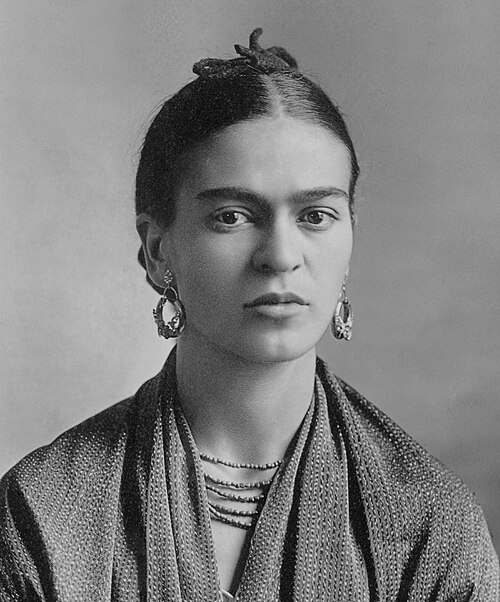
Frida’s paintings are like a picture diary. She painted her pain, her sadness, her hopes and her pride in being Mexican. She often wore colourful dresses from southern Mexico, flowers in her hair, and she painted her thick eyebrows exactly as they were. Today her face is recognised all over the world, and her blue house is a museum you can visit.
At a glance
- Born
- 6 July 1907, Coyoacán, Mexico City (she sometimes gave 1910, the year the Mexican Revolution began)
- Died
- 13 July 1954, in the same house, the Casa Azul (Blue House), aged 47
- Turning point
- Bus accident on 17 September 1925; she began painting during her recovery
- Spouse
- Diego Rivera, muralist (married 1929, divorced 1939, remarried 1940)
- Output
- Roughly 150–200 paintings, many of them small self-portraits, plus drawings and an illustrated diary
- Famous works
- Henry Ford Hospital (1932), The Two Fridas (1939), Self-Portrait with Thorn Necklace and Hummingbird (1940), The Broken Column (1944)
- Style
- Personal, symbolic figurative painting drawing on Mexican folk art, votive retablos and pre-Columbian imagery; often linked to Surrealism, a label she rejected
- Legacy
- Rediscovered from the late 1970s; now a global icon of art, Mexican identity, feminism and disability
Easy
Who was Frida Kahlo?
Frida Kahlo was a Mexican painter who lived from 1907 to 1954. She is best known for her self-portraits: pictures of herself, often looking straight at the viewer with a calm, serious face, surrounded by animals, plants, ribbons, blood, tears or symbols from Mexican history and religion. She painted in oil, usually on small boards or metal sheets rather than big canvases.
Kahlo did not paint battles, kings or landscapes. Her subject was her own life: her injured body, her operations and hospital stays, her marriage, her inability to have children, her friendships and her love for Mexico. Because she painted these very private things so directly, many people feel that her pictures speak to them personally.
During her lifetime she was respected by other artists but was often seen as the wife of the more famous Diego Rivera. Only decades after her death did she become one of the best-known artists in the world. Today her image appears on posters, books, films and even dolls, and her paintings sell for record prices.
Easy
Childhood in the Blue House
Frida was born on 6 July 1907 in the Casa Azul, the Blue House, in Coyoacán, then a village on the edge of Mexico City. Her father, Guillermo Kahlo, was a photographer who had emigrated from Germany; her mother, Matilde Calderón y González, was Mexican, of Indigenous and Spanish descent. Frida had three sisters, Matilde, Adriana and Cristina, as well as half-sisters from her father’s first marriage. Later in life she liked to say she was born in 1910, the year the Mexican Revolution began, as if she and modern Mexico had been born together.
At the age of six she caught polio. The illness left her right leg thinner and shorter, and she walked with a slight limp. Her father encouraged her to play sports to build strength, which was unusual for girls at the time. He also taught her to use a camera and to retouch photographs, skills that trained her eye for detail.
In 1922 Frida entered the National Preparatory School in Mexico City, one of the best schools in the country, where only a few dozen of the students were girls. She planned to become a doctor. She joined a lively group of students who loved books, jokes and politics. At the school she first saw Diego Rivera, who was painting a mural in its auditorium.
Easy
The accident that changed everything
On 17 September 1925, Frida and her boyfriend Alejandro Gómez Arias were riding a wooden bus home when it collided with an electric streetcar. Frida was terribly hurt. Her spine was broken in three places, her pelvis and collarbone were fractured, her right leg was broken in many places and her right foot was crushed, and a metal handrail pierced her abdomen. Doctors were not sure she would live.
She spent months in bed, much of it in plaster casts and corsets. Her dream of studying medicine ended. To pass the time, she started to paint. Her mother had a special easel made so she could paint lying down, and a mirror was fixed above the bed. Looking at her own face every day, she began the self-portraits that would become her life’s work. Her first known paintings date from 1926.
The accident left her with pain that never fully went away. Over the following decades she had many operations, perhaps more than thirty, mostly on her spine and right leg. Pain, medicine and hospitals became part of her life and a central subject of her art.
Easy
Frida and Diego
In 1928, after she had recovered enough to walk again, Frida joined circles of young artists and Communists in Mexico City. There she met Diego Rivera properly and showed him her paintings, asking whether she should keep going. He encouraged her. They married on 21 August 1929; she was 22 and he was 42. Her parents joked that it was the marriage of an elephant and a dove, because Diego was huge and Frida was small.
Their marriage was famous and stormy. Both had other relationships, and Diego had an affair with Frida’s sister Cristina, which hurt her deeply. They divorced in 1939 and married again in San Francisco on 8 December 1940. Despite the pain, they admired each other’s art, and Diego repeatedly called Frida a great painter.
Diego was one of the leaders of Mexican muralism, a movement that painted huge public murals about Mexican history, workers and the Revolution. Frida’s art went in a different direction: small, intimate pictures about one person’s experience. Together, the two show two sides of Mexican art after the Revolution.
Intermediate
Post-revolutionary Mexico and mexicanidad
Kahlo grew up during and after the Mexican Revolution (1910–1920), a long and violent upheaval that overthrew the dictatorship of Porfirio Díaz. In the 1920s the new government, especially the education minister José Vasconcelos, commissioned public murals and promoted a national culture that celebrated Mexico’s Indigenous past and popular traditions rather than imitating Europe. This cultural movement is often called mexicanidad (“Mexicanness”).
Kahlo embraced it in her own way. From around 1929 she often wore the Tehuana costume of the Isthmus of Tehuantepec in southern Mexico, a region associated with strong, independent women: embroidered blouses, long skirts, rebozo shawls and flowers or ribbons in her hair. She collected folk art, pre-Hispanic sculpture and small votive paintings. Her clothing was a statement of identity and politics, and it also hid the braces and the thinner leg that marked her body.
Politically, Kahlo was on the left throughout her adult life. She joined the Mexican Communist Party in 1927, left it around 1929 when Rivera was expelled, and later rejoined. In 1937 she and Rivera helped the exiled Russian revolutionary Leon Trotsky obtain asylum in Mexico, and he and his wife lived in the Blue House until 1939; Kahlo had a brief affair with him. In her final years she painted admiring images of Marx and Stalin, which many admirers today find difficult to reconcile with her other work.
Intermediate
Years abroad: the United States and Paris
From late 1930 to 1933 Kahlo lived mostly in the United States while Rivera painted murals there: first in San Francisco, then briefly in New York, then in Detroit, where he worked on the Detroit Industry murals for the Detroit Institute of Arts. Kahlo felt out of place in what she called “Gringolandia” and missed Mexico. In Self-Portrait on the Borderline between Mexico and the United States (1932), she stands on a pedestal between an ancient Mexican world of temples and plants and an American world of factories, smokestacks and machines.
In Detroit in July 1932 she suffered a miscarriage and was treated at Henry Ford Hospital. Her painting Henry Ford Hospital shows her naked and bleeding on a hospital bed floating in an empty landscape, linked by red ribbons to a foetus, a snail, a pelvis and other objects. It was one of the first pictures in which she used the form of the Mexican retablo, a small devotional painting on tin, to show a personal disaster with shocking frankness. Soon after, her mother died in Mexico.
Her first solo exhibition was held at the Julien Levy Gallery in New York in November 1938; about half of the works on show were sold. The French poet André Breton, leader of the Surrealists, had met her in Mexico that year and wrote an essay for the catalogue, calling her art “a ribbon around a bomb”. In early 1939 she exhibited in Paris, where the French state acquired her self-portrait The Frame, which was described at the time as making her the first Mexican artist in the Louvre’s collection (the painting is now in the Centre Pompidou). She disliked Paris’s art world, however, describing the Surrealists in letters as pretentious.
Intermediate
Reading her major paintings
The Two Fridas (1939), painted around the time of her divorce, is her first large work, almost 1.75 m square. Two Fridas sit hand in hand under a stormy sky. One wears a white European-style dress, the other a Tehuana dress. Their hearts are exposed and joined by a blood vessel; the Mexican Frida holds a small portrait of Diego, while the European Frida uses surgical forceps to stop a vein that drips blood onto her dress. The picture has been read as a double portrait of her mixed German and Mexican heritage, of the self Diego loved and the self he rejected, or of the split between inner and outer life. It is now in the Museo de Arte Moderno in Mexico City.
Self-Portrait with Thorn Necklace and Hummingbird (1940) shows her face-on, with a necklace of thorns cutting into her neck and a dead black hummingbird hanging from it like a pendant. A spider monkey sits behind one shoulder and a black cat peers over the other, against a dense wall of leaves. The thorns recall Christ’s crown of thorns; in Mexican folk tradition hummingbirds were used as love charms. The painting turns personal heartbreak into an image that looks almost like a religious icon.
The Broken Column (1944), painted after spinal surgery, shows her body split open to reveal a cracked Ionic column instead of a spine. She wears a steel orthopaedic corset, nails pierce her skin all over, and tears run down her face, yet her gaze is steady. Behind her stretches a cracked, barren land. The picture combines the Christian image of the martyr with a very modern, medical view of the body.
Other important works include Frieda and Diego Rivera (1931), a wedding portrait; What the Water Gave Me (1938), in which objects from her life float in her bathwater; Self-Portrait with Cropped Hair (1940), in which she wears a man’s suit after her divorce; The Wounded Deer (1946), where her head sits on the body of a deer pierced by arrows; and Moses (1945), which won a national prize. Her last known painting, of cut watermelons, bears the words “Viva la Vida” (“Long live life”).
Intermediate
Techniques, sources and the Surrealism question
Kahlo was largely self-taught, though she learned from her father, from a printmaker friend of the family and from watching Rivera. Her early portraits imitate Italian Renaissance painting, with long necks and elegant poses. From about 1929 her style became flatter and more direct, borrowing from Mexican popular painting: portraits of the colonial era, ex-voto retablos with their short explanatory inscriptions, and the bright colours of folk crafts.
She also drew on pre-Columbian art and Aztec ideas of duality, life and death, and the earth mother, and on Catholic imagery of saints, martyrs and the Sacred Heart. These sources are mixed with anatomy and medical imagery she knew well from her many hospital stays. The result is a symbolic language in which the body is opened up to show emotional truths.
Breton and others claimed her as a Surrealist, and she took part in Surrealist exhibitions, including the International Surrealist Exhibition in Mexico City in 1940, where The Two Fridas was shown. Kahlo herself rejected the label, reportedly saying that she never painted dreams but her own reality. Art historians still debate the question: some see her as an independent painter who shared certain Surrealist devices, others as part of a broader international movement that the Surrealists merely tried to annex.
Intermediate
Teacher, activist and last years
In 1943 Kahlo began teaching at the national school of painting and sculpture known as La Esmeralda. As her health worsened, she taught at home in the Blue House. A group of loyal students, Fanny Rabel, Arturo García Bustos, Guillermo Monroy and Arturo Estrada, became known as “Los Fridos”. She encouraged them to paint the life of ordinary people in the streets and markets.
Her health declined sharply in the 1940s and 1950s. She wore a series of plaster and steel corsets and underwent several spinal operations; in 1953 her right leg was amputated below the knee because of gangrene. In April 1953 the Galería de Arte Contemporáneo in Mexico City held her first solo exhibition in her own country. Forbidden by doctors to get out of bed, she arrived by ambulance and was carried in on a stretcher, and her four-poster bed was placed in the gallery so she could receive visitors.
Kahlo died in the Blue House on 13 July 1954, a week after her 47th birthday. The official cause was a pulmonary embolism; some biographers have suggested an overdose, but this cannot be proven. Her ashes rest in a pre-Columbian urn in the house. In 1958 Rivera’s gift of the house opened to the public as the Frida Kahlo Museum.
Intermediate
From “Diego’s wife” to world icon
For about twenty years after her death Kahlo was known mainly to specialists and in Mexico. Interest grew in the late 1970s and 1980s with the feminist rediscovery of women artists, exhibitions in Mexico, the United States and Britain, and above all Hayden Herrera’s biography Frida (1983). The Chicano movement in the United States adopted her as a symbol of Mexican-American identity and pride.
By the 1990s the phenomenon sometimes called “Fridamania” had begun: her face appeared on T-shirts, mugs and posters, and in 2002 the Hollywood film Frida starred Salma Hayek. Her diary was published in facsimile in 1995. In 2025 her painting The Dream (The Bed) sold at auction for about 54.7 million US dollars, a record for a work by a woman artist.
Kahlo has become an icon for many different groups: for feminists, because she painted women’s bodies and experiences such as miscarriage without shame; for people with disabilities and chronic illness, because she showed pain and medical treatment openly; for LGBTQ communities, because of her relationships with women and her play with gender; and for Mexico, as a national symbol. Critics warn that commercial “Fridamania” can flatten her into a brand and hide her politics, her humour and the complexity of her art.
Advanced
Biography, myth and the problem of sources
Kahlo is unusually hard to separate from her legend, partly because she built it herself. She altered her birth year, dressed as a public persona, wrote vivid letters and a diary, and painted her life as a set of emblematic scenes. Her paintings are often treated as direct autobiography, but they are carefully constructed images that borrow from religious and popular conventions. Scholars increasingly warn against the “biographical fallacy” of reading every picture simply as a record of suffering.
The main sources are her letters (to Gómez Arias, to friends such as the photographer Nickolas Muray, and to doctors), her diary kept in the last decade of her life, photographs by her father and by many well-known photographers, testimony by friends and students, and the paintings themselves. Herrera’s 1983 biography, based on interviews with people who knew her, remains the foundation of most popular accounts, but some of its interpretations and anecdotes have been questioned. Details such as the exact number of her operations, the extent of her injuries and the cause of her death vary between accounts.
In 2004 the bathroom and other sealed spaces in the Blue House were opened, revealing thousands of documents, photographs, clothes and corsets that Rivera had asked to be kept closed for fifteen years after his death; the process was delayed longer by his patron Dolores Olmedo. This archive has since fed new exhibitions on her dress and self-fashioning and new research on her working methods.
Advanced
Interpretive debates
Feminist art history. From the 1970s, scholars such as Laura Mulvey and Peter Wollen, who curated a 1982 exhibition at the Whitechapel Gallery in London pairing Kahlo with the photographer Tina Modotti, used her work to challenge the male-centred canon of modernism. They emphasised her treatment of the female body, reproduction and domestic life as serious artistic subjects.
Identity and the colonial past. Another line of research examines her mexicanidad: whether her Tehuana dress and use of Indigenous imagery were an authentic expression of heritage, a political statement allied to post-revolutionary nationalism, or a form of performance that turned Indigenous culture into costume. Many scholars see all three at once, and relate her work to wider debates about mestizaje and postcolonial identity in Mexico.
Disability and the body. Disability studies scholars have reread her work as one of the most sustained representations of chronic pain and medical intervention in modern art, arguing that it resists both pity and the idea of heroic “overcoming”.
Market and heritage. In 1984 Mexico declared her work part of the national artistic heritage, restricting the export of paintings held in the country. At the same time, the scarcity of her works and the global demand for them have encouraged forgeries and legal disputes over her name and image, which have become a trademark. How to study Kahlo apart from “Frida” the brand is itself a methodological problem.
Key ideas
- Self-portrait as autobiography
- Kahlo made herself her main subject, using her own face and body to explore pain, love, identity and politics.
- The body opened up
- She often shows hearts, spines, blood and wounds, turning inner feelings and medical experience into visible images.
- Mexicanidad
- The post-revolutionary celebration of Mexico’s Indigenous and popular culture, visible in her clothing, collections and imagery.
- Retablo form
- She borrowed the small votive paintings on tin that Mexicans offered to saints, with their direct depiction of disasters.
- Duality
- Pairs of opposites, such as Mexican and European, life and death, sun and moon, recur throughout her work.
- Not Surrealism, but reality
- Although linked to Surrealism, Kahlo insisted she painted her own reality rather than dreams.
- Afterlife as icon
- After her death she became a global symbol, which brings both recognition and the risk of commercial simplification.
Records
- 1907 — Born on 6 July in the Blue House, Coyoacán.
- c. 1913 — Contracts polio, which weakens her right leg.
- 1925 — Seriously injured in a bus accident on 17 September; begins painting while bedridden.
- 1929 — Marries Diego Rivera on 21 August.
- 1930 — Moves with Rivera to San Francisco; lives in the United States until 1933.
- 1932 — Miscarriage in Detroit; paints Henry Ford Hospital.
- 1938 — First solo exhibition, Julien Levy Gallery, New York.
- 1939 — Exhibits in Paris; divorces Rivera; paints The Two Fridas.
- 1940 — Remarries Rivera in San Francisco on 8 December.
- 1953 — First solo exhibition in Mexico; right leg amputated below the knee.
- 1954 — Dies in the Blue House on 13 July.
- 1958 — The Blue House opens as the Frida Kahlo Museum.
Glossary
- Self-portrait
- A picture an artist makes of himself or herself.
- Polio
- A disease caused by a virus that can damage nerves and weaken muscles, especially in children; today it is prevented by vaccines.
- Mural
- A large painting made directly on a wall; Diego Rivera was one of the great Mexican muralists.
- Retablo (ex-voto)
- A small devotional painting, often on tin, made to thank a saint for help in an accident or illness.
- Tehuana
- A woman from the Isthmus of Tehuantepec in southern Mexico, or the traditional dress associated with the region.
- Surrealism
- An art movement founded in Paris in the 1920s that explored dreams and the unconscious.
- Mexicanidad
- A movement celebrating Mexican national identity and Indigenous culture after the Revolution.
- Mexican Revolution
- The armed struggle of 1910–1920 that overthrew the Díaz dictatorship and reshaped Mexico.
- Corset (orthopaedic)
- A stiff support of plaster, leather or steel worn to hold the spine in place.
Questions and answers
Why did Frida Kahlo paint so many pictures of herself?
She started painting while stuck in bed with a mirror above her, and she said she painted herself because she was so often alone and was the subject she knew best.
Why are her eyebrows so famous?
She had naturally thick eyebrows that met in the middle and a faint moustache, and she painted them boldly instead of hiding them, as a sign of honesty and pride.
Was Frida Kahlo a Surrealist?
André Breton called her one and she showed with the Surrealists, but she rejected the label, saying she painted her own reality. Scholars still debate how far she shared their aims.
Where can I see her paintings?
Major collections are in Mexico City, at the Frida Kahlo Museum, the Museo de Arte Moderno and the Museo Dolores Olmedo, and in museums such as MoMA in New York and the Centre Pompidou in Paris.
How reliable is the popular story of her life?
Much of it comes from her own self-presentation and from one influential biography. Details such as the number of operations and the cause of her death differ between accounts, and scholars read her paintings as constructed images, not simple diary entries.
Why did she wear traditional Mexican dresses?
They expressed her pride in Mexican and Indigenous culture and her political ideals, and the long skirts also covered her weaker leg and medical braces.
Sources and further reading
- Frida Kahlo. Wikipedia
- 프리다 칼로. 위키백과
- Frida Kahlo Museum. Wikipedia
- Diego Rivera. Wikipedia
- The Two Fridas. Wikipedia
- The Broken Column. Wikipedia
- Self-Portrait with Thorn Necklace and Hummingbird. Wikipedia
- Henry Ford Hospital (painting). Wikipedia
- Hayden Herrera, Frida: A Biography of Frida Kahlo. Harper & Row, 1983
Related
- GuernicaPablo Picasso’s large 1937 painting responds to the bombing of the Basque town of Gernika during the Spanish Civil War.
- The Starry NightVincent van Gogh’s 1889 painting presents a night sky in sweeping, rhythmic strokes above a village.
- TenochtitlanCapital of the Mexica, founded on an island in Lake Texcoco and conquered in 1521.
- Virginia WoolfEnglish novelist and essayist whose experiments with narrative time and consciousness helped shape literary modernism.
- Langston HughesAmerican poet and writer associated with the Harlem Renaissance, whose work drew on Black life, speech and music.
Written with AI assistance from the published sources listed above, and revised as new research appears.