Start at the top for an easy introduction. Go further down for more detail and scholarship.
- Easy
- Intermediate
- Advanced
For young readers
Imagine the whole world had just been through the worst war in history. Tens of millions of people had died, and many cities were in ruins. People everywhere asked: how can we stop this from ever happening again?
In April 1945, before the war had even finished, representatives from fifty countries travelled to San Francisco, a city on the west coast of the United States. For two months they argued, bargained and wrote together in an opera house and other buildings.
What they wrote was the Charter of the United Nations. A charter is like the rulebook and promise of a club. The countries promised to settle their arguments peacefully, not to attack one another, to work together against hunger and disease, and to respect human rights.
The Charter begins with the words “We the peoples of the United Nations”, and says the goal is to save the children and grandchildren of the world from the terrible sadness of war.
On 26 June 1945 the delegates signed the Charter. On 24 October 1945 enough countries had agreed to it, and the United Nations was officially born. That is why 24 October is celebrated as United Nations Day. Today almost every country in the world, 193 of them, belongs to the UN.
At a glance
- Dates
- 25 April – 26 June 1945
- Place
- San Francisco, United States, mainly at the War Memorial Opera House and the Veterans Building
- Participants
- Delegations of 50 states; about 850 delegates, some 3,500 people in all with advisers and staff, and about 2,500 press and observers
- Sponsors
- United States, United Kingdom, Soviet Union and China (France joined the great powers’ consultations)
- Basis
- The Dumbarton Oaks proposals (1944), the Yalta agreements (February 1945) and amendments from other governments
- Result
- Charter of the United Nations and Statute of the International Court of Justice, adopted 25 June and signed 26 June 1945
- In force
- 24 October 1945, after ratification by the five permanent members of the Security Council and a majority of signatories
- Original members
- 51: the 50 states at the conference plus Poland, which signed on 15 October 1945
Easy
What was the San Francisco Conference?
The United Nations Conference on International Organization, usually called the San Francisco Conference, was the meeting at which the United Nations was designed and agreed. It opened on 25 April 1945 and closed on 26 June 1945 with the signing of the Charter of the United Nations.
It was one of the largest international conferences ever held up to that time. Delegations from fifty countries, from large powers like the United States and the Soviet Union to small states in Latin America, the Middle East and Europe, worked in commissions and committees to turn a draft plan into a full treaty. Journalists from around the world reported on it daily.
The Charter they produced set up the main parts of the UN that still exist: the General Assembly, where every member has a seat and a vote; the Security Council, responsible for peace and security; the Economic and Social Council; the Trusteeship Council; the International Court of Justice; and the Secretariat, the organization’s staff.
The conference did not start from a blank page. The great powers had already agreed on a draft, and much of the work at San Francisco consisted of amending, clarifying and adding to it. Yet the smaller states won real changes, and the Charter that emerged was longer, more detailed and more concerned with economic, social and human-rights questions than the original plan.
Easy
Why did the world want a United Nations?
The Second World War, which began in 1939, was the deadliest conflict in human history. Tens of millions of soldiers and civilians died in battles, bombings, famine and genocide, including the murder of six million Jews in the Holocaust. Cities from Warsaw to Manila lay in ruins.
After the First World War, countries had created the League of Nations in 1920 to keep the peace. But the League was weak: the United States never joined, other powers left it, and it could not stop the aggression of Japan in China, Italy in Ethiopia or Germany in Europe. Many leaders were determined to build something stronger this time.
The new organization’s first purpose, in the Charter’s words, was “to save succeeding generations from the scourge of war”. It was also meant to encourage cooperation on problems such as poverty, health and education, which many people believed had helped cause the war, and to promote respect for human rights.
Intermediate
The road to San Francisco, 1941–1945
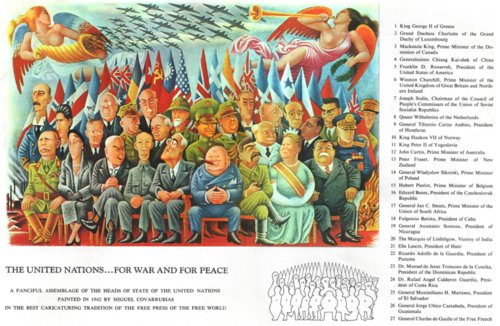
The idea took shape during the war itself. In August 1941 President Franklin D. Roosevelt and Prime Minister Winston Churchill issued the Atlantic Charter, a statement of principles for the post-war world. On 1 January 1942, twenty-six nations fighting the Axis signed the Declaration by United Nations in Washington; the name “United Nations”, suggested by Roosevelt, at first simply meant the wartime alliance. In October 1943 the Moscow Declaration of the United States, Britain, the Soviet Union and China called for a general international organization based on the sovereign equality of all peace-loving states.
From August to October 1944, officials of the four powers met at Dumbarton Oaks, a mansion in Washington, D.C. Because the Soviet Union was not at war with Japan and would not meet the Chinese directly, the talks were held in two phases. They produced the Proposals for the Establishment of a General International Organization, the first draft of the UN’s structure. Two key questions were left open: how voting in the Security Council would work, and the Soviet demand that all sixteen Soviet republics become members.
At the Yalta Conference in February 1945, Roosevelt, Churchill and Stalin settled these questions. The permanent members of the Security Council would have a veto over substantive decisions; the Soviet Union would receive two extra seats, for Ukraine and Byelorussia (Belarus); and the United States would host a conference in San Francisco on 25 April to complete the Charter. Invitations went to the states that had declared war on Germany or Japan and signed the Declaration by United Nations by early March 1945.
Intermediate
Inside the conference
The conference opened just thirteen days after Roosevelt’s sudden death on 12 April 1945. His successor, Harry S. Truman, addressed the opening session by radio. The heads of the four sponsoring delegations took turns presiding over plenary sessions, while the US Secretary of State, Edward Stettinius Jr., chaired the key steering and executive committees. The war in Europe was still going on; Germany surrendered on 8 May, in the middle of the conference, while the war against Japan continued.
The work was organized into four commissions, dealing with general provisions, the General Assembly, the Security Council and judicial organization, which were divided into twelve technical committees. Every decision in committee required a two-thirds majority. Proposals and amendments from dozens of governments were debated clause by clause, while the great powers held their own private consultations, including France, which became a permanent member of the Security Council.
The finished Charter was adopted unanimously on 25 June at the Opera House. On 26 June delegates signed it in a ceremony at the Veterans Memorial Building; China, the first of the Allies to have been attacked by an Axis power, signed first. Poland, whose government was still disputed, could not attend, but a space was left for its signature, and it signed on 15 October 1945, becoming the 51st original member.
Intermediate
The great arguments
The veto. Many smaller and middle powers, led by Australia’s foreign minister H. V. Evatt and others, fought hard to limit the veto of the five permanent members. The great powers insisted that without it they would not join. A crisis arose when the Soviet delegation argued that the veto should apply even to whether the Security Council could discuss a dispute. Truman sent his adviser Harry Hopkins to Moscow, and Stalin agreed in June that procedural matters, including placing an issue on the agenda, would not be subject to veto. The veto over substantive decisions remained.
Membership disputes. The Soviet Union opposed the admission of Argentina, which had stayed neutral for most of the war and whose military government was seen as sympathetic to the Axis. The United States and Latin American states supported Argentina. In the end Argentina, Ukraine and Byelorussia were all admitted. The question of Poland’s government, a sign of the growing tension between the Soviet Union and the Western Allies, was left unresolved at the conference.
Regional arrangements and self-defence. Latin American states, which had just agreed on mutual defence in the Act of Chapultepec in March 1945, feared that the Security Council veto could paralyse their regional system. The compromise was Article 51, which recognises “the inherent right of individual or collective self-defence” until the Security Council acts. This article later became the legal basis for alliances such as NATO.
Colonies and trusteeship. The conference also debated the future of colonies and territories taken from defeated powers. The result was Chapter XI, a declaration on non-self-governing territories, and a trusteeship system (Chapters XII–XIII). Colonial powers resisted any commitment to independence; the Charter speaks of “self-government” and, only for trust territories, of progress toward “self-government or independence”.
Intermediate
Human rights and the voices of smaller states
The Dumbarton Oaks proposals had mentioned human rights only once. At San Francisco, Latin American states, smaller countries and a large group of American non-governmental organizations invited as consultants pushed to strengthen them. The final Charter refers to human rights and fundamental freedoms in its preamble and several articles, and commits members to promote them “without distinction as to race, sex, language, or religion”. The Economic and Social Council was given a commission on human rights, which later drafted the Universal Declaration of Human Rights (1948).
Women’s rights were also contested. The Brazilian scientist and diplomat Bertha Lutz, with Minerva Bernardino of the Dominican Republic and other Latin American women delegates, insisted that the preamble affirm “the equal rights of men and women”, and that Article 8 guarantee women’s eligibility for all UN posts. Some other delegates, including the American delegate Virginia Gildersleeve, thought such language unnecessary. Only four of the delegates who signed the Charter were women.
The preamble’s opening words, “We the peoples of the United Nations”, echo the Constitution of the United States. The South African leader Jan Smuts, who had helped design the League of Nations, proposed an early draft of the preamble. The contrast between the Charter’s language of human rights and Smuts’s own support for racial segregation in South Africa has been noted by many historians.
Intermediate
From signature to reality
The Charter had to be ratified by each country according to its own constitution. The US Senate, which had rejected the League of Nations in 1919–20, approved the Charter on 28 July 1945 by 89 votes to 2, a sign of how much American opinion had changed. The Charter entered into force on 24 October 1945, when the five permanent members of the Security Council and a majority of the other signatories had deposited their ratifications. That date is celebrated as United Nations Day.
The first General Assembly met in London in January 1946, and the organization later settled in New York. The UN’s membership grew from 51 to 193 as decolonisation created dozens of new states in Asia, Africa, the Caribbean and the Pacific. The Charter has been amended only a few times, for example to enlarge the Security Council from eleven to fifteen members in 1965; the five permanent members and their veto remain unchanged.
The Charter also placed the UN at the centre of a wider family of institutions. Specialized agencies, some older than the UN and some newly created, such as the Food and Agriculture Organization (1945), UNESCO (1945) and the World Health Organization (1948), were linked to it through the Economic and Social Council. UNICEF was set up by the General Assembly in 1946 to help children in war-torn countries. Together with the International Monetary Fund and the World Bank, planned at Bretton Woods in 1944, these bodies formed the architecture of international cooperation after the war.
The Cold War soon limited the Security Council. The veto was used frequently, and the collective security system imagined in 1945 rarely worked as planned. But the UN became a central forum for diplomacy, peacekeeping, humanitarian aid, public health, refugee protection and the development of international law.
Intermediate
Perspectives from different parts of the world
For the Western Allies, San Francisco often appears as a triumph of liberal internationalism, correcting the failures of the League. For the Soviet Union, the conference was a test of whether the new organization would be dominated by the capitalist powers; the veto was its guarantee. For China, a permanent seat recognised its long resistance to Japan, though the Chinese Civil War would soon divide the country and raise the question of who represented it, a question settled in the UN only in 1971.
Much of the world was not represented at all. Most of Africa and much of Asia were still under colonial rule. Only four independent African states, Egypt, Ethiopia, Liberia and South Africa, took part. India and the Philippines attended although they were not yet independent. Korea, then a Japanese colony, had no seat; Korean independence activists in the United States, including Syngman Rhee, lobbied for recognition of the Korean Provisional Government without success.
The UN later played a direct role in Korea’s history: it supervised elections in the South in 1948, and after North Korea’s invasion in 1950 the Security Council, meeting while the Soviet Union was boycotting it, authorised a multinational force. The two Koreas joined the UN together only in 1991, and Ban Ki-moon of South Korea served as Secretary-General from 2007 to 2016. Such histories show that the meaning of 1945 differs depending on where it is viewed from.
Advanced
How historians interpret the founding
Early accounts, many written by participants, told the story as a hopeful new beginning. Ruth B. Russell’s A History of the United Nations Charter (1958), prepared at the Brookings Institution, reconstructed the drafting in detail from American records and remains a standard reference for the negotiations.
Later historians have stressed the role of power. Stephen Schlesinger’s Act of Creation (2003) highlighted the dominance of the United States at San Francisco, including the US Army’s interception of other delegations’ diplomatic communications, which the US delegation used in negotiations. Mark Mazower’s No Enchanted Palace (2009) argued that the UN’s ideological roots lay partly in the imperial internationalism of figures such as Smuts, and that the organization was designed in part to preserve the influence of great powers and empires rather than to end them. Others have answered that, whatever the founders intended, colonised peoples soon used the Charter’s language of self-determination and human rights to win independence.
A third line of research recovers the contributions of smaller states and non-state actors: Latin American diplomats who shaped human rights and regional provisions, middle powers such as Australia, Canada and New Zealand, women delegates such as Lutz, and the NGOs whose lobbying led to Article 71, which allows the Economic and Social Council to consult non-governmental organizations. These studies present the Charter as the outcome of real bargaining rather than simply the plan of the great powers.
Advanced
The Charter as law: key provisions and debates
The Charter has 111 articles in 19 chapters. Its most important legal rule is Article 2(4), which obliges members to refrain from “the threat or use of force against the territorial integrity or political independence of any state”. The only exceptions written into the Charter are self-defence under Article 51 and enforcement action authorised by the Security Council under Chapter VII. Article 2(7) protects matters “essentially within the domestic jurisdiction” of states, while Article 103 says that obligations under the Charter prevail over other treaties.
These provisions have been debated ever since. Lawyers and governments disagree over whether self-defence can be anticipatory, whether it applies to attacks by non-state groups, and whether “humanitarian intervention” without Security Council authorisation can ever be lawful. The later doctrine of the “responsibility to protect” (2005) tried to reconcile sovereignty with the protection of populations from atrocities.
The veto remains the most criticised part of the 1945 settlement. Supporters argue that it kept the great powers inside the organization and prevented the UN from going to war against one of them. Critics point out that it has blocked action in many crises and reflects the power structure of 1945 rather than today’s world. Proposals to reform or enlarge the Security Council have been discussed for decades, but because amendments require the approval of all five permanent members, they have not succeeded.
Key ideas
- Collective security
- The idea that states act together against any aggressor, so that an attack on one is a concern for all.
- Sovereign equality
- Every member state, large or small, has equal legal status and one vote in the General Assembly.
- Great-power responsibility
- Five permanent members with a veto were given special responsibility for peace, a compromise between ideals and power.
- Prohibition of force
- Article 2(4) forbids the threat or use of force against other states, except in self-defence or with Security Council authorisation.
- Human rights
- For the first time a universal treaty committed states to promote human rights without discrimination.
- Economic and social cooperation
- Peace was linked to progress in living standards, health and education, not only to military security.
- Self-determination
- The Charter’s mention of the self-determination of peoples later became a powerful argument for decolonisation.
Records
- 1920 — The League of Nations is founded after the First World War.
- 1941 — Roosevelt and Churchill issue the Atlantic Charter in August.
- 1942 — On 1 January, 26 nations sign the Declaration by United Nations.
- 1943 — The Moscow Declaration calls for a general international organization.
- 1944 — The Dumbarton Oaks Conference drafts proposals for the new organization (August–October).
- 1945 — February: the Yalta Conference agrees on Security Council voting and calls the San Francisco Conference.
- 1945 — 25 April – 26 June: the San Francisco Conference drafts and signs the Charter.
- 1945 — 24 October: the Charter enters into force and the United Nations comes into existence.
- 1946 — The first General Assembly meets in London in January.
- 1948 — The General Assembly adopts the Universal Declaration of Human Rights.
- 1965 — An amendment enlarges the Security Council from 11 to 15 members.
- 1991 — North and South Korea join the United Nations.
Glossary
- Charter
- A founding document that sets out the purposes, rules and structure of an organization.
- Delegate
- A person sent to represent a country or group at a meeting.
- Ratification
- The formal approval of a treaty by a country, according to its own laws.
- Security Council
- The UN body responsible for international peace and security, with five permanent and (today) ten elected members.
- Veto
- The power of a permanent member of the Security Council to block a substantive decision.
- General Assembly
- The UN body in which all member states are represented, each with one vote.
- Trusteeship
- A system under which certain territories were administered under UN supervision, with the aim of self-government or independence.
- Collective self-defence
- The right of states to help defend another state that has been attacked.
- League of Nations
- The international organization founded in 1920 that preceded the UN.
- Axis
- The alliance of Germany, Italy, Japan and their partners in the Second World War.
Questions and answers
Why was the conference held in San Francisco?
The United States offered to host it, and the Allied leaders agreed on San Francisco at Yalta. It was a large city with suitable buildings on the Pacific, facing the war against Japan that was still going on.
Is the UN a world government?
No. It is an organization of sovereign states. It cannot make laws for people directly, and it depends on its members to act.
Why do only five countries have a veto?
The main Allied powers of 1945, the United States, Soviet Union, United Kingdom, China and France, insisted on it as a condition of joining. It remains one of the most debated features of the UN.
Was Korea at the founding of the UN?
No. Korea was under Japanese colonial rule and had no seat. The two Koreas joined the UN in 1991.
What is the difference between 26 June and 24 October?
The Charter was signed on 26 June 1945, but it only came into force on 24 October 1945, when enough countries had ratified it. 24 October is United Nations Day.
Did the UN succeed in preventing another world war?
There has been no Third World War, but historians disagree about how much credit the UN deserves compared with other factors, such as nuclear deterrence. Many wars have happened since 1945, and the Security Council has often been blocked.
How reliable are the records of the conference?
Very full official records were published, in many volumes, and national archives hold delegation papers. Historians also use memoirs and intelligence material, which show private bargaining not visible in the public record.
Sources and further reading
- 1945: The San Francisco Conference. United Nations
- United Nations Charter (full text). United Nations
- The Formation of the United Nations, 1945. Office of the Historian, U.S. Department of State
- United Nations Conference on International Organization. Wikipedia
- Charter of the United Nations. Wikipedia
- Dumbarton Oaks Conference. Wikipedia
- Bertha Lutz. Wikipedia
- Ruth B. Russell, A History of the United Nations Charter: The Role of the United States, 1940–1945. Brookings Institution, 1958
- Stephen C. Schlesinger, Act of Creation: The Founding of the United Nations. Westview Press, 2003
- Mark Mazower, No Enchanted Palace: The End of Empire and the Ideological Origins of the United Nations. Princeton University Press, 2009
Related
- Assassination of Archduke Franz FerdinandThe killing of Archduke Franz Ferdinand and his wife Sophie in Sarajevo on 28 June 1914 triggered a diplomatic crisis that led to the First World War.
- October RevolutionBolshevik forces overthrew Russia’s Provisional Government in Petrograd in October 1917, opening a new phase of revolution and civil conflict.
- March 1st MovementA Korean independence movement began with public declarations and demonstrations on 1 March 1919 and spread across the peninsula.
- GuernicaPablo Picasso’s large 1937 painting responds to the bombing of the Basque town of Gernika during the Spanish Civil War.
- United States Declaration of IndependenceDocument adopted by the Continental Congress on 4 July 1776 declaring the thirteen colonies independent of Britain.
Written with AI assistance from the published sources listed above, and revised as new research appears.