Start at the top for an easy introduction. Go further down for more detail and scholarship.
- Easy
- Intermediate
- Advanced
For young readers
Imagine a library so big that it contains every book that could ever be written, with every possible arrangement of letters. Somewhere on its shelves is the story of your whole life, and also millions of books with one wrong letter. That is one of the stories in Ficciones.
Ficciones means “fictions”, stories that are made up. Its author, Jorge Luis Borges, lived in Buenos Aires, the capital of Argentina. He loved encyclopedias, maps, mirrors, detective stories and old books, and he liked to play games with ideas.
In one story, two friends find an encyclopedia article about a country that does not exist. Then they discover a whole secret encyclopedia about an imaginary planet, and slowly objects from that planet start to appear in our world.
In another, a boy falls from a horse and afterwards remembers absolutely everything: every leaf on every tree, every cloud at every minute. It sounds like a superpower, but it makes his life very hard, because he cannot forget anything long enough to think.
The stories are short, often only ten pages, but they are like puzzles or mazes. Many writers around the world, and even scientists and computer programmers, have been inspired by them.
At a glance
- Author
- Jorge Luis Borges (1899–1986), Argentina
- Published
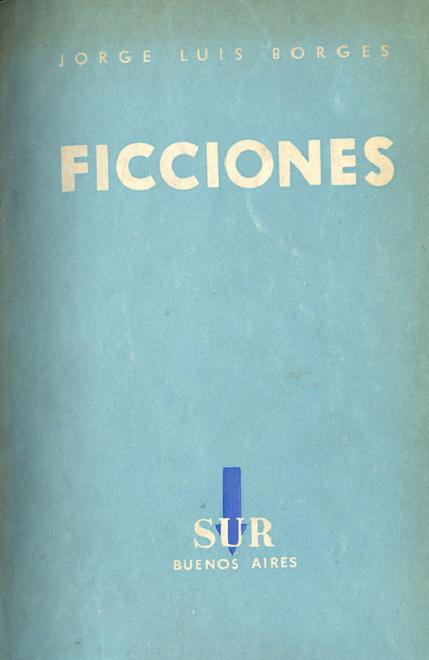
- Buenos Aires, 1944 (Editorial Sur); expanded edition 1956 (Emecé)
- Language
- Spanish
- Structure
- Two parts: “The Garden of Forking Paths” (eight stories, first published as a separate book in 1941) and “Artifices” (six stories in 1944, nine from 1956)
- Genre
- Short fiction mixing fantasy, detective story, philosophical essay and fake scholarship
- Famous stories
- “Tlön, Uqbar, Orbis Tertius”, “Pierre Menard, Author of the Quixote”, “The Library of Babel”, “The Garden of Forking Paths”, “Funes the Memorious”, “Death and the Compass”, “The South”
- English
- Grove Press edition edited by Anthony Kerrigan, 1962
- Significance
- Made Borges internationally famous; a founding text for later postmodern and Latin American fiction
Easy
What is Ficciones?
Ficciones is a collection of short stories by Jorge Luis Borges, one of the most important writers of the twentieth century. It was published in Buenos Aires in 1944 and became his most famous book. The title simply means “Fictions”, but it is also a hint: these stories are constantly aware that they are made up, and they play with the boundary between invention and reality.
Most of the stories are very short, and many do not look like ordinary stories at all. Some are written as book reviews of books that do not exist, others as obituaries, footnoted essays, detective puzzles or confessions. Borges fills them with real and imaginary books, real and imaginary scholars, and precise-sounding details, so that the reader is never quite sure where fact ends and fiction begins.
Their favourite images are labyrinths, mirrors, libraries, encyclopedias, dreams, lotteries and infinite time. Through them, Borges asks big questions in a playful way: Can we ever know the universe? Is the world ordered or chaotic? What makes a person the same person over time? What happens when an idea is so powerful that it changes reality?
Easy
What is in the book?
Part One, The Garden of Forking Paths, was first published as its own small book in 1941. It contains eight pieces: “Tlön, Uqbar, Orbis Tertius”, “The Approach to Al-Mu’tasim”, “Pierre Menard, Author of the Quixote”, “The Circular Ruins”, “The Lottery in Babylon”, “An Examination of the Work of Herbert Quain”, “The Library of Babel” and “The Garden of Forking Paths”.
Part Two, Artifices, was added in 1944 with six stories: “Funes the Memorious”, “The Form of the Sword”, “Theme of the Traitor and the Hero”, “Death and the Compass”, “The Secret Miracle” and “Three Versions of Judas”. In the 1956 edition Borges added three more: “The End”, “The Sect of the Phoenix” and “The South”. Most of the stories had first appeared in the Buenos Aires magazine Sur or the newspaper La Nación.
Each part has a short prologue. In the first, Borges says that composing vast books is a laborious and impoverishing madness, and that it is better to pretend those books already exist and offer a summary or commentary on them. This idea explains why so many of his stories are reviews, notes or summaries of imaginary works.
Easy
Four famous stories
“Tlön, Uqbar, Orbis Tertius” begins with Borges and his real friend, the writer Adolfo Bioy Casares, finding an article about a country called Uqbar in one copy of an encyclopedia. Later a volume turns up from an encyclopedia of Tlön, an imaginary planet whose people believe that only minds and perceptions exist, not material things. A postscript, dated in the future, reveals that a secret society invented Tlön, and that objects and ideas from Tlön are starting to take over the real world.
“The Library of Babel” describes a universe made of endless hexagonal rooms full of books. Every book has 410 pages and is made up of 25 symbols in every possible combination. Somewhere the library contains every true history and every lie, and the true explanation of the library itself, but finding a meaningful page is almost hopeless. Its librarians fall into despair, superstition and fanaticism.
In “The Garden of Forking Paths”, a Chinese spy working for Germany in the First World War must pass a secret message before a British agent catches him. He visits a scholar who has solved the riddle of the spy’s ancestor’s unfinished novel: a book in which time branches, so that all possible outcomes happen at once. The story is both a detective thriller and a meditation on time.
“Funes the Memorious” tells of a young Uruguayan man who, after being thrown from a horse, remembers everything he has ever perceived in complete detail. Because he cannot forget, he cannot generalise or abstract, and so, the narrator suggests, he cannot really think.
Intermediate
Other stories: identity, faith and fate
“Pierre Menard, Author of the Quixote” is written as a tribute to an imaginary French writer who tried, not to copy or translate Cervantes’s Don Quixote, but to write it again, word for word, as a twentieth-century man. The narrator compares identical passages and argues that Menard’s version is richer, because the same words mean something different in a different time. It is a comic story and a serious argument about reading, authorship and history.
“The Circular Ruins” follows a magician who dreams a son into existence, detail by detail, only to discover that he himself is a dream of someone else. “The Lottery in Babylon” imagines a society where a secret Company’s lottery gradually controls everything, until chance and order can no longer be told apart.
In “Death and the Compass”, a brilliant detective follows a series of murders that seem to follow the mystic Hebrew name of God, only to find that the pattern was a trap laid for him by his enemy. “The Secret Miracle” concerns a Jewish playwright in Prague, arrested by the Nazis in 1939, who asks God for time to finish his play; in the instant before the firing squad shoots, time stops for him for a whole year. “Three Versions of Judas” presents an imaginary theologian’s arguments that Judas, not Jesus, was the true incarnation of God.
“The Form of the Sword” and “Theme of the Traitor and the Hero” play with betrayal and hidden identity against the background of Irish rebellions. “The South”, added in 1956, which Borges once called perhaps his best story, follows a librarian who, after a serious head injury much like Borges’s own, travels south into the Argentine countryside and walks out to a knife fight; the story can also be read as the dream of a man dying in hospital.
Intermediate
Buenos Aires, Sur and a world at war
In the 1930s and 1940s Buenos Aires was one of the largest and wealthiest cities in the Americas, with a vigorous publishing industry and many immigrants from Europe. The magazine Sur, founded by Victoria Ocampo in 1931, connected Argentine writers with European and North American literature, and published many of Borges’s stories. His friend Bioy Casares, with whom he wrote detective parodies and edited anthologies of fantastic literature, shared his taste for tightly plotted, intellectual fiction rather than realism.
Ficciones was written during the Second World War. Borges was openly anti-fascist and anti-Nazi, at a time when parts of Argentina’s elite and military sympathised with the Axis. Some stories reflect this directly, such as the Prague setting of “The Secret Miracle” and the postscript of “Tlön”, where a seductive, orderly invented system begins to dominate the real world, which many readers link to the totalitarian ideologies of the time.
Borges was also reacting to literary debates at home. Much Argentine and Latin American fiction of the period favoured realism, social themes and national subjects. Borges argued that Argentine writers had a right to the whole of world culture and need not restrict themselves to local colour. When The Garden of Forking Paths failed to win a national literary prize in 1942, Sur published a special section in his support. After Perón came to power, Borges lost his library job in 1946, being reassigned, in his own famous account, as an inspector of poultry and rabbits; he resigned.
Intermediate
Key ideas and techniques
Philosophy as fiction. Borges took ideas from philosophers such as Berkeley, Hume and Schopenhauer, from Kabbalah and Christian theology, and from mathematics, and built stories around them. He did not argue that the ideas were true; he treated them, as he said, for their aesthetic value, exploring what the world would be like if they were.
Infinity and the labyrinth. The library, the forking garden, the endless lottery and the maze of Death and the Compass are all images of a universe too large or too complex to grasp. Borges’s characters often seek a hidden order, a key or a centre, and either fail or find something unexpected.
Fake scholarship. Borges mixed real books and people with invented ones, adding footnotes, dates and bibliographies. This technique makes the fantastic feel documentary, and it also makes readers think about how knowledge is built from texts that we must trust.
Economy and precision. Unlike many modernist novelists, Borges wrote very short pieces with carefully chosen adjectives, understatement and ironic humour. Much of the pleasure lies in the calm, scholarly tone applied to astonishing ideas.
Intermediate
Detective stories and the pleasure of the puzzle
Borges loved detective fiction, especially the English tradition of G. K. Chesterton and the American Edgar Allan Poe, whom he regarded as the inventor of the genre. He admired its strict rules: a problem is set, clues are laid out fairly, and a solution arrives that is surprising but inevitable. Several stories in Ficciones, above all “The Garden of Forking Paths” and “Death and the Compass”, use this structure openly.
But Borges also turns the detective story inside out. In “Death and the Compass”, the detective’s brilliant reasoning is exactly what leads him into the trap: his enemy has predicted that he will look for an intellectual pattern rather than a simple explanation. In “The Garden of Forking Paths”, the real mystery is not who committed the crime but what time itself is like. The solution of the plot opens onto a larger puzzle that no detective can solve.
This gives many stories a double structure. On the surface there is a tight plot with a twist; underneath there is a philosophical problem. Readers are invited to act like detectives themselves, noticing clues in names, dates and footnotes. Real people, such as Bioy Casares in “Tlön”, and invented ones sit side by side, and part of the fun is working out which is which. Rereading is rewarded: details that seem decorative on a first reading often turn out to be essential on a second.
With Bioy Casares, Borges also wrote comic detective stories under the shared pseudonym H. Bustos Domecq, beginning in 1942. That collaboration, alongside Ficciones, shows how seriously he took so-called popular genres at a time when many critics dismissed them.
Intermediate
Influence and legacy
“The Garden of Forking Paths”, translated by Anthony Boucher in Ellery Queen’s Mystery Magazine in 1948, was the first of Borges’s works to appear in English. His international fame, however, came after he shared the Prix International (Formentor Prize) with Samuel Beckett in 1961. In 1962 two English collections appeared, the Grove Press Ficciones and the anthology Labyrinths, and Borges became a reference point for writers everywhere.
Ficciones was important for the writers of the Latin American “Boom” of the 1960s, such as Julio Cortázar, Gabriel García Márquez and Carlos Fuentes, even though their politics and styles often differed from Borges’s. In the United States and Europe, writers such as John Barth, Italo Calvino and Umberto Eco drew on his games with fiction; Barth’s essay “The Literature of Exhaustion” (1967) presented Borges as a model for literature after modernism. Eco’s The Name of the Rose includes a blind librarian named Jorge of Burgos.
The influence reaches beyond literature. “The Library of Babel” is cited in discussions of information, combinatorics and the internet, and a website has been built that simulates it. “The Garden of Forking Paths” has been linked to the many-worlds interpretation of quantum mechanics and to hypertext fiction, and its title gave a name to a problem in statistics. “Tlön” is often read as a parable about how invented systems and virtual worlds can reshape reality.
Advanced
Text, editions and translation
Ficciones has a layered textual history. The stories first appeared in periodicals between 1939 and 1944 (and, for the later additions, up to the early 1950s); “The Approach to Al-Mu’tasim” was older still, first included in Borges’s essay collection History of Eternity (1936). They were then collected in The Garden of Forking Paths (1941) and in Ficciones (Sur, 1944), and the 1956 Emecé edition added three stories and a new note. Borges revised his texts across editions, and he also added postscripts and notes, so scholars compare versions to trace his changes.
The date 1944 therefore marks the combined volume rather than the composition of each story; the “Tlön” postscript is dated 1947 inside a story published in 1940, one of Borges’s deliberate games with time.
In English, the 1962 Grove Press edition was the work of several translators under Anthony Kerrigan, and many stories were also translated by James E. Irby and Donald A. Yates for Labyrinths. Andrew Hurley’s single-translator Collected Fictions (1998) offered a new version. Differences between translations, for example in how they render Borges’s distinctive adjectives and understatement, are themselves a subject of study, fittingly for an author who wrote about translation as creation in “Pierre Menard”.
Advanced
Critical debates
Universal or Argentine? Early critics in Argentina sometimes accused Borges of being “Europeanised” and disconnected from national reality. Later readings have emphasised how deeply his work engages with Argentina: the gaucho tradition rewritten in “The End” and “The South”, the suburbs of Buenos Aires, and the question of how a peripheral culture relates to the European canon. Beatriz Sarlo’s study Borges, a Writer on the Edge (1993) is a well-known argument for reading him from the Argentine margins.
Precursor of theory. Philosophers and theorists have treated Ficciones as anticipating their own ideas. “Pierre Menard” is often read as anticipating reader-response criticism and later arguments about the “death of the author”; Michel Foucault opened The Order of Things (1966) with a Borges passage (from a later essay, not from Ficciones). Critics debate whether such readings illuminate the stories or turn them into illustrations of theories that came later.
Politics. Borges’s later political statements, including support for the military coups in Argentina and accepting an honour from the Pinochet regime in Chile in 1976, positions he later partly revised when he criticised the Argentine junta’s abuses in the 1980s, have complicated his reputation and are often cited as a reason he never received the Nobel Prize. Scholars debate how far the anti-totalitarian themes of Ficciones should be read in light of these later positions.
Genre. Ficciones is sometimes called fantastic literature, sometimes metafiction, sometimes philosophical fiction. Borges himself used detective-story structures and the fantastic as tools; critics disagree over whether his stories should be understood mainly as formal games, as philosophy, or as expressions of personal anxieties about memory, identity and blindness.
Key ideas
- Metafiction
- Fiction that openly reflects on its own nature as fiction, for example through fake reviews and footnotes.
- The labyrinth
- Borges’s central image for a universe that is complex, perhaps infinite, and hard for the mind to master.
- Infinity
- Endless libraries, lotteries and branching times explore what infinity would mean for human life.
- Idealism
- The philosophical view that reality consists of minds and ideas, taken to extremes on the planet Tlön.
- Reading changes meaning
- As Pierre Menard shows, the same words mean different things in different times and to different readers.
- Memory and forgetting
- Funes suggests that thinking requires forgetting, generalising and abstracting.
- Order and chance
- Stories like The Lottery in Babylon ask whether the world is governed by design or by chance.
Records
- 1899 — Jorge Luis Borges is born in Buenos Aires on 24 August.
- 1931 — Victoria Ocampo founds the magazine Sur in Buenos Aires.
- 1936 — “The Approach to Al-Mu’tasim” appears in Borges’s History of Eternity.
- 1938 — On 24 December Borges suffers a severe head wound and infection.
- 1939 — “Pierre Menard, Author of the Quixote” is published in Sur in May.
- 1940 — “Tlön, Uqbar, Orbis Tertius” is published in Sur.
- 1941 — The Garden of Forking Paths is published as a book of eight stories.
- 1944 — Ficciones combines it with the six stories of Artifices.
- 1948 — “The Garden of Forking Paths” appears in English, Borges’s first work translated into English.
- 1956 — An expanded edition adds “The End”, “The Sect of the Phoenix” and “The South”.
- 1961 — Borges shares the Prix International with Samuel Beckett.
- 1962 — English translations Ficciones and Labyrinths are published.
Glossary
- Short story
- A brief piece of fiction, usually read in one sitting.
- Labyrinth
- A maze of paths in which it is easy to get lost; for Borges, a symbol of the universe.
- Metafiction
- Fiction that draws attention to the fact that it is invented.
- Idealism
- In philosophy, the view that reality is fundamentally mental, made of ideas or perceptions.
- Prologue
- An introduction at the beginning of a book.
- Postscript
- A note added at the end of a text, after the main part.
- Sur
- An influential literary magazine founded in Buenos Aires in 1931 by Victoria Ocampo.
- Latin American Boom
- The international success of Latin American novelists in the 1960s and 1970s.
- Ultraism
- An avant-garde poetry movement in Spain and Argentina around 1920 that emphasised striking metaphors.
Questions and answers
Is the Library of Babel real?
No, it is imaginary. But people have calculated how big it would be, and a website has been made that imitates it.
Are the books and people in the stories real?
Some are and some are not. Borges mixed real writers, friends and books with invented ones, which is part of his game.
Why are the stories so short?
Borges believed it was better to imagine vast books and write short summaries or reviews of them than to write the vast books themselves.
What should I read first?
Many readers start with “The Library of Babel”, “Funes the Memorious” or “The Garden of Forking Paths”, which are short and gripping. “Tlön” is richer but denser.
Was Borges influenced by his own life when writing Ficciones?
Yes, in part. The head injury of 1938 lies behind both the first story he wrote in this manner and “The South”, and his work as a librarian shaped “The Library of Babel”. But the stories are not simple autobiography.
Did Ficciones influence philosophy and science?
It has been widely cited by philosophers, literary theorists, physicists and computer scientists, though whether Borges ‘anticipated’ their ideas is debated.
Why did Borges never win the Nobel Prize?
The Swedish Academy does not explain its choices. Many commentators point to his controversial political statements of the 1970s, but this remains an interpretation.
Sources and further reading
- Ficciones. Wikipedia
- 픽션들. 위키백과
- Jorge Luis Borges. Wikipedia
- Tlön, Uqbar, Orbis Tertius. Wikipedia
- The Library of Babel. Wikipedia
- The Garden of Forking Paths. Wikipedia
- Pierre Menard, Author of the Quixote. Wikipedia
- Funes the Memorious. Wikipedia
- Edwin Williamson, Borges: A Life. Viking, 2004
Related
- Don QuixoteMiguel de Cervantes’s two-part novel follows a man who takes chivalric romances for reality and sets out with Sancho Panza. Its shifting viewpoints helped shape the modern novel.
- One Thousand and One NightsA collection of tales that developed over centuries from several storytelling traditions.
- Franz KafkaPrague-born German-language writer whose stories portray uncertainty, opaque authority and people struggling to understand their circumstances.
- ZhuangziA Chinese thinker associated with Daoism and with writings that question fixed judgments and conventional ambitions.
- Library of AlexandriaAn ancient center for collecting and studying texts in Ptolemaic Alexandria.
- UlyssesJames Joyce’s novel follows a day in Dublin through changing styles and the inner lives of its characters.
Written with AI assistance from the published sources listed above, and revised as new research appears.