Start at the top for an easy introduction. Go further down for more detail and scholarship.
- Easy
- Intermediate
- Advanced
For young readers
About 400 years ago in Spain, there lived a thin, tall gentleman of about fifty in a village in La Mancha, a dry, windy region in the middle of the country. He loved reading books about knights who fought giants and rescued princesses. He read so much, day and night, that he began to believe the stories were true.
So he decided to become a knight himself. He put on his great-grandfather’s rusty armour, made a helmet out of cardboard, named his skinny old horse Rocinante, and gave himself a grand new name: Don Quixote de la Mancha. Every knight needs a lady to love, so he chose a farm girl from a nearby village and called her Dulcinea del Toboso, although she never knew about it.
He asked a plump, practical farmer called Sancho Panza to be his squire, promising to make him governor of an island one day. Sancho rode along on his donkey. The two make a perfect pair: the knight has his head in the clouds, and Sancho thinks about food, sleep and money.
In the most famous adventure, Don Quixote sees some windmills and shouts that they are giants. Sancho says, “Those are windmills!” but the knight charges anyway, and a sail of the windmill throws him and his horse to the ground. He often gets beaten up, yet he never stops trying to help people, even when they do not want his help.
The book is very funny, but it is also kind and sad. By the end, readers love both the dreaming knight and his sensible friend. Today people everywhere use the word “quixotic” for someone with big, beautiful ideas that do not quite fit the real world.
At a glance
- Author
- Miguel de Cervantes Saavedra (1547–1616)
- Published
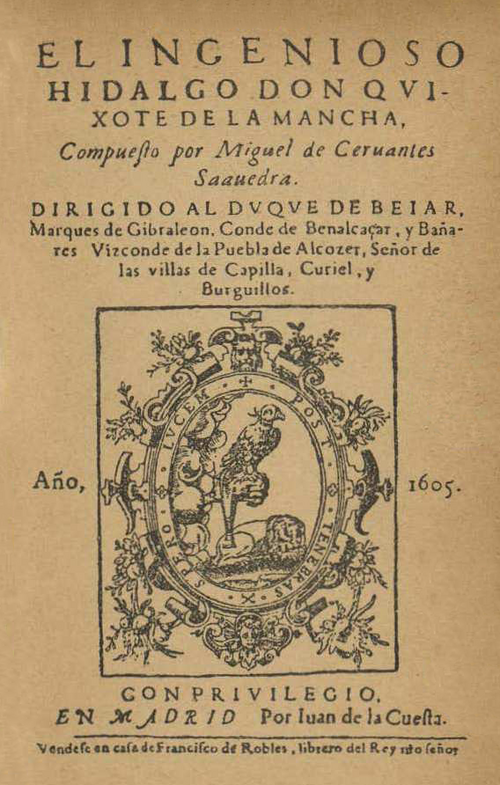
- Part One, Madrid, 1605 (El ingenioso hidalgo don Quijote de la Mancha); Part Two, Madrid, 1615 (Segunda parte del ingenioso caballero don Quijote de la Mancha)
- First printer
- Juan de la Cuesta, for the bookseller Francisco de Robles
- Length
- Part One 52 chapters; Part Two 74 chapters
- Language
- Spanish (Castilian)
- Setting
- La Mancha and other parts of Spain, including Aragon and Barcelona, around 1600
- Genre
- Prose fiction parodying chivalric romances; widely regarded as a founding work of the modern novel
- Early translation
- English translation of Part One by Thomas Shelton, 1612; French versions from 1614
Easy
What is Don Quixote?
Don Quixote is a long novel by the Spanish writer Miguel de Cervantes. It follows Alonso Quijano, a minor country gentleman (hidalgo) from La Mancha, who reads so many romances of chivalry, the popular adventure books of the sixteenth century, that he loses his judgment and sets out to become a knight-errant, righting wrongs across Spain.
The novel was published in two parts: the first in 1605 and the second in 1615, a few months before the author’s death. It was an immediate success. Within a few years it had been reprinted many times, and characters from it appeared in festivals and parades in Spain and even in Spanish America.
Don Quixote is often called the first modern novel. It is not literally the first long work of prose fiction, but it was new in the way it mixes comedy and seriousness, shows ordinary life in detail, lets characters change through conversation, and constantly asks how books shape the way people see the world.
Easy
The story of Part One (1605)
The famous first sentence begins: “In a village of La Mancha, whose name I do not care to remember…”. The narrator describes the gentleman’s thin build, his simple meals and his obsession with books of chivalry. He cleans his ancestors’ armour, names his horse Rocinante, renames himself Don Quixote, and chooses a village girl, Aldonza Lorenzo, as his imaginary lady, Dulcinea del Toboso.
On his first outing he stops at an inn, which he takes for a castle, and the amused innkeeper “knights” him in a mock ceremony. After he is beaten and brought home, his niece, housekeeper, the village priest and the barber burn most of his library, sparing only a few books they judge worth keeping. Undeterred, he sets out again, this time with Sancho Panza as his squire.
The adventures that follow are among the best known in world literature: the attack on the windmills; the battle with a flock of sheep he believes to be armies; the barber’s brass basin that he wears as the legendary “helmet of Mambrino”; the freeing of a chain of convicts who then stone him; and his penance in the Sierra Morena mountains in imitation of heroes of romance.
Part One also includes several stories told by characters the travellers meet, such as the tale of the “Curious Impertinent”, about a husband who tests his wife’s fidelity, and the story of a captive who escaped from Algiers. In the end the priest and the barber trick Don Quixote into a cage on an ox-cart and bring him home, and the narrator hints at a third outing.
Easy
The story of Part Two (1615)
In Part Two, Don Quixote and Sancho discover that they have become famous: a book about their earlier adventures, Part One itself, is being read all over Spain, and people they meet know who they are. This lets Cervantes play games in which characters discuss the mistakes and gaps in the first book.
Many adventures are now staged by others. Sancho, unable to find Dulcinea, pretends that a coarse peasant girl is the lady under enchantment. Don Quixote descends into the Cave of Montesinos and claims to have seen marvellous visions. A Duke and Duchess who have read the book invite the pair to their castle and play elaborate tricks on them, including a flight on a wooden horse, Clavileño.
They also make Sancho governor of a pretend “island”, Barataria. To everyone’s surprise, he judges cases with wisdom and common sense, then gives up the post, saying he prefers his freedom. Later, on the beach at Barcelona, Don Quixote is defeated by the “Knight of the White Moon”, actually his neighbour Sansón Carrasco in disguise, and must promise to go home and give up knighthood for a year.
Back in his village he falls ill with a fever. Before he dies, he recovers his sanity, calls himself Alonso Quijano “the Good” again, rejects the books of chivalry and makes his will, while Sancho, in tears, begs him to get up and go out to the fields as shepherds. The ending closes the story so that no one else can continue it.
Easy
Who was Cervantes?
Miguel de Cervantes was born in 1547 in Alcalá de Henares, near Madrid, the son of a surgeon who moved often in search of work. As a young man he went to Italy, joined the Spanish forces and fought in the naval Battle of Lepanto in 1571, where he was wounded in the chest and lost the use of his left hand. He was proud of this all his life.
In 1575, sailing home, he was captured by Barbary corsairs and held as a captive in Algiers for five years. He tried to escape four times and was finally ransomed in 1580 with help from the Trinitarian friars. Captivity, escape and the meeting of Christians and Muslims around the Mediterranean appear in several of his works.
Back in Spain he wrote plays and a pastoral novel, La Galatea (1585), without great success, and worked as a commissary collecting supplies for the Spanish Armada and later as a tax collector in Andalusia. Accounting problems led to imprisonment in Seville in 1597. In the prologue to Part One, the narrator describes the book as having been “engendered in a prison”, and many scholars link this to Seville, though this cannot be proved.
After Don Quixote he published the Exemplary Novels (1613), the verse Journey to Parnassus (1614), a collection of plays (1615) and, posthumously, the romance The Trials of Persiles and Sigismunda (1617). He died in Madrid on 22 April 1616 and was buried the next day in the Convent of the Barefoot Trinitarians, where remains believed to include his were identified in 2015.
Intermediate
Spain around 1600: empire, crisis and books
Cervantes wrote at the height of Spain’s “Golden Age” of literature and art, but also in a time of crisis. Spain ruled a global empire, yet it faced repeated state bankruptcies, costly wars, plague and economic decline in Castile. Many readers have seen in the impoverished hidalgo, with his old armour and dreams of glory, a figure of a nobility whose world had passed.
The novel reflects Spanish society in detail: innkeepers, muleteers, goatherds, galley slaves, priests, barbers, dukes, bandits in Catalonia and Morisco exiles. The Moriscos were Muslims who had been forcibly converted to Christianity; between 1609 and 1614 the Spanish crown expelled them. In Part Two, Sancho meets his old neighbour Ricote, a Morisco who has returned secretly in disguise, and the scene has been read in very different ways, as support for the expulsion or as a quiet expression of sympathy for its victims.
The romances of chivalry that drive Don Quixote mad had been hugely popular in sixteenth-century Spain, beginning with Amadís de Gaula (printed in 1508 in the version of Garci Rodríguez de Montalvo). Moralists criticized them as absurd and harmful. Cervantes’s narrator claims that his only aim is to destroy their authority, but the novel also shows real affection for the genre and borrows many of its devices.
Intermediate
Narrative techniques: a book that knows it is a book
In chapter 9 of Part One the story breaks off in mid-battle. The narrator then tells how he found, in the market of Toledo, Arabic notebooks containing the rest of the history, written by a Moorish historian named Cide Hamete Benengeli, and had them translated by a Morisco. From then on the novel is presented as a translation of Cide Hamete’s work, with frequent comments on whether this “Arab” author can be trusted. The effect is to make readers aware that every story has a teller who may be unreliable.
Part Two goes further. Characters have read Part One and comment on it. Cervantes also responds to a real event: in 1614 a spurious Second Volume of Don Quixote appeared in Tarragona under the pseudonym Alonso Fernández de Avellaneda. In Cervantes’s Part Two, Don Quixote learns of this fake book, changes his route so as not to go to Zaragoza as the false Quixote did, and meets a character from Avellaneda’s book who testifies that he is the real Don Quixote.
The novel mixes many voices and genres: parody of romance, pastoral episodes, picaresque scenes of low life, moral essays, short novellas, poems, letters and courtroom scenes. The dialogues between Don Quixote and Sancho are at its heart. Over the course of the book each is influenced by the other; critics have called this the “quixotization” of Sancho and the “sanchification” of Don Quixote.
Intermediate
Themes: reality, illusion and freedom
The central theme is the relation between reading and reality. Don Quixote interprets everything through the books he has read, and when reality contradicts him, he blames enchanters who have transformed things. Sancho, who cannot read, trusts his senses. Yet the novel does not simply prove the knight wrong: other characters also live by stories, and those who mock him are often more foolish or cruel than he is.
The book also reflects on justice and freedom. Don Quixote often tries to defend the weak, though his interventions frequently make things worse; the freeing of the galley slaves raises the question of whether the king’s justice is just. Speeches such as Don Quixote’s praise of freedom as “one of the most precious gifts that heaven gave to men” have been cited ever since.
Much of the humour is physical and harsh: the knight and squire are beaten, tossed in blankets and humiliated. Modern readers often find the cruelty of the Duke and Duchess in Part Two disturbing, and the novel itself seems to criticize them. How we should respond to this laughter, and whether the book is mainly comic or tragic, is one of the oldest debates about it.
Intermediate
Influence and legacy
Don Quixote spread quickly through Europe. Thomas Shelton’s English translation of Part One appeared in 1612, and French and Italian translations soon followed; Shakespeare and John Fletcher apparently based their lost play Cardenio on one of its episodes. In the eighteenth century English novelists such as Henry Fielding, whose Joseph Andrews (1742) is presented as written “in imitation of the manner of Cervantes”, Tobias Smollett (who translated it) and Laurence Sterne learned from its humour and self-conscious narration.
The Romantic movement, especially in Germany, transformed Don Quixote into a noble idealist crushed by a prosaic world. Nineteenth-century novelists took up this image: Gustave Flaubert’s Madame Bovary has been called a female Quixote whose mind is formed by romantic novels, and Fyodor Dostoevsky counted Don Quixote among the rare “positively beautiful” characters in literature and drew on him for Prince Myshkin in The Idiot.
In the twentieth century Spanish thinkers such as Miguel de Unamuno and José Ortega y Gasset made the novel central to reflection on Spanish identity, and Jorge Luis Borges’s story “Pierre Menard, Author of the Quixote” (1939) used it to explore how meaning depends on the reader and the age. The novel has inspired paintings by Honoré Daumier and Pablo Picasso, Richard Strauss’s tone poem, ballets, films and the musical Man of La Mancha. In a 2002 poll organized with the Norwegian Nobel Institute, writers from many countries named it the best work of fiction ever written.
Advanced
Interpretive debates: comic book or tragic idealism?
Early readers in Spain and England mostly read Don Quixote as a comic book, a burlesque of chivalric romance full of beatings and absurd situations. From the late eighteenth century, German Romantic critics such as Friedrich Schlegel and later Schelling and Heine read it as a profound work about the conflict between the ideal and the real, with the knight as a tragic hero.
Twentieth-century criticism has often been described as divided between “soft” readings, which continue the Romantic sympathy for the idealistic knight, and “hard” readings, which insist on the novel’s comic intent in its own historical context. Anthony Close’s The Romantic Approach to Don Quixote (1978) was an influential critique of reading modern ideas back into the book. Others argue that the novel’s richness lies precisely in its openness to both responses.
Theoretical works have given it a central place in the history of literature. Erich Auerbach’s chapter on it in Mimesis emphasized its cheerful, playful representation of everyday reality; Georg Lukács’s Theory of the Novel treated Don Quixote as the first great novel of a world abandoned by God; Michel Foucault’s The Order of Things (1966) read the knight as a figure lost between an older world of resemblances and a new order of signs; and Mikhail Bakhtin connected it with carnival and many-voiced prose.
Advanced
Text, composition and open questions
The first edition of Part One (1605) was printed quickly and contains many errors and inconsistencies. The most famous is the theft of Sancho’s donkey: in the first edition the donkey disappears without explanation and then reappears; the second Madrid edition of 1605 inserted passages describing its theft and recovery, but these were placed awkwardly. In Part Two Cervantes jokes about this confusion and blames the printer or the historian. Modern critical editions, such as the one prepared under Francisco Rico for the Instituto Cervantes, weigh the early editions against one another.
How and when the book was composed is uncertain. Some scholars have argued that the first chapters began as a short exemplary novel that grew in the writing. A related puzzle is the anonymous Entremés de los romances, a short comic play about a man maddened by ballads, which resembles the opening chapters; whether it was a source for Cervantes or an imitation of him is debated. Others see the structure of Part One, with its interpolated tales, as a deliberate experiment. Part Two is better dated: Avellaneda’s book is first mentioned in chapter 59, and scholars discuss how much of Part Two had been written before Cervantes knew of it.
The identity of Avellaneda has never been established. Candidates have included the Aragonese soldier-writer Jerónimo de Pasamonte, proposed by Martín de Riquer, who notes that Cervantes may have mocked him as the galley slave Ginés de Pasamonte, as well as Lope de Vega’s circle and others. None of these proposals has been proved.
Advanced
Reading Don Quixote today
Recent scholarship reads Don Quixote in several frameworks. Historians of the book study how the novel represents printing, reading and literacy, including the scene in Barcelona where Don Quixote visits a printing shop. Scholars of the Mediterranean read its captivity narratives and its fictional Arab historian in relation to Cervantes’s years in Algiers and to the situation of Moriscos in Spain.
Gender studies examine characters such as Marcela, a shepherdess who defends her right to refuse suitors and live freely, and Dorotea, who takes charge of her own story. Disability and medical historians discuss how the novel represents madness, which Cervantes describes using the theory of the humours: the knight’s brain “dried up” from too much reading and too little sleep.
Translation is also a subject in its own right. There are many English versions, from Shelton (1612) and Motteux to Tobias Smollett, John Ormsby, Samuel Putnam, J. M. Cohen, Edith Grossman (2003) and others, and each reflects the tastes of its time. The novel has been translated into a very large number of languages, including Korean, Chinese and Japanese, and its reception in each culture has its own history.
Key ideas
- Parody
- Imitating a genre in an exaggerated way to make fun of it; the novel parodies romances of chivalry.
- Metafiction
- Fiction that draws attention to itself as fiction, as when characters in Part Two discuss the book of Part One.
- Unreliable narrator
- The story is supposedly translated from the Arab historian Cide Hamete Benengeli, whose truthfulness the narrator questions.
- Idealism and realism
- Don Quixote’s noble dreams collide with a hard, ordinary world, represented by Sancho’s practical common sense.
- Perspectivism
- Things look different to different people, as in the basin that is a helmet to one man and a basin to another.
- Mutual influence
- Knight and squire gradually change each other through their conversations.
- Reading and life
- The novel asks how the stories we read shape what we see, believe and do.
Records
- 1547 — Miguel de Cervantes is born in Alcalá de Henares.
- 1571 — Cervantes is wounded at the Battle of Lepanto.
- 1575 — Captured by corsairs and taken to Algiers; ransomed in 1580.
- 1597 — Imprisoned in Seville over accounts from his tax-collecting work.
- 1605 — Part One is published in Madrid by Juan de la Cuesta for Francisco de Robles.
- 1612 — Thomas Shelton’s English translation of Part One appears.
- 1614 — A spurious sequel by “Alonso Fernández de Avellaneda” is published in Tarragona.
- 1615 — Cervantes publishes Part Two.
- 1616 — Cervantes dies in Madrid on 22 April.
- 1742 — Henry Fielding’s Joseph Andrews announces itself as written in the manner of Cervantes.
- 1939 — Borges publishes “Pierre Menard, Author of the Quixote”.
- 2002 — An international poll of writers names Don Quixote the best work of fiction ever written.
Glossary
- Hidalgo
- A member of the lower nobility in Spain, often with a title but little money.
- Knight-errant
- A knight who wanders in search of adventures to prove his courage and help the weak.
- Romance of chivalry
- A long prose adventure story about knights, very popular in sixteenth-century Spain, such as Amadís de Gaula.
- Squire
- A knight’s attendant; Sancho Panza is Don Quixote’s squire.
- Morisco
- A Muslim of Spain, or a descendant of one, forcibly converted to Christianity; expelled from Spain in 1609–1614.
- Picaresque
- A type of story about a low-born rogue’s adventures, popular in Golden Age Spain.
- Interpolated tale
- A separate story inserted into a larger narrative, often told by a character.
- Golden Age (Siglo de Oro)
- The period of flourishing Spanish literature and art, roughly the sixteenth and seventeenth centuries.
Questions and answers
Did Don Quixote really fight windmills?
In the story, yes. He thinks the windmills are giants, charges at them with his lance, and gets knocked down by a turning sail.
Was Dulcinea real?
Not really. In the story she is based on a farm girl named Aldonza Lorenzo, but Don Quixote imagines her as a perfect princess, and she never takes part in his adventures.
Why is it called the first modern novel?
Because it combines realistic everyday life, characters who develop through dialogue, many points of view and a playful awareness of being a book. Critics disagree about the exact meaning of “first”.
What was the fake sequel?
In 1614 an unknown writer calling himself Alonso Fernández de Avellaneda published an unauthorized continuation. Cervantes mocked it in his own Part Two.
Is the book meant to be funny or sad?
Both readings have a long history. Early readers mostly laughed; Romantic critics saw a tragic idealist; many scholars today stress the novel’s mixture of comedy and pathos.
Where did Cervantes write it?
Not precisely known. The prologue says it was conceived in a prison, often linked to Seville; Part One was printed in Madrid, where Cervantes spent his last years.
Sources and further reading
- Don Quixote. Wikipedia
- Miguel de Cervantes. Wikipedia
- Alonso Fernández de Avellaneda. Wikipedia
- Don Quijote de la Mancha (edition of the Instituto Cervantes, directed by Francisco Rico). Centro Virtual Cervantes, Instituto Cervantes
- Miguel de Cervantes; Edith Grossman (trans.), Don Quixote. Ecco / HarperCollins, 2003
- Erich Auerbach; Willard R. Trask (trans.), Mimesis: The Representation of Reality in Western Literature. Princeton University Press, 1953
- Anthony Close, The Romantic Approach to Don Quixote. Cambridge University Press, 1978
Related
- William ShakespeareEnglish playwright and poet whose plays span comedy, history and tragedy.
- Journey to the WestMing novel that turns a Buddhist pilgrimage into a journey of adventure and satire.
- Divine ComedyItalian narrative poem by Dante Alighieri describing a journey through Hell, Purgatory and Paradise.
- Fyodor DostoevskyRussian novelist whose works probe moral responsibility, poverty, belief and the pressures of modern city life.
- FiccionesJorge Luis Borges’s collection of stories explores imagined books, labyrinths, chance and the limits of knowledge.
Written with AI assistance from the published sources listed above, and revised as new research appears.