Start at the top for an easy introduction. Go further down for more detail and scholarship.
- Easy
- Intermediate
- Advanced
For young readers
Long ago in China there lived a real monk named Xuanzang. He wanted to read the Buddha’s teachings in their original language, so he walked from China to India and back, a trip that took about sixteen years. People loved his story so much that, over hundreds of years, storytellers added monsters, magic and jokes to it. Those stories became the book Journey to the West.
The most famous character is Sun Wukong, the Monkey King. He was born from a stone egg on a mountain. He learns 72 magic changes, can jump across the sky on a cloud with one somersault, and carries an iron staff that can shrink to the size of a needle or grow as tall as the sky. He is so naughty that he makes trouble in Heaven itself, until the Buddha traps him under a mountain.
After 500 years, Monkey is set free on one condition: he must protect the monk on his long walk to India. Two other helpers join them. Zhu Bajie, the pig, loves food and sleeping and often complains. Sha Wujing, a former river monster, is calm and hard-working. A dragon prince even turns into the monk’s white horse.
On the road, demons keep trying to catch the monk, because they believe that eating his flesh will let them live forever. Monkey has to use his tricks and his staff to save him again and again. The pilgrims must pass through 81 troubles before they finally reach the Buddha and receive the holy books.
The book is funny and exciting, but it also asks big questions: How do we learn to control our wild minds? How can very different friends work together? Children in China, Korea, Japan and many other places still know the Monkey King from cartoons, comics, films and games.
At a glance
- Type
- Chinese vernacular novel in 100 chapters, mixing prose with poems
- Earliest surviving edition
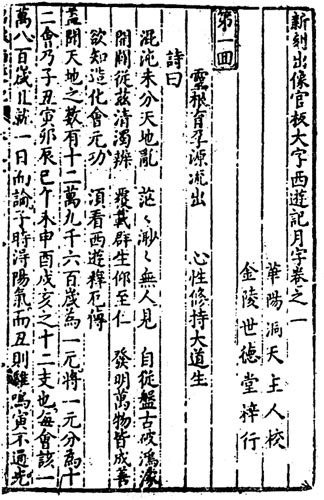
- 1592, printed by the Shidetang publishing house in Nanjing; earlier editions may have existed but do not survive
- Author
- Traditionally attributed to Wu Cheng’en (c. 1500–c. 1582) of Huai’an; the attribution is still debated
- Period
- Late Ming dynasty (1368–1644)
- Historical basis
- The pilgrimage of the monk Xuanzang (602–664) to India, c. 629–645
- Main characters
- Tang Sanzang (Tripitaka), Sun Wukong (Monkey), Zhu Bajie (Pigsy), Sha Wujing (Sandy), and the White Dragon Horse
- Status
- One of the “Four Classic Novels” of Chinese literature
- Famous English versions
- Arthur Waley’s abridged “Monkey” (1942); Anthony C. Yu’s complete translation (1977–1983)
Easy
What is Journey to the West?
Journey to the West (Xiyou ji) is a Chinese novel of one hundred chapters. It tells how the Buddhist monk Tang Sanzang, protected by three supernatural disciples, travels from the Tang capital Chang’an to India to bring back Buddhist scriptures. On the way the pilgrims meet demons, dragons, gods, strange kingdoms and one another’s bad habits.
The oldest complete edition that survives was printed in 1592 by a publishing house called Shidetang in Nanjing, one of the great book-printing centres of Ming China. Nobody signed it with a clear author’s name, and the question of who wrote it is still discussed today.
The novel is counted among the “Four Classic Novels” of Chinese literature, together with Romance of the Three Kingdoms, Water Margin and Dream of the Red Chamber. It is written in a lively vernacular, closer to everyday speech than classical Chinese, and it is filled with poems that describe landscapes, battles and characters.
Easy
The real journey behind the story
The novel grew out of a real event. Xuanzang (602–664) was a Chinese monk who felt that the Buddhist texts available in China were incomplete and sometimes contradictory. Around 629, defying a ban on travel abroad, he left Chang’an and travelled west along the Silk Roads, through the oasis kingdoms of Central Asia, into India.
In India he studied for years, including at the great monastery of Nalanda, and collected hundreds of Buddhist texts. He returned to China around 645 and was welcomed by Emperor Taizong. He spent the rest of his life translating the texts he had brought back, and he produced, with his disciple Bianji, the Great Tang Records on the Western Regions, a description of the lands he had seen.
The real Xuanzang was a brave and learned traveller. In the novel he becomes Tang Sanzang (“Tripitaka”, after the Buddhist canon), a kind but timid monk who weeps easily, trusts the wrong people and needs his disciples to rescue him. Much of the fun of the novel comes from this reversal.
The novel keeps some traces of the real journey: the western direction, the dangerous deserts and mountains, the many kingdoms along the way, and the goal of bringing scriptures back to China. But the geography becomes fantastic, and the historical countries of Central Asia are replaced by invented kingdoms ruled by foolish kings, clever queens and disguised demons.
Easy
The story, part by part
Chapters 1–7 tell the life of Sun Wukong. A monkey born from a stone on the Mountain of Flowers and Fruit becomes king of the monkeys, then searches for immortality. A Daoist master teaches him the 72 transformations and the somersault cloud. He takes an iron staff from the Dragon King of the Eastern Sea and erases his name from the register of the dead. Given a small post in Heaven, he rebels, calls himself “Great Sage Equal to Heaven”, eats the peaches of immortality and fights the heavenly armies. Only the Buddha can stop him: Monkey bets he can jump out of the Buddha’s palm, fails, and is trapped under the Mountain of Five Elements.
Chapters 8–12 prepare the pilgrimage. The Buddha wishes to send scriptures to China, and the bodhisattva Guanyin searches for a pilgrim. These chapters tell the unusual birth of the monk, a story of the Tang emperor Taizong’s visit to the underworld, and the choice of Sanzang to travel west.
Chapters 13–100 are the journey itself. Sanzang frees Monkey, who is controlled by a golden band around his head that tightens when the monk recites a spell. Zhu Bajie, once a heavenly marshal reborn as a pig-like creature, and Sha Wujing, a banished heavenly general living in a river, join the group; a dragon prince becomes the white horse. Famous episodes include the White Bone Demon who tricks Sanzang into banishing Monkey, the Red Boy with his fire, the Kingdom of Women, the Flaming Mountains and Princess Iron Fan, and the “false Monkey” whom no one can tell from the real one.
At last they reach Vulture Peak. Two of the Buddha’s disciples first give them scrolls with no writing, because the pilgrims have brought no gift; the Buddha sets the matter right. On the way home one last disaster completes the required 81 ordeals. The pilgrims are rewarded: Sanzang and Monkey become Buddhas, and even Pigsy gets a heavenly job in which he can eat at every offering.
Easy
A team of very different companions
Sun Wukong is clever, brave, proud and impatient. He can see through a demon’s disguise at once, but he also hits first and asks later. His name means roughly “Monkey Awakened to Emptiness”, a Buddhist name given by his teacher.
Zhu Bajie (“Pig of the Eight Prohibitions”) is greedy, lazy and fond of women, and he often suggests giving up and going home. Yet he is strong, funny and loyal in his own way. Sha Wujing (“Sand Awakened to Purity”) is the quiet one who carries the luggage and keeps the peace. Tang Sanzang is pure and devoted, but helpless and easily fooled.
Readers have long noticed that the team works like a single person: Monkey is the restless mind, Pigsy the bodily appetites, Sandy steady effort, and the monk the heart that is trying to reach enlightenment. The quarrels and reconciliations between them are as important to the story as the battles with demons.
Around the pilgrims stands a large cast of helpers and rivals. The bodhisattva Guanyin appears again and again to rescue the group or to test them. Heavenly generals, local mountain gods and dragon kings can be summoned for help, and Monkey’s old sworn brother, the Bull Demon King, becomes an enemy. Many demons are memorable personalities in their own right, with families, homes and ambitions, which is one reason the novel has been so easy to adapt.
Intermediate
From pilgrimage to legend: how the story grew
Within a few generations of Xuanzang’s death, legends had begun to gather around him. A biography written by his disciples already contained miraculous elements. By the Song dynasty (960–1279) there was a short printed storytelling text, the Da Tang Sanzang qujing shihua (“Poetic Tale of Tripitaka of the Great Tang Fetching the Scriptures”), which survives in Japan. In it a monkey-like helper, in the shape of a scholar in white, already guides the monk.
In the Yuan (1271–1368) and early Ming periods the story was told on stage and by professional storytellers. A fragment preserved in the huge early-Ming Yongle Encyclopedia retells an episode that also appears in the novel, and a Korean language textbook of the period, the Pak tongsa, summarizes Journey to the West stories, which shows that some form of the tale circulated widely in East Asia before the 1592 edition.
The 1592 novel therefore did not invent the story. Its achievement was to gather these materials into a carefully shaped one-hundred-chapter book, expand the characters, add a great deal of comedy and verse, and give the whole a structure built around numbers (such as the 81 ordeals) and the ideas of Buddhism, Daoism and Confucianism.
Intermediate
Ming China: print, cities and the three teachings
In the sixteenth century the lower Yangzi region, including Nanjing, Suzhou and Hangzhou, was the richest and most urban part of China. Commercial printing flourished, and publishers produced illustrated editions of long vernacular novels for a growing readership of merchants, officials and educated townspeople.
This period also saw lively debate about the mind. The philosopher Wang Yangming (1472–1529) taught that moral knowledge lies within the mind itself, and his followers argued about how to cultivate it. At the same time many writers treated Confucianism, Buddhism and Daoism as “three teachings” that could be combined. Journey to the West mixes all three freely: Monkey learns Daoist techniques of immortality, serves a Buddhist mission, and moves through a heavenly bureaucracy modelled on the imperial government.
That bureaucracy is also a target of satire. The Jade Emperor’s court is pompous and helpless; gods and bodhisattvas turn out to own the pets or servants who escape to become demons; and even the Buddha’s disciples ask for a “gift”. Many readers have seen in this a comic picture of Ming officialdom.
The 1592 edition was printed with illustrations, and its preface presents the book as both entertaining and meaningful. Long novels of this kind were expensive, but they were also read aloud, retold by storytellers and staged in theatres, so the story reached people who could not read. This mixture of elite and popular audiences helps explain why the novel moves so easily between learned religious allusion and broad slapstick.
Intermediate
Themes: comedy, allegory and the mind
On the surface the novel is an adventure and a comedy, full of disguises, tricks and slapstick fights. Pigsy’s greed and Monkey’s boasting are always good for a laugh, and many demons are more ridiculous than frightening.
Beneath the surface, many readers find an allegory of spiritual cultivation. Chapter titles often call Monkey the “mind-monkey” (xinyuan), a Buddhist image for the restless mind that jumps from thought to thought like a monkey from branch to branch. The golden band that controls him can be read as discipline, and the long road as the gradual taming of the self. The novel also uses the vocabulary of Daoist inner alchemy, in which the characters correspond to elements and substances to be refined.
The book also plays with the idea of emptiness. Monkey’s religious name contains the word “emptiness” (kong); demons are often illusions; and the blank scriptures at the end have been read both as a joke about corruption and as a hint that the deepest truth cannot be written down.
Intermediate
Influence and legacy across the world
Journey to the West inspired sequels and responses in the Ming and Qing periods, most famously Dong Yue’s Xiyou bu (“Supplement to the Journey to the West”), in which Monkey wanders through a dream world. Episodes from the novel became standard pieces of Chinese opera, and the Monkey King became a figure of popular religion, worshipped in some temples in southern China and Southeast Asia.
The story spread across East Asia. In Japan it inspired countless adaptations, from Edo-period retellings to television dramas, anime and manga; the Dragon Ball series, for example, famously borrowed its hero’s name and staff from Sun Wukong. In Korea the pilgrims are known as Son Ogong, Jeo Palgye and Sa Ojeong, and they appear in children’s books and dramas.
In the West, Arthur Waley’s abridged translation Monkey (1942) made the Monkey King famous; Anthony C. Yu’s complete translation (1977–1983) brought out the poems and religious depth that earlier versions had left out. In the twenty-first century the story continues to inspire films, animation and video games made in China and elsewhere.
Advanced
Editions, text history and the question of sources
Scholars distinguish between the full hundred-chapter recension represented by the 1592 Shidetang edition and several shorter versions printed in Fujian around the same period, such as those associated with Zhu Dingchen and Yang Zhihe. Whether these abridged versions are condensations of the long novel or witnesses to earlier stages of the story has been debated; Glen Dudbridge’s studies of the novel’s antecedents were important in examining these relationships.
In the Qing period the novel circulated mainly in commentary editions that read it as a text of inner alchemy or of combined Confucian, Buddhist and Daoist cultivation, such as Liu Yiming’s Xiyou yuanzhi. Twentieth-century scholars like Hu Shi rejected these allegorical commentaries as over-reading and emphasized the novel’s humour; later scholars, notably Anthony C. Yu and Andrew Plaks, argued that its religious and allegorical structure is real and deliberate. The balance between comedy and allegory remains a central interpretive question.
Another long debate concerns the origins of Sun Wukong. Hu Shi suggested a link with Hanuman, the monkey hero of the Indian Ramayana, who might have reached China through Buddhist or maritime contacts. Lu Xun instead pointed to Wuzhiqi, a water monster of Chinese legend. Others emphasize local monkey cults and the monkey figure of the Song storytelling text. Most scholars now see Monkey as a composite figure shaped by several traditions, and the question of direct Indian influence is still open.
Advanced
Reading the novel today: methods and perspectives
Modern research approaches Journey to the West from several angles. Textual scholars compare editions and trace the story’s growth through storytelling texts, drama and religious literature. Historians of religion study how the novel reflects Ming Buddhism and Daoism and how it fed back into popular religion, including the cult of the Monkey King.
Literary critics examine its structure, noting the careful patterning of episodes and numbers, and the role of the embedded poems, which earlier translations often cut. Others study it as satire of bureaucracy, as comic fiction, or as a story about the limits of heroism: Monkey can defeat almost any demon but often needs help from Guanyin or the demon’s heavenly owner to finish the job.
Comparative readers have paired it with other pilgrimage and quest narratives, such as Dante’s Divine Comedy or Bunyan’s The Pilgrim’s Progress, while others caution against forcing a Chinese novel into European categories. Recent work on adaptation looks at how the Monkey King has been reinvented in modern China, in Japanese and Korean popular culture, and in Asian diaspora literature, where he often stands for cultural identity and rebellion.
Key ideas
- Pilgrimage
- A religious journey to a sacred place; the novel turns Xuanzang’s real pilgrimage into a long, symbolic road of trials.
- The mind-monkey (xinyuan)
- A Buddhist image of the restless mind; Monkey’s taming by the golden band can be read as the discipline of the mind.
- Three teachings
- Confucianism, Buddhism and Daoism, which the novel mixes freely in its gods, techniques and moral lessons.
- 81 ordeals
- The fixed number of trials the pilgrims must pass through before completing their mission, reflecting the novel’s numerical design.
- Satire of bureaucracy
- Heaven is shown as a pompous, inefficient government, and even holy figures can be corrupt, which mocks human institutions.
- Teamwork of opposites
- Four very different companions must cooperate, and their conflicts are as important as their battles.
- Emptiness (kong)
- The Buddhist teaching that things lack fixed selfhood, echoed in Monkey’s name and the illusions the pilgrims meet.
Records
- 602 CE — Birth of the monk Xuanzang.
- c. 629 CE — Xuanzang leaves Chang’an for India, defying a ban on foreign travel.
- c. 645 CE — Xuanzang returns to Chang’an with hundreds of Buddhist texts.
- 646 CE — The Great Tang Records on the Western Regions is completed.
- c. 1200 — Song-era storytelling text “Poetic Tale of Tripitaka Fetching the Scriptures” circulates (date debated).
- c. 1408 — The Yongle Encyclopedia preserves a prose fragment of a Journey to the West story.
- 1592 — Earliest surviving hundred-chapter edition printed by Shidetang in Nanjing.
- c. 1625 — A Huai’an local gazetteer lists a work called Xiyou ji among Wu Cheng’en’s writings.
- c. 1923 — Hu Shi and Lu Xun promote the attribution of the novel to Wu Cheng’en.
- 1942 — Arthur Waley’s abridged English translation “Monkey” is published.
- 1977 — Anthony C. Yu’s complete English translation begins to appear (completed 1983).
Glossary
- Tripitaka
- “Three baskets”, the Buddhist canon of scriptures; also a title for the monk Tang Sanzang.
- Bodhisattva
- In Mahayana Buddhism, an enlightened being who helps others; Guanyin, the bodhisattva of compassion, guides the pilgrims.
- Vernacular novel
- A long work of fiction written in a language close to everyday speech rather than in classical literary Chinese.
- Jade Emperor
- The ruler of Heaven in Chinese popular religion, shown in the novel as head of a heavenly bureaucracy.
- Inner alchemy (neidan)
- Daoist practices of refining the body’s energies to reach immortality; Qing commentators read the novel in these terms.
- Gazetteer
- An official local history of a county or prefecture, recording geography, officials and local writers.
- Recension
- A distinct version of a text produced by revision or editing.
- Vulture Peak
- A mountain in India where the Buddha preached; in the novel, the pilgrims’ final destination.
Questions and answers
Was the Monkey King a real monkey?
No. Sun Wukong is a fictional character. The monk he protects is based on a real person, Xuanzang, but Monkey, Pigsy and Sandy were added by storytellers.
Did Xuanzang really go to India?
Yes. He left China around 629, studied in India for years, and returned around 645 with hundreds of Buddhist texts, which he spent the rest of his life translating.
Why do the demons want to eat the monk?
In the novel, the monk is the reincarnation of a disciple of the Buddha, and demons believe that eating his flesh will make them immortal.
Who wrote Journey to the West?
It is traditionally credited to Wu Cheng’en, but the evidence is thin and the author of the 1592 edition is not certainly known.
Is the novel a religious allegory or a comedy?
Both readings have strong defenders. Qing commentators read it as spiritual allegory; Hu Shi stressed its humour; many recent scholars see comedy and allegory working together.
Is Sun Wukong based on the Indian monkey god Hanuman?
Hu Shi proposed this, and Lu Xun suggested a Chinese water monster instead. Scholars still debate it; many see Monkey as combining several traditions.
Sources and further reading
- Journey to the West. Wikipedia
- Wu Cheng’en. Wikipedia
- Xuanzang. Wikipedia
- Great Tang Records on the Western Regions. Wikipedia
- Sun Wukong. Wikipedia
- Anthony C. Yu (trans.), The Journey to the West (4 vols.). University of Chicago Press, 1977–1983
- Glen Dudbridge, The Hsi-yu chi: A Study of Antecedents to the Sixteenth-Century Chinese Novel. Cambridge University Press, 1970
- Andrew H. Plaks, The Four Masterworks of the Ming Novel. Princeton University Press, 1987
Related
- Siddhartha Gautama (the Buddha)Founder of Buddhism, who taught a path to liberation from suffering on the Ganges plain. His dates are disputed.
- RamayanaA Sanskrit epic about Rama, Sita and their exile, preserved in many versions across South and Southeast Asia.
- Dream of the Red ChamberA Qing-era novel centered on the Jia family, celebrated for its closely observed characters and account of an elite household’s decline.
- Wang YangmingMing philosopher and official who taught that moral knowledge must be realized in action.
- Divine ComedyItalian narrative poem by Dante Alighieri describing a journey through Hell, Purgatory and Paradise.
- Don QuixoteMiguel de Cervantes’s two-part novel follows a man who takes chivalric romances for reality and sets out with Sancho Panza. Its shifting viewpoints helped shape the modern novel.
Written with AI assistance from the published sources listed above, and revised as new research appears.