Start at the top for an easy introduction. Go further down for more detail and scholarship.
- Easy
- Intermediate
- Advanced
For young readers
Imagine a giant picture book, as thick as three big dictionaries, that tries to describe everything about a whole people: their gods, their festivals, their stories, their kings, their merchants, their doctors, the animals and plants around them — and the terrible war in which their city was conquered. That is the Florentine Codex.
It was made in Mexico about 450 years ago, a few decades after Spanish soldiers conquered the great Aztec city of Tenochtitlan in 1521. A Spanish friar named Bernardino de Sahagún wanted to understand the Nahua people, who spoke a language called Nahuatl, so that he could teach them Christianity.
But Sahagún could not do it alone. He asked Nahua elders, who remembered the time before the Spanish came, to tell what they knew. Young Nahua scholars who could write in Nahuatl, Spanish and Latin wrote their words down. Nahua painters made more than two thousand colourful pictures.
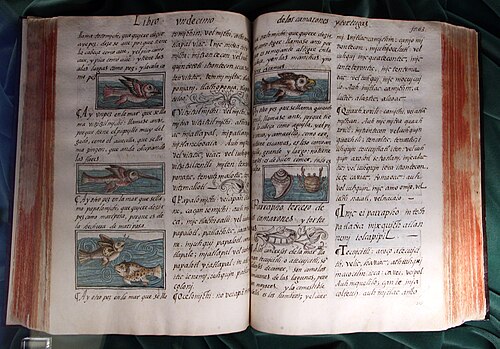
Each page has two columns: Nahuatl on the right and Spanish on the left. The Spanish is not always a word-for-word translation, so the two sides sometimes tell slightly different things. The pictures tell a third story of their own.
The book was sent to Spain and later ended up in a library in Florence, Italy, which is why it is called the Florentine Codex. “Codex” is an old word for a handwritten book.
Today anyone can look at every page online. Nahua people in Mexico, who still speak Nahuatl, read it too, and some of it has even been summarised in a modern form of their language.
At a glance
- Made
- Research from c. 1545/1558; final manuscript copied 1575–1577 at the Colegio de Santa Cruz, Tlatelolco (today Mexico City)
- Creators
- Bernardino de Sahagún (c. 1499–1590), Franciscan friar, with Nahua elders, trilingual Nahua scholars (among them Antonio Valeriano, Alonso Vegerano, Martín Jacobita and Pedro de San Buenaventura), scribes and painters
- Languages
- Nahuatl (right column) and Spanish (left column); the Spanish is often a summary or commentary rather than a translation
- Size
- 12 books, about 2,400–2,500 pages, today bound in three volumes
- Images
- Nearly 2,500 painted images and decorative elements (one count: 1,844 images plus 628 decorations), about half of them in Book 11 on natural history
- Location
- Biblioteca Medicea Laurenziana, Florence, Italy
- Access
- Digitised by the World Digital Library (2012); Digital Florentine Codex by the Getty Research Institute (2023)
- Significance
- The richest single source on Nahua culture before the conquest and on the conquest as told from the Nahua side
Easy
What is the Florentine Codex?
The Florentine Codex is a handwritten book, or codex, made in colonial Mexico between the 1540s and 1577. Its full title is the Historia general de las cosas de Nueva España, the “General History of the Things of New Spain.” It is the most complete version of a huge research project directed by the Franciscan friar Bernardino de Sahagún and carried out with Nahua elders, scholars and artists.
Its subject is the culture of the Nahua, the Nahuatl-speaking peoples of central Mexico, including the Mexica who ruled the empire that is often called “Aztec.” It describes their gods and rituals, calendar, beliefs about the future, speeches and moral teachings, rulers and nobles, merchants and craftspeople, bodies and illnesses, animals, plants and minerals — and finally the Spanish conquest.
The book is written in two parallel columns: Nahuatl on the right and Spanish on the left, with painted images set into the text. Because it combines Indigenous testimony, Indigenous writing and Indigenous painting within a European book format, many scholars see it as a genuinely co-authored work — some even call it a “mestizo book.”
The manuscript has been kept since the 16th century in the Medici family’s library in Florence, the Biblioteca Medicea Laurenziana, which is why it is called the Florentine Codex.
Easy
Twelve books about a whole world
The codex is divided into twelve books. Book 1 is about the gods; Book 2 about the calendar and the great festivals; Book 3 about the origins of the gods; Books 4 and 5 about divination, omens and signs; Book 6 about rhetoric, moral philosophy and theology, including the formal speeches called huehuetlahtolli, “words of the elders”; and Book 7 about the sun, moon, stars and the measuring of time.
Books 8 to 10 turn to society: kings and lords, merchants, and then people of all kinds — family members, craftspeople, healers, and even the body and its illnesses. Book 11, called in the digital edition “Forest, Garden, Orchard,” is a natural history of animals, birds, insects, fish, trees, herbs, stones and colours. It contains about half of all the images in the codex.
Book 12 is different: it is a history of the conquest of Mexico, told from the perspective of Nahua people of Tenochtitlan and especially Tlatelolco. It begins with omens that were said to have foretold disaster, and follows the arrival of the Spaniards, the meetings with the ruler Moteuczoma, the massacre at the festival of Toxcatl in 1520, the epidemic of smallpox and the long siege that ended in 1521.
Taken together, the twelve books are sometimes compared to an encyclopedia like the Natural History of the Roman author Pliny — but written largely from the knowledge of the people being described.
Easy
Who made it?
Bernardino de Sahagún was born around 1499 in the town of Sahagún in León, Spain, studied at the University of Salamanca, joined the Franciscan order and arrived in New Spain in 1529. He learned Nahuatl and in 1536 became a Latin teacher at the new Imperial Colegio de Santa Cruz in Tlatelolco, a college for young Indigenous noblemen. He lived in Mexico for more than sixty years and died in 1590.
The college was crucial. Its students became expert scholars, fluent in Nahuatl, Spanish and Latin. Several of them — including Antonio Valeriano of Azcapotzalco, Alonso Vegerano of Cuauhtitlan, Martín Jacobita of Tlatelolco and Pedro de San Buenaventura — worked with Sahagún for years, gathering information, writing the Nahuatl texts and correcting drafts. As one Getty essay puts it, the friars were teachers but were also learning from their students.
The information itself came largely from Nahua elders, men of age and rank who had grown up before or just after the conquest and were respected as knowledgeable about the old ways. They answered Sahagún’s questions, often by consulting painted manuscripts of the traditional kind, and discussed their answers in groups.
The images were painted by Nahua artists, the heirs of the tlacuilo tradition of scribe-painters. Scholars have identified the work of about twenty-two different hands. Without these Nahua authors, as the historian Baltazar Brito Guadarrama writes, the Sahagún corpus would never have seen the light.
Intermediate
How the codex was made: from interviews to a finished book
The project took decades. Around 1558–1561, at Tepepulco (in today’s state of Hidalgo), Sahagún and his assistants interviewed a group of elders and recorded their answers, often alongside pictures. These early drafts survive today and are known as the Primeros Memoriales, a name given by the Mexican historian Francisco del Paso y Troncoso.
From about 1561 Sahagún continued the work in Tlatelolco with a new group of elders, checking and expanding the material, and later in Mexico City he organised it into twelve books. Several intermediate drafts, now kept in Madrid, show how the texts were revised. Sahagún compared the accounts from different places and informants to judge their reliability — one reason he is sometimes called a pioneer of ethnography.
The final clean copy — the Florentine Codex — was made in 1575–1577 in a kind of workshop. Scribes wrote the Nahuatl column first, then the Spanish column, leaving spaces for images, which the artists filled in. The last pages of Book 12 show blank spaces where images were never painted: the artists apparently ran out of time.
The work was done during a catastrophe. A great epidemic, known in Nahuatl as cocoliztli, struck in 1576. Sahagún wrote in Book 10 that the plague of that year had left hardly anyone in the college — almost everyone had gone, either dead or sick. The finished codex is therefore also a record made by survivors.
Intermediate
Three narratives on one page: Nahuatl, Spanish and images
The Nahuatl and Spanish columns were written for different readers. The Spanish was meant for the Spanish court and for Franciscan officials. The Nahuatl, as Sahagún explained in a prologue, was written because his superiors ordered him to record in the Mexican language whatever would be useful for the teaching and support of Christianity among the Indigenous people — and for friars who needed to improve their Nahuatl.
As a result, the two columns do not match exactly. The Spanish often summarises, shortens or comments on the Nahuatl, and sometimes adds Sahagún’s judgements. In Book 12, for example, the Spanish text describing the Toxcatl massacre of 1520 is highly abbreviated, and the space is filled with images, while the Nahuatl column gives a detailed and horrifying account.
The images form a third narrative. They combine Mesoamerican conventions — such as speech scrolls, place signs and the symbolic use of colour — with European techniques such as landscape, shading and perspective. For Nahua painters, colour was not decoration; it helped make the image a true presence of what it showed. Some images add Christian framing, while others preserve details the texts leave out.
Scholars at the Getty Research Institute argue that only by reading all three narratives together — the Nahuatl, the Spanish and the pictures, which sometimes agree and sometimes conflict — can we understand the intentions of the codex’s makers and the transformed world of late 16th-century Mexico.
Intermediate
Book 12: the conquest from the Nahua side
Book 12 is the only strictly historical book of the Historia general, and it is one of the most important Indigenous accounts of the Spanish conquest. It was based on the memories of people from Tlatelolco, the twin city of Tenochtitlan, whose warriors held out until the final defeat in August 1521.
It tells the story very differently from the letters of Hernán Cortés or the chronicle of Bernal Díaz del Castillo. It describes the fear caused by omens, the strange appearance of the Spaniards and their horses and dogs, the massacre of dancers at the festival of Toxcatl, the smallpox epidemic that killed many people including rulers, and the hunger, disease and fighting of the long siege.
Book 12 also reflects local politics. Written with Tlatelolcan informants, it tends to praise the bravery of Tlatelolco’s warriors and is sometimes critical of the leaders of Tenochtitlan. Its account of Moteuczoma, portrayed as fearful and indecisive, may reflect the blame and bitterness of the decades after the conquest rather than a neutral description.
In the 20th century, Book 12 became famous through collections such as Miguel León-Portilla’s Visión de los vencidos (The Broken Spears, 1959) and James Lockhart’s We People Here (1993), which made “the vision of the vanquished” widely known and changed how the conquest is taught.
Intermediate
Why was it made? Mission, knowledge and memory
Sahagún’s stated purpose was religious. Like a doctor who must know a disease to cure it, he argued, a missionary had to understand the old religion in detail in order to recognise and uproot what he called idolatry. He worried that many conversions were only on the surface, and warned that the Catholic faith might not last long in New Spain.
Yet the result goes far beyond a manual for missionaries. The codex preserves prayers, poetic speeches, medical knowledge, agricultural terms, the names of hundreds of plants and animals, and the vocabulary of crafts such as featherwork. It records a language and a way of seeing the world in their own words, at a time when epidemics were killing a large share of the population.
For the Nahua scholars and elders, taking part may have had different meanings. Some scholars suggest that they used the project to preserve the memory of their ancestors, the dignity of their nobility, and the history of their own altepetl (city-state). Their motives were probably as varied as the people involved.
This double character — a tool of colonial evangelisation and a vessel of Indigenous memory — is central to how the codex is understood today.
Intermediate
From Mexico to Florence: the codex’s travels
In the 1570s Spanish authorities grew suspicious of writings about Indigenous religion in Indigenous languages. King Philip II ordered that Sahagún’s works be sent to Spain. In a letter to the king dated 26 March 1578, Sahagún wrote that he had finished the clean copies — twelve books in four volumes — and handed them to the Franciscan commissary general, Rodrigo de Sequera, to be sent with the fleet. He asked to be told if they did not arrive, so that the work would not be lost and forgotten.
The manuscript seems to have reached the Spanish court around 1578. Exactly how it then travelled to Florence is still discussed by historians; it probably entered the collections of the Medici grand dukes before the end of the 16th century, and it later became part of the Biblioteca Medicea Laurenziana. It is now bound in three volumes.
For two centuries the codex was little known. The librarian Angelo Maria Bandini described it in 1793, and in the 19th and 20th centuries scholars in Mexico, Europe and the United States studied it. The Mexican historian Francisco del Paso y Troncoso published facsimiles of Sahagún’s manuscripts in the early 20th century (the Primeros Memoriales appeared in 1906), and a full colour facsimile of the Florentine Codex was published in 1979 with the support of the Mexican government.
The first complete English translation of the Nahuatl text, by Arthur J. O. Anderson and Charles E. Dibble, appeared in twelve parts between 1950 and 1982 — a thirty-year project. Spanish editions include those of Ángel María Garibay and of Alfredo López Austin and Josefina García Quintana.
Intermediate
The codex today
In 2012 the World Digital Library published high-resolution scans of the whole manuscript. In 2023 the Getty Research Institute launched the Digital Florentine Codex, begun in 2017, which makes the texts and nearly 2,500 images searchable, with transcriptions and translations in Spanish and English.
The digital edition also includes something new: chapter summaries and audio recordings in Eastern Huasteca Nahuatl, a living variety of the language, prepared by the Nahua scholar Eduardo de la Cruz Cruz. This means that the codex is being returned, in a sense, to speakers of the language in which much of it was first composed.
For Nahua communities and for Mexico as a whole, the codex is part of a living cultural heritage. Its images of gods, festivals, foods such as tamales and tortillas, and animals such as the axolotl appear in schools, museums and popular culture.
For researchers in anthropology, history, linguistics, art history, botany and medicine, it remains an indispensable source — but one that must be read critically, with attention to who was speaking, who was writing and for whom.
Advanced
Scholarly debates: authorship, voice and the “father of ethnography”
Sahagún is often called the “father of anthropology” or of American ethnography because of his systematic questionnaires, his use of multiple informants and his cross-checking of accounts. Critics note that the label can obscure his missionary aims and the work of his Nahua collaborators. His questions were shaped by European categories — for example, the organisation of books on gods, then humans, then nature follows medieval encyclopedias — and these categories framed what the elders could say.
Authorship is a central issue. Recent scholarship, including the Digital Florentine Codex, credits the codex to Sahagún together with Antonio Valeriano, Alonso Vegerano, Martín Jacobita, Pedro de San Buenaventura, Diego de Grado, Bonifacio Maximiliano, Mateo Severino and others. How much of the Nahuatl text reflects the elders’ own words, how much the students’ editing, and how much Sahagún’s direction is debated and probably varies from chapter to chapter.
Another debate concerns the reliability of the account of pre-conquest religion. Informants were speaking decades after the conquest, to a friar whose goal was to eradicate their old religion, in a colonial society where practising that religion could be punished. Some descriptions may be idealised, others shaped by Christian ideas. Scholars compare the codex with archaeology, pre-conquest codices and other colonial sources to test its claims.
Book 12 raises its own questions. Its Tlatelolcan perspective, its portrayal of Moteuczoma and its omens may reflect post-conquest interpretation. Sahagún himself produced a revised version of the conquest account in 1585, which suggests that he was uneasy with parts of the earlier text. Historians now read Book 12 not as a transparent eyewitness report but as an Indigenous historical interpretation composed a generation after the events.
Advanced
Evidence and methods: reading a colonial manuscript
Modern study of the codex combines philology, art history and material analysis. Philologists compare the Nahuatl of the Florentine Codex with the earlier drafts in Madrid to trace how texts were revised. Linguists use it as a major source for Classical Nahuatl vocabulary and grammar.
Art historians have analysed the images’ styles to distinguish individual painters, and have studied the pigments. Research led by Diana Magaloni Kerpel showed that the artists used both Mesoamerican colourants and European materials, and that colours carried symbolic meanings. The image count compiled by Bérénice Gaillemin — 1,844 images and 628 decorative elements, 2,472 in all — shows how central images were to the project.
The manuscript’s unfinished pages, erasures and changes of hand reveal the conditions of its production, including the 1576 epidemic. Scientific studies of skeletons from that period have proposed that one of the cocoliztli epidemics may have been caused by a form of Salmonella, showing how the codex’s descriptions of disease intersect with modern research.
Finally, digital methods — high-resolution imaging, searchable transcriptions, image tagging in several languages and IIIF manifests — allow researchers to study text and image together at a scale that was impossible with printed editions, and to involve Nahuatl speakers in interpretation.
Key ideas
- Collaborative authorship
- The codex was created by a Franciscan friar together with Nahua elders, trilingual Nahua scholars and painters; it is increasingly credited to all of them.
- Three narratives
- Nahuatl text, Spanish text and images tell overlapping but different stories, and must be read together.
- Ethnography and evangelisation
- The project aimed to help missionaries uproot the old religion, yet it preserved an extraordinary record of that religion and culture.
- The vision of the vanquished
- Book 12 gives a Nahua account of the conquest that challenges Spanish narratives, though it reflects its own local and post-conquest viewpoint.
- Encyclopedic knowledge
- The codex covers religion, society, language, medicine and natural history, making it a foundational source for many disciplines.
- Survival and memory
- Completed during the epidemic of 1576, the codex is also a monument to the survival of Nahua knowledge amid catastrophe.
- Return to the community
- Digital editions with modern Nahuatl summaries bring the codex back to speakers of the language.
Records
- 1521 — Fall of Tenochtitlan and Tlatelolco to Spanish and allied Indigenous forces.
- 1529 — Bernardino de Sahagún arrives in New Spain.
- 1536 — The Imperial Colegio de Santa Cruz is founded at Tlatelolco; Sahagún teaches Latin there.
- 1558 — Research at Tepepulco begins (to 1561), producing the Primeros Memoriales.
- 1561 — Sahagún continues the work in Tlatelolco with new elders and his former students.
- 1575 — The final bilingual, illustrated manuscript is copied (to 1577).
- 1576 — A great epidemic (cocoliztli) empties the college during the work.
- 1578 — Sahagún reports to Philip II that the twelve books have been handed over to be sent to Spain.
- 1590 — Death of Sahagún in Mexico City.
- 1793 — Angelo Maria Bandini describes the manuscript in Florence.
- 1950 — Anderson and Dibble begin publishing the English translation of the Nahuatl text (completed 1982).
- 2023 — The Getty Research Institute launches the Digital Florentine Codex.
Glossary
- Codex
- A handwritten book with pages, as opposed to a scroll; used for both pre-conquest and colonial Mesoamerican manuscripts.
- Nahuatl
- The language of the Nahua peoples of central Mexico, including the Mexica; still spoken today by more than a million people.
- Mexica
- The people of Tenochtitlan and Tlatelolco, rulers of the empire often called “Aztec.”
- Tlatelolco
- The twin city of Tenochtitlan, site of a great market and later of the Colegio de Santa Cruz where the codex was finished.
- Tlacuilo (tlahcuiloh)
- A Nahua scribe-painter trained to create pictorial manuscripts.
- Huehuetlahtolli
- “Words of the elders”: formal speeches of advice and ceremony, recorded in Book 6.
- Primeros Memoriales
- The early drafts of Sahagún’s research, made at Tepepulco around 1558–1561.
- Cocoliztli
- Nahuatl for “pestilence”; the name for devastating epidemics in 16th-century Mexico, including that of 1576.
- Altepetl
- The Nahua city-state or community, with its own lands, rulers and patron deity.
- Colegio de Santa Cruz
- A college founded in 1536 in Tlatelolco to educate young Indigenous noblemen in Latin and European learning.
Questions and answers
Why is a Mexican book called “Florentine”?
Because the manuscript has been kept for centuries in a library in Florence, Italy, which grew out of the Medici family’s collections.
Who wrote it — the friar or the Nahua?
Both. Sahagún directed the project, but Nahua elders supplied the knowledge, trilingual Nahua scholars wrote much of the text, and Nahua artists painted the images. Scholars today treat it as a collaborative work.
Are the Spanish and Nahuatl columns the same?
No. The Spanish is often a summary or commentary, and sometimes leaves things out or adds the friar’s opinions. The Nahuatl is usually fuller.
How many pictures are in it?
Nearly 2,500 painted images and decorative elements. About half of them are in Book 11, which describes animals, plants and minerals.
Can I see it?
Yes. The whole manuscript can be viewed online through the World Digital Library scans and the Getty Research Institute’s Digital Florentine Codex.
How reliable is Book 12 as a source for the conquest?
It is invaluable as a Nahua perspective, but it was composed decades after 1521 by informants from Tlatelolco, and reflects their memories, local loyalties and post-conquest interpretations. Historians read it alongside Spanish and other Indigenous sources.
Was Sahagún sympathetic to Nahua culture?
His attitude was mixed. He admired Nahua language, rhetoric and knowledge, but he regarded their religion as idolatry to be eradicated. The codex reflects both admiration and missionary purpose.
Sources and further reading
- Florentine Codex. Wikipedia
- Bernardino de Sahagún. Wikipedia
- Primeros Memoriales. Wikipedia
- Kim N. Richter and Alicia Maria Houtrouw (eds.), Digital Florentine Codex. Getty Research Institute, 2023
- Kim N. Richter and Alicia Maria Houtrouw, Introducing the Florentine Codex (1575–77) and Its Three Narratives. Getty Research Institute, Digital Florentine Codex, 2023
- Baltazar Brito Guadarrama, Nahua Informants, Students, Scribes, and Artists: The Other Authors of the Florentine Codex. Getty Research Institute, Digital Florentine Codex, 2023
- Manuel Aguilar-Moreno, The Itinerant Life of the Florentine Codex. Getty Research Institute, Digital Florentine Codex, 2023
- Bernardino de Sahagún; trans. Arthur J. O. Anderson and Charles E. Dibble, Florentine Codex: General History of the Things of New Spain. School of American Research / University of Utah Press, 1950–1982
- James Lockhart, We People Here: Nahuatl Accounts of the Conquest of Mexico. University of California Press, 1993
- Miguel León-Portilla, Visión de los vencidos: Relaciones indígenas de la conquista. Universidad Nacional Autónoma de México, 1959
Related
- TenochtitlanCapital of the Mexica, founded on an island in Lake Texcoco and conquered in 1521.
- Popol VuhK'iche' Maya narrative of origins, divine figures and ancestral history.
- Maya scriptLogosyllabic writing system of the Maya, combining word signs and syllable signs, used from about 300 BC until the Spanish conquest and largely deciphered in the second half of the twentieth century.
- Diego RiveraMexican painter (1886–1957) whose vast public frescoes of Mexican history and labour made him a leader of Mexican muralism.
- Columbus's First VoyageChristopher Columbus's 1492 Atlantic voyage for the Spanish Crown reached islands inhabited by Indigenous peoples.
Written with AI assistance from the published sources listed above, and revised as new research appears.