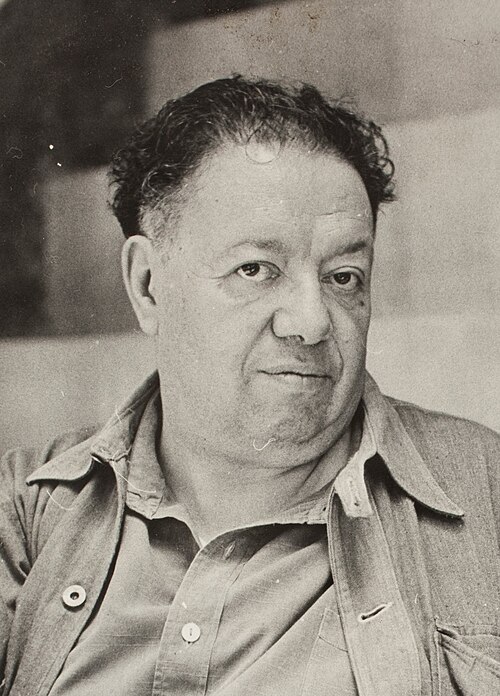
Start at the top for an easy introduction. Go further down for more detail and scholarship.
- Easy
- Intermediate
- Advanced
For young readers
Diego Rivera was born in 1886 in the city of Guanajuato, in Mexico. When he was three he started drawing on the walls of his house. Instead of scolding him, his parents covered the walls with chalkboards and canvas so he could keep drawing!
He went to art school in Mexico City when he was about ten. As a young man he travelled to Spain and France, where he met famous artists and tried out a new style called Cubism, which shows things as if they were broken into pieces and put back together.
After a big revolution in Mexico, the new government wanted art that ordinary people could see and understand—not just rich people in private houses. So Rivera came home and began painting huge pictures directly on the walls of schools, palaces and government offices.
His murals are full of people: farmers planting corn, workers in mines and factories, children in schools, heroes of the revolution, and scenes of the Aztec city before the Spanish arrived. He wanted Mexicans to feel proud of their Indigenous history and of the people who work with their hands.
Rivera also painted in the United States. In Detroit he filled a whole museum courtyard with pictures of car factories. In New York a painting he made caused a big argument because it showed a communist leader, and the building’s owners had it destroyed. Rivera painted it again in Mexico City.
He was married to the painter Frida Kahlo, and today both of them are among the best-known artists in the world. Mexico treats his murals as national treasures, and millions of visitors go to see them every year.
At a glance
- Lived
- December 8, 1886 (Guanajuato, Mexico) – November 24, 1957 (Mexico City)
- Nationality
- Mexican
- Field
- Painting, especially fresco murals; also easel painting, drawing and museum architecture (Anahuacalli)
- Movement
- Mexican muralism, as one of “Los Tres Grandes” with José Clemente Orozco and David Alfaro Siqueiros; early Cubist period in Paris (1913–1917)
- Major murals
- Secretariat of Public Education (1922–1928); Chapingo chapel (1923–1927); National Palace, Mexico City (1929–1935 and later); Detroit Industry (1932–1933); Man at the Crossroads (1933, destroyed); Dream of a Sunday Afternoon in the Alameda Central (1946–1947)
- Mural career
- About 1922–1953, in Mexico City, Chapingo, Cuernavaca, San Francisco, Detroit and New York
- Politics
- Joined the Mexican Communist Party in 1922, expelled in 1929; hosted Leon Trotsky; sought readmission in the 1950s
- Status
- His works are declared historic monuments (monumentos históricos) by the Mexican government
Easy
Who was Diego Rivera?
Diego Rivera was a Mexican painter best known for his large frescoes—paintings made on fresh wet plaster so that the colour becomes part of the wall. Between 1922 and 1953 he covered walls in Mexico City, Chapingo and Cuernavaca in Mexico, and in San Francisco, Detroit and New York in the United States. Together with José Clemente Orozco and David Alfaro Siqueiros, he is counted among the “three greats” of Mexican muralism.
Rivera believed that art should belong to everyone. Instead of making pictures for a few collectors, he wanted to paint in public places where workers, farmers and schoolchildren could see them for free. His murals tell stories: the history of Mexico from the ancient Aztec world to the twentieth century, the struggles of the Mexican Revolution, and the work of ordinary people in fields, mines and factories.
He was also a controversial public figure: a Marxist who worked for capitalist patrons, a man of enormous energy and charm who was also famous for his temper and his many love affairs, and a storyteller who often exaggerated his own life. His marriage to the painter Frida Kahlo made the couple one of the most famous in the history of art.
Easy
Childhood and training
Rivera was born on December 8, 1886, in Guanajuato, a silver-mining city in central Mexico, to a well-off family. His twin brother Carlos died at the age of two. Diego began drawing at three; when he drew on the walls, his parents put up chalkboards and canvas to encourage him.
From about the age of ten he studied at the Academy of San Carlos in Mexico City, the country’s main art school, where he learned the academic European tradition of drawing and painting. With a grant from Teodoro Dehesa, the governor of Veracruz, he left for Europe in 1907, first studying in Madrid.
At that time Mexico was ruled by the long dictatorship of Porfirio Díaz, whose government admired European culture and paid little attention to Indigenous traditions. The Mexican Revolution broke out in 1910 while Rivera was in Europe. Its long civil war and its promises of land and justice for the poor would later become his greatest subject.
Easy
Paris, Cubism and Italy
From Madrid Rivera moved to Paris, then the centre of modern art. He lived among artists and writers in the Montparnasse district; his friends included the painters Amedeo Modigliani, who painted his portrait in 1914, Chaïm Soutine and Moïse Kisling, and the writer Ilya Ehrenburg. In 1911 he married the Russian artist Angelina Beloff. Their son, born in 1916, died as a baby in 1918.
Between 1913 and 1917 Rivera painted in the Cubist style developed by Pablo Picasso and Georges Braque, breaking objects and people into overlapping flat planes. His Cubist paintings, such as his portraits of friends, are now exhibited in major museums. Around 1917, influenced by Paul Cézanne, he moved toward simpler forms and large areas of bright colour.
In 1920, encouraged by the Mexican ambassador Alberto Pani, Rivera travelled through Italy to study Renaissance frescoes by artists such as Giotto and Michelangelo. These great wall paintings, which told religious stories to people who could not read, showed him how art on walls could teach a whole society.
Intermediate
Mexican muralism: art for a new nation
When the fighting of the Revolution ended around 1920, President Álvaro Obregón appointed the philosopher José Vasconcelos as minister of public education. Vasconcelos launched a government programme to paint murals on public buildings. The goal was to educate a largely illiterate population, celebrate the Revolution, and build a new national identity that took pride in Mexico’s Indigenous and mestizo (mixed) heritage. Rivera returned to Mexico in 1921 to join it.
His first major mural, Creation (1922), was painted in encaustic (colour mixed with hot wax) in the Bolívar Amphitheatre of the National Preparatory School. It is an allegorical composition still close to European models. According to the story he told, he painted it carrying a pistol to protect himself from hostile right-wing students. In the same year he helped found the Union of Revolutionary Technical Workers, Painters and Sculptors, whose manifesto called for public art for the people, and he joined the Mexican Communist Party.
The muralists did not always agree with the government or with each other. Vasconcelos preferred classical European forms, while the painters increasingly used a bolder style and openly revolutionary content. Orozco’s work was darker and more tragic, Siqueiros’s more experimental and militant; Rivera’s was the most narrative and orderly, full of clearly outlined figures and details of daily life.
Intermediate
The great Mexican cycles: Education Ministry and Chapingo
In September 1922 Rivera began painting the courtyards of the new Secretariat of Public Education in Mexico City, a former convent. By 1928 he and his assistants had painted over a hundred fresco panels around its courtyards. They show Mexican festivals, markets, dances, miners, weavers and farmers, and—on the upper floor—revolutionary ballads, including the panel In the Arsenal, in which Frida Kahlo is shown handing out weapons. Here Rivera developed his mature style: large, simplified, rounded figures, strong outlines and warm earth colours, partly inspired by pre-Hispanic art.
At the National School of Agriculture at Chapingo, near Texcoco (today the Autonomous University of Chapingo), he painted the main hall and corridor of the school and, between 1923 and 1927, its former chapel. The chapel murals are often called his masterpiece of the 1920s. Where a church would show saints, Rivera painted the transformation of the land and of society. The murdered revolutionary leader Emiliano Zapata and his comrade Otilio Montaño lie buried beneath a field, their bodies nourishing the corn. A reclining nude on the end wall, modelled on his second wife, Guadalupe Marín, symbolizes the liberated, fertile earth.
These cycles show how Rivera turned the language of Christian art—processions, sacrifice, resurrection—into a secular story of labour, revolution and renewal. They also show his mixing of sources: Italian fresco technique, Cubist composition, Mexican folk art and ancient Mesoamerican imagery.
Intermediate
The National Palace: the epic of the Mexican people
Rivera’s most ambitious work is on the main staircase of the National Palace, the seat of government on the Zócalo, the great central square of Mexico City. Painted between 1929 and 1935 and covering about 450 square metres, the staircase murals, often called The History of Mexico or The Epic of the Mexican People, tell the country’s story from the ancient past to Rivera’s own day, like a giant triptych.
The right wall shows the pre-Hispanic world centred on the god-hero Quetzalcóatl. The huge central wall shows the Spanish conquest with its violence—including torture and slavery—as well as friars defending Indigenous people; above it come the wars of independence, the U.S. and French invasions, the Reform era and the Revolution. The left wall shows modern Mexico as Rivera saw it in the 1930s: corrupt politicians and foreign capitalists on one side, and Karl Marx pointing to a future society of workers on the other. Frida Kahlo appears here too.
On the first-floor corridor Rivera later painted a series of panels on pre-Hispanic cultures, such as the great market of Tlatelolco and the peoples of Michoacán, Oaxaca and the Huasteca—Tarascans, Zapotecs, Mixtecs and Huastecs— ending with the arrival of Hernán Cortés at Veracruz. The series was never finished. The palace murals did more than almost any other work to shape how Mexicans and foreigners imagine the country’s history.
Intermediate
In the United States: San Francisco, Detroit and New York
Rivera lived mostly in the United States from 1930 to 1934. In San Francisco he painted murals for the City Club of the Stock Exchange and for the California School of Fine Arts. In 1931 the new Museum of Modern Art in New York gave him a retrospective exhibition, for which he painted portable fresco panels.
In 1932 the Detroit Institute of Arts, with money from Edsel Ford, commissioned him to paint its central courtyard. After studying the Ford River Rouge plant for months, Rivera and his assistants painted twenty-seven panels in about eight months. Detroit Industry shows workers building the 1932 V8 engine among blast furnaces and assembly lines, together with scenes of medicine, chemistry and aviation. Rivera himself thought it his most successful work. When it was unveiled, some clergy called a vaccination panel—arranged like a Nativity scene—blasphemous, and a newspaper called the murals “un-American,” but the museum and Ford kept them. They were designated a U.S. National Historic Landmark in 2014.
In New York in 1933 Rivera began Man at the Crossroads for the lobby of the RCA Building at Rockefeller Center. When he added a portrait of Vladimir Lenin, Nelson Rockefeller asked him to remove it. Rivera refused, offering instead to add Abraham Lincoln. He was stopped, paid in full, and the unfinished fresco was covered and in 1934 destroyed. A General Motors commission in Chicago was cancelled. In 1934 Rivera repainted the composition, from photographs, at the Palacio de Bellas Artes in Mexico City as Man, Controller of the Universe.
Intermediate
Later life, Frida Kahlo and last works
Rivera married Frida Kahlo, then a 22-year-old art student, in 1929, when he was 42. Their marriage was stormy: both had affairs, and they divorced in 1939, only to remarry in San Francisco in 1940. They lived in linked houses and studios in Mexico City and shared a passion for Mexican popular culture and radical politics. From 1937 they hosted the exiled Russian revolutionary Leon Trotsky for several months. Kahlo died in 1954; in 1955 Rivera married Emma Hurtado, his art dealer.
In 1940 Rivera painted Pan American Unity in front of visitors at the Golden Gate International Exposition in San Francisco, a ten-panel mural about the meeting of the art and technology of North and South America. In 1946–1947 he painted Dream of a Sunday Afternoon in the Alameda Central for a Mexico City hotel: a crowd of figures from Mexican history strolling in the park, with the young Rivera holding the hand of the skeleton La Catrina, a figure borrowed from the printmaker José Guadalupe Posada. An inscription reading “God does not exist” caused a scandal, and the mural was hidden for years until Rivera removed it. After the 1985 earthquake the mural was moved to its own museum.
In his last decades Rivera also designed the Anahuacalli, a pyramid-like building of volcanic stone in Coyoacán to house his large collection of pre-Hispanic objects; it opened as a museum in 1964, with about 2,000 pieces on display. He died in Mexico City on November 24, 1957, and was buried at the Panteón de Dolores cemetery.
Advanced
Art and politics: a communist painter with capitalist patrons
Rivera’s career was shaped by a tension between his Marxist convictions and his patrons. In Mexico he worked for a post-revolutionary state that promoted national unity but increasingly moved away from radical reform; in the United States he was paid by the Rockefellers and the Fords. In 1929 the Mexican Communist Party expelled him, officially because of his suspected Trotskyist sympathies; critics on the left also objected to his acceptance of government and wealthy private commissions. Siqueiros, a more militant communist, attacked him in print in 1934 as an opportunist whose art served the state and foreign capital.
Scholars have interpreted this double position in different ways. Some, including sympathetic early biographers such as Bertram Wolfe, stress Rivera’s ability to place radical messages in official spaces, as in the National Palace or at Rockefeller Center. Others see his murals as helping the one-party state build a unifying national myth that obscured continuing inequality. Anthony Lee’s study of Rivera’s San Francisco murals and Catha Paquette’s work on his patrons at MoMA and Rockefeller Center examine how the meanings of his murals were negotiated with the institutions that paid for them.
The Rockefeller Center affair in particular has become a classic case in debates about artistic freedom versus property rights. Rivera argued that a work of art belongs to humanity; the building’s managers argued that they had bought the wall. The affair inspired poems by Archibald MacLeish and E. B. White and remains a reference point in discussions of censorship in public art.
Advanced
Indigenismo and the image of the pre-Hispanic past
Rivera’s murals were central to indigenismo, the post-revolutionary movement that celebrated Indigenous cultures as the root of Mexican identity. His idealized Aztec market at Tlatelolco and his Quetzalcóatl cycle at the National Palace presented a golden age destroyed by conquest, and his Indigenous farmers and labourers became national icons. He also collected pre-Hispanic art on a large scale and built the Anahuacalli to display it.
Historians and anthropologists have also criticized this vision. Scholars such as Renato González Mello have examined links between Rivera’s imagery and state-sponsored anthropology of the period. Critics argue that indigenismo often celebrated Indigenous people as symbols of the past or as picturesque types, while the living Indigenous communities of Mexico had little voice in how they were represented and continued to face poverty and pressure to assimilate. The murals’ contrast between noble Aztecs and cruel Spaniards has also been called too simple by historians of the conquest.
Rivera’s transformation of La Catrina offers a small example of his myth-making. Posada’s original print was a satire of Mexicans who imitated European fashions. In the Alameda mural Rivera gave her a full body and Indigenous features and placed her at the heart of Mexican history, helping turn her into the national icon now linked to the Day of the Dead.
Advanced
Technique, sources and legacy
Rivera worked mainly in true fresco (buon fresco): each day a section of wet lime plaster was laid, the design transferred from full-size drawings, and the pigments painted in before the plaster dried. This required careful planning and a team of plasterers and assistants, including artists who later became well known, such as Ben Shahn, Lucienne Bloch and Rina Lazo. His compositions combine Renaissance perspective and Cubist interlocking planes with the flat, crowded storytelling of pre-Hispanic codices.
Much of what we know about Rivera’s life comes from his own tales, which he embellished freely. His autobiography, compiled by Gladys March from years of interviews and published after his death in 1960, includes claims—such as having practised cannibalism as a student—that historians regard as inventions. Biographers therefore check his stories against letters, contracts, photographs and the testimony of others.
Rivera’s influence was enormous. His success in the United States is often credited with encouraging the New Deal mural programmes of the 1930s, and Mexican muralism later inspired the Chicano mural movement and public art throughout Latin America. His painting The Rivals (1931) held the auction record for a Latin American artist until 2021, when it was surpassed by a work by Frida Kahlo. In Mexico his murals are protected as historic monuments, and the Detroit courtyard is a U.S. National Historic Landmark.
Key ideas
- Public art
- Rivera painted on the walls of schools, palaces and ministries so that everyone, including people who could not read, could see art for free.
- History as epic
- His murals present the whole history of Mexico as a single story of conquest, resistance and revolution.
- Dignity of labour
- Farmers, miners and factory workers are the heroes of his paintings, reflecting his Marxist beliefs.
- Indigenismo
- He celebrated Mexico’s pre-Hispanic civilizations as the foundation of national identity—a vision both powerful and debated.
- Fresco
- Painting on fresh wet plaster, a Renaissance technique he revived to make durable art that is part of the building itself.
- Art and power
- His career shows the tension between radical political messages and the governments and millionaires who paid for them.
- Modernism meets tradition
- He combined Cubism and European modern art with Mexican folk art and ancient Mesoamerican imagery.
Records
- 1886 — Diego Rivera is born on December 8 in Guanajuato, Mexico.
- c. 1896 — He begins studying at the Academy of San Carlos in Mexico City.
- 1907 — With a state grant he travels to Europe, studying first in Madrid, then settling in Paris.
- 1913 — He begins his Cubist period (to 1917) in Paris.
- 1921 — After studying frescoes in Italy, he returns to Mexico to join Vasconcelos’s mural programme.
- 1922 — He paints Creation at the National Preparatory School, begins the Education Ministry murals and joins the Communist Party.
- 1923 — He begins the Chapingo chapel murals (completed 1927).
- 1929 — He marries Frida Kahlo, is expelled from the Communist Party and begins the National Palace staircase.
- 1931 — Retrospective exhibition at the Museum of Modern Art, New York.
- 1932 — He begins Detroit Industry at the Detroit Institute of Arts (completed 1933).
- 1933 — Man at the Crossroads at Rockefeller Center is halted over a portrait of Lenin and later destroyed.
- 1947 — He completes Dream of a Sunday Afternoon in the Alameda Central.
- 1957 — He dies in Mexico City on November 24.
Glossary
- Mural
- A large painting made directly on a wall or ceiling.
- Fresco
- A technique of painting with pigments on fresh, wet lime plaster, so the colour becomes part of the wall.
- Encaustic
- Painting with colours mixed into hot wax.
- Cubism
- An early twentieth-century art style that shows objects broken into flat, overlapping geometric planes.
- Mexican Revolution
- The armed struggle of 1910–1920 that overthrew the Díaz dictatorship and reshaped Mexican politics and society.
- Los Tres Grandes
- “The three great ones”: Rivera, José Clemente Orozco and David Alfaro Siqueiros, leaders of Mexican muralism.
- Indigenismo
- A movement celebrating Indigenous cultures as central to national identity, influential in Mexico after the Revolution.
- Mestizo
- Of mixed Indigenous and European ancestry; also used for Mexico’s idea of itself as a mixed nation.
- Triptych
- An artwork in three parts, usually a large central part with two side parts.
- La Catrina
- An elegant female skeleton created by printmaker José Guadalupe Posada, now a symbol of the Day of the Dead.
Questions and answers
Why did Rivera paint on walls instead of canvases?
He wanted art to be public. A painting on the wall of a school or palace can be seen by thousands of people for free, while a canvas often ends up in a private home.
Was Diego Rivera married to Frida Kahlo?
Yes. They married in 1929, divorced in 1939 and married again in 1940. They stayed together until her death in 1954.
What happened to the mural at Rockefeller Center?
Rivera included a portrait of Lenin and refused to remove it. The work was stopped, covered and destroyed in 1934. He painted a new version in Mexico City’s Palacio de Bellas Artes.
Where can I see his most important murals?
In Mexico City at the National Palace, the Secretariat of Public Education, the Palacio de Bellas Artes and the Museo Mural Diego Rivera; at Chapingo; and in the United States at the Detroit Institute of Arts and in San Francisco.
Was Rivera a communist?
Yes. He joined the Mexican Communist Party in 1922, was expelled in 1929, sympathized with Trotsky, and later tried to rejoin. His political views are visible in many murals.
Is his autobiography reliable?
Only partly. Rivera loved telling tall tales, and historians consider several stories in it, such as his claim of cannibalism, to be inventions.
How do scholars criticize his image of Indigenous Mexico?
Some argue that his murals idealized the Aztec past and turned Indigenous people into national symbols while living communities had little say in their representation.
Sources and further reading
- Diego Rivera. Wikipedia
- Mexican muralism. Wikipedia
- National Palace (Mexico). Wikipedia
- Detroit Industry Murals. Wikipedia
- Man at the Crossroads. Wikipedia
- Sueño de una Tarde Dominical en la Alameda Central. Wikipedia
- Pan American Unity. Wikipedia
- Anahuacalli Museum. Wikipedia
- Bertram D. Wolfe, The Fabulous Life of Diego Rivera. Stein and Day, 1963
- Desmond Rochfort, Mexican Muralists: Orozco, Rivera, Siqueiros. Laurence King, 1993
Related
- Frida KahloMexican painter known for self-portraits that explore the body, identity, relationships and personal experience.
- TenochtitlanCapital of the Mexica, founded on an island in Lake Texcoco and conquered in 1521.
- Florentine CodexA twelve-book encyclopedia of Nahua (Aztec) life in parallel Nahuatl and Spanish, painted with nearly 2,500 images and completed at Tlatelolco in 1575–1577.
- GuernicaPablo Picasso’s large 1937 painting responds to the bombing of the Basque town of Gernika during the Spanish Civil War.
- Sistine Chapel ceilingCeiling frescoes painted by Michelangelo in the Sistine Chapel between 1508 and 1512.
- October RevolutionBolshevik forces overthrew Russia’s Provisional Government in Petrograd in October 1917, opening a new phase of revolution and civil conflict.
Written with AI assistance from the published sources listed above, and revised as new research appears.