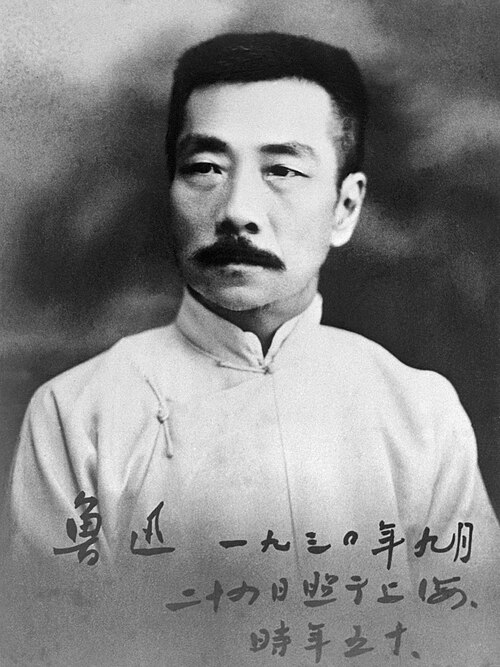
Start at the top for an easy introduction. Go further down for more detail and scholarship.
- Easy
- Intermediate
- Advanced
For young readers
Lu Xun was born in China in 1881, in a town full of canals called Shaoxing. His family was once rich and important, but when he was a boy his grandfather went to prison and his father became very ill. Young Lu Xun had to carry things to the pawnshop to get money for medicine, and his father still died.
He decided to become a doctor. He went all the way to Japan to study medicine. But one day, in class, he saw a picture of a Chinese man about to be executed while a crowd of other Chinese people simply stood and watched. Lu Xun later said that this moment changed his mind: he felt that a sick body was not China’s biggest problem. People’s minds and hearts needed waking up, and he thought stories could do that.
So he became a writer. In 1918 he wrote a story called “Diary of a Madman”. It was written in everyday spoken Chinese instead of the old, difficult written language, which was new and exciting at the time. In the story, a man becomes afraid that everyone around him wants to eat him. It sounds like a scary tale, but it is really about how old customs can hurt people.
His most famous character is Ah Q, a poor man who is always losing but always tells himself he has won. Readers laughed at Ah Q, and then realized they sometimes acted like him too.
Lu Xun also wrote hundreds of short, fierce essays about what was wrong in society. He spent his last years in Shanghai and died there in 1936. Today his stories are read in schools across China and translated all over the world.
At a glance
- Born
- 25 September 1881, Shaoxing, Zhejiang, Qing China, as Zhou Zhangshou; later named Zhou Shuren
- Died
- 19 October 1936, Shanghai
- Pen name
- Lu Xun (魯迅), first used for “Diary of a Madman” in 1918; he used many other pen names
- Education
- Jiangnan Naval Academy and School of Mines and Railways, Nanjing; Sendai Medical School, Japan (1904–06)
- Main fiction
- Call to Arms (Nahan, 1923), Wandering (Panghuang, 1926), Old Tales Retold; including “Diary of a Madman” and “The True Story of Ah Q”
- Other works
- Wild Grass (prose poems), Dawn Blossoms Plucked at Dusk (memoirs), about 16 volumes of essays, A Brief History of Chinese Fiction, many translations
- Movement
- A leading writer of the New Culture Movement and the May Fourth era; later associated with the League of Left-Wing Writers (1930)
- Places
- Shaoxing, Nanjing, Tokyo and Sendai, Beijing (1912–26), Xiamen, Guangzhou, Shanghai (1927–36)
Easy
Who was Lu Xun?
Lu Xun is the pen name of Zhou Shuren, a Chinese writer, critic, scholar and translator who lived from 1881 to 1936. He is widely regarded as the most important Chinese writer of the first half of the twentieth century and as a founder of modern Chinese literature.
He lived through enormous changes. He was born under the Qing dynasty, when men wore their hair in a long queue and officials were chosen by examinations on the Confucian classics. He saw the empire fall in the 1911 revolution, the new Republic of China struggle with warlords and foreign pressure, and the rise of the Nationalist and Communist parties.
Lu Xun wrote relatively little fiction: about thirty-three stories in three collections. But stories such as “Diary of a Madman”, “Kong Yiji”, “Medicine”, “My Old Home” and “The True Story of Ah Q” changed what Chinese fiction could be. They were written in the modern vernacular (baihua), used new forms borrowed and adapted from European, Russian and Japanese literature, and looked unflinchingly at poverty, cruelty and indifference.
Even more of his work consists of short critical essays, called zawen (“miscellaneous writings”). In them he attacked hypocrisy, violence, censorship and blind respect for tradition, often with bitter humour. He also wrote prose poems, memoirs and classical-style poetry, studied the history of Chinese fiction, translated Russian, Japanese and European literature, and promoted woodcut printing as a modern art for ordinary people.
Easy
Childhood in a falling family
Lu Xun was born in Shaoxing, a canal town in Zhejiang province, into a family of scholar-officials and landlords. As a boy he studied the Confucian classics, but he preferred illustrated books, folk stories, local opera and ghost tales told by a family servant. Many of these memories later appeared in his essays and stories.
In 1893, when he was twelve, his grandfather Zhou Fuqing was arrested for trying to bribe an examination official and was sentenced to death, a sentence that was postponed year after year until he was finally released. The family spent much of its wealth to save him. Lu Xun’s father, Zhou Boyi, fell ill and died in 1896. During his illness the boy made daily trips to the pawnshop and to the pharmacy to buy expensive traditional remedies that did not help.
Lu Xun later wrote that this experience taught him how people treat a family that has fallen in the world. It also left him deeply distrustful of traditional medicine, which he came to see as an example of how old customs could do harm.
Because the family could no longer afford the usual path to an official career, in 1898 he went to Nanjing to study at a free, government-funded naval academy and then at a school of mines and railways. There he read Western science and thought in translation, including Thomas Huxley’s Evolution and Ethics as translated by Yan Fu, which introduced many Chinese readers to ideas of evolution and the struggle for survival.
Easy
From medicine to literature
In 1902 Lu Xun went to Japan on a government scholarship, like thousands of young Chinese at the time who hoped to learn how Japan had modernized so quickly. After studying Japanese in Tokyo, in 1904 he enrolled at the medical school in Sendai. He hoped, he later said, to cure people like his father and to serve his country as a doctor.
In the preface to his first story collection, Call to Arms (1923), he told a famous story. During a lecture in Sendai, the teacher showed lantern slides of the Russo-Japanese War. One slide showed a Chinese man, said to be a spy for Russia, about to be beheaded by Japanese soldiers, while a crowd of Chinese stood around watching. The Japanese students cheered. Lu Xun wrote that he then realized that healthy bodies were useless if people’s spirits were numb, and that the first task was to change their spirit, for which literature was the best means.
He left medical school in 1906 and returned to Tokyo to work on literature. He also went home that year for an arranged marriage with Zhu An, a woman chosen by his mother; the marriage was never a real partnership. In Tokyo he wrote essays, including “On the Power of Mara Poetry” (1908), which introduced European Romantic rebels such as Byron to Chinese readers, and with his younger brother Zhou Zuoren he translated stories from Eastern European literatures. His plan for a literary magazine failed, and few people read his early work.
His teacher of anatomy in Sendai, Fujino Genkurō, who corrected his lecture notes with great care, appears in a warm memoir Lu Xun wrote about him in 1926. The Sendai years thus left him with both humiliation and gratitude toward Japan.
Intermediate
Beijing, the “iron house” and “Diary of a Madman”
After returning to China in 1909, Lu Xun taught in Hangzhou and Shaoxing. After the 1911 revolution he joined the Ministry of Education of the new Republic in 1912 and moved with it to Beijing, where he lived until 1926. The Republic soon disappointed him. For several years he spent his evenings copying ancient inscriptions, collecting old texts and reading Buddhist scriptures, deliberately avoiding public life.
In 1917 his friend Qian Xuantong asked him to write for New Youth (Xin qingnian, also called La Jeunesse), the radical magazine edited by Chen Duxiu that was leading the New Culture Movement against Confucian tradition and for vernacular writing. In the preface to Call to Arms, Lu Xun recalled his answer with an image that became famous: imagine an iron house without windows, almost impossible to break, in which many people are sleeping and will soon suffocate. If you wake a few of them, are you not making them suffer? His friend replied that if a few wake up, there is some hope of destroying the house. Lu Xun agreed to write.
“Diary of a Madman” appeared in New Youth in May 1918. It borrows its title and diary form from Nikolai Gogol’s story of the same name. A short preface in classical Chinese explains that the diary belonged to a man who has since recovered; the diary itself is in vernacular. The diarist becomes convinced that the people around him, even his own brother, are cannibals. Reading an old history book, he finds the words “benevolence and righteousness” written across every page, and between the lines two words: “eat people”. The story ends with the cry “Save the children…”.
The story was read as a devastating allegory: the old moral order, with its Confucian virtues, was in reality a system in which the strong consumed the weak. It is often called the first modern short story in Chinese vernacular, although literary historians note earlier vernacular experiments. Over the next few years Lu Xun published the stories collected in Call to Arms, including “Kong Yiji”, about a failed scholar mocked in a wine shop, “Medicine”, in which a family feeds their sick son a bun soaked in the blood of an executed revolutionary, and “My Old Home”, which ends with the reflection that hope is like a path across the land: there was none at first, but when many people walk the same way, a path appears.
Intermediate
Ah Q and the “spiritual victory”
“The True Story of Ah Q”, Lu Xun’s longest work of fiction, was published in weekly instalments in the supplement of the Beijing Morning Post from December 1921 to February 1922 under the pen name Ba Ren. Its hero is a poor, landless day labourer in the village of Weizhuang. Ah Q is beaten, insulted and cheated, but he always finds a way to tell himself that he has really won: if someone beats him, he thinks, it is as if a son were beating his father. Lu Xun called this his “method of spiritual victory”.
Ah Q is also a bully to those weaker than himself, and he is eager to follow whatever is fashionable. When news of the 1911 revolution reaches the village, he decides to become a “revolutionary” because the local gentry seem afraid of it. In the end the gentry themselves take over the revolution, and Ah Q is arrested for a robbery he did not commit. Unable to write his name, he is told to sign with a circle, and worries only that it is not round enough. He is shot as an example while a crowd complains that the execution was not entertaining.
Readers immediately recognized Ah Q as a portrait of habits they saw around them and in themselves: face-saving, self-deception, submission to the powerful and cruelty to the weak. “Ah Q-ism” became a common expression in Chinese. The story is also a bitter comment on the 1911 revolution, which Lu Xun believed had changed the flag but not the society.
Lu Xun’s second story collection, Wandering (1926), is darker and more inward. “The New Year’s Sacrifice” tells of Xianglin’s Wife, a widowed servant whose misfortunes lead her village to treat her as unlucky and impure until she dies in the snow. Other stories follow intellectuals who return home defeated or who abandon their ideals.
Intermediate
Essays, prose poems, scholarship and translation
Lu Xun’s essays (zawen) fill many volumes. They are usually short and written in response to a current event: a massacre of students, a new censorship law, a fashionable opinion. His style is compressed, allusive and ironic. He attacked conservatives who defended Confucian morality, but also fellow radicals and literary rivals, and his quarrels with writers such as Liang Shiqiu and with other leftists were famous. Many of these essays are hard to translate because they depend on references to events and people of the time.
Wild Grass (published 1927) is a collection of prose poems full of dreams, shadows and paradox, often regarded as his most personal and experimental work. Dawn Blossoms Plucked at Dusk collects memoirs of his childhood and youth, including the essay on his teacher Fujino. Old Tales Retold, his last collection of fiction, rewrites ancient legends and stories of philosophers such as Confucius, Laozi and Mozi with ironic modern details.
Lu Xun was also a serious scholar. His lectures at Peking University and other colleges in the early 1920s became A Brief History of Chinese Fiction, the first systematic history of Chinese fiction, which helped establish novels such as Dream of the Red Chamber and Journey to the West as objects of academic study.
He translated a great deal, especially from Russian and Japanese, including Gogol’s Dead Souls. He argued for a deliberately literal “hard translation” that preserved foreign sentence structures, believing that Chinese itself had to be enriched by new forms of expression. In the 1930s he also supported young artists in the woodcut movement, collecting European prints and organizing workshops.
Intermediate
Politics, Shanghai and the final years
In 1925–26 Lu Xun became involved in conflicts at the Beijing Women’s Normal College, where he taught, and fell in love with one of his students, Xu Guangping. After the 18 March 1926 massacre, when government troops fired on student demonstrators in Beijing and killed two of his students, he wrote the essay “In Memory of Miss Liu Hezhen”. Later that year he left Beijing, teaching briefly in Xiamen and then in Guangzhou at Sun Yat-sen University.
In 1927 the Nationalist Party (Kuomintang) under Chiang Kai-shek turned violently against its Communist allies. Horrified by the killings of young people, Lu Xun left Guangzhou and settled in Shanghai with Xu Guangping. Their son, Zhou Haiying, was born in 1929. In Shanghai he lived by writing and editing, moving several times to avoid danger.
Around this time he read Marxist literary theory and moved to the left. In 1930 he became a leading figure in the League of Left-Wing Writers, aligned with the Communist Party. In 1931 several young writers he knew were executed by the Nationalist authorities, and he wrote angrily about them. Yet he never joined the Communist Party, and he quarrelled bitterly with party-linked literary leaders in the League, whom he accused of bureaucratic bullying.
Lu Xun had long suffered from tuberculosis and was a heavy smoker. He died in Shanghai on 19 October 1936, aged 55. Thousands attended his funeral, and his coffin was covered with a banner reading “Soul of the Nation”. He is buried in a tomb in Lu Xun Park (formerly Hongkou Park) in Shanghai, near which a museum is dedicated to him.
Intermediate
Influence and legacy in China and East Asia
After his death, Lu Xun was claimed by the Chinese Communist Party. In 1940 Mao Zedong wrote that he was not only a great writer but also “a great thinker and a great revolutionary”, and this judgment became the official view in the People’s Republic. His works were widely taught, and during the Cultural Revolution his was one of very few modern literary voices allowed. This official cult could make him seem like a monument rather than the doubting, independent writer he was.
In Taiwan under martial law, by contrast, his works were restricted for decades because of their association with the left. After political liberalization they were read freely there as well. In mainland China today his stories remain central to school textbooks, although the number and choice of texts has been debated.
Lu Xun has been especially important in Japan and Korea. In Japan, the critic Takeuchi Yoshimi’s book Lu Xun (1944) made him a model for thinking about how Asian societies could resist and absorb Western modernity; Lu Xun remains widely read there, and “Mr Fujino” has appeared in Japanese school textbooks. In Korea, his stories were translated and discussed from the colonial period onward, and many Korean intellectuals saw in his struggle against both tradition and imperialism a situation similar to their own.
Internationally, translations by Yang Xianyi and Gladys Yang, by William Lyell, and by Julia Lovell have made him one of the most widely read Chinese writers. Writers in many countries have cited him as an example of literature that combines artistic innovation with moral seriousness.
Advanced
Interpretive debates
Revolutionary or sceptic? The Maoist interpretation presented Lu Xun’s life as a progress from evolutionism to Marxism and from individualism to collectivism. Scholars outside the official framework have emphasized instead his doubt, despair and irony. Leo Ou-fan Lee’s Voices from the Iron House (1987) reads him as a modernist whose inner conflicts, visible in Wild Grass, cannot be reduced to a political programme. In the 1980s mainland scholars also began to stress his individualism and his debt to thinkers such as Nietzsche.
National character. Lu Xun’s criticism of the “national character” (guominxing) of Chinese people was a central theme of his work. Some scholars, notably Lydia H. Liu in Translingual Practice (1995), have argued that this discourse came partly from Western missionary writing, especially Arthur Smith’s Chinese Characteristics, which Lu Xun read in Japanese translation, and have asked how far his critique reproduced foreign stereotypes. Others reply that he transformed these ideas into a tool of self-criticism aimed at social change.
Literary judgment. The critic C. T. Hsia, in A History of Modern Chinese Fiction (1961), admired Lu Xun’s best stories but argued that his later polemical writing narrowed his art. Defenders see the essays as a genuine new literary form suited to an age of crisis. The claim that “Diary of a Madman” was the first modern vernacular Chinese story has also been qualified by scholars who point to earlier experiments, including by women writers such as Chen Hengzhe.
Translation and language. Lu Xun’s “hard translation” and his mixture of classical and vernacular language have been reassessed by translation-studies scholars, who see in them a deliberate strategy to make Chinese readers feel the foreignness of new ideas rather than assimilating them smoothly.
Advanced
Biographical sources and their reliability
Much of what we know about Lu Xun’s early life comes from his own writings: the preface to Call to Arms, the memoirs in Dawn Blossoms Plucked at Dusk, and autobiographical sketches. These are carefully shaped literary texts written years after the events. The lantern-slide story, for example, is told differently in different accounts, and researchers in Sendai have not identified a slide that exactly matches his description, so many scholars treat it as a condensed or symbolic version of his turn to literature rather than a precise record.
Other important sources are his diaries, kept from 1912 to 1936, his extensive letters, including the correspondence with Xu Guangping published as Letters Between Two (1933), and memoirs by family members, friends and students. His brother Zhou Zuoren wrote detailed recollections of their shared childhood and Tokyo years, but the two brothers broke off relations in 1923 for reasons neither explained publicly, and Zhou Zuoren later collaborated with the Japanese occupation, which affected how his testimony was received.
After 1949, biographies published in the People’s Republic were shaped by the official image of Lu Xun as a revolutionary, and some episodes were emphasized or played down accordingly. The standard Complete Works (Lu Xun quanji) has been published in several annotated editions since the first edition of 1938, and the annotations themselves reflect changing political judgments.
Modern scholarship therefore reads Lu Xun’s life through several layers: his own self-representation, the partisan memories of those around him, and the later work of canonization. Distinguishing among them is part of understanding both the writer and the history of modern China.
Key ideas
- Literature as cure
- Lu Xun abandoned medicine because he believed the spirit of a people needed to change first, and fiction could awaken it.
- The iron house
- His image of sleepers in a sealed house: waking them brings pain, but perhaps also the hope of breaking out.
- “Eating people”
- In “Diary of a Madman”, the old moral order is exposed as a system in which people devour one another.
- Spiritual victory
- Ah Q’s habit of turning every defeat into an imagined triumph, a satire of self-deception.
- National character critique
- His sustained criticism of apathy, face-saving and cruelty, aimed at changing society rather than despising it.
- Zawen
- The short, combative essay he developed into a major literary form.
- Hard translation
- Literal translation that keeps foreign structures, to enrich Chinese with new modes of thought.
Records
- 1881 — Born Zhou Zhangshou in Shaoxing, Zhejiang, on 25 September.
- 1893 — His grandfather is arrested in an examination bribery case; the family’s fortunes decline.
- 1898 — Enters the Jiangnan Naval Academy in Nanjing; takes the name Zhou Shuren.
- 1902 — Goes to Japan on a government scholarship.
- 1904 — Enrols at Sendai Medical School; leaves in 1906 to pursue literature.
- 1912 — Joins the Ministry of Education of the Republic of China; moves to Beijing.
- 1918 — “Diary of a Madman” appears in New Youth under the pen name Lu Xun.
- 1921 — “The True Story of Ah Q” begins serial publication (December 1921–February 1922).
- 1923 — Call to Arms, his first story collection, is published; break with his brother Zhou Zuoren.
- 1926 — Wandering is published; after the 18 March massacre he leaves Beijing for Xiamen.
- 1927 — Moves to Guangzhou and then settles in Shanghai with Xu Guangping.
- 1930 — Becomes a leading member of the League of Left-Wing Writers.
- 1936 — Dies in Shanghai on 19 October.
Glossary
- Baihua
- Written vernacular Chinese, close to everyday speech, promoted by the New Culture Movement instead of classical Chinese.
- Classical Chinese (wenyan)
- The ancient written language used for official and literary writing for two thousand years.
- New Culture Movement
- A movement of the 1910s–20s that criticized Confucian tradition and promoted science, democracy and vernacular literature.
- May Fourth Movement
- Student-led protests beginning on 4 May 1919, and more broadly the cultural reform era associated with them.
- New Youth
- The magazine edited by Chen Duxiu in which “Diary of a Madman” appeared.
- Zawen
- Short satirical or critical essays on current affairs.
- Queue
- The long braid Han Chinese men were required to wear under the Qing dynasty.
- League of Left-Wing Writers
- An association of left-wing writers founded in Shanghai in 1930.
- Pen name
- A name an author uses instead of his or her real name.
Questions and answers
Why did Lu Xun stop studying medicine?
He wrote that seeing a lantern slide of Chinese onlookers at an execution convinced him that changing people’s spirit mattered more than healing their bodies, and that literature could do this.
Is “Diary of a Madman” a horror story?
It uses a frightening idea, cannibalism, but it is an allegory: the “eating of people” stands for the cruelty hidden inside traditional morality.
Who is Ah Q?
A poor, uneducated villager who always convinces himself he has won, even when beaten. He became a symbol of self-deception.
Was Lu Xun a Communist?
He moved to the left and led the League of Left-Wing Writers, but he never joined the Communist Party and argued with party-linked leaders. The Party honoured him after his death.
Is the lantern-slide story true?
Lu Xun told it himself, but the exact slide has not been found and details differ between accounts, so many scholars see it as a shaped retelling of a real turning point.
Why is he still important?
He created a new kind of Chinese fiction in the vernacular and a model of the writer as independent critic of society; his stories remain central in China and are read around the world.
What did Lu Xun write besides stories?
Essays, prose poems, memoirs, classical-style poems, a history of Chinese fiction, and many translations.
Sources and further reading
- Lu Xun. Wikipedia
- 루쉰. Korean Wikipedia
- Diary of a Madman (Lu Xun). Wikipedia
- The True Story of Ah Q. Wikipedia
- New Culture Movement. Wikipedia
- League of Left-Wing Writers. Wikipedia
- Leo Ou-fan Lee, Voices from the Iron House: A Study of Lu Xun. Indiana University Press, 1987
- Lu Xun, translated by Julia Lovell, The Real Story of Ah-Q and Other Tales of China: The Complete Fiction of Lu Xun. Penguin Classics, 2009
- Lydia H. Liu, Translingual Practice: Literature, National Culture, and Translated Modernity—China, 1900–1937. Stanford University Press, 1995
Related
- March 1st MovementA Korean independence movement began with public declarations and demonstrations on 1 March 1919 and spread across the peninsula.
- Natsume SōsekiJapanese novelist whose fiction explores social change, loneliness and the tension between personal wishes and obligation.
- Dream of the Red ChamberA Qing-era novel centered on the Jia family, celebrated for its closely observed characters and account of an elite household’s decline.
- Journey to the WestMing novel that turns a Buddhist pilgrimage into a journey of adventure and satire.
- ConfuciusTeacher from the state of Lu whose sayings, gathered in the Analects, shaped ethics and government across East Asia.
- Franz KafkaPrague-born German-language writer whose stories portray uncertainty, opaque authority and people struggling to understand their circumstances.
Written with AI assistance from the published sources listed above, and revised as new research appears.