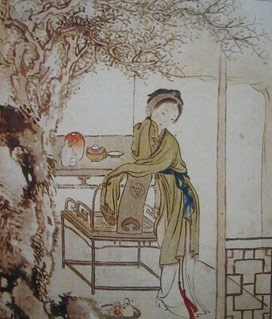
Start at the top for an easy introduction. Go further down for more detail and scholarship.
- Easy
- Intermediate
- Advanced
For young readers
Long, long ago, says the story, a goddess named Nüwa mended the broken sky with magic stones. One stone was left over. It could think and feel, and it was sad that it had not been used. So it asked to be carried down into the human world to see what life was like.
The stone is born into a very rich family in Beijing as a boy named Jia Baoyu, who comes into the world with a piece of jade in his mouth. He lives in a huge house full of grandparents, aunts, cousins and servants—hundreds of people! Baoyu does not like studying for exams. He prefers poetry, flowers and spending time with his girl cousins.
His closest friend is his cousin Lin Daiyu, a clever, sensitive girl who writes beautiful poems but is often sick and sad. Another cousin, Xue Baochai, is calm, kind and sensible. The family builds a magical garden, and the young people live there, writing poems, playing games and growing up.
But the family spends too much money and some of the grown-ups do bad things. Slowly, the happy world starts to fall apart. The book shows that wealth and beauty do not last forever, a bit like a wonderful dream that fades when you wake up.
The book has more than four hundred characters, from grand ladies to kitchen maids, and each one feels like a real person. In China people love it so much that there is a whole field of study just about this one novel, called “Redology.”
At a glance
- Author
- Cao Xueqin (c. 1715/1724 – 1763/1764) for the first 80 chapters; the last 40 chapters’ authorship is disputed
- Written
- Mid-eighteenth century (about 1740s–1760s), Qing dynasty
- Place
- Beijing, where Cao Xueqin lived and wrote
- Form
- Vernacular novel in 120 chapters (hui) in the standard printed version; manuscripts contain up to 80
- Language
- Written vernacular Chinese (based on the northern Mandarin of Beijing), with many poems in classical style
- First printing
- 1791 (Cheng Weiyuan and Gao E), revised 1792
- Other titles
- The Story of the Stone (石頭記); A Dream of Red Mansions
- Status
- One of the “Four Great Classical Novels” of Chinese literature
Easy
What is Dream of the Red Chamber?
Dream of the Red Chamber (Hongloumeng) is a long Chinese novel written in the eighteenth century, during the Qing dynasty. It tells the story of the Jia family, a wealthy and noble clan living in the capital, and especially of the teenage heir Jia Baoyu and the girls and young women around him. Many readers in China consider it the greatest Chinese novel ever written.
The title uses “red chamber” to mean the richly decorated rooms where the daughters of wealthy families lived. The “dream” points to the novel’s central idea: that the splendour of this world, its love and its wealth, may be as passing as a dream. The book was first known as The Story of the Stone (Shitouji), and the first chapter lists other titles it was given.
The novel is celebrated for its enormous cast—roughly forty major characters and hundreds of minor ones—and for the realism of its everyday details: food, clothes, medicine, festivals, poetry games, household accounts and the tensions between masters and servants. At the same time, it is framed by myth and filled with dreams, prophecies and symbols.
Easy
The story
The novel opens in myth. When the goddess Nüwa repaired the sky, one stone was left unused. Made conscious by its time in the heavens, it begs a Buddhist monk and a Daoist priest to take it into the human world. In a parallel legend, a divine attendant waters a crimson flower in heaven; when both are born as humans, the flower-spirit will repay him with the tears of a lifetime. These become Jia Baoyu and Lin Daiyu.
Baoyu grows up in the Rongguo mansion, one of two linked households of the Jia clan in the capital (the other is the Ningguo mansion). He is doted on by his grandmother, the family matriarch, and feared by his stern father, who wants him to study the Confucian classics for the civil service examinations. Baoyu hates this path and prefers the company of girls, whom he calls pure, while men seem to him coarse. His orphaned cousin Lin Daiyu comes to live with the family; she is brilliant, proud and frail. Another cousin, Xue Baochai, is prudent, well-mannered and admired by the elders.
When Baoyu’s elder sister becomes an imperial consort, the family builds a vast garden, the Garden of Grand View, for her visit. Afterwards the young cousins move into it, and for a time it becomes an enclosed paradise of poetry clubs, flowers and friendship. Around them, the capable and ruthless Wang Xifeng manages the household, and the wider world breaks in through visitors such as Granny Liu, a poor country woman whose visits show the gulf between rich and poor.
Beneath the elegance, the family is rotting: extravagance, debts, corruption, sexual scandals and abuse of power. In the version most people read, Baoyu is tricked into marrying Baochai while Daiyu dies of illness and grief; the family’s property is confiscated by the emperor; and Baoyu, after passing the examinations, leaves the world to become a monk. The stone returns to where it came from.
Intermediate
A world of characters
Grandmother Jia, the widowed matriarch of the Rongguo mansion, sits at the top of the household. Her authority is affectionate but absolute, and much of the family’s pleasure—feasts, theatricals, outings in the garden—revolves around her. Baoyu’s parents, the rigid Jia Zheng and the outwardly pious Lady Wang, represent Confucian duty and the anxious control of a mother over her son’s future.
Wang Xifeng, married to Baoyu’s cousin Jia Lian, is one of the most memorable figures in Chinese fiction. Witty, charming and a brilliant manager, she keeps the huge household running, but she also lends money at interest, takes bribes and destroys rivals. Her cleverness serves the family and harms it at the same time, a small image of the whole house.
The young women of the garden each have their own world. Besides Daiyu and Baochai, there are Baoyu’s sisters and cousins—Yuanchun the imperial consort, the capable Tanchun, the timid Yingchun, the aloof Xichun—and the lively Shi Xiangyun, who loves to drink and compose poems. Among the maids, the proud Qingwen and the loyal Xiren are drawn as fully as their mistresses, and the novel pays close attention to the injustice of their dependent lives.
The servants, stewards, actors, nuns, relatives and visitors form a society of their own, with gossip, rivalries and alliances. Through them the novel shows how power and money flow through a great household, and how the fate of the powerful drags down many who had no voice in its decisions.
Intermediate
Themes: love, illusion and the fall of a house
At the gate of the dream-realm that Baoyu visits in chapter 5, the Land of Illusion (Taixu huanjing), hangs a couplet that sums up the book: when the false is taken for true, the true becomes false; where nothing is taken for something, something becomes nothing. The novel constantly blurs truth (zhen) and falsehood (jia)—even the family name Jia sounds like the word for “false.”
In that dream Baoyu reads registers foretelling the fates of the “Twelve Beauties of Jinling” in cryptic poems and hears songs about their sorrows. Most will meet unhappy ends. The episode gives the novel a tragic framework: the reader watches the young women flourish in the garden knowing that their youth and beauty will be lost. The Buddhist and Daoist ideas that frame the book—attachment brings suffering, worldly glory is empty—stand in tension with its intense affection for the people and pleasures it describes.
The novel is also a sharp portrait of Qing elite society. It shows how the examination system, family hierarchy, marriage politics and the dependence of servants shaped lives. Critics have especially praised its women characters, who are more varied and fully drawn than in earlier Chinese fiction, and its sympathy for maids and concubines whose lives were controlled by others.
Baoyu himself is an unusual hero: gentle, emotional, indifferent to official success and often absurd. Some readers see him as a critic of Confucian orthodoxy, others as a portrait of passion (qing) that must finally be transcended. The love triangle of Baoyu, Daiyu and Baochai has been read as a contrast between feeling and propriety, poetry and practicality.
Intermediate
How the novel is written
Dream of the Red Chamber belongs to the Chinese tradition of the chapter novel (zhanghui xiaoshuo), in which each chapter has a paired-line title and often ends with a line inviting readers to find out what happens in the next chapter. It inherits devices from oral storytelling but uses them with great self-awareness.
Its language is a supple written vernacular close to the speech of Beijing, which helped establish Mandarin as a literary language. Characters speak in distinctive voices, from the polished talk of the matriarch to the earthy jokes of Granny Liu. The novel also contains a large number of poems, song lyrics, riddles and couplets, written for different characters in styles suited to their personalities; many of them secretly foreshadow those characters’ fates.
Cao Xueqin structured the book through contrasts and echoes: the two mansions, pairs of characters who mirror each other, festivals that mark the passing years, and the seasons of the garden from spring blossoms to autumn decay. Small objects—Baoyu’s jade, Baochai’s golden locket, a handkerchief, a fan—carry layers of meaning that later chapters bring back.
Intermediate
Manuscripts and printed editions
During Cao Xueqin’s lifetime and for decades after, the novel circulated only in handwritten copies, usually under the title The Story of the Stone and with at most eighty chapters. About a dozen early manuscripts survive. Many contain commentary in red ink, attributed mainly to a figure calling himself Zhiyanzhai (“Red Inkstone Studio”) and another called Jihu Sou; these copies are therefore called the “Rouge” or zhiben manuscripts.
The best-known manuscripts are named after the cyclical years that appear in them: the Jiaxu manuscript (1754), the Jimao (1759) and the Gengchen (1760). Scholars stress that the surviving copies are mostly later transcriptions and that these dates refer to rounds of copying and commentary, not necessarily to the physical copies themselves.
In 1791 Cheng Weiyuan and Gao E published the first printed edition, in 120 chapters, made with movable type; a revised edition followed in 1792. These are known as the Chengjia and Chengyi editions. Cheng’s preface said that he had gathered the missing chapters over years from various sources and that he and Gao E had edited them. The 120-chapter version became the one that most readers knew for over a century.
Modern scholarly editions usually base the first eighty chapters on the early manuscripts and add the last forty from the Cheng–Gao text, noting their different status.
Intermediate
Influence and legacy
Soon after it was printed, the novel became a sensation. Readers wrote sequels, poems and commentaries, painters illustrated its scenes, and a saying claimed that anyone who talks without mentioning the Red Chamber has read books in vain. Its characters became types: a sickly, sensitive young woman might be called a “Lin Daiyu.”
In the twentieth century the novel was made into operas, many films and television series; the 1987 Chinese television adaptation became a national event. Its stories are also well known in Korea, Japan and Vietnam. In Korea, a Korean-language manuscript translation of the full text was made in the late nineteenth century for the royal household, a sign of how widely the novel travelled in East Asia.
Complete English translations include A Dream of Red Mansions by Yang Xianyi and Gladys Yang and The Story of the Stone by David Hawkes and John Minford, who divided the work between them—Hawkes the first eighty chapters, Minford the last forty—mirroring the novel’s own textual history. The novel has also been translated into Korean, Japanese, Russian, German, French and many other languages.
Advanced
Redology: a century of scholarship and politics
The study of this single novel is so extensive that it has its own name, Redology (hongxue). Early twentieth-century interpreters of the “index” or “hidden meaning” school read the novel as a coded political allegory; Cai Yuanpei’s 1917 study, for example, interpreted it as expressing anti-Manchu feeling, with characters standing for historical figures.
In 1921 Hu Shi published his textual research on the novel, arguing on documentary grounds that Cao Xueqin was the author of the first eighty chapters, that the novel drew heavily on his family’s history, and that the last forty chapters were by Gao E. This “New Redology,” continued by Yu Pingbo and Zhou Ruchang, focused on authorship, manuscripts and biography.
Redology became political in 1954, when Mao Zedong backed criticism by two young scholars, Li Xifan and Lan Ling, of Yu Pingbo’s “bourgeois” approach. The campaign turned into a nationwide attack on Hu Shi’s influence. For decades afterward, official interpretation read the novel as an exposure of feudal society and class oppression. Since the 1980s scholarship has become more pluralistic, returning to textual questions, aesthetics, material culture and comparative studies.
Advanced
Evidence and interpretation
Much of what is known about Cao Xueqin’s life comes from scattered evidence: poems by friends such as the Manchu brothers Dunmin and Duncheng, archival records about the Cao family’s textile posts and confiscation, and hints in the commentaries. Some supposed relics and documents that surfaced in the twentieth century have been disputed or judged forgeries, so claims about Cao’s biography need careful sourcing.
The identity of the commentators is also uncertain. Zhiyanzhai has been proposed as a relative of Cao—an uncle, a cousin, even a woman who appears in the novel—but no identification is universally accepted. The commentaries mention personal memories of events in the story, which supports the idea that the novel drew on family experience, but they cannot simply be taken as factual testimony.
Interpretation also raises questions of comparison. Readers outside China have compared the novel with Proust’s In Search of Lost Time, with Murasaki Shikibu’s Tale of Genji and with the family sagas of European realism. Such comparisons can illuminate its treatment of memory, society and desire, but specialists warn that the novel’s framework of Buddhist and Daoist thought, its intertextual play with Chinese poetry, and its roots in the chapter-novel tradition should be understood on their own terms.
Key ideas
- Truth and falsehood (zhen and jia)
- The novel constantly plays on the similar sounds of “true” and “false” (and the family name Jia), questioning whether the world of wealth and feeling is real or illusion.
- Dream and awakening
- Life is presented as a dream from which the stone—and the reader—must eventually awaken, a theme drawn from Buddhist and Daoist traditions.
- Qing (feeling, passion)
- Deep emotional attachment, embodied by Baoyu and Daiyu, which the novel both celebrates and shows as a source of suffering.
- The decline of a great house
- The slow collapse of the Jia family through extravagance, corruption and political misfortune, mirroring the transience of worldly glory.
- The Garden of Grand View
- An enclosed garden where the young people live, a symbolic paradise of youth and poetry that cannot last.
- Foreshadowing through poetry
- Poems, riddles and songs, especially in chapter 5, secretly predict the fates of characters.
Records
- c. 1715 — Probable birth of Cao Xueqin (estimates range from 1715 to 1724).
- c. 1727 — The Cao family’s property in Jiangning is confiscated under the Yongzheng Emperor; the family moves to Beijing.
- 1754 — Date recorded in the Jiaxu manuscript of The Story of the Stone with Zhiyanzhai’s commentary.
- 1760 — Date recorded in the Gengchen manuscript (80 chapters, with gaps).
- c. 1763 — Death of Cao Xueqin (1763 or 1764), with the novel unfinished.
- 1791 — Cheng Weiyuan and Gao E print the first 120-chapter edition (Chengjia edition).
- 1792 — Revised Chengyi edition is printed.
- 1917 — Cai Yuanpei publishes a “hidden meaning” interpretation of the novel.
- 1921 — Hu Shi’s textual research founds “New Redology.”
- 1954 — A political campaign criticizes Yu Pingbo and Hu Shi’s approach to the novel.
- 1973 — The first volume of David Hawkes’s English translation The Story of the Stone appears.
- 1987 — A celebrated Chinese television adaptation is broadcast.
Glossary
- Hui (回)
- A chapter of a traditional Chinese novel, usually with a two-line title.
- Redology (hongxue)
- The scholarly study of Dream of the Red Chamber.
- Zhiyanzhai (脂硯齋)
- “Red Inkstone Studio,” the pen name of the main commentator in the early manuscripts.
- Zhiben
- The early handwritten copies of the novel bearing Zhiyanzhai’s commentary.
- Chengjia and Chengyi editions
- The first (1791) and revised (1792) printed 120-chapter editions by Cheng Weiyuan and Gao E.
- Eight Banners
- The military and administrative system of the Qing dynasty, in which the Cao family was registered as bondservants.
- Land of Illusion (太虛幻境)
- The dream-realm Baoyu visits in chapter 5, where he sees the fates of the Twelve Beauties.
- Four Great Classical Novels
- Romance of the Three Kingdoms, Water Margin, Journey to the West and Dream of the Red Chamber.
Questions and answers
Why is it called “Dream of the Red Chamber”?
“Red chamber” referred to the decorated quarters of young women in wealthy families, and the “dream” suggests that all the splendour and love of that world is fleeting, like a dream. The novel was first known as The Story of the Stone.
Is the book very long?
Yes. In the standard version it has 120 chapters, and English translations fill about 2,500 pages in five volumes. Many readers start with an abridged version or a good introduction.
Did Cao Xueqin finish the novel?
Almost certainly not. The early manuscripts end at eighty chapters, and the commentaries suggest that he had drafted or planned more than survived. The last forty chapters of the printed edition were added later, and scholars disagree about who wrote them.
Is the Jia family based on Cao Xueqin’s own family?
The decline of the Jia family has clear parallels with the fall of the Cao family, and the commentators hint at real memories. But the novel is a work of imagination, and scholars warn against reading it as straightforward autobiography.
Who is the main character, Baoyu or Daiyu?
Baoyu is the central figure, and the frame story makes him the incarnation of the stone. But the novel is equally about the many young women around him, and Daiyu and Baochai are as important to its meaning as he is.
How reliable are the early commentaries as evidence?
They are the closest witnesses to the author and his circle, and they mention events of the lost ending. But the commentators’ identities are uncertain, the surviving manuscripts are copies, and their remarks are sometimes cryptic, so they must be used cautiously.
Sources and further reading
- Dream of the Red Chamber. Wikipedia
- Cao Xueqin. Wikipedia
- Redology. Wikipedia
- Gao E. Wikipedia
- Zhiyanzhai. Wikipedia
- Hongloumeng (Chinese text). Chinese Text Project
- Cao Xueqin; trans. David Hawkes and John Minford, The Story of the Stone (5 vols.). Penguin Books, 1973–1986
- Cao Xueqin and Gao E; trans. Yang Xianyi and Gladys Yang, A Dream of Red Mansions (3 vols.). Foreign Languages Press, 1978–1980
Related
- Journey to the WestMing novel that turns a Buddhist pilgrimage into a journey of adventure and satire.
- The Tale of GenjiEarly eleventh-century Japanese narrative, generally attributed to the court writer Murasaki Shikibu.
- ZhuangziA Chinese thinker associated with Daoism and with writings that question fixed judgments and conventional ambitions.
- Lu XunChinese writer and critic whose fiction and essays examined social hierarchy, custom and the pressures of modern change.
- War and PeaceLeo Tolstoy’s novel follows families through the Napoleonic wars and reflects on history, chance and everyday life.
Written with AI assistance from the published sources listed above, and revised as new research appears.