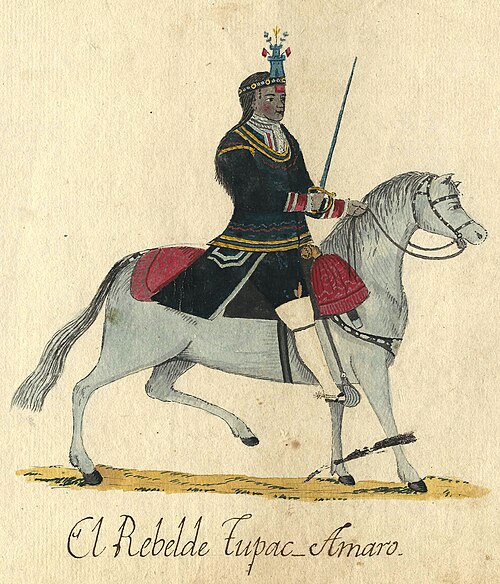
Start at the top for an easy introduction. Go further down for more detail and scholarship.
- Easy
- Intermediate
- Advanced
For young readers
About 250 years ago, the Andes Mountains of South America were ruled by Spain. The Spanish had conquered the Inca Empire more than two hundred years before. Many Indigenous people were forced to work in dangerous silver mines and to buy goods they did not want at very high prices.
A man named José Gabriel Condorcanqui was a local chief of several villages near the old Inca capital of Cusco. He was proud to be descended from the last Inca ruler, Túpac Amaru. He also ran a business with mules, carrying goods along mountain roads, so he saw with his own eyes how people were suffering.
For years he asked Spanish officials and judges to stop the unfair treatment. Nobody listened. So in November 1780 he captured a cruel Spanish governor and led an uprising. He took the name of his ancestor and became Túpac Amaru II.
His wife, Micaela Bastidas, was just as important. She organised food, money and weapons for the rebel army and gave orders when he was away. Other women, like Tomasa Tito Condemayta, led fighters too.
Tens of thousands of people joined them, but they could not capture the city of Cusco. In 1781 Túpac Amaru II was betrayed and captured. The Spanish executed him, Micaela and members of their family in a very cruel way in the main square of Cusco, to frighten others.
The uprising was defeated, but it was not forgotten. Today many people in Peru, Bolivia and around the world remember Túpac Amaru II and Micaela Bastidas as heroes who stood up against injustice.
At a glance
- Lived
- Born 1742 (some sources give 1738) in Surimana, Tinta province, near Cusco; executed 18 May 1781 in Cusco
- Birth name
- José Gabriel Condorcanqui Noguera
- Role
- Kuraka (hereditary Indigenous chief, cacique) of Tungasuca, Pampamarca and Surimana; muleteer and trader; leader of the 1780–1781 rebellion
- Ancestry
- Claimed descent from Túpac Amaru I, the last Inca ruler of Vilcabamba, executed by the Spanish in 1572
- Spouse
- Micaela Bastidas (1744–1781), co-leader and chief organiser of the rebellion
- Rebellion
- Began 4 November 1780 with the seizure of corregidor Antonio de Arriaga; continued by others until 1783 across today’s Peru and Bolivia
- Toll
- One estimate: about 100,000 Indigenous people and 10,000–40,000 non-Indigenous people died in the wider rebellion
- Legacy
- Symbol of Indigenous resistance and of Peruvian national identity; his name was adopted by movements from Uruguay’s Tupamaros to Bolivian and Peruvian politics
Easy
Who was Túpac Amaru II?
Túpac Amaru II was the name taken in 1780 by José Gabriel Condorcanqui, an Indigenous leader from the highlands south of Cusco in what is now Peru. He was a kuraka, or hereditary chief, of several Quechua-speaking communities, and he claimed descent from Túpac Amaru, the last ruler of the independent Inca state of Vilcabamba, whom the Spanish had executed in 1572.
In November 1780 he began a rebellion against the abuses of Spanish colonial officials. It grew into the largest anti-colonial uprising in 18th-century Spanish America, spreading across the southern Andes of Peru and into Upper Peru (today’s Bolivia), and involving tens of thousands of fighters.
The rebellion was led not by one man alone but by a family and a network. His wife, Micaela Bastidas, was a co-leader and the chief organiser of supplies and communications. Relatives, local chiefs, muleteers, women commanders and ordinary peasants all played important roles.
Túpac Amaru II was captured in April 1781 and executed in Cusco on 18 May 1781. The rebellion continued under his cousin Diego Cristóbal Túpac Amaru and, in the Aymara-speaking region, under Túpac Katari, until 1783. Although it was crushed, it left a deep mark on Andean memory and on the later history of Peru and Bolivia.
Easy
Early life: a chief, a trader and a student
José Gabriel Condorcanqui Noguera was born in Surimana, in the province of Tinta (today Canas and Canchis, Cusco Region), probably in 1742, though some sources give 1738. His family held the position of kuraka over the communities of Surimana, Pampamarca and Tungasuca.
He was educated at the Jesuit college of San Francisco de Borja in Cusco, a school for the sons of Indigenous nobility, where he learned Spanish and Latin in addition to his native Quechua. Spanish observers would later describe him as a well-educated man who could move easily between Indigenous and Spanish worlds.
Besides governing his communities, he ran a business with mule trains, carrying goods along the roads between Cusco, Potosí and other towns. This work took him through many Indigenous communities and made him familiar with their hardships, and it gave him a network of contacts that would later help spread the rebellion.
In 1760 he married Micaela Bastidas of Pampamarca. They had three sons: Hipólito, Mariano and Fernando.
Easy
The colonial world he lived in
By the 18th century, Spain had ruled the Andes for more than two hundred years. Indigenous communities paid tribute to the Crown and owed labour. The most hated obligation was the mita of Potosí: every year, communities had to send men to work in the silver mines of Potosí, where many died or never returned.
Local Spanish governors, called corregidores, were supposed to administer justice, but many used their power to enrich themselves. Through the reparto de mercancías, they forced Indigenous people to buy goods — mules, cloth, even items they had no use for — at inflated prices, driving families into debt.
In the 1770s, the Bourbon kings of Spain introduced reforms to raise more revenue from the colonies. The sales tax (alcabala) was increased and collected more strictly, new customs houses were set up, and trade routes were reorganised when the Viceroyalty of the Río de la Plata was created in 1776, cutting Upper Peru off from Lima. Bad harvests and economic disruption added to the burden.
These pressures fell on Indigenous peasants, but also on mestizo and Creole traders and even some kurakas. Protests and local riots broke out across the Andes in the 1770s, so the rebellion of 1780 came as the climax of a long period of unrest.
Intermediate
From petitions to rebellion
Before taking up arms, Condorcanqui tried the legal path. He petitioned the authorities in Tinta, Cusco and Lima to end what he called oppressive practices — the mining mita, the forced distribution of goods and the abusive textile workshops (obrajes). In the late 1770s he spent time in Lima pursuing these cases, as well as a lawsuit over his claim to descend from the Inca royal line, which was contested by a rival family.
His petitions were rejected or ignored. Meanwhile, conflict grew between him and the corregidor of Tinta, Antonio de Arriaga, a harsh official who was also in dispute with the local clergy.
On 4 November 1780, after a banquet in honour of King Charles III’s name day, Condorcanqui and his followers seized Arriaga. They forced him to write letters summoning officials, money and weapons, and then assembled a crowd of about 200 people, surrounded by some 4,000 Indigenous followers, to witness his execution. Arriaga was hanged in the square of Tungasuca; according to accounts, the rope broke at the first attempt.
From this moment Condorcanqui used the name Túpac Amaru. In his proclamations he said he acted because of the repeated outcries of the people against the corregidores and other abuses, and that he acted in the name of the king against bad officials — a common way of justifying revolt in the Spanish empire.
Intermediate
The campaign: Sangarará and the siege of Cusco
News of Arriaga’s death spread quickly along the roads. Thousands of Indigenous peasants abandoned their labour obligations and joined the rebels. On 16 November 1780 Túpac Amaru II issued a proclamation decreeing the freedom of enslaved Africans and Afro-Peruvians, seeking to widen his support.
On 18 November 1780, at Sangarará, the rebels destroyed a force sent from Cusco, killing hundreds of Spanish and loyalist soldiers; the church where many had taken refuge caught fire. The victory brought weapons and prestige, but the violence alarmed Creoles and the clergy — the bishop of Cusco excommunicated Túpac Amaru — and ended hopes of an alliance with people of Spanish descent.
Instead of marching immediately on Cusco, Túpac Amaru II moved south to gather support around Lake Titicaca. Micaela Bastidas urged him in letters to attack Cusco quickly before Spanish reinforcements arrived. When the rebel army, perhaps 40,000 to 60,000 strong, finally besieged the city in early January 1781, it was defended by Spanish troops and by loyal Indigenous forces. After about a week the rebels withdrew.
The failure at Cusco was a turning point. Royal troops arrived from Lima under José del Valle, and the rebels were defeated at Combapata on 5 April 1781. The next day, Túpac Amaru II was betrayed by two of his officers, Ventura Landaeta and Francisco Cruz, and captured with members of his family.
Intermediate
Micaela Bastidas and the women of the rebellion
Micaela Bastidas was born in 1744 in Pampamarca. Her origins are debated: some documents suggest she was of mixed African and Indigenous descent, although her marriage record called both her parents Spaniards, perhaps as a mark of respectability. She married José Gabriel in 1760, before her sixteenth birthday.
During the rebellion she was in charge of supplying the troops — gathering and distributing money, food, clothing and weapons — and of maintaining discipline and communication. She issued orders, recruited fighters and managed the rebel headquarters at Tungasuca. Many historians regard her as the more decisive strategist of the pair.
Other women also led. Tomasa Tito Condemayta, a female kuraka, commanded rebel forces; she was executed in Cusco in 1781. In Upper Peru, Bartolina Sisa, wife of Túpac Katari, commanded during the siege of La Paz, and Gregoria Apaza also played a leading role.
The prominence of women in the leadership was remarkable for the time, and it has made Micaela Bastidas a symbol of women’s participation in Latin American independence and Indigenous struggles.
Intermediate
Trial and execution
After his capture, Túpac Amaru II was interrogated and tortured by order of the visitador general, José Antonio de Areche. When asked to name his accomplices, he is reported to have replied that there were none but the two of them: Areche as oppressor and himself as liberator, and that both deserved to die. The words may have been shaped by later tradition, but they became famous.
On 18 May 1781, in the main square of Cusco, the Spanish carried out a public execution designed to terrify. Túpac Amaru II was forced to watch the executions of his wife Micaela Bastidas, his eldest son Hipólito, Tomasa Tito Condemayta and other relatives and allies. Because Micaela’s neck was too slender for the garrote, she was strangled with a rope and beaten.
Túpac Amaru II was then to be torn apart by four horses. When this failed, he was beheaded. Parts of his body and those of his family were sent to towns across the region and displayed as a warning. His youngest son, Fernando, about ten years old, was made to watch, and was later sent to Spain, where he spent the rest of his life in exile.
The cruelty of the punishment was meant to end the rebellion and destroy the symbol of Inca descent. Instead, it helped turn Túpac Amaru II and Micaela Bastidas into martyrs.
Intermediate
The wider rebellion and its repression
The uprising did not end with his death. His cousin Diego Cristóbal Túpac Amaru and nephew Andrés continued the fight, and in the Aymara-speaking region around La Paz, Julián Apasa, who took the name Túpac Katari, besieged the city in 1781 — for 109 days in the first phase, with a second siege later that year. About 20,000 people died in the sieges. Túpac Katari was captured and executed on 15 November 1781.
Diego Cristóbal accepted a peace offer and surrendered in January 1782, but in July 1783 the Spanish arrested and executed him on the pretext that he had broken the agreement. By then the wider rebellion had cost an estimated 100,000 Indigenous lives and between 10,000 and 40,000 non-Indigenous lives.
The Spanish then tried to erase the memory of the Incas. Areche’s decrees banned the wearing of Indigenous dress, the use of Quechua in some contexts and almost any commemoration of Inca culture; paintings of Inca rulers were destroyed; and the hereditary office of kuraka was largely abolished, removing a layer of Indigenous leadership. Garcilaso de la Vega’s Comentarios Reales, a history celebrating the Incas, was reportedly also suppressed.
Some reforms followed: the reparto de mercancías was abolished, and the corregidores were replaced by new officials called intendants. But the mita and tribute continued until independence.
Intermediate
Memory and legacy
In the independence era of the early 19th century, some leaders presented Túpac Amaru II as a precursor of freedom from Spain. Yet for much of the 19th century, Peruvian elites, most of them of Spanish descent, were uneasy about celebrating an Indigenous revolt.
In the 20th century his image changed. Indigenista writers and artists celebrated him, and the military government of Juan Velasco Alvarado (1968–1975) made him the official symbol of its “revolution” and of its 1969 agrarian reform, replacing a portrait of Francisco Pizarro in the Government Palace with one of Túpac Amaru II.
His name travelled far. The Tupamaros urban guerrilla movement of Uruguay and the Túpac Amaru Revolutionary Movement (MRTA) in Peru took his name, and the American rapper Tupac Shakur was named after him. In Bolivia, Túpac Katari and Bartolina Sisa became central to the Katarista Indigenous movement and were declared national Aymara heroes in 2005.
For many Quechua and Aymara people, the story of Túpac Amaru II, Micaela Bastidas and Túpac Katari is not just history but a living memory of dignity and resistance. Andean traditions about Inkarrí — the Inca king whose body will one day be reunited and return — have sometimes been linked to his dismemberment, though scholars debate how closely.
Advanced
Scholarly debates: reformer, revolutionary or Inca restorer?
The most persistent debate is about his goals. His proclamations often invoked the Spanish king, condemned only “bad government,” and promised to protect Creoles and the Church. Some historians therefore see him as a reformer who wanted to remove abusive officials rather than to end Spanish rule. Others note that he also referred to himself as heir of the Incas and, in at least one disputed document, as king, and argue that his ultimate aim was an independent Andean order.
A second debate concerns the difference between the leaders and the followers. Túpac Amaru II sought a multi-ethnic coalition including Creoles, mestizos and the Church; many of the peasants, artisans and women who joined the rebellion, however, seem to have hoped to turn the world upside down, ending forced labour and racial hierarchy. Violence against Spaniards and people seen as their allies, which the leadership sometimes tried to restrain, reflected these deeper aspirations and made the coalition impossible.
A third debate places the rebellion in the “age of revolutions.” It began only four years after the United States Declaration of Independence and a decade before the Haitian Revolution. Historians such as Charles F. Walker emphasise its local Andean roots, while others explore its connections to Enlightenment ideas, Atlantic politics and the Bourbon reforms. Sinclair Thomson’s work on the Aymara region shows how community politics and the crisis of the kuraka system shaped insurgency.
Finally, scholars debate his place in national narratives. Presenting him as the first hero of Peruvian independence can obscure the Indigenous and anti-colonial character of the rebellion and the fact that many Creoles fought against it; presenting him purely as an Indigenous leader can overlook his position as an educated, bilingual kuraka and trader deeply embedded in colonial society.
Advanced
Sources and their reliability
Most of what we know about Túpac Amaru II comes from documents written by his enemies: trial records, confessions obtained under torture, official reports and the sentence pronounced by Areche. These are rich but biased sources, created to justify repression, and they must be read critically.
The rebels’ own voices survive in their edicts, proclamations and letters. The correspondence of Micaela Bastidas is especially valuable, revealing her role in logistics and strategy and her frustration with delays. Some documents attributed to Túpac Amaru II, such as a proclamation in which he calls himself king, are of disputed authenticity.
Later accounts, including memoirs such as that of his relative Juan Bautista Túpac Amaru, written after decades of imprisonment and exile, and 19th-century histories, added details and sometimes legends. Oral tradition in Andean communities preserved other memories, which historians and anthropologists have begun to take seriously.
Modern scholarship combines these sources with economic and demographic data, studies of the Bourbon reforms, and comparison with other Andean revolts, producing a more complex picture of a movement that was at once local and continental, loyalist in language and revolutionary in effect.
Key ideas
- Colonial exploitation
- The mita, the reparto de mercancías and Bourbon taxes placed heavy burdens on Indigenous communities and fuelled the rebellion.
- Inca descent as political symbol
- By taking the name Túpac Amaru, Condorcanqui drew on the memory of the Inca rulers to give legitimacy to his movement.
- “Long live the king, death to bad government”
- Like many colonial rebels, he framed his revolt as loyal to the king but against abusive officials, making his true aims a matter of debate.
- Shared leadership
- Micaela Bastidas, Tomasa Tito Condemayta, Bartolina Sisa and others show that women were central to leading the uprising.
- Exemplary terror
- The public execution and dismemberment of the leaders, and the ban on Inca symbols, were meant to destroy both the rebellion and its memory.
- Andean and Atlantic revolution
- The rebellion belongs to both a long Andean tradition of resistance and the wider age of revolutions in the Americas.
- Contested memory
- He has been claimed as a precursor of independence, a national symbol, an Indigenous hero and an emblem of revolutionary movements.
Records
- 1572 — Túpac Amaru I, the last ruler of Inca Vilcabamba, is executed in Cusco.
- c. 1742 — José Gabriel Condorcanqui is born in Surimana (some sources say 1738).
- 1760 — He marries Micaela Bastidas.
- 1776 — Creation of the Viceroyalty of the Río de la Plata disrupts Andean trade; Bourbon fiscal reforms intensify.
- 1780 — 4 November: seizure of corregidor Antonio de Arriaga, who is hanged days later; 18 November: rebel victory at Sangarará.
- 1781 — January: failed siege of Cusco; 6 April: capture; 18 May: execution of Túpac Amaru II, Micaela Bastidas and others in Cusco.
- 1781 — Túpac Katari and Bartolina Sisa besiege La Paz; Túpac Katari is executed on 15 November.
- 1783 — Diego Cristóbal Túpac Amaru is executed despite a peace agreement; the rebellion ends.
- 1969 — Peru’s military government under Juan Velasco Alvarado launches an agrarian reform, using Túpac Amaru II as its emblem.
- 2005 — Bolivia declares Túpac Katari and Bartolina Sisa national Aymara heroes.
Glossary
- Kuraka (cacique)
- A hereditary Indigenous chief in the Andes who governed communities and mediated with Spanish authorities.
- Corregidor
- A Spanish provincial governor with judicial and administrative powers, often accused of abuse.
- Mita
- Forced rotational labour, especially in the silver mines of Potosí, owed by Indigenous communities under Spanish rule.
- Reparto de mercancías
- The forced sale of goods to Indigenous people by corregidores, often at inflated prices.
- Bourbon reforms
- 18th-century reforms by Spain’s Bourbon kings to centralise administration and increase colonial revenue.
- Alcabala
- A sales tax, raised and collected more strictly in the 1770s.
- Visitador general
- A royal inspector with sweeping powers; José Antonio de Areche held this office in Peru.
- Criollo (Creole)
- A person of Spanish descent born in the Americas.
- Inkarrí
- An Andean mythic figure, the Inca king whose dismembered body will one day be reunited and return.
Questions and answers
Why did he call himself Túpac Amaru?
He was descended from Túpac Amaru, the last Inca ruler, who was executed by the Spanish in 1572. Taking this name reminded people of the Inca past and gave his movement authority.
What did the rebels want?
At first they demanded an end to abuses such as forced labour in the mines, forced sales of goods and corrupt governors. Many followers hoped for a much bigger change: an end to colonial hierarchy altogether.
Who was Micaela Bastidas?
She was Túpac Amaru II’s wife and a leader of the rebellion in her own right, in charge of supplies, money, weapons and communication. She was executed with him in 1781.
Did the rebellion succeed?
Militarily it failed, and it was brutally repressed. But it led to some reforms, such as ending forced sales of goods, and it became a powerful symbol for later movements.
Was Túpac Amaru II fighting for independence?
Historians disagree. His proclamations often said he was loyal to the king and opposed only bad officials, but some documents and the actions of his followers suggest more radical aims.
Is the rapper Tupac Shakur connected to him?
Yes, in name: Tupac Shakur was named after Túpac Amaru II, showing how far his fame travelled.
How do we know about his life if most documents were written by his enemies?
Historians read Spanish trial records critically and compare them with the rebels’ own proclamations and letters, especially those of Micaela Bastidas, and with later memoirs and oral traditions.
Sources and further reading
- Túpac Amaru II. Wikipedia
- Rebellion of Túpac Amaru II. Wikipedia
- Micaela Bastidas. Wikipedia
- Túpac Katari. Wikipedia
- 투팍 아마루 2세. 위키백과
- Charles F. Walker, The Tupac Amaru Rebellion. Belknap Press of Harvard University Press, 2014
- Sinclair Thomson, We Alone Will Rule: Native Andean Politics in the Age of Insurgency. University of Wisconsin Press, 2002
Related
- Inca road systemA network of perhaps 40,000 km of roads, stairways, grass-rope bridges and way stations that bound the Inca Empire together from Colombia to Chile.
- Machu PicchuInca settlement in the Andes, probably established in the fifteenth century.
- Haitian RevolutionA revolution beginning with an uprising of enslaved people in Saint-Domingue led to the abolition of slavery there and Haiti’s independence in 1804.
- United States Declaration of IndependenceDocument adopted by the Continental Congress on 4 July 1776 declaring the thirteen colonies independent of Britain.
- Donghak Peasant RevolutionA mass uprising of Korean peasants in 1894–1895, organised through the Donghak religion, against corrupt officials and then against Japanese occupation forces.
Written with AI assistance from the published sources listed above, and revised as new research appears.