Start at the top for an easy introduction. Go further down for more detail and scholarship.
- Easy
- Intermediate
- Advanced
For young readers
About 250 years ago, the east coast of North America had thirteen colonies ruled by Great Britain, a country across the Atlantic Ocean. Many colonists were angry. They had to pay taxes that Britain decided, but they had no say in the British Parliament that made the laws.
Arguments turned into fighting in 1775. The next summer, leaders from all thirteen colonies met in the city of Philadelphia. They decided it was time to say: we are not colonies any more, we are free and independent states.
A young man from Virginia named Thomas Jefferson wrote the first draft. Other leaders, including John Adams and Benjamin Franklin, helped improve it. On 4 July 1776 the meeting, called the Continental Congress, approved it. That is why Americans celebrate the Fourth of July as Independence Day.
The most famous sentence says that “all men are created equal” and have rights to “Life, Liberty and the pursuit of Happiness.” These are big, beautiful words. But at that time, hundreds of thousands of Black people were enslaved in the colonies, women could not vote, and Native American nations were treated unfairly. Many of the people who signed the Declaration themselves held people in slavery.
Over the years, people who were left out used these very words to demand fairness—women asking for the vote, enslaved people and their allies fighting slavery, and people in other countries seeking their own independence. So the Declaration became a promise that later generations kept trying to make come true.
At a glance
- Adopted
- 4 July 1776 (independence voted 2 July 1776)
- Place
- Pennsylvania State House (now Independence Hall), Philadelphia
- Adopted by
- The Second Continental Congress, representing thirteen colonies
- Main drafter
- Thomas Jefferson, for a Committee of Five (Adams, Franklin, Jefferson, Livingston, Sherman)
- Signers
- 56 delegates; most signed the engrossed parchment on 2 August 1776
- Structure
- Introduction, preamble, list of grievances against George III, denunciation of the British people, formal declaration
- Original
- Engrossed parchment held at the National Archives, Washington, D.C.
- Context
- American Revolutionary War (1775–1783)
Easy
What was the Declaration of Independence?
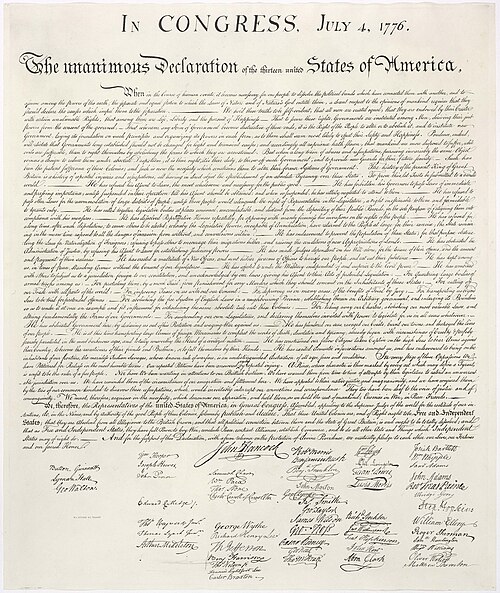
The Declaration of Independence is a one-page document in which representatives of thirteen British colonies in North America announced, on 4 July 1776, that the colonies were now “Free and Independent States” no longer under the British Crown. It was addressed not only to Britain and to the colonists but, as its first sentence says, to “the opinions of mankind”: it explained the reasons for separation to the whole world.
The Declaration did not itself create a government or a constitution. The fighting of the American Revolutionary War had already been going on for more than a year. Its immediate purpose was practical: to make the break with Britain official, to unite the colonies, and to allow them to seek alliances and aid from foreign powers such as France.
Yet the document’s second paragraph, with its claim that “all men are created equal” and endowed with “unalienable Rights,” made it far more than a diplomatic notice. Over the next two and a half centuries it became one of the most quoted political texts in the world, used by abolitionists, feminists, civil rights campaigners and independence movements—often to point out how far reality fell short of its words.
Easy
Background: from British subjects to rebels
In 1763 Britain won the Seven Years’ War against France, gaining vast territory in North America but also enormous debts. To pay for the defence of the empire, Parliament began to tax the colonies directly: the Sugar Act (1764), the Stamp Act (1765) and the Townshend duties (1767). Many colonists protested that they could be taxed only by their own elected assemblies, not by a Parliament in which they had no representatives—“no taxation without representation.”
Protests, boycotts and clashes followed, including the Boston Massacre (1770) and the Boston Tea Party (1773). Britain responded with the Coercive Acts (1774), which closed Boston’s port and restricted self-government in Massachusetts. The colonies sent delegates to a First Continental Congress in 1774 to coordinate resistance.
In April 1775 fighting broke out at Lexington and Concord in Massachusetts. A Second Continental Congress met in Philadelphia, created an army under George Washington, and at first still sought reconciliation with King George III. But the king declared the colonies in rebellion, Parliament cut off their trade, and Britain hired German troops. In January 1776 Thomas Paine’s pamphlet Common Sense argued powerfully for independence and republican government, and it sold widely. By spring many colonies and towns were instructing their delegates to support independence.
Easy
How it was written
On 7 June 1776 Richard Henry Lee of Virginia proposed a resolution that “these United Colonies are, and of right ought to be, free and independent States.” Congress postponed the vote to give hesitant colonies time, but on 11 June it appointed a Committee of Five to prepare a declaration: John Adams, Benjamin Franklin, Thomas Jefferson, Robert R. Livingston and Roger Sherman.
The committee asked Jefferson, then thirty-three, to write the draft. He worked in rented rooms in a house at Market and Seventh Streets in Philadelphia. Adams and Franklin suggested changes, and the committee presented the draft to Congress on 28 June.
On 2 July Congress approved Lee’s resolution for independence; New York’s delegates abstained because they lacked instructions, and New York approved a week later. Congress then debated the draft line by line for two days, cutting about a quarter of it. On 4 July it approved the final text. That evening the printer John Dunlap produced broadsides that were sent throughout the states and to the army; about two dozen of these first printings survive.
A handwritten, formal copy on parchment—an “engrossed” copy—was later prepared, and most delegates signed it on 2 August 1776, with some signing later. John Hancock, the president of Congress, signed first and largest. Because signing was treason in British eyes, the full list of signers was not officially printed until January 1777.
Intermediate
What the text says
The Declaration has five parts. The introduction explains that when one people must dissolve its political bonds with another, a “decent respect to the opinions of mankind” requires them to declare the causes. The preamble then sets out a theory of government: all men are created equal; they are endowed by their Creator with unalienable rights, among them life, liberty and the pursuit of happiness; governments are instituted to secure these rights and derive their just powers from the consent of the governed; and when a government becomes destructive of these ends, the people have the right to alter or abolish it.
The longest part is an indictment of George III, a list of about twenty-seven grievances (counts vary depending on how they are divided). It accuses the king of obstructing colonial laws, dissolving legislatures, keeping standing armies in peacetime without consent, cutting off trade, imposing taxes without consent, depriving colonists of trial by jury and waging war against them. Notably, it addresses the king rather than Parliament, because the colonists had come to argue that Parliament had no authority over them at all.
A shorter section criticizes the British people for ignoring colonial appeals. The conclusion declares the colonies “Free and Independent States,” absolved from allegiance to the Crown, with full power to make war, conclude peace, form alliances and trade. It ends with a pledge: “we mutually pledge to each other our Lives, our Fortunes and our sacred Honor.”
Intermediate
Where the ideas came from
Jefferson later wrote that he had not aimed at originality but at expressing the common sense of the subject, “an expression of the American mind.” The Declaration’s ideas drew on a broad tradition: English constitutional history, including the Glorious Revolution of 1688 and the English Bill of Rights; the natural-rights philosophy of John Locke, whose Second Treatise of Government argued that government rests on consent and may be resisted when it violates rights; and writers of the Scottish Enlightenment and classical republicanism.
The immediate models were closer to home. George Mason’s Virginia Declaration of Rights, adopted on 12 June 1776, began with the claim that all men are by nature equally free and independent and have inherent rights. Jefferson had also drafted a preamble for Virginia’s new constitution listing grievances against the king. The list of grievances followed a long English tradition of formal complaints against rulers.
The phrase “pursuit of happiness,” in place of Locke’s familiar trio of “life, liberty and property,” has attracted much discussion. Scholars disagree about whether it reflects a broader moral philosophy of human flourishing, a public sense of happiness as the well-being of society, or simply eighteenth-century usage in which happiness and property were closely linked.
Intermediate
Who was left out
In 1776 roughly one in five people in the thirteen colonies was enslaved, most of them of African descent. Jefferson himself enslaved hundreds of people over his lifetime, as did several other signers. His draft had included a long passage blaming George III for the Atlantic slave trade; Congress deleted it, in part to satisfy South Carolina and Georgia, and because many northern merchants had profited from the trade. Critics at the time noticed the contradiction: the English writer Samuel Johnson had asked in 1775 how it was that the loudest yelps for liberty came from the drivers of enslaved people.
The final text also accuses the king of having “excited domestic insurrections amongst us,” a reference to British offers of freedom to enslaved people who escaped patriot masters to fight for the Crown, such as Lord Dunmore’s proclamation of November 1775. Thousands of enslaved people did seek freedom behind British lines during the war.
The Declaration describes Native Americans as “merciless Indian Savages.” Many Indigenous nations saw the colonists’ hunger for western lands, which Britain had tried to limit in 1763, as a far greater threat than the Crown, and many allied with Britain. For them the new republic’s independence often meant accelerating loss of land.
Women were not mentioned. In March 1776 Abigail Adams had urged her husband John to “remember the ladies” in the new laws; he treated the request as a joke. Loyalists—colonists who remained faithful to Britain, perhaps a fifth of the white population by some estimates—were also excluded from the “one people” the Declaration described; tens of thousands later left for Canada, Britain and the Caribbean.
Intermediate
What happened next
The Declaration was read aloud in towns and army camps. In New York, after George Washington had it read to his troops on 9 July, a crowd pulled down a gilded lead statue of George III, which was reportedly melted into musket balls. Declaring independence did not win it, however. The war lasted seven more years.
Independence made foreign alliances possible. After the American victory at Saratoga in 1777, France signed a treaty of alliance with the United States in 1778, and Spain and the Dutch Republic later joined the war against Britain. The surrender of a British army at Yorktown in 1781 led to peace negotiations, and in the Treaty of Paris of 1783 Britain recognized the independence of the United States.
The new states wrote constitutions, many with declarations of rights. The Articles of Confederation and then the Constitution of 1787 created a national government. But the Declaration’s principle of equality was not written into the Constitution, which accommodated slavery; the language of equality entered constitutional law only with the Fourteenth Amendment after the Civil War.
For the people of the new states, independence changed daily life unevenly. Former colonial governments were replaced by elected assemblies, and more white men gained the right to vote as property requirements were loosened in some states. Vermont’s constitution of 1777 banned adult slavery, and Pennsylvania passed a gradual abolition law in 1780, with other northern states following; in the South, slavery expanded. Loyalists lost property and often their homes, and many Indigenous nations faced new pressure on their lands after the peace of 1783, which did not include them.
Intermediate
Memory and global influence
The Declaration was not immediately treated as sacred. In the 1790s it became a political symbol, claimed by Jefferson’s Republican party, and after the War of 1812 it became a national icon. The deaths of both Jefferson and Adams on 4 July 1826, exactly fifty years after its adoption, deepened its aura. In 1823 William J. Stone made an engraved facsimile, and the fading parchment itself was eventually moved, in 1952, to the National Archives, where it is displayed in the Rotunda.
Excluded groups turned its words into arguments. The Declaration of Sentiments adopted at the Seneca Falls women’s rights convention in 1848 rewrote it as “all men and women are created equal.” In 1852 Frederick Douglass asked, in a famous speech, what the Fourth of July meant to an enslaved person. Abraham Lincoln made the Declaration’s principle of equality central to his opposition to slavery; his Gettysburg Address of 1863 begins by dating the nation from 1776. Martin Luther King Jr. called its promises a “promissory note” in 1963.
Abroad, the Declaration created a new genre: the declaration of independence. Haiti’s declaration of 1804, the declarations of many Spanish American states from 1810 onward, and many twentieth-century anti-colonial declarations followed. On 2 September 1945 Ho Chi Minh opened Vietnam’s declaration of independence by quoting the American Declaration’s words on equality and unalienable rights. Historians note that such declarations borrowed the form of claiming statehood among the powers of the earth at least as much as the language of individual rights.
Advanced
Different perspectives: Britain, Loyalists and others
In Britain the Declaration was answered in print. The former governor of Massachusetts, Thomas Hutchinson, published Strictures upon the Declaration of the Congress at Philadelphia (1776), and John Lind wrote An Answer to the Declaration of the American Congress (1776), which included a short critique by the young Jeremy Bentham. They rejected the grievances as distorted and mocked the claim of self-evident natural rights. Many British historians long treated the Revolution as a civil war within the empire rather than a struggle between two nations.
Loyalist historiography, revived by historians in recent decades, emphasizes that the Revolution was also a civil conflict among colonists, with violence, confiscation of property and forced exile. For Loyalist refugees, the new nations of Canada and the British Caribbean were built partly by people who had rejected the Declaration.
African American and Indigenous perspectives have reshaped how the event is taught. Historians have documented enslaved people who used the war to claim freedom—fighting for either side or fleeing—and the ways that independence strengthened settler expansion west. Public debate about how to balance the Declaration’s universal ideals with the realities of slavery and dispossession continues, especially around national anniversaries.
Advanced
Scholarly debates and sources
Historians have long argued about the Declaration’s intellectual sources. Carl Becker’s The Declaration of Independence (1922) emphasized Locke and natural-rights philosophy. Garry Wills’s Inventing America (1978) argued for the influence of the Scottish moral-sense philosophers, especially Francis Hutcheson, a thesis that drew sharp criticism from other scholars. Pauline Maier’s American Scripture (1997) shifted attention away from Jefferson’s genius to the roughly ninety local and state declarations of spring 1776, showing that the Declaration expressed widespread opinion and was edited collectively by Congress.
David Armitage’s The Declaration of Independence: A Global History (2007) placed the document in the history of international law. He argued that its original significance lay largely in its assertion of statehood—the claim of the new states to equal standing among the powers of the earth—and traced more than a hundred later declarations of independence around the world. Other scholars have debated whether the Declaration has legal force in American law; courts have rarely treated it as directly enforceable, though it heads the “Organic Laws” in the United States Code.
Primary sources are unusually rich: Jefferson’s “original Rough draught,” preserved at the Library of Congress with edits in several hands; the journals of the Continental Congress; the Dunlap broadsides; the engrossed parchment; and letters by participants such as John Adams, who predicted that 2 July would be celebrated as the great anniversary. Recollections written decades later, including Jefferson’s and Adams’s, disagree on details and must be used with care.
Key ideas
- Natural (unalienable) rights
- Rights that belong to people by nature, not granted by governments, such as life, liberty and the pursuit of happiness.
- Consent of the governed
- Governments gain their just powers from the agreement of the people they govern.
- Right of revolution
- When a government persistently violates rights, the people may alter or abolish it and create a new one.
- Equality
- The claim that “all men are created equal,” limited in practice in 1776 but later used to demand rights for excluded groups.
- Statehood and sovereignty
- The Declaration claimed for the colonies the full powers of independent states in international relations—to make war, peace, alliances and trade.
- Grievances
- A formal list of accusations against a ruler, following English constitutional tradition, used to justify resistance.
- Appeal to world opinion
- The Declaration addressed “the opinions of mankind,” presenting the colonies’ case before other nations in order to gain recognition and support.
Records
- 1763 — End of the Seven Years’ War; Britain begins new policies toward its North American colonies.
- 1765 — The Stamp Act provokes widespread colonial protest.
- 1773 — The Boston Tea Party.
- 1775 — Fighting begins at Lexington and Concord (19 April); the Second Continental Congress meets.
- 1776 — January: Thomas Paine’s Common Sense. 7 June: Lee Resolution. 11 June: Committee of Five appointed.
- 1776 — 2 July: Congress votes for independence. 4 July: Declaration adopted; Dunlap broadsides printed.
- 1776 — 2 August: most delegates sign the engrossed parchment.
- 1778 — France allies with the United States.
- 1783 — Treaty of Paris: Britain recognizes American independence.
- 1826 — Jefferson and Adams both die on 4 July, the fiftieth anniversary.
- 1848 — The Seneca Falls Declaration of Sentiments adapts the Declaration for women’s rights.
- 1952 — The parchment is transferred to the National Archives in Washington, D.C.
Glossary
- Continental Congress
- The assembly of delegates from the colonies that coordinated resistance to Britain and later governed the United States during the war.
- Lee Resolution
- The motion for independence introduced by Richard Henry Lee on 7 June 1776 and passed on 2 July.
- Engrossed copy
- A formal, handwritten final copy of a document, prepared for signing.
- Broadside
- A large sheet printed on one side, used to spread news and official texts.
- Loyalists
- Colonists who remained loyal to the British Crown during the Revolution.
- Patriots
- Colonists who supported resistance to Britain and independence.
- Unalienable
- Unable to be taken away or given up; in modern spelling often “inalienable.”
- Treaty of Paris (1783)
- The peace treaty in which Britain recognized the independence of the United States.
Questions and answers
Did everyone sign on 4 July?
No. Congress adopted the text on 4 July, but most delegates signed the engrossed parchment on 2 August 1776, and some signed even later. Paintings showing a signing on 4 July combine several events.
Why is the Fourth of July the holiday and not the second?
The vote for independence was on 2 July, and John Adams expected that day to be celebrated. But the adopted text bore the date 4 July, and that date was printed on the copies spread across the country, so it became the anniversary.
Did the Declaration end slavery?
No. Slavery remained legal in all thirteen states in 1776. Some northern states began to abolish it in the following decades, but it ended nationally only in 1865 with the Thirteenth Amendment. Opponents of slavery, however, often cited the Declaration’s promise of equality.
Is the Declaration part of US law?
It is not a constitution and does not create enforceable rights on its own. It appears first among the “Organic Laws” in the United States Code, and it is often cited to interpret American ideals, but courts have rarely treated it as directly binding law.
Did Jefferson write it alone?
Jefferson wrote the draft, but Adams and Franklin suggested revisions and Congress made many changes, removing about a quarter of the text. Historians such as Pauline Maier stress that it was a collective document reflecting widely shared ideas.
How did other countries use it?
It created the model for declarations of independence. Haiti (1804), many Spanish American republics, and twentieth-century states such as Vietnam (1945) issued declarations, some quoting it directly. Historians count more than a hundred declarations of independence worldwide.
Why did the Declaration blame the king and not Parliament?
By 1776 many colonial leaders argued that Parliament had no lawful authority over the colonies at all and that their only link to Britain was through the king. Breaking with the king therefore meant breaking with Britain.
Sources and further reading
- Declaration of Independence: A Transcription. U.S. National Archives
- The Declaration of Independence: A History. U.S. National Archives
- United States Declaration of Independence. Wikipedia
- Lee Resolution. Wikipedia
- Committee of Five. Wikipedia
- Declaration of Sentiments. Wikipedia
- Pauline Maier, American Scripture: Making the Declaration of Independence. Alfred A. Knopf, 1997
- David Armitage, The Declaration of Independence: A Global History. Harvard University Press, 2007
- Carl L. Becker, The Declaration of Independence: A Study in the History of Political Ideas. Harcourt, Brace, 1922
Related
- Jean-Jacques RousseauGeneva-born writer whose arguments about inequality, political authority and education influenced European thought.
- Storming of the BastilleThe seizure of a Paris fortress and prison on 14 July 1789 became an early emblem of the French Revolution.
- Haitian RevolutionA revolution beginning with an uprising of enslaved people in Saint-Domingue led to the abolition of slavery there and Haiti’s independence in 1804.
- March 1st MovementA Korean independence movement began with public declarations and demonstrations on 1 March 1919 and spread across the peninsula.
- United Nations Conference on International OrganizationDelegates met in San Francisco in 1945 to draft and sign the United Nations Charter after the devastation of the Second World War.
Written with AI assistance from the published sources listed above, and revised as new research appears.