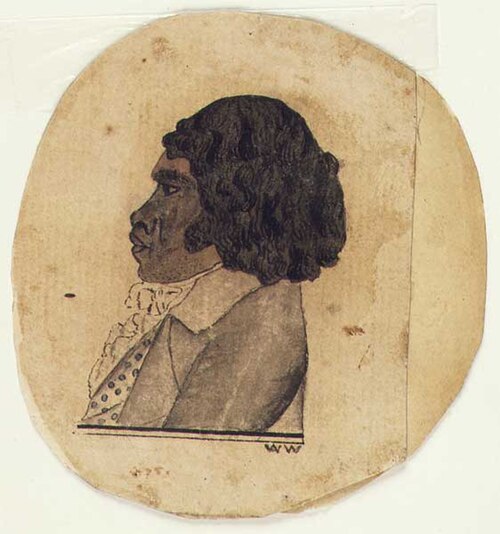
Start at the top for an easy introduction. Go further down for more detail and scholarship.
- Easy
- Intermediate
- Advanced
For young readers
Long before there was a city called Sydney, the big harbour there was the home of Aboriginal families who fished, hunted, sang and held ceremonies on their own land, called Country. One of them was a boy born around 1764 into the Wangal clan. He had several names, and today he is best known as Bennelong.
In 1788, when Bennelong was a young man, ships from Britain arrived with soldiers and prisoners and started a colony. The newcomers did not ask permission. They cut down trees, took fish and land, and brought diseases. In 1789 a terrible sickness called smallpox killed very many Aboriginal people around the harbour.
The British governor, Arthur Phillip, wanted someone who could explain the local people’s language and customs. So in 1789 his men grabbed Bennelong and another man, Colebee, and took them to the colony by force. Colebee escaped quickly. Bennelong stayed for about six months, learning English very fast and teaching the British about his people, and then he slipped away.
Later Bennelong chose to come back and talk with the governor. He and Phillip even swapped names, which in Bennelong’s culture was a way to show respect and friendship. A small brick hut was built for him on a point of land in the harbour. Today that place is called Bennelong Point, and the Sydney Opera House stands there.
In 1792 Bennelong sailed all the way to England with a younger relative, Yemmerrawanne. They saw London, went to the theatre and visited famous buildings. But Bennelong missed home, and sadly Yemmerrawanne became sick and died there. Bennelong came back to Sydney in 1795.
At home, Bennelong went back to living with his own people and following his own laws. Some colonists were cross about this, but Bennelong had made his choice. He became a respected leader of a group living by the Parramatta River, and when he died in 1813 about two hundred Aboriginal people gathered to honour him.
At a glance
- Lived
- About 1764 – 3 January 1813
- People and Country
- Wangal clan, south-western shore of Sydney Harbour (Port Jackson), with close ties to neighbouring clans; the coastal Sydney peoples are often grouped as the Eora, a word meaning “people”
- Language
- The Sydney (Dharug/Eora) language; he also learned English quickly
- Known for
- Go-between and diplomat between Aboriginal clans and the British colony; first Aboriginal man known to travel to England and return
- Writing
- A 1796 letter to the Phillips family in England, dictated by him, is the earliest known text in English by an Aboriginal author
- Places named for him
- Bennelong Point (site of the Sydney Opera House), the federal electoral division of Bennelong (1949), Bennelong Park and Bennelong Bridge
- Died and buried
- Kissing Point on the Parramatta River; buried in the orchard of his friend James Squire (grave site identified in present-day Putney)
Easy
Who was Bennelong?
Bennelong was an Aboriginal man of the Wangal clan, whose Country lay along the south-western shore of Sydney Harbour and the Parramatta River. He was born around 1764, so he was about twenty-four when the British First Fleet arrived in January 1788. He lived through the first twenty-five years of the colony of New South Wales and died on 3 January 1813.
He is remembered because he stood at the meeting point of two worlds. The British kidnapped him in 1789 to use him as an interpreter; afterwards he built, on his own terms, a long and sometimes stormy relationship with Governor Arthur Phillip, helped open regular contact between the local clans and the colony, travelled to England, and then returned to lead a community of his own people. He was, as the Australian Dictionary of Biography puts it, an Aboriginal conciliator and diplomat.
Almost everything written about Bennelong during his lifetime was written by British officers. They recorded what they saw, but they often misunderstood what he was doing and why. Historians today try to read those records carefully, together with knowledge of Aboriginal law, kinship and culture, to understand Bennelong as a person with his own goals—not simply as a character in the colonists’ story.
Easy
Country, family and many names
Before 1788, the lands and waters around Sydney Harbour were home to many clans, each connected to a particular stretch of Country. Bennelong’s clan, the Wangal, were custodians of lands on the southern side of the Parramatta River. His father’s name is recorded as Goorah Goorah and his mother’s as Gagulh or Gagolh. He had several sisters whose marriages to men of nearby clans created political links for their brother. He is also recorded as owning the small harbour island of Memel, inherited through his father.
Bennelong had five names, recorded by the British as Wollarrebarre (Woollarawarre), Wogultrowe, Bannellon (Bennelong), Boinba and Bundebunda. Some were given during different stages of his ceremonial life; the last may have been a totem name meaning hawk. The officer Watkin Tench wrote that he preferred to be called Woollarawarre. Exchanging names was a common way for his people to show respect and friendship.
Bennelong had close kinship and language links reaching south to Botany Bay (Kamay), north across the harbour to Pittwater, and west to Parramatta. The people of the coastal Sydney clans spoke varieties of the language now usually called Dharug or the Sydney language. The word “Eora,” often used as a name for these peoples, originally meant “people” in the wordlists made by the First Fleet officers; it has been used as a group name by outsiders since the late nineteenth century and by many Aboriginal people since the late twentieth.
Easy
1788: strangers arrive, sickness follows
In January 1788 a fleet of eleven British ships commanded by Arthur Phillip arrived, first at Botany Bay and then at a cove on the southern shore of Port Jackson that the local people called Warrane. The British named it Sydney Cove and set up a penal colony there with about 1,300 convicts, soldiers and officials. The land already belonged to Aboriginal clans, but the British treated it as theirs to take.
Relations were tense from the start. Aboriginal people generally avoided the settlement while defending their land and fishing grounds, and there were many clashes. Phillip had instructions to establish friendly relations, and when the local people kept their distance, he turned to kidnapping. At the end of 1788 his men seized a man named Arabanoo to train him as an interpreter.
Then, in April 1789, smallpox swept through the clans around the harbour. Bodies were found on beaches and in coves, and canoes disappeared from the water. Bennelong later told the colonists that about half of his people around the harbour had died. His first wife and Arabanoo were among the dead. How the disease arrived is still debated by historians, but its effect was catastrophic: it tore apart families and clans just as the colony was growing.
Intermediate
Kidnapped: six months in the colony
In November 1789 a British boat went to Manly, on the northern side of the harbour, where Bennelong and his older relative Colebee had gathered with many others for a whale feast. Offered fish from the boat, the two men waded out and were violently seized. People on the shore threw spears; the British fired back and rowed away with their prisoners. Lieutenant William Bradley, who took part, called it the most unpleasant service he was ever ordered to do.
The two men were held under guard and in shackles. Colebee escaped within about a month. Bennelong stayed for about six months. During this time he learned English remarkably quickly, while the British struggled with his language, and he learned a great deal about British food, manners, weapons and ranks—more, some historians say, than the British learned from him. Whether he stayed because he was prevented from leaving or because he chose to, out of curiosity or for strategic reasons, is still discussed.
In May 1790 Bennelong slipped away. In the months that followed he began a relationship with Barangaroo, a respected Gamaragal (Cammeraygal) woman from the north side of the harbour. Their daughter, Dilboong, died as a baby. Barangaroo died in 1791, and Bennelong cremated her remains in the governor’s garden, according to the customs of her people.
Intermediate
The spear at Manly and a new kind of relationship
In September 1790 Governor Phillip heard that Bennelong had been seen at Manly and hurried there. Bennelong greeted him warmly, but another man, Willemering, threw a spear that struck the governor in the shoulder. Phillip survived and ordered that there be no revenge. A few days later Bennelong visited him, and their relationship resumed.
What happened at Manly has been interpreted in many ways. Some see a misunderstanding. Others see a deliberate, non-lethal act of payback under Aboriginal law for the kidnapping of Arabanoo, Colebee and Bennelong—a debt that had to be settled before relations could be repaired. Historians also disagree about Bennelong’s own role: was he a bystander whose attempt at diplomacy was hijacked, or did he arrange the whole event? Sources even differ on Willemering himself, described in different accounts as a clever man (karadji) from Broken Bay or as a man from the Balgowlah area.
After Manly, Bennelong began regular visits to the settlement and to Government House, and members of his clan came with him. The Australian Dictionary of Biography suggests this can be seen as a change of policy by the local First Nations groups, led by Bennelong. He and Phillip exchanged names: Bennelong gave the governor one of his own names, Woollarawarre, and sometimes called himself “governor.” At his request a small brick hut was built for him on the eastern point of Sydney Cove—Tubowgule to its Gadigal owners—now Bennelong Point.
The relationship was never simple. In December 1790 soldiers shot dead Bennelong’s friend Bangai for supposedly stealing potatoes, and Bennelong responded with a counter-raid and demanded to know the soldier’s name. Yet by February 1791 the two men had reconciled again. Through such crises they repeatedly damped down cycles of revenge and helped steer both sides towards an uneasy tolerance.
Intermediate
Journey to England, 1792–1795
When Phillip sailed home in December 1792, Bennelong and a younger relative, Yemmerrawanne (about seventeen years old), went with him on the ship Atlantic. They were the first Aboriginal people known to have visited England. Unlike some earlier visitors from the Americas and the Pacific, they were not treated as formal ambassadors. Many writers have said they were presented to King George III, but there is no direct evidence of this.
Expense claims submitted to the government give glimpses of their time in London: new clothes, visits to St Paul’s Cathedral and the Tower of London, trips to the theatre, a hired boat for bathing. They lived for a time with Henry Waterhouse, and later at Eltham, where they were looked after by Mr and Mrs Phillips and met Lord Sydney. Their portraits were painted.
Yemmerrawanne fell seriously ill with a chest infection and died in 1794. Bennelong cared for him and performed last rites, then waited alone to go home. He suffered from the cold, homesickness and the long delay; he spent months aboard HMS Reliance before it finally sailed in early 1795. On the voyage the surgeon George Bass helped nurse him, and Bennelong taught Bass some of his language. Of nearly three years away, about eighteen months were spent at sea or aboard ships in dock.
Intermediate
Coming home: the letter, the law and Kissing Point
Bennelong reached Sydney in September 1795 to find his wife Kurubarabula had left him and the colony larger and expanding fast, with land grants spreading along the Parramatta River and the Hawkesbury. A year later he dictated a letter to Mr Phillips in England. He gave news of his wife, said he would not travel to England again, sent greetings to Mrs Phillips and Lord Sydney, and asked for stockings, shoes and handkerchiefs—perhaps, the Australian Dictionary of Biography suggests, as gifts to help him rebuild relationships at home. This letter is recognised as the earliest known piece of writing in English by an Aboriginal author.
Bennelong increasingly lived by his own people’s law. He took part in and officiated at ceremonies, including the last recorded initiation ceremony at Port Jackson in 1797, and in gatherings where disputes were settled through ritual payback—sometimes receiving punishment, sometimes making sure it was carried out. In December 1797, when soldiers interfered in the lawful punishment of his associate Colebee, Bennelong speared a soldier and was beaten and jailed for a night. Colonial writers began to call him insolent and troublesome. Some records also mention heavy drinking in these years.
Meanwhile, in the mid-1790s, the Wangal had joined with the Burramattagal and Wallumedagal peoples, fellow custodians of the Parramatta River, in a new settlement on Wallumedagal Country at Kissing Point. Bennelong married into this group and became a senior leader. His fourth wife, Boorong, was the sister of the Burramattagal leader Bidgee Bidgee; their son, Digidigi (called Dicky in colonial records), was born in 1803. By the early 1800s Bennelong led a group of about one hundred people and was respected as an elder by the surviving Botany Bay peoples as well.
He still visited governors Hunter, King, Bligh and Macquarie from time to time and kept up relations with local settlers to secure a safe place for his people. Violent conflict between Aboriginal groups and colonists spread across the Cumberland Plain in these years, including the resistance led by the Bidjigal man Pemulwuy, but there is no record that Bennelong took part—perhaps a deliberate choice to protect his community.
Intermediate
Death, burial and places of memory
Bennelong died at Kissing Point on 3 January 1813, aged about forty-eight or forty-nine, and was buried in the orchard of the brewer James Squire, a friend to him and his clan. The Sydney Gazette notice was contemptuous, calling him a “thorough savage” who could not be changed from the character nature gave him. That sentence says less about Bennelong than about colonial attitudes at a time when more and more land was being fenced for farms.
His own people honoured him very differently. About three months after his death, some two hundred Aboriginal men gathered for a great commemorative ritual battle, encouraged by many women and children. His wife Boorong, who also died in 1813, was buried beside him, and so, in 1821, was Nanbaree of the Gadigal clan, who asked to lie with him. Bidgee Bidgee visited the grave into the 1820s and led the Kissing Point community for years.
In 2011 archaeologist Peter Mitchell of Macquarie University announced that he had located the likely grave site beneath a house in present-day Putney, and said local Aboriginal authorities would be consulted. In 2018 the New South Wales government bought the property to create a memorial to Bennelong and a place to commemorate the impact of colonisation on Aboriginal people of the Sydney area.
Bennelong’s name is spread across Sydney: Bennelong Point, the Opera House’s site; Bennelong Park near Kissing Point; Bennelong Bridge across Homebush Bay (opened 2016); and the federal electorate of Bennelong, created in 1949, the first federal electoral division named after an Indigenous Australian.
Advanced
Reading the colonial record: what the sources can and cannot tell us
The main sources for Bennelong’s life are the journals and published accounts of First Fleet officers—Watkin Tench’s narratives (published 1789 and 1793), David Collins’s An Account of the English Colony in New South Wales (1798), William Bradley’s journal, and the governor’s dispatches—together with government expense records from England, newspaper notices in the Sydney Gazette from 1803, and the 1796 letter. As historian Emma Dortins writes in the Australian Dictionary of Biography, few of the many references convey much about Bennelong’s own perspective or his place among his own people.
Colonial observers recorded his appetite, moods, fights and marriages in detail but rarely explained Aboriginal law, kin obligations or diplomacy. Episodes such as the Manly spearing, the cremation of Barangaroo in the governor’s garden, or payback rituals were described through British categories of friendship, treachery or savagery. Reading “against the grain” means asking what Aboriginal protocol, ceremony or strategy might lie behind an episode—while admitting that some questions cannot be answered from the surviving evidence.
Even basic details vary between sources: the names of his parents and sisters, the number and order of his wives, whether the hut built for him was a simple hut or a small brick house, the identity of Willemering, and whether the 1796 letter was written or dictated. Such variations are signs of how the record was produced—by different officers, at different times, with limited understanding of the language—rather than simply errors to be tidied away.
Recent scholarship has also drawn on linguistic work, such as reconstructions of the Sydney language from officers’ notebooks, and on the knowledge of Aboriginal communities in Sydney today. Researchers including Keith Vincent Smith, who focused on Bennelong among his own people, and Kate Fullagar, whose 2023 book examines Bennelong and Phillip together, have added new perspectives.
Advanced
Tragic figure or strategist? The changing story of Bennelong
For much of the nineteenth and twentieth centuries, Bennelong’s life was told as a tragedy of promise and fall: a “noble savage” taken up by the colonists, exhibited in England, who then “relapsed” into drink and “savagery.” The historian Manning Clark wrote that Bennelong disgusted his civilisers and became an exile from his own people. The Sydney Gazette’s obituary set the pattern. Dortins argues that this understanding has “tinted—and tainted” many later biographies.
Since the late twentieth century, historians and Aboriginal commentators have challenged this narrative. Bennelong can be seen as someone who saw the best and worst of British society and deliberately chose his own way of life; as a warrior-diplomat who used the colonists’ desire for conciliation to benefit himself and his people; and as a leader whose main achievement was to keep kin networks alive and secure a place for his community at Kissing Point. The great gathering of about two hundred people after his death suggests he had succeeded in that aim. The claim that he became an exile from his own people is contradicted by his leadership at Kissing Point.
Emma Dortins’s book The Lives of Stories (2018) treats Bennelong’s story as one of three Aboriginal–settler friendships whose retellings have shaped national memory, reconciliation and cultural revival. She stresses that each generation retells the story for its own purposes, and that historians are themselves storytellers. The story of Bennelong and Phillip has served as a founding myth of friendship; it has also been re-read as a story of kidnapping, epidemic and dispossession.
Popular history often contrasts Bennelong “the conciliator” with Pemulwuy “the warrior,” the Bidjigal man who led resistance against the colony from 1790 until he was killed in 1802. The Australian Dictionary of Biography cautions that the two were not opposites: they spent time together at Bennelong Point, may have discussed strategies for both adapting to and resisting the British presence, and both used mixtures of conciliation and force. Seeing Aboriginal responses to invasion as a range of strategies, rather than a choice between collaboration and resistance, is one of the key shifts in recent scholarship.
Advanced
Language, writing and the question of Aboriginal authorship
Bennelong was a skilled linguist. His quick command of English made him the colony’s most important interpreter in its early years, and he taught words of his own language to officers and to George Bass. The Sydney language itself was disrupted within a couple of generations by epidemic and dispossession; it has been partly reconstructed from colonial notebooks, especially those of William Dawes, who learned from his companion Patyegarang. Words such as dingo, woomera, wallaby, wombat and waratah passed from the Sydney area into English.
The 1796 letter holds a special place in Australian literary history as the earliest known text in English by an Aboriginal author; it has been reprinted in the Anthology of Australian Aboriginal Literature (2008). Because it was dictated to a scribe, scholars discuss what “authorship” means here. Its content—family news, a firm statement that he would not go to England again, and requests for goods useful in Aboriginal exchange—shows Bennelong using British writing for his own social purposes.
Bennelong’s life also sits within a wider history of Indigenous people from around the world who travelled to Europe in the age of empire, and whose experiences were recorded mostly by Europeans. Comparing such cases helps historians ask how empire displayed, used and misunderstood Indigenous visitors, and how those visitors pursued their own goals.
Today Bennelong is remembered in Sydney place names, in historical and artistic retellings, and in ongoing work by Aboriginal communities and historians to tell the history of the Sydney area from Aboriginal perspectives. The planned memorial at his grave site, with a museum about the impact of colonisation, reflects how far public memory of Bennelong has moved from the dismissive notice of 1813.
Key ideas
- Go-between
- Bennelong acted as interpreter and diplomat between Aboriginal clans and the British colony, on terms he increasingly set himself.
- Kidnapping as policy
- The early colony seized Aboriginal men—Arabanoo, then Bennelong and Colebee—to force communication, a starting point historians now stress.
- Payback and law
- Episodes such as the spearing at Manly may reflect Aboriginal legal practices of ritual payback that colonists did not understand.
- Exchange of names
- Swapping names with Phillip signalled respect and kinship in Bennelong’s culture.
- Return to Country
- After England, Bennelong chose his own law and kin, leading a community at Kissing Point—no simple “fall.”
- Reading the archive
- Almost all records are British; historians read them critically to recover Bennelong’s own purposes.
- Conciliator and warrior
- Bennelong and Pemulwuy were not opposites; both mixed diplomacy and force in responding to invasion.
Records
- c. 1764 — Bennelong is born into the Wangal clan on the south side of the Parramatta River.
- 1788 — The British First Fleet arrives and establishes a colony at Warrane (Sydney Cove).
- 1789 — Smallpox devastates the harbour clans in April; in November Bennelong and Colebee are kidnapped at Manly.
- 1790 — Bennelong leaves the settlement in May; in September Phillip is speared at Manly; regular visits and a hut at Bennelong Point follow.
- 1791 — Barangaroo dies; Bennelong and Phillip reconcile after the shooting of Bangai.
- 1792 — Bennelong and Yemmerrawanne sail with Phillip to England in December.
- 1794 — Yemmerrawanne dies in England.
- 1795 — Bennelong returns to Sydney in September aboard HMS Reliance.
- 1796 — He dictates a letter to the Phillips family, the earliest known English text by an Aboriginal author.
- 1797 — He takes part in the last recorded initiation ceremony at Port Jackson; in December he spears a soldier who interfered in Colebee’s punishment.
- 1813 — Bennelong dies at Kissing Point on 3 January; about two hundred people gather for a commemorative ritual battle.
- 2018 — The New South Wales government buys the house over his grave site to create a memorial.
Glossary
- Country
- In Aboriginal English, the land, waters and places a people belong to and care for, with spiritual and legal meaning.
- Wangal
- Bennelong’s clan, custodians of lands on the southern side of the Parramatta River.
- Eora
- A Sydney-language word meaning “people,” now often used as a name for the coastal Aboriginal peoples of Sydney.
- Warrane
- The local name for the cove the British called Sydney Cove.
- Tubowgule
- The Gadigal name of the tidal island and point later called Bennelong Point.
- Payback
- A form of traditional justice in which a wrong is answered by a proportionate ritual punishment, often a spearing.
- Karadji
- A clever man or healer with spiritual and ritual authority.
- First Fleet
- The eleven British ships that arrived in 1788 to found the penal colony of New South Wales.
- Kissing Point
- A place on the Parramatta River where Bennelong led a community in his later years.
Questions and answers
Why is the Sydney Opera House on “Bennelong Point”?
Because a small brick hut was built there for Bennelong in the early 1790s. The Gadigal people call the place Tubowgule.
Did Bennelong want to go to the colony?
Not at first—he was kidnapped. Later he chose to visit and deal with the British, but on his own terms.
Did Bennelong meet the King of England?
Many books say so, but there is no direct evidence that he was presented to King George III.
Why did Bennelong leave colonial life after returning from England?
He chose to live by his own law and with his own kin. Colonists called this a “relapse,” but many historians now see it as a deliberate choice and a form of leadership.
Was Bennelong responsible for Governor Phillip being speared?
Historians disagree. Interpretations range from a misunderstanding, to a bystander’s diplomacy gone wrong, to a planned, non-lethal payback for the kidnappings.
How reliable are the sources about his life?
They are almost all written by British colonists who did not fully understand Aboriginal culture; details such as family names and the order of his marriages differ between accounts.
How do Bennelong and Pemulwuy compare?
They are often cast as “conciliator” and “warrior,” but they knew each other and both mixed conciliation with force.
Sources and further reading
- Emma Dortins, Bennelong (c. 1764–1813). Australian Dictionary of Biography / Indigenous Australian Dictionary of Biography, National Centre of Biography, ANU, 2026
- Bennelong. Wikipedia
- Eora. Wikipedia
- Wangal. Wikipedia
- Bennelong Point. Wikipedia
- Pemulwuy. Wikipedia
- Emma Dortins, The Lives of Stories: Three Aboriginal–Settler Friendships. ANU Press and Aboriginal History (Aboriginal History Monographs), 2018
- Kate Fullagar, Bennelong & Phillip: A History Unravelled. Scribner, 2023
- Watkin Tench, A Complete Account of the Settlement at Port Jackson, 1793
Related
- Treaty of WaitangiAgreement in English and Māori first signed on 6 February 1840 by the British Crown’s representative William Hobson and Māori rangatira, now regarded as a founding document of New Zealand.
- Nzinga of Ndongo and MatambaMbundu queen who ruled Ndongo and Matamba for nearly forty years, resisting Portuguese conquest through diplomacy, war and shifting alliances.
- Túpac Amaru IIAndean kuraka of Inca descent who in 1780 led the largest anti-colonial uprising of 18th-century Spanish America, executed in Cusco in 1781.
- Columbus's First VoyageChristopher Columbus's 1492 Atlantic voyage for the Spanish Crown reached islands inhabited by Indigenous peoples.
Written with AI assistance from the published sources listed above, and revised as new research appears.