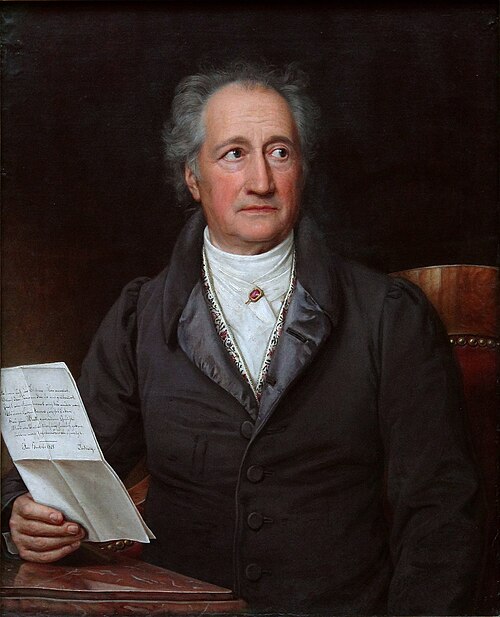
Start at the top for an easy introduction. Go further down for more detail and scholarship.
- Easy
- Intermediate
- Advanced
For young readers
Goethe (say “GUR-tuh”) was born in the German city of Frankfurt in 1749. He grew up in a big house full of books, learned many languages, and loved puppet theatre. One of his favourite puppet stories was about Doctor Faust, a scholar who makes a deal with the devil. Goethe kept thinking about that story for the rest of his life.
When he was only 25, Goethe wrote a sad novel called The Sorrows of Young Werther, about a young man who loves someone he cannot marry. The book became a sensation all over Europe. Young men dressed like Werther in blue coats and yellow waistcoats, and Goethe became famous almost overnight.
Soon afterwards a young duke invited him to the small town of Weimar. Goethe stayed there for the rest of his life. He did not only write; he helped run the duke’s little state, looked after mines and roads, ran a theatre and advised the university in nearby Jena.
Goethe was curious about everything. He studied how plants grow and change, how the bones of animals and humans are alike, and how we see colours. He believed that if you look at nature very patiently, it will show you its secrets.
His most famous work is Faust, a huge play in two parts that took him about sixty years to finish. Faust wants to know everything and feel everything, so he makes a bet with a devil called Mephistopheles. Today schools, streets and the German cultural institute around the world, the Goethe-Institut, are named after him.
At a glance
- Born
- 28 August 1749, Frankfurt am Main (Free Imperial City in the Holy Roman Empire)
- Died
- 22 March 1832, Weimar, aged 82
- Language
- German
- Main place of work
- Weimar, capital of the Duchy (from 1815 Grand Duchy) of Saxe-Weimar-Eisenach, from 1775
- Roles
- Poet, dramatist, novelist, critic, minister and privy councillor, theatre director, natural scientist
- Major works
- Götz von Berlichingen (1773), The Sorrows of Young Werther (1774), Wilhelm Meister’s Apprenticeship (1795–96), Faust Part One (1808) and Part Two (1832), Elective Affinities (1809), West-Eastern Divan (1819)
- Scientific works
- The Metamorphosis of Plants (1790), Theory of Colours (1810)
- Movements
- Sturm und Drang in youth; with Schiller, the leading figure of Weimar Classicism
Easy
Who was Goethe?
Johann Wolfgang von Goethe is to German literature roughly what Shakespeare is to English or Dante to Italian: the writer against whom others are measured. He wrote lyric poems, ballads, plays, novels, an autobiography, travel writing, essays on art and literature, and scientific studies. His collected writings, letters and diaries fill well over a hundred volumes.
He lived a long life, from 1749 to 1832, through a period of enormous change: the late Enlightenment, the American and French Revolutions, the wars of Napoleon, the end of the Holy Roman Empire in 1806, and the beginning of the industrial age. His works reflect many of these changes, but always through the lives and feelings of individual people.
Goethe was not only a writer. For decades he was a senior official in the small Duchy of Saxe-Weimar-Eisenach, and he spent a great deal of time on scientific research. He believed that art, science and practical life were connected, and that a person should try to develop all of his or her abilities.
Easy
Youth in Frankfurt, Leipzig and Strasbourg
Goethe was born on 28 August 1749 in Frankfurt am Main into a wealthy middle-class family. His father, Johann Caspar Goethe, a lawyer with an imperial title, taught his children at home with private tutors; his mother, Catharina Elisabeth Textor, was the daughter of the city’s chief magistrate and a lively storyteller. Goethe learned Latin, Greek, French, Italian, English and some Hebrew, drew, played music and read widely.
At sixteen he was sent to study law at the University of Leipzig (1765–68), where he wrote light poems and plays in the elegant rococo style of the time. After a serious illness he returned home, then completed his legal studies at Strasbourg (1770–71). There he met the philosopher and critic Johann Gottfried Herder, who opened his eyes to folk song, to Shakespeare and to the Gothic cathedral as expressions of a people’s living spirit. Goethe’s love for Friederike Brion, a pastor’s daughter in the village of Sesenheim, inspired some of the freshest love poems in German.
Back in Frankfurt, and briefly at the imperial court of justice in Wetzlar, he practised law without much enthusiasm and threw himself into writing. His play Götz von Berlichingen (1773), about a rebellious sixteenth-century knight, broke the rules of French classical drama in the manner of Shakespeare and made him a leader of the young movement known as Sturm und Drang (“Storm and Stress”).
Easy
Werther: a book that swept Europe
In 1774 Goethe published The Sorrows of Young Werther, a short novel told mostly through the letters of a sensitive young man who falls in love with Lotte, a woman engaged to someone else, and finally takes his own life. Goethe drew on his own unhappy love for Charlotte Buff in Wetzlar and on the suicide of an acquaintance, Karl Wilhelm Jerusalem.
The novel was an immediate international sensation. It was translated into French and English within a few years, imitated, parodied and attacked. Fans wore Werther’s costume, and “Werther fever” became a phrase. Some critics blamed the book for encouraging suicide, and there were reports of young people who killed themselves in imitation, though how many cases were real is uncertain. Much later, sociologists named the imitation of widely publicised suicides the “Werther effect”.
Werther matters because it gave powerful literary form to a new kind of inner life: intense feeling, love of nature, frustration with social rules and class barriers, and the sense that the individual heart is the measure of all things. Goethe himself later looked on this work with some distance; he revised it in 1787 and saw its hero as a warning as much as a model.
Intermediate
Weimar: poet and statesman
In November 1775 the eighteen-year-old Duke Karl August of Saxe-Weimar-Eisenach invited Goethe to Weimar, a town of only about six thousand people. Goethe stayed for the rest of his life. In 1776 he entered the duke’s privy council, and over the next decade he took on responsibility for mining (including an ambitious attempt to reopen the silver and copper mines at Ilmenau), roads, military recruitment and, from 1782, the state finances. In 1782 the emperor ennobled him, which added “von” to his name.
Government work taught Goethe about practical life, but it also left him little time to finish major works. His close friendship with Charlotte von Stein, a married lady of the court, shaped his emotional and literary life in these years and produced hundreds of letters. His official record has also been examined critically: for example, in 1783 he supported the duke’s decision not to spare a young woman, Johanna Höhn, convicted of killing her newborn child, a case that scholars discuss in relation to the Gretchen tragedy in Faust.
In September 1786 Goethe left secretly for Italy, where he stayed until June 1788. In Rome, Naples and Sicily he drew, studied classical art and architecture, and experienced what he felt as a rebirth. On his return he gave up most of his administrative duties, though he kept supervising cultural and scientific institutions, including the University of Jena. He began living with Christiane Vulpius, a young woman who worked in an artificial-flower workshop; their son August was born in 1789. They married in 1806, after French troops had occupied Weimar following the Battle of Jena. Weimar society long looked down on Christiane because of her humble origins.
Intermediate
Friendship with Schiller and Weimar Classicism
From 1794 until Schiller’s death in 1805, Goethe and the dramatist and philosopher Friedrich Schiller formed one of the most productive literary friendships in history. They were very different: Goethe started from concrete observation, Schiller from ideas and moral freedom, influenced by Kant. Their letters discuss poetry, drama and philosophy in depth. Together they wrote satirical epigrams (the Xenien, 1796), and Goethe, as director of the Weimar court theatre from 1791 to 1817, staged Schiller’s great plays.
This period is known as Weimar Classicism. Inspired by ancient Greek and Roman art, its writers aimed at balance, form and a humane ideal of the whole person, in contrast to both the excesses of Sturm und Drang and, later, what Goethe saw as the one-sidedness of the Romantics. Works of these years include the verse drama Iphigenia in Tauris (in its verse form, 1787), Torquato Tasso (1790), the Roman Elegies, the ballads written in friendly competition with Schiller, the epic idyll Hermann and Dorothea (1797) and Wilhelm Meister’s Apprenticeship (1795–96).
Wilhelm Meister, the story of a young merchant’s son who seeks his place in life through the theatre and finally through a secret society that guides his education, became the model of the Bildungsroman, the “novel of formation”. It also contains famous songs, such as Mignon’s “Kennst du das Land” (“Do you know the land where the lemon trees bloom?”), set to music by many composers.
Intermediate
Faust: a lifetime’s work
Goethe worked on Faust for about sixty years. An early version, the so-called Urfaust, existed by the mid-1770s and is known from a copy made by a lady of the Weimar court and rediscovered in 1887. He published a Fragment in 1790, Part One in 1808, and completed Part Two shortly before his death; it was published in 1832 after he died.
Part One begins with a “Prologue in Heaven” in which the Lord allows Mephistopheles to tempt the scholar Faust, confident that a good man, even in his dark striving, remains aware of the right way. Faust, bored and despairing of book learning, makes a wager with Mephistopheles: if he ever says to a passing moment, “Stay, you are so beautiful!”, the devil may take him. The second half becomes the tragedy of Gretchen (Margarete), a young woman whom Faust seduces and abandons; she kills her baby, is condemned to death and, at the end, is saved by divine grace.
Part Two is vast and symbolic. Faust visits the imperial court, where paper money is invented; travels into classical antiquity, where he marries Helen of Troy; and at last becomes a ruler reclaiming land from the sea, a project that causes the deaths of an old couple, Philemon and Baucis. Blind and dying, he imagines a free people on free land. Angels carry his soul upward, and the drama ends with the line that “the eternal feminine draws us on”. Readers still debate whether Faust is a hero of human striving, a warning about modern ambition and domination, or both.
Intermediate
Goethe the scientist
Goethe considered his scientific work as important as his poetry. In 1784 he identified the intermaxillary bone in the human skull, a bone known in animals whose presence in humans had been doubted; he took this as evidence of the unity of animal and human form, though the French anatomist Félix Vicq d’Azyr had described it independently somewhat earlier.
In The Metamorphosis of Plants (1790) he argued that the different organs of a flowering plant, such as leaves, sepals, petals and stamens, can be understood as transformations of one basic organ, the leaf. He coined the word “morphology” for the study of form and its transformations. He also imagined an Urpflanze, a primal plant, as the archetype of all plants; when he explained it to Schiller in 1794, Schiller replied that this was not an experience but an idea.
His longest scientific work, the Theory of Colours (1810), attacked Newton’s explanation that white light is made up of coloured rays. Goethe instead studied how colours arise at the boundary between light and darkness, and devoted long sections to coloured shadows, afterimages and the psychological effects of colours. Physicists have rejected his polemic against Newton, but his careful descriptions of colour perception influenced painters, physiologists and philosophers.
Intermediate
Late works and world literature
After Schiller’s death, Goethe became a kind of national institution, visited by admirers from all over Europe. In 1808, at Erfurt, he met Napoleon, who had read Werther several times and reportedly greeted him with the words “Vous êtes un homme” (“You are a man”). In 1812 he met Beethoven at the spa town of Teplitz; they admired each other’s work but did not become close.
His late works are among his most original. The novel Elective Affinities (1809) uses a chemical metaphor to explore marriage and passion. In his autobiography, Poetry and Truth (published from 1811), he shaped the story of his early life with artistic freedom. Inspired by a German translation of the fourteenth-century Persian poet Hafez, he wrote the West-Eastern Divan (1819), a cycle of poems in dialogue with Persian poetry and Islamic culture. Wilhelm Meister’s Journeyman Years (1821, revised 1829) turned the novel of education into a loose, experimental book about work, renunciation and emigration.
In conversations recorded by his young secretary Johann Peter Eckermann, Goethe declared in 1827, after reading a Chinese novel in translation, that national literature now meant little and that “the epoch of world literature” (Weltliteratur) was at hand. By this he meant not a list of masterpieces but a growing exchange among writers and readers of different nations. His wife Christiane had died in 1816, and his son August died in Rome in 1830. Goethe finished Faust in 1831 and died in Weimar on 22 March 1832.
Advanced
Goethe’s way of thinking: nature, form and “delicate empiricism”
Goethe distrusted abstract systems, but his work had a real philosophical dimension. From his reading of Spinoza in the 1780s he took the idea of a God immanent in nature rather than standing outside it. He read Kant, especially the Critique of Judgment (1790), with sympathy for its treatment of organisms and art, while resisting the idea that the mind can never know nature in itself.
His scientific method, which he sometimes called “delicate empiricism” (zarte Empirie), asked the observer to study a phenomenon patiently, in many variations and series, until an “archetypal phenomenon” (Urphänomen) became visible: a basic pattern, such as the polarity of light and darkness in colour, beyond which explanation should not go. Key concepts in his thought include metamorphosis, polarity (the tension of opposites) and Steigerung (intensification, or raising to a higher level).
Philosophers have interpreted this legacy in different ways. Hegel appreciated Goethe’s idea of the archetypal phenomenon; Schopenhauer began his work on vision in dialogue with Goethe’s colour theory, which led to a cooling of their relations; Wittgenstein wrote remarks on colour that engage with Goethe; and in the twentieth century some philosophers of science have revived his approach as a form of phenomenology of nature. Others see his rejection of mathematical physics as a dead end. The debate is not only about Goethe but about what counts as scientific knowledge.
Advanced
Sources, editions and the making of the “Goethe myth”
Few writers left a larger record. Besides his works, Goethe’s letters, diaries and official papers survive in huge numbers, and many contemporaries recorded his conversations. The standard complete edition of the nineteenth century, the Weimar or “Sophie” edition (1887–1919), runs to 143 volumes; modern critical editions such as the Frankfurt and Munich editions continue to refine the texts. The Goethe and Schiller Archive in Weimar holds the main manuscript collections.
These sources must be used with care. Poetry and Truth is a deliberately artistic autobiography, as its title admits, written decades after the events. Eckermann’s Conversations with Goethe (1836–48) are an invaluable record but were edited and shaped by Eckermann years later. Goethe himself curated his image, burning some papers and preparing the final edition of his works. Later biographers, from the nineteenth century to Nicholas Boyle’s large multi-volume study Goethe: The Poet and the Age (1991– ), have had to separate the writer’s self-presentation from documentary evidence.
Goethe’s reputation also has its own history. In the nineteenth century he was turned into a national monument, a symbol of German cultural greatness; after 1871 he was sometimes used to support nationalist claims he would not have shared. After 1945, both German states invoked him as a representative of humanist culture, sometimes with the uncomfortable fact in mind that the Buchenwald concentration camp had been built on the Ettersberg hill near Weimar, where Goethe had walked. Recent scholarship has examined his political conservatism, his attitudes toward the French Revolution, his role as a minister of a small absolutist state and his treatment of women, alongside his openness to other cultures and his vision of world literature.
Advanced
Influence around the world
Goethe’s influence spread far beyond Germany. His lyric poems were set to music hundreds of times, by Mozart, Beethoven, Schubert (Erlkönig, Gretchen am Spinnrade), Schumann, Wolf and many others. Faust inspired operas by Berlioz and Gounod, symphonic works by Liszt and Mahler, and countless adaptations on stage and screen. Writers from Thomas Carlyle and Ralph Waldo Emerson to Thomas Mann engaged with his work, and Mann’s novel Lotte in Weimar (1939) made him a character.
In East Asia, Goethe became a major reference point during modernisation. Werther and Faust were translated and widely read in Japan from the Meiji period onward, and Werther was translated into Chinese in 1922 by the poet Guo Moruo, and it became a model of the modern individual and of romantic love for young readers. In Korea, Werther and Faust were introduced in the early twentieth century and became standard works in school and university curricula.
His idea of Weltliteratur has become a founding concept in comparative literature, and his dialogue with Hafez in the West-Eastern Divan is often cited as an example of respectful engagement between Europe and the Islamic world. The Goethe-Institut, founded in 1951, promotes German language and culture internationally under his name.
Key ideas
- Sturm und Drang
- A German literary movement of the 1770s that celebrated genius, strong feeling, nature and rebellion against rules; Goethe’s Götz and Werther are its best-known works.
- Weimar Classicism
- The mature style of Goethe and Schiller (about 1786–1805), inspired by ancient art and aiming at balance, form and the harmonious development of the whole person.
- Bildung
- Self-formation or education in the broadest sense: developing all one’s abilities through experience. Wilhelm Meister made this the theme of the Bildungsroman.
- Faustian striving
- The restless desire to know, experience and achieve more, never content with the moment; admired as creative and feared as destructive.
- Metamorphosis
- Goethe’s idea that living forms develop by transforming a basic pattern, as the organs of a plant are variations of the leaf.
- Urphänomen
- An “archetypal phenomenon”: a basic pattern in nature, found by patient observation, beyond which explanation should not go.
- Weltliteratur
- “World literature”: Goethe’s vision of an age in which literatures of different nations are read, translated and exchanged with one another.
Records
- 1749 — 28 August: born in Frankfurt am Main.
- 1765 — Begins law studies at Leipzig.
- 1770 — Studies in Strasbourg; meets Herder.
- 1773 — Götz von Berlichingen is published.
- 1774 — The Sorrows of Young Werther makes him famous across Europe.
- 1775 — Arrives in Weimar at the invitation of Duke Karl August.
- 1786 — Leaves for Italy (until 1788).
- 1790 — Publishes The Metamorphosis of Plants and Faust: A Fragment.
- 1794 — Friendship with Schiller begins; it lasts until Schiller’s death in 1805.
- 1808 — Faust Part One is published; meets Napoleon at Erfurt.
- 1819 — West-Eastern Divan is published.
- 1832 — 22 March: dies in Weimar; Faust Part Two is published posthumously.
Glossary
- Weimar
- A small town in Thuringia, capital of the duchy of Saxe-Weimar-Eisenach, where Goethe lived from 1775 until his death.
- Privy council
- The small group of senior advisers who governed the duchy with the duke; Goethe joined it in 1776.
- Bildungsroman
- A novel about the development of a young person’s character and place in the world.
- Mephistopheles
- The devil figure in Faust, witty and cynical, who makes a wager with Faust.
- Gretchen tragedy
- The part of Faust Part One about Margarete, who is seduced by Faust and condemned for killing her child.
- Urfaust
- The earliest surviving version of Faust from the 1770s, known from a copy found in 1887.
- Morphology
- The study of the form and structure of living things; Goethe coined the term.
- Intermaxillary bone
- A bone of the upper jaw; Goethe’s 1784 study of it in humans supported his belief in a common plan of animal forms.
- Divan
- In Persian and related traditions, a collected volume of a poet’s works; Goethe borrowed the word for his West-Eastern Divan.
- Goethe-Institut
- Germany’s cultural institute, founded in 1951, which teaches German and promotes cultural exchange worldwide.
Questions and answers
How do you say Goethe’s name?
In German it sounds roughly like “GUR-tuh”, but without a strong r; the “oe” is the German sound ö.
Why did it take him so long to write Faust?
He started it in his twenties and kept returning to it as his life and ideas changed. Part One came out when he was nearly 60, and he finished Part Two only months before he died at 82.
Was Goethe really a scientist?
Yes. He did careful research on plants, bones, rocks and colours. Some of his ideas, such as the metamorphosis of plants and the word “morphology”, lasted; his attack on Newton’s theory of light did not.
Was Goethe a Romantic?
Not exactly. In his youth he led Sturm und Drang, which prepared Romanticism, and many Romantics admired him. But in his mature years, with Schiller, he developed Weimar Classicism, and he criticised some Romantic tendencies.
What did Goethe mean by “world literature”?
He meant a new age in which writers and readers of different nations read and translate each other and learn from one another, not just a list of famous books.
How reliable is Goethe’s autobiography?
Poetry and Truth is valuable but was written decades later with artistic freedom, as its title says. Historians check it against letters, diaries and official records.
How did Goethe react to the French Revolution?
He was sceptical of revolutionary violence and preferred gradual reform. He accompanied the duke on the 1792 campaign against revolutionary France and later wrote about it; his attitude has been debated as both wise moderation and conservatism.
Sources and further reading
- Johann Wolfgang von Goethe. Wikipedia
- 요한 볼프강 폰 괴테. 위키백과
- Anthony K. Jensen, Johann Wolfgang von Goethe. Internet Encyclopedia of Philosophy
- Goethe’s Faust. Wikipedia
- The Sorrows of Young Werther. Wikipedia
- Theory of Colours. Wikipedia
- Weltliteratur. Wikipedia
- Nicholas Boyle, Goethe: The Poet and the Age. Oxford University Press, 1991–2000
- Rüdiger Safranski, Goethe: Kunstwerk des Lebens. Carl Hanser Verlag, 2013
Related
- William ShakespeareEnglish playwright and poet whose plays span comedy, history and tragedy.
- HafezPersian lyric poet especially known for ghazals of love, longing and spiritual ambiguity.
- Baruch SpinozaDutch philosopher who developed a rigorous account of nature, human freedom and the relation between reason and religion.
- Immanuel KantPrussian philosopher whose accounts of knowledge, moral duty and judgment reshaped modern philosophy.
- Georg Wilhelm Friedrich HegelGerman philosopher whose account of history, thought and social institutions profoundly influenced later philosophy.
- Jean-Jacques RousseauGeneva-born writer whose arguments about inequality, political authority and education influenced European thought.
Written with AI assistance from the published sources listed above, and revised as new research appears.