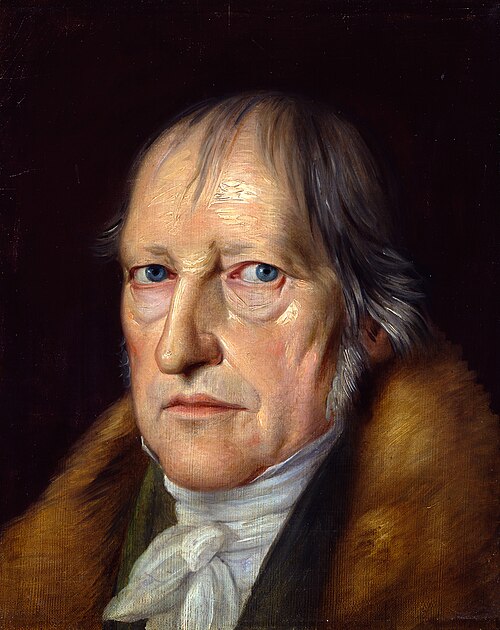
Start at the top for an easy introduction. Go further down for more detail and scholarship.
- Easy
- Intermediate
- Advanced
For young readers
Imagine you are learning to ride a bike. First you wobble, then you fall, then you learn from the fall and ride a little better. Hegel thought that whole peoples, and even human thinking itself, learn in a similar way: they try something, run into a problem, and then find a better way that keeps what was good about the old one.
Hegel was born in the city of Stuttgart in Germany in 1770. As a young man he studied to become a church minister, but he became a teacher and then a professor of philosophy instead. Philosophy means “love of wisdom”: it asks big questions like “What is true?”, “What is freedom?” and “How should we live together?”
When Hegel was 36, the French emperor Napoleon marched into the town where he lived, called Jena. Hegel had just finished his most famous book, the Phenomenology of Spirit. He wrote to a friend that he had seen Napoleon riding through the streets, and called him the “world-soul” on horseback, because to Hegel it felt as if history itself was riding by.
Hegel used the word “Spirit” (Geist in German) for the shared mind of people living together: their language, laws, art, religion and science. He believed that over thousands of years this shared mind slowly becomes freer and understands itself better.
His books are famously hard to read, even for grown-up professors. But his ideas changed how people think about history, politics, religion and art, and thinkers who came after him, such as Karl Marx, built on his ideas or argued against them.
At a glance
- Lived
- 27 August 1770, Stuttgart – 14 November 1831, Berlin
- Country
- Duchy of Württemberg (birth); later Bavaria and Prussia, in the German lands of the Holy Roman Empire and German Confederation
- Field
- Philosophy: logic, metaphysics, ethics, political philosophy, philosophy of history, art and religion
- Movement
- German Idealism, after Kant, Fichte and Schelling
- Major works
- Phenomenology of Spirit (1807); Science of Logic (1812–1816); Encyclopaedia of the Philosophical Sciences (1817, rev. 1827, 1830); Elements of the Philosophy of Right (1820, dated 1821)
- Posts
- Jena (lecturer), Bamberg (newspaper editor), Nuremberg (school rector), Heidelberg and Berlin (professor)
- Key ideas
- Spirit (Geist), dialectic, sublation (Aufhebung), recognition, ethical life, history as the progress of freedom
- Influence
- Marx and the Young Hegelians, British Idealism, existentialism, critical theory, and many present-day debates on recognition and social freedom
Easy
Who was Hegel?
Georg Wilhelm Friedrich Hegel was one of the most influential philosophers of the modern age. He lived from 1770 to 1831, a time of enormous change in Europe: the French Revolution, the wars of Napoleon, the end of the Holy Roman Empire and the beginnings of industrial society all happened in his lifetime.
Hegel tried to build a complete philosophical “system” that would explain how everything fits together: logic and nature, the human mind, family life, economics and the state, art, religion and philosophy itself. What ties the system together is the idea that reality is best understood not as a set of fixed things but as a process of development in which contradictions are worked through.
He is often grouped with Johann Gottlieb Fichte and Friedrich Schelling as one of the great “German Idealists”, the philosophers who responded to Immanuel Kant. Many historians see Hegel as the high point of that movement, and his ideas became a starting point for much of the philosophy of the next two centuries.
Easy
A life in five cities
Hegel was born in Stuttgart on 27 August 1770, the son of an official at the court of the Duke of Württemberg. His mother died when he was thirteen. In 1788 he entered the Tübingen Stift, a Protestant seminary that trained ministers and teachers. There he shared rooms with two young men who also became famous: the poet Friedrich Hölderlin and the philosopher Friedrich Schelling. The three friends admired ancient Greek culture and followed the French Revolution with excitement.
Instead of becoming a pastor, Hegel worked as a private tutor for wealthy families, first in Bern (1793–1796) and then in Frankfurt (1797–1800). In 1801 he moved to the University of Jena, then a lively centre of philosophy and literature, where he taught as an unpaid lecturer and worked closely with Schelling. It was in Jena that he finished the Phenomenology of Spirit in 1806, just as Napoleon defeated Prussia at the Battle of Jena on 14 October.
The war closed the university, and Hegel had to find other work. He edited a newspaper in Bamberg (1807–1808) and then served for eight years as rector (headmaster) of a secondary school in Nuremberg, where he taught philosophy to teenagers. There he married Marie von Tucher in 1811, and published his Science of Logic. He also had an older son, Ludwig, born in 1807 to his landlady in Jena, who later joined the family.
In 1816 Hegel finally became a professor at Heidelberg, and in 1818 he accepted the chair of philosophy at the new University of Berlin, the capital of Prussia. His lectures there drew students from across Germany and beyond, and he served as rector of the university in 1829–1830. He died in Berlin on 14 November 1831, during a cholera epidemic; his doctors blamed cholera, though some historians think another stomach illness was the cause. He was buried in the Dorotheenstadt cemetery near Fichte.
Easy
The big idea: truth has a history
Many earlier philosophers looked for truths that never change, like the rules of geometry. Hegel agreed that philosophy seeks truth, but he insisted that we cannot understand an idea, a society or even ourselves without seeing how they came to be. An acorn, an oak sapling and a full-grown oak are the same living thing at different stages; to understand the oak you need the whole story.
Hegel wrote that “the true is the whole”. He meant that any single viewpoint, taken by itself, is partial. When we push a partial viewpoint to its limits, it runs into problems it cannot solve. The solution is not to throw it away completely, but to move to a richer viewpoint that includes what was right in the old one. Hegel called this movement “dialectic”.
Applied to history, this idea became one of Hegel’s most famous claims: that world history is the story of humanity’s growing awareness of freedom. In his lectures he described a movement from societies where only one ruler was thought to be free, through societies where some people were free, to modern societies that recognize, at least in principle, that every human being is free.
Intermediate
Historical and philosophical background
Hegel’s philosophy grew out of the debates that followed Immanuel Kant’s Critique of Pure Reason (1781). Kant had argued that the human mind actively shapes experience, but also that we can never know “things in themselves” as they are apart from us. Fichte and Schelling tried to overcome this split between mind and world in different ways. Hegel, after first working alongside Schelling, came to believe that Schelling’s “Absolute”, in which all differences disappear, was empty; in the preface to the Phenomenology he mocked it as a night in which all cows are black.
Politically, Hegel was shaped by the French Revolution. As a student he celebrated it; later he criticized the Terror of 1793–1794 as the result of an abstract idea of freedom that destroyed every institution standing in its way. He also watched Napoleon abolish the old Holy Roman Empire (1806) and spread legal reforms across Germany. After Napoleon’s defeat, Prussia under King Frederick William III wavered between reform and restoration, and Hegel’s writings in Berlin were read against that tense background.
The early nineteenth century was also the age of Romanticism, with its love of feeling, nature and the individual genius. Hegel shared the Romantics’ interest in history and culture, but he rejected the idea that truth could be grasped by intuition or feeling alone. For him, philosophy had to work in the medium of concepts and argument, even when its subject was religion or art.
Economics mattered to him too. Hegel read the Scottish political economists, including Adam Smith and James Steuart, and was one of the first philosophers to give “civil society”, the world of markets, work and private interest, a separate place between the family and the state.
Intermediate
The Phenomenology of Spirit (1807)
The Phenomenology of Spirit is Hegel’s most famous and most difficult book. It follows consciousness through a series of “shapes”, each a way of understanding the world and oneself. It starts with the simplest attitude, “sense-certainty”, which thinks it can grasp the pure “this, here, now”, and shows how each attitude fails on its own terms and gives way to a more complex one. The journey passes through perception, understanding, self-consciousness, reason, social and historical “spirit”, and religion, and ends in what Hegel calls “absolute knowing”.
The best-known passage describes the relation of “lordship and bondage”, often called the master–slave dialectic. Two self-conscious beings each want to be recognized by the other, and they struggle. One, fearing death, submits and becomes the servant; the other becomes the master. But the master’s victory is hollow: he is recognized only by someone he does not recognize as an equal. The servant, by contrast, through fear and through working on the world, begins to develop real independence. The passage suggests that selfhood depends on mutual recognition.
Later chapters discuss Greek tragedy (especially Sophocles’ Antigone), the Enlightenment, the French Revolution’s “absolute freedom and terror”, and Kantian morality. Because it moves so freely between logic, psychology and history, readers still disagree about what exactly the book is: an introduction to Hegel’s system, a history of the human spirit, or a philosophical novel of the education of consciousness.
Intermediate
Logic, the system and the method
In the Science of Logic (published in three parts, 1812, 1813 and 1816), Hegel tried to derive the basic categories of thought, such as being, nothing, becoming, quality, quantity, essence and concept, from one another without assuming anything in advance. The book famously begins with pure “being”, which turns out to be so empty that it is indistinguishable from “nothing”; the truth of both is “becoming”.
The Encyclopaedia of the Philosophical Sciences, first published in Heidelberg in 1817 and revised in 1827 and 1830, sets out the whole system in three parts: the Logic, the Philosophy of Nature, and the Philosophy of Spirit. The last part moves from the individual mind (“subjective spirit”) to social institutions (“objective spirit”) and finally to art, religion and philosophy (“absolute spirit”), the ways in which a community comes to understand itself and reality as a whole.
A key term throughout is Aufhebung, usually translated “sublation”. The German verb aufheben can mean “to cancel”, “to preserve” and “to lift up”. Hegel used all three meanings at once: in a dialectical step, a limited position is cancelled as the whole truth, preserved as a moment within a richer view, and lifted to a higher level.
Hegel’s method is often summarized as “thesis, antithesis, synthesis”. Scholars widely agree that this formula is misleading. Hegel almost never used these words; they are more closely associated with Fichte, and the triad was popularized as a description of Hegel by later writers. Hegel himself stressed that the movement comes from within the concepts themselves, through “determinate negation”, rather than from a mechanical recipe.
Intermediate
Freedom, society and the state: the Philosophy of Right
The Elements of the Philosophy of Right, published in Berlin in 1820 (with 1821 on the title page), is Hegel’s account of what it means for freedom to become real in the world. It moves through three stages. “Abstract right” covers personhood, property and contract. “Morality” covers individual conscience, intention and responsibility. “Ethical life” (Sittlichkeit) covers the institutions in which people actually live: the family, civil society and the state.
Hegel argues that freedom is not simply doing whatever one wants. Real freedom requires social institutions in which people can recognize their own will and find meaning, and which in turn recognize them. Civil society, with its markets and division of labour, brings great gains but also produces poverty and a “rabble” cut off from society; Hegel saw this problem clearly and admitted that civil society alone cannot solve it.
The preface contains two of Hegel’s most quoted lines: that what is rational is actual and what is actual is rational, and that “the owl of Minerva spreads its wings only with the falling of dusk”, meaning that philosophy understands an era only when it is already ending. The first line has often been read as a defence of the Prussian state as it was. Many scholars reply that by “actual” (wirklich) Hegel meant what fully realizes its rational purpose, not whatever happens to exist, and they point out that the state he describes, with a constitutional monarchy, representative estates and public trial by jury, went beyond the Prussia of 1820.
Intermediate
The Berlin lectures: history, art, religion and philosophy
In Berlin Hegel lectured regularly on the philosophy of world history, aesthetics (the philosophy of art), the philosophy of religion and the history of philosophy. He never published these lectures himself. After his death, his students and friends issued them as books in the collected “Friends’ edition” (1832–1845), combining Hegel’s own notes with students’ transcripts.
In the Lectures on the Philosophy of World History, Hegel described history as the progress of the consciousness of freedom, moving roughly from Asia through Greece and Rome to the Christian and Germanic world of Europe. In the Lectures on Aesthetics he treated art as a way in which truth appears to the senses, from symbolic art (such as Egyptian architecture) through classical Greek sculpture to Romantic art, and he suggested that in the modern world art no longer serves as the highest expression of truth.
These lectures made Hegel famous and remain widely read. They also contain some of his most troubling passages. He described Africa as having no history in his sense, treated China and India as stages that Europe had left behind, and made sweeping judgments about peoples he had never studied closely. Today these claims are recognized as Eurocentric and, in places, racist, and they are a central part of any serious assessment of his legacy.
Intermediate
Followers, critics and legacy
Soon after Hegel’s death his followers divided. “Right Hegelians” stressed the harmony of his system with Christianity and the Prussian state. “Left” or “Young Hegelians”, including David Friedrich Strauss, Ludwig Feuerbach, Bruno Bauer and the young Karl Marx, used his dialectic to criticize religion and existing politics. Marx later said he had found Hegel’s dialectic “standing on its head” and had set it on its feet, turning it into a theory of material and economic history.
Other thinkers defined themselves against Hegel. Arthur Schopenhauer, who taught in Berlin at the same time, despised him. Søren Kierkegaard attacked the idea that a system could capture the existing individual. In the twentieth century, Karl Popper, in The Open Society and Its Enemies (1945), portrayed Hegel as an enemy of liberal democracy, a reading many Hegel scholars reject as a caricature.
Hegel’s influence also spread widely. British Idealists such as F. H. Bradley and T. H. Green, American pragmatists including John Dewey, and French thinkers who attended Alexandre Kojève’s Paris lectures on the Phenomenology in the 1930s all drew on him. The Frankfurt School of critical theory, and later philosophers of recognition such as Axel Honneth, reworked his ideas on society and freedom. His picture of history also influenced debates about modernity in East Asia, where Hegel and Marx were translated and studied intensively in the twentieth century.
Advanced
Debates: metaphysician, post-Kantian or something else?
For much of the twentieth century, Hegel was usually read as a speculative metaphysician: a philosopher who claimed that reality as a whole is the self-development of a cosmic Spirit or God, knowable by pure thought. On this “traditional” reading, Hegel returned to a kind of pre-Kantian metaphysics, and critics from the analytic tradition often treated him as the model of what philosophy should not be.
From the 1970s onward, a “non-metaphysical” or “post-Kantian” interpretation gained ground, especially in the English-speaking world. Scholars such as Klaus Hartmann, Robert Pippin and Terry Pinkard read Hegel as completing Kant’s critique of metaphysics: his logic, on this view, is a theory of the categories that any rational thinking must use, and “Spirit” refers to the social practices through which humans give and demand reasons. Robert Brandom developed a related reading focused on normativity and recognition.
A third group, often called “revised metaphysical” readers, including Stephen Houlgate and Robert Stern, argues that Hegel really was doing metaphysics, but not the dogmatic kind: his logic is a study of the fundamental structures of being itself, reached without presupposing Kant’s split between thought and world. Frederick Beiser, among others, has warned that stripping Hegel of metaphysics and religion makes him more acceptable to modern readers at the cost of historical accuracy. The debate remains open and shapes how translators render key terms like Geist (“spirit” or “mind”) and Begriff (“concept” or “notion”).
A related debate concerns his politics. Liberal readers stress the Philosophy of Right’s defence of individual rights, property, conscience and constitutional government; critics from both left and right point to its hereditary monarch, its limited franchise and its exclusion of women from public life. Historians have also tried to separate Hegel’s published text from his more reform-minded lecture transcripts, which were written in a period of strict Prussian censorship after the Carlsbad Decrees of 1819.
Advanced
Evidence and texts: what we can know about Hegel
Our knowledge of Hegel’s life rests on his letters, official documents, the memories of friends and students, and early biographies, especially Karl Rosenkranz’s life of Hegel (1844), which drew on papers now partly lost. Modern biographies, such as Terry Pinkard’s Hegel: A Biography (2000), try to correct legends that grew up in the nineteenth century, including the image of Hegel as the official philosopher of the Prussian state.
The textual situation is complicated. Only four books appeared in Hegel’s lifetime, along with essays, reviews and lecture outlines. The famous lecture courses survive as editions assembled from his manuscripts and students’ notes, and the nineteenth-century editors sometimes merged notes from different years into one smooth text. The critical edition of his Collected Works (Gesammelte Werke), begun in 1968, publishes the student transcripts year by year, which has changed scholars’ understanding of how his lectures on history, art and religion evolved.
New questions have also come from outside Europe-focused scholarship. In an influential essay, “Hegel and Haiti” (2000), later expanded into the book Hegel, Haiti, and Universal History (2009), Susan Buck-Morss argued that Hegel’s master–slave dialectic may have been shaped by news of the Haitian Revolution, which he could have read about in the journal Minerva. Other scholars consider the evidence circumstantial. The debate has encouraged renewed study of how Hegel’s ideas of freedom relate to slavery and colonialism, and of how his philosophy has been received in Africa, Latin America and Asia.
Translation is a further layer. Key terms have no exact equivalents in English, Korean, Japanese or Chinese, and Hegel’s reception in East Asia was shaped by particular choices: for example, the Japanese translations that fixed terms such as “dialectic” and “sublation” were also adopted in Korean. Reading Hegel critically therefore involves attention not only to the German text but also to the long chain of editors and translators between him and us.
Key ideas
- Spirit (Geist)
- The shared, self-developing life of human thought and culture — language, institutions, art, religion and philosophy — through which a community comes to understand itself.
- Dialectic
- The movement by which a limited position, pushed to its limits, reveals its own contradictions and passes into a richer position that includes its truth.
- Sublation (Aufhebung)
- Cancelling, preserving and lifting up at once: how a superseded stage survives as a moment within a higher one.
- Recognition
- The idea that self-consciousness and freedom depend on being acknowledged by others whom we acknowledge in return; dramatized in the lordship–bondage passage.
- Ethical life (Sittlichkeit)
- The concrete social world of family, civil society and state in which freedom becomes real, as opposed to abstract rights or private conscience alone.
- History as the progress of freedom
- Hegel’s claim that world history shows humanity’s growing awareness that human beings as such are free.
- The true is the whole
- No single viewpoint or moment is the full truth; truth is the complete, developed system in which each part has its place.
Records
- 1770 — Hegel born in Stuttgart, Duchy of Württemberg, on 27 August.
- 1788 — Enters the Tübingen Stift; befriends Hölderlin and Schelling.
- 1793 — Becomes a house tutor in Bern; moves to Frankfurt in 1797.
- 1801 — Moves to Jena; publishes an essay on the difference between Fichte’s and Schelling’s systems.
- 1806 — Finishes the Phenomenology of Spirit as Napoleon wins the Battle of Jena (14 October); the book appears in 1807.
- 1808 — Becomes rector of a gymnasium in Nuremberg after a year as a newspaper editor in Bamberg.
- 1812 — First part of the Science of Logic published; the work is completed in 1816.
- 1816 — Becomes professor at Heidelberg; publishes the Encyclopaedia in 1817.
- 1818 — Takes up the chair of philosophy at the University of Berlin.
- 1820 — Elements of the Philosophy of Right published (dated 1821).
- 1831 — Dies in Berlin on 14 November during a cholera epidemic.
- 1832 — Students and friends begin publishing his collected works and lectures (to 1845).
Glossary
- German Idealism
- The philosophical movement after Kant, led by Fichte, Schelling and Hegel, which held that mind or reason plays a basic role in the structure of reality.
- Phenomenology
- For Hegel, the study of the ways in which consciousness appears to itself and develops toward true knowledge.
- Absolute
- Reality understood as a complete, self-explaining whole; for Hegel it is not a static thing but a process.
- Civil society
- The sphere of economic life, work, markets and private interests, standing between the family and the state.
- Determinate negation
- A negation that has a specific result: showing the failure of one position produces a new, definite position, not mere nothingness.
- Young Hegelians
- Radical followers of Hegel in the 1830s and 1840s, such as Strauss, Feuerbach, Bauer and Marx, who turned his ideas against religion and the state.
- Master–slave dialectic
- Popular name for the lordship-and-bondage passage of the Phenomenology, about the struggle for recognition.
- Tübingen Stift
- A Protestant seminary in Württemberg that trained clergy and teachers; Hegel, Hölderlin and Schelling studied there.
Questions and answers
Why is Hegel so hard to read?
He invented his own technical vocabulary, used everyday German words in unusual senses, and tried to follow the movement of concepts step by step. Even experts argue about many sentences. Good introductions and commentaries help a great deal.
Did Hegel really say “thesis, antithesis, synthesis”?
Almost never. The formula is more closely associated with Fichte and was later used by others to summarize Hegel. Most scholars think it oversimplifies his method.
Did Hegel really see Napoleon?
Yes. In a letter written on 13 October 1806, the day before the Battle of Jena, he described seeing the emperor riding through the town and called him the world-soul.
Was Hegel a defender of the Prussian state?
This is debated. He held a state professorship and praised the rational state, but the institutions he described went beyond the Prussia of his time, and his lecture notes suggest more reformist views than his published book.
How did Hegel influence Marx?
Marx took over Hegel’s idea that history develops through conflict and contradiction, but replaced Spirit with material and economic forces. He criticized Hegel’s idealism while keeping his dialectical method.
What do scholars criticize most in Hegel today?
Besides his difficulty, his Eurocentric and sometimes racist remarks about Africa and Asia, his views on women, and the question of whether his claims about the rationality of history can be defended.
Sources and further reading
- Paul Redding, Georg Wilhelm Friedrich Hegel. Stanford Encyclopedia of Philosophy, 1997, rev. 2025
- Hegel’s Dialectics. Stanford Encyclopedia of Philosophy
- Georg Wilhelm Friedrich Hegel. Wikipedia
- The Phenomenology of Spirit. Wikipedia
- Elements of the Philosophy of Right. Wikipedia
- Young Hegelians. Wikipedia
- Terry Pinkard, Hegel: A Biography. Cambridge University Press, 2000
- Frederick C. Beiser, Hegel. Routledge, 2005
- Susan Buck-Morss, Hegel, Haiti, and Universal History. University of Pittsburgh Press, 2009
Related
- Immanuel KantPrussian philosopher whose accounts of knowledge, moral duty and judgment reshaped modern philosophy.
- Baruch SpinozaDutch philosopher who developed a rigorous account of nature, human freedom and the relation between reason and religion.
- Johann Wolfgang von GoetheGerman writer whose poetry, drama and fiction, from the Sturm und Drang to Weimar Classicism, became central to German literature and European culture.
- Das KapitalKarl Marx’s study of capitalism, labor and value; its first volume appeared in 1867.
- Storming of the BastilleThe seizure of a Paris fortress and prison on 14 July 1789 became an early emblem of the French Revolution.
- Haitian RevolutionA revolution beginning with an uprising of enslaved people in Saint-Domingue led to the abolition of slavery there and Haiti’s independence in 1804.
Written with AI assistance from the published sources listed above, and revised as new research appears.