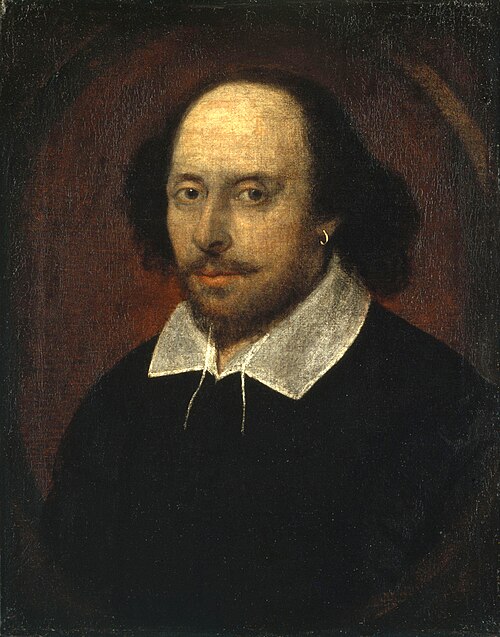
Start at the top for an easy introduction. Go further down for more detail and scholarship.
- Easy
- Intermediate
- Advanced
For young readers
William Shakespeare was born in 1564 in Stratford-upon-Avon, a small market town in England. His father made gloves and was an important man in the town. William went to the local school, where children studied Latin for many hours a day and read old Roman poets and plays.
As a young man he moved to London, the big, busy capital city. There he became an actor and began writing plays. London’s theatres were loud, exciting places. Thousands of people, rich and poor, crowded in to watch sword fights, ghosts, kings, clowns and lovers. There was no electric light, so plays were usually performed in the afternoon in open-air theatres.
Shakespeare wrote about 39 plays. Some are comedies, which are funny and end with weddings, like A Midsummer Night’s Dream, where fairies play tricks on lovers in a forest. Some are tragedies, sad stories that end in death, like Romeo and Juliet, Hamlet and Macbeth. Others are histories about England’s kings. He also wrote 154 short poems called sonnets.
He was very good with words. He wrote many of his lines in a rhythm like a heartbeat: da-DUM, da-DUM, da-DUM, da-DUM, da-DUM. Many phrases English speakers still use, like “wild-goose chase” and “the be-all and end-all”, were first written down in his plays or were made famous by them.
Shakespeare died in 1616. Seven years later, two of his actor friends collected his plays into one big book, now called the First Folio. Without that book, about half of his plays might have been lost forever. Today his plays are translated into many languages and performed everywhere, from London’s rebuilt Globe Theatre to stages in Seoul, Tokyo, Lagos and São Paulo.
At a glance
- Lived
- Baptized 26 April 1564, Stratford-upon-Avon; died 23 April 1616, Stratford-upon-Avon (Julian calendar dates)
- Active
- c. 1589–1613 as actor, playwright and shareholder in London’s theatres
- Country
- Kingdom of England under Elizabeth I and James I
- Companies
- Lord Chamberlain’s Men (from 1594), renamed the King’s Men (1603)
- Works
- About 39 plays (some co-written), 154 sonnets, and narrative poems including Venus and Adonis (1593) and The Rape of Lucrece (1594)
- Theatres
- The Theatre, the Globe (built 1599) and the indoor Blackfriars (from 1608)
- Collected edition
- The First Folio (1623), compiled by John Heminges and Henry Condell, with 36 plays
- Language
- Early Modern English, in blank verse, rhymed verse and prose
Easy
Who was Shakespeare?
William Shakespeare (1564–1616) was an English playwright, poet and actor. He wrote comedies, tragedies, histories and late romances for the commercial theatres of London, and he was a part-owner of the acting company that performed them. He is often considered the greatest writer in the English language.
Shakespeare was not famous only after his death. By the 1590s his poems were bestsellers, and a writer named Francis Meres listed him in 1598 among the best English authors for both comedy and tragedy. But he was also a working professional who wrote for actors, audiences and box-office income, not a solitary genius writing for posterity.
Today his works are studied in schools worldwide, performed in almost every language, and adapted into films, operas, ballets, musicals, novels and comics. Words and phrases from his plays have entered everyday English.
Shakespeare lived at a turning point in English history. England was a Protestant kingdom after decades of religious upheaval, London was growing rapidly, and English was becoming a language of ambitious literature alongside Latin, Italian and French. His career overlapped with those of other gifted dramatists, including Christopher Marlowe, Ben Jonson, Thomas Middleton and John Webster, and he learned from and competed with them.
Easy
His life: from Stratford to London and back
Shakespeare was baptized in Holy Trinity Church, Stratford-upon-Avon, on 26 April 1564; his exact birthday is unknown, though it is traditionally celebrated on 23 April. His father, John Shakespeare, was a glove-maker and wool dealer who served as the town’s bailiff (mayor), and his mother, Mary Arden, came from a farming family. William probably attended the King’s New School in Stratford, where pupils learned Latin grammar, rhetoric and classical literature, though no school records survive.
In November 1582, at eighteen, he married Anne Hathaway, who was 26. Their daughter Susanna was baptized in May 1583, and the twins Hamnet and Judith in February 1585. Hamnet died in 1596 at the age of eleven. After the twins’ birth, records fall silent for several years, which scholars call the “lost years” (1585–1592).
By 1592 Shakespeare was known in London: a pamphlet attributed to the playwright Robert Greene mocked an “upstart Crow” who thought himself “the only Shake-scene in a country”, which is usually taken as a jealous attack on him. From 1594 he belonged to the Lord Chamberlain’s Men, the leading company of the age, and in 1599 members of the company built the Globe Theatre on the south bank of the Thames.
Shakespeare became prosperous. In 1597 he bought New Place, the second-largest house in Stratford, a year after his father had been granted a coat of arms. After about 1610 he seems to have spent more time in Stratford, while still collaborating on plays. He died on 23 April 1616, aged 52, and was buried in Holy Trinity Church. In his will he famously left his wife his “second best bed”.
Easy
The theatre world of Elizabethan and Jacobean London
London’s first purpose-built commercial playhouses opened in the 1560s and 1570s. The open-air theatres, such as the Globe, were round or many-sided wooden buildings with a thrust stage surrounded on three sides by standing spectators (the “groundlings”), who paid a penny, and by galleries for those who paid more. Performances took place in daylight with little scenery, so the words themselves had to create night, storms, battlefields and forests.
All the actors were men and boys; women’s roles were played by boy actors. Companies needed patrons, and the Lord Chamberlain’s Men were protected by a high court official. When James I became king in 1603, he took the company under his own patronage, and it became the King’s Men. From 1608 the company also used the Blackfriars, an indoor theatre lit by candles, which suited quieter music and more intimate effects.
Theatre was controversial. City authorities and Puritan preachers attacked playhouses as places of idleness and disorder, and theatres were closed for long periods when plague struck, as in 1592–94 and 1603. During the 1613 performance of Henry VIII, a cannon shot set the Globe’s thatched roof on fire and the theatre burned down; it was rebuilt the next year.
Being a shareholder mattered. Shakespeare was not only paid for his scripts; he owned a share in the company and, from 1599, in the Globe building itself, so he earned a portion of the profits. This business model, unusual among playwrights, helps explain both his wealth and the steady output of about two plays a year that he wrote for the same group of actors, including the famous tragedian Richard Burbage and comic actors such as Will Kemp and later Robert Armin.
Intermediate
The plays and poems
In the early 1590s Shakespeare wrote English history plays (the three parts of Henry VI and Richard III), early comedies such as The Comedy of Errors and The Taming of the Shrew, and the bloody Roman tragedy Titus Andronicus. When plague closed the theatres, he published two long narrative poems, Venus and Adonis (1593) and The Rape of Lucrece (1594), dedicated to the young Earl of Southampton.
The later 1590s brought Romeo and Juliet, A Midsummer Night’s Dream, The Merchant of Venice, the history cycle from Richard II to Henry V, and the mature comedies Much Ado About Nothing, As You Like It and Twelfth Night. Around 1599–1608 came the great tragedies: Julius Caesar, Hamlet, Othello, King Lear, Macbeth, Antony and Cleopatra and Coriolanus, along with darker “problem plays” such as Measure for Measure.
His final period includes the romances Pericles, Cymbeline, The Winter’s Tale and The Tempest, stories of loss, wandering, reconciliation and magic. His last works were collaborations with John Fletcher: Henry VIII, The Two Noble Kinsmen and a lost play, Cardenio, apparently based on an episode in Cervantes’ Don Quixote.
Shakespeare’s 154 sonnets were published in 1609. Most are addressed to or concern a young man, and later ones a mysterious “dark lady”; they explore love, time, beauty, jealousy and the power of poetry to outlast death. Who the people behind the poems were, and whether the order and publication were authorized by Shakespeare, remain unresolved.
Intermediate
Language, character and dramatic craft
Much of Shakespeare’s drama is written in blank verse: unrhymed lines of iambic pentameter, five pairs of unstressed and stressed syllables. He used this form flexibly, breaking lines between speakers, shifting the stresses and, in his later plays, packing verse with dense, interrupted thought. He switched to prose for comic scenes, servants, letters and characters in madness or disguise, and used rhyme for songs, spells and endings of scenes.
His vocabulary is exceptionally rich, and the Oxford English Dictionary records many words and phrases whose earliest known written use is in his works. Some of these he probably coined; others were likely in speech before him, and digital searches of other writers have pushed back the first-known dates of some words. Either way, his plays fixed many expressions in the language.
Shakespeare borrowed most of his plots. His sources include Raphael Holinshed’s Chronicles for the English histories and Macbeth, Thomas North’s English translation of Plutarch’s Lives for the Roman plays, Ovid’s Metamorphoses, Italian novellas and older English plays. What he added was complexity: characters who speak in soliloquies that seem to reveal a changing inner life, plots that interweave several stories, and a mixture of comic and tragic tones that classical rules would have kept apart.
He also wrote for particular bodies and spaces. Clowns’ parts changed when the company’s leading comic actor changed; long, complex roles such as Hamlet, Othello and Lear were shaped for Burbage; and the late romances, with their music and spectacle, suit the candlelit Blackfriars. Stage directions are sparse, so much of the action is embedded in the dialogue, which is one reason directors have found the plays so open to reinterpretation in different periods, languages and staging styles.
Intermediate
Big questions in the plays
The histories and Roman plays ask what makes power legitimate, what happens when a ruler is overthrown, and how ordinary people suffer in civil war. They were written in a monarchy anxious about who would succeed the childless Queen Elizabeth, and in which censorship limited what could be said openly.
The tragedies explore ambition (Macbeth), jealousy and racism (Othello), grief, revenge and doubt (Hamlet), and the collapse of family and kingdom (King Lear). The comedies play with disguise, gender and mistaken identity, often through heroines such as Rosalind and Viola who dress as young men, roles originally played by boy actors.
Modern readers also study how the plays treat outsiders and the people they portray: the Jewish moneylender Shylock in The Merchant of Venice, the Black general Othello, Caliban on the island of The Tempest, and the women who are silenced or who resist. These plays reflect the prejudices of their time, and they also give such characters some of the most powerful speeches, which is why they continue to provoke debate in performance.
Intermediate
How the plays survived: quartos and the First Folio
No manuscript of a Shakespeare play in his own hand survives, apart, probably, from three pages of the collaborative play Sir Thomas More, where a passage known as “Hand D” is widely attributed to him. Plays belonged to the acting companies, not to authors, and only some were printed during his lifetime.
About half of his plays first appeared individually as cheap small-format books called quartos. Some quarto texts differ greatly from later versions; the 1603 first quarto of Hamlet, for example, is much shorter and differently worded. Scholars once called such texts “bad quartos” produced from faulty memories, but many now see them as evidence of theatrical adaptation or early drafts, and the question remains open.
In 1623 John Heminges and Henry Condell, fellow actors in the King’s Men, published Mr. William Shakespeares Comedies, Histories, & Tragedies, known as the First Folio. It contained 36 plays, 18 of which had never been printed before, including Macbeth, The Tempest, Twelfth Night and Julius Caesar. It includes Ben Jonson’s poem praising Shakespeare as “not of an age, but for all time”. About 235 copies are known to survive.
Because the texts differ, every modern edition is the result of choices. Editors decide whether to follow the quarto or the Folio, whether to combine them (as has long been done with King Lear and Hamlet), how to modernize spelling and punctuation, and how to explain difficult words. Since the 1980s many scholars have argued that some differences reflect Shakespeare’s own revisions, so that, for example, the quarto and Folio versions of King Lear may be treated as two versions of the play.
Intermediate
Afterlife and global influence
After the theatres reopened in 1660, Shakespeare’s plays were often rewritten to suit new tastes; for more than a century King Lear was performed with a happy ending. In the eighteenth century editors such as Nicholas Rowe, Alexander Pope and Samuel Johnson produced scholarly editions, and the actor David Garrick organized the 1769 Shakespeare Jubilee in Stratford, a milestone in turning Shakespeare into a national icon.
German Romantic writers, including Goethe and the translators A. W. Schlegel and Ludwig Tieck, embraced Shakespeare as a model of natural genius; French, Russian and Italian writers and composers followed, and Verdi’s operas Macbeth, Otello and Falstaff are among many musical adaptations. Shakespeare was also taught in schools across the British Empire, where he could be both a colonial instrument and material that local writers reworked for their own purposes.
In East Asia, Tsubouchi Shōyō completed a Japanese translation of all the plays by 1928, and Akira Kurosawa transposed Macbeth and King Lear to feudal Japan in Throne of Blood (1957) and Ran (1985). Korean, Chinese, Indian and African theatre-makers have produced versions that blend Shakespeare with local performance traditions. Productions at the rebuilt Shakespeare’s Globe in London, which opened in 1997, have hosted companies from dozens of countries.
Advanced
What do we really know? Biographical evidence
Shakespeare is better documented than most commoners of his time, but the records say little about his thoughts. The surviving documents include parish registers of baptism, marriage and burial; the 1582 marriage licence bond; records of property purchases and lawsuits; tax records; a deposition he gave in 1612 in the Belott–Mountjoy lawsuit in London; six signatures; and his will. Payment and patent records connect him with the Lord Chamberlain’s and King’s Men, and printed title pages and literary references identify him as author.
Much that is popularly told about him comes from later anecdotes. Nicholas Rowe’s 1709 biographical essay passed on stories, such as that young Shakespeare fled Stratford after poaching deer, which cannot be verified. Biographers must separate documents from tradition, and Samuel Schoenbaum’s documentary studies were influential in insisting on this discipline.
Many biographies read the life through the works, for example linking Hamnet’s death to Hamlet or the sonnets to real affairs. Such connections are possible but speculative, and scholars disagree about how far the plays can be used as autobiography. Questions such as Shakespeare’s religious sympathies, given that his family had Catholic connections in a Protestant state, have been argued in both directions.
Advanced
Collaboration, chronology and attribution
Scholars now agree that Shakespeare often worked with others, as was normal in the period. Titus Andronicus is widely thought to include work by George Peele, Pericles by George Wilkins, Timon of Athens by Thomas Middleton, and the late plays by John Fletcher. Middleton also appears to have revised Macbeth and, probably after Shakespeare’s death, Measure for Measure. The New Oxford Shakespeare (2016) went further and credited Christopher Marlowe as co-author of the Henry VI plays, a claim that some scholars accept and others dispute.
These conclusions rest on stylometry and linguistic analysis: comparing vocabulary, function words, metrical habits, contractions and spelling preferences across large digital corpora of early modern drama. Stanley Wells and Gary Taylor’s Oxford editions of the 1980s, with the Textual Companion (1987), made such evidence central, and debate continues about how reliable the methods are for short or revised passages.
The dates of most plays are also approximate, reconstructed from printing records, performance records, references in other works, topical allusions and changes in Shakespeare’s metrical style. Standard chronologies agree in broad outline but differ by a year or more for many plays.
Key ideas
- Blank verse
- Unrhymed iambic pentameter, the flexible verse form of most of Shakespeare’s dramatic speech.
- Soliloquy
- A speech in which a character alone on stage thinks aloud, as in Hamlet’s “To be, or not to be”, giving the audience access to inner conflict.
- Genre mixing
- Shakespeare combined comedy and tragedy, kings and clowns, in ways that broke classical rules and influenced later drama.
- Commercial theatre
- His plays were written for paying audiences of all classes in London’s playhouses, shaping their variety and energy.
- Collaboration
- Like other playwrights of his time, Shakespeare co-wrote some plays, and others revised his work.
- Legitimacy of power
- The histories and tragedies repeatedly ask what makes a ruler rightful and what follows when order breaks down.
- Textual instability
- Many plays survive in versions that differ, so every modern edition involves editorial choices.
Records
- 1564 — Shakespeare is baptized in Stratford-upon-Avon on 26 April.
- 1582 — Marries Anne Hathaway.
- 1592 — Greene’s pamphlet attacks an “upstart Crow”, showing Shakespeare is active in London.
- 1593 — Publishes Venus and Adonis while the theatres are closed by plague.
- 1594 — Becomes a member of the Lord Chamberlain’s Men.
- 1596 — His son Hamnet dies, aged eleven.
- 1599 — The Globe Theatre is built on the south bank of the Thames.
- 1603 — James I becomes king; the company becomes the King’s Men.
- 1609 — Shakespeare’s Sonnets are published.
- 1613 — The Globe burns down during a performance of Henry VIII.
- 1616 — Shakespeare dies in Stratford on 23 April.
- 1623 — The First Folio collects 36 plays, 18 of them printed for the first time.
Glossary
- Iambic pentameter
- A line of verse with five metrical feet, each an unstressed syllable followed by a stressed one.
- Quarto
- A small book made by folding printing sheets twice; many single plays were first printed this way.
- Folio
- A large book made by folding sheets once; the First Folio is Shakespeare’s first collected works.
- Groundlings
- Spectators who paid the lowest price to stand in the yard around the stage.
- Sonnet
- A 14-line poem; the “Shakespearean” form has three quatrains and a closing couplet.
- Romance
- Here, the late plays that combine loss, wandering, magic and reconciliation, such as The Tempest.
- Stylometry
- The statistical study of writing style, used to test who wrote which parts of a text.
- Jacobean
- Belonging to the reign of James I of England (1603–1625).
Questions and answers
Did Shakespeare really invent lots of words?
His plays contain the first written record of many words and phrases, but some were probably already spoken before him. He certainly made many expressions popular.
Why did boys play the women’s parts?
Women were not allowed to act on the public stage in England until 1660, so trained boy actors played female roles.
How many plays did Shakespeare write?
About 38 or 39, depending on how co-written plays are counted. The First Folio has 36; Pericles and The Two Noble Kinsmen are usually added.
Is it true that Shakespeare and Cervantes died on the same day?
Both died dated 23 April 1616, but not on the same day: England used the Julian calendar and Spain the Gregorian, and Cervantes actually died on 22 April and was buried on the 23rd.
Did someone else write Shakespeare’s plays?
Theories naming Bacon, Oxford or Marlowe exist, but historians and literary scholars overwhelmingly reject them on documentary evidence.
How reliable are the texts we read today?
They are carefully edited, but many plays survive in differing quartos and the Folio, so editors must choose between readings, and some passages remain uncertain.
What is the best evidence for collaboration?
Stylometric analysis of vocabulary, metre and spelling across early modern plays, combined with external evidence such as title pages and records.
Sources and further reading
- William Shakespeare. Wikipedia
- William Shakespeare. Shakespeare Birthplace Trust
- Shakespeare’s works. Folger Shakespeare Library
- First Folio. Wikipedia
- Globe Theatre. Wikipedia
- Shakespeare’s sonnets. Wikipedia
- S. Schoenbaum, William Shakespeare: A Compact Documentary Life. Oxford University Press, 1977
- Stanley Wells and Gary Taylor, with John Jowett and William Montgomery, William Shakespeare: A Textual Companion. Clarendon Press, 1987
- James Shapiro, Contested Will: Who Wrote Shakespeare?. Simon & Schuster, 2010
Related
- Don QuixoteMiguel de Cervantes’s two-part novel follows a man who takes chivalric romances for reality and sets out with Sancho Panza. Its shifting viewpoints helped shape the modern novel.
- Johann Wolfgang von GoetheGerman writer whose poetry, drama and fiction, from the Sturm und Drang to Weimar Classicism, became central to German literature and European culture.
- HomerThe poet tradition credits with the Iliad and the Odyssey, the founding epics of Greek literature. Whether one person composed both is debated.
- VirgilA Roman poet whose Aeneid became one of the most influential works of Latin literature.
- Journey to the WestMing novel that turns a Buddhist pilgrimage into a journey of adventure and satire.
Written with AI assistance from the published sources listed above, and revised as new research appears.