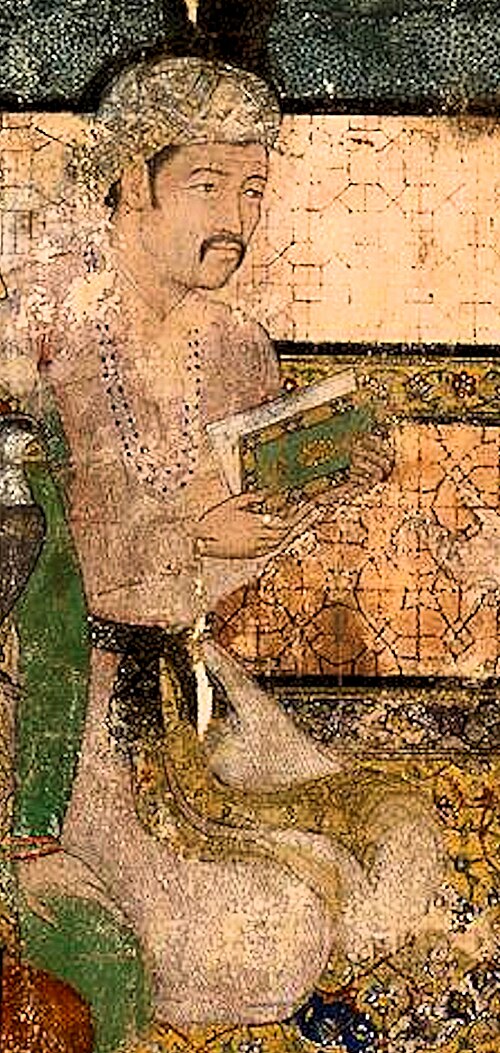
Start at the top for an easy introduction. Go further down for more detail and scholarship.
- Easy
- Intermediate
- Advanced
For young readers
Akbar became an emperor when he was only 13 years old. His father had just died after falling down a flight of stone stairs, and a trusted general named Bairam Khan helped the boy rule until he was old enough to do it himself.
Akbar never learned to read well. But he loved books! Every day, helpers read to him out loud, and he remembered an amazing amount. He built up a library with thousands of handwritten books in many languages.
Akbar ruled over people who followed many different faiths: Muslims, Hindus, Jains, Sikhs, Zoroastrians, Christians and Jews. He built a special hall and invited teachers from these religions to explain their ideas and to argue politely with each other. He wanted to find out what was good in each of them.
He also built a brand-new capital city out of red sandstone, called Fatehpur Sikri, which means “City of Victory”. Its gates, courtyards and palaces still stand today, even though people left the city only about fifteen years after it was built.
Akbar was also a warrior who fought many battles, and some of them were very cruel. Historians remember both sides of him: the curious ruler who listened to many voices, and the conqueror who built his empire by force.
At a glance
- Full name
- Abu’l-Fath Jalal-ud-Din Muhammad Akbar; known as Akbar the Great
- Born
- 15 October 1542, at the fortress of Amarkot (Umerkot), in present-day Sindh, Pakistan
- Died
- October 1605, at Agra; buried in his mausoleum at Sikandra, near Agra
- Reign
- 1556–1605, third emperor of the Mughal dynasty, after Babur and Humayun
- Capitals
- Agra, Fatehpur Sikri (built from 1569–71), Lahore (1585–98), then Agra again
- Main policies
- Mansabdari ranks for nobles, the dahsala land-revenue system, alliances with Rajput kings, abolition of the jizya tax on non-Muslims, and the ideal of sulh-i kul (“peace with all”)
- Main sources
- Abu’l-Fazl’s Akbarnama and Ain-i Akbari; the critical history of Abd al-Qadir Badauni; Jesuit letters and reports
- Successor
- His son Salim, who reigned as the emperor Jahangir
Easy
Who was Akbar?
Akbar was the third ruler of the Mughal dynasty, a family of Central Asian origin that governed much of the Indian subcontinent from the sixteenth to the eighteenth century. His grandfather Babur had founded Mughal rule in north India in 1526, but his father Humayun lost the kingdom to the Afghan ruler Sher Shah Suri and spent years in exile. When Akbar came to the throne in 1556, the Mughals held only a small, insecure territory around Delhi, Agra and the Punjab.
By the time Akbar died almost fifty years later, the Mughal Empire stretched from Kabul and Kandahar in the north-west to Bengal in the east, and from Kashmir in the north to the northern Deccan in the south. He turned a conquering dynasty into a lasting state with a system of ranks, provinces and taxes that his successors kept for more than a century.
Akbar is also remembered for his interest in religion and ideas. He held famous debates among representatives of many faiths, sponsored the translation of Sanskrit classics into Persian, and developed a style of kingship that tried to stand above any single religious community. For this reason he became a symbol of tolerance in modern India, although historians also stress his violent campaigns and the political calculations behind his policies.
Easy
A childhood in exile and a teenage emperor
Akbar was born on 15 October 1542 at Amarkot, a fortress in the desert of Sindh, where his parents had been given refuge by the local Hindu ruler. His father Humayun was on the run after losing his kingdom; his mother, Hamida Banu Begum, was the daughter of a Persian scholar. While Humayun fled on to Safavid Persia, the infant Akbar was left in the care of relatives in Afghanistan, and he grew up among soldiers, hunters and horses rather than books.
In 1555 Humayun, with help from the Persian shah Tahmasp I, reconquered Delhi. A few months later he died after a fall on the steps of his library. On 14 February 1556, in the town of Kalanaur in the Punjab, the thirteen-year-old Akbar was enthroned on a simple brick platform by his guardian, the general Bairam Khan.
The young emperor’s position was fragile. Hemu, a Hindu general and minister who served the Sur dynasty, captured Delhi and Agra. On 5 November 1556 the Mughal army under Bairam Khan defeated Hemu at the Second Battle of Panipat, north of Delhi. Hemu was wounded, captured and executed. The victory secured the Mughal return to power.
For about four years Bairam Khan governed in Akbar’s name. In 1560 the young emperor, encouraged by his foster mother Maham Anga and her circle, dismissed Bairam Khan and sent him on pilgrimage to Mecca; Bairam was murdered on the way. By around 1562 Akbar had freed himself from the influence of court factions and began to rule in person.
Easy
Building an empire by war and alliance
Akbar spent much of his reign on campaign. His armies took Malwa and the central Indian kingdom of Garha, whose queen Rani Durgavati died fighting in 1564. In 1567–68 he besieged the great Rajput fortress of Chittorgarh in Mewar. After it fell in February 1568, the surviving defenders and, according to the sources, about 30,000 non-combatants were massacred. Ranthambore fell soon after. Akbar’s victory proclamation for Chittor described the war in the language of holy war against unbelievers.
Later campaigns brought in the rich trading province of Gujarat (1572–73), with its ports on the Arabian Sea, and Bengal (1574–76). Kabul was incorporated in 1585 after the death of Akbar’s half-brother Mirza Muhammad Hakim, Kashmir was annexed in 1586, and Sindh and Kandahar followed in the 1590s. In his last years Akbar pushed into the Deccan, taking Ahmadnagar in 1600 and the fortress of Asirgarh in 1601.
Force was only half of the story. Akbar drew many Rajput kings into Mughal service. In 1562 he married a princess of Amber (Amer), daughter of Raja Bharmal; she later became known by the title Mariam-uz-Zamani and was the mother of the future emperor Jahangir. Rajput rulers who submitted kept their home lands and became high-ranking commanders in the imperial army. Those who resisted, such as Rana Pratap of Mewar, faced war: Pratap was defeated at the Battle of Haldighati in 1576 but continued to resist from the hills.
Easy
Fatehpur Sikri, the City of Victory
Akbar honoured the Sufi saint Shaikh Salim Chishti, who lived at the village of Sikri near Agra and had foretold the birth of his son. When a son, Salim, was born there in 1569, Akbar began building a new walled capital on the ridge at Sikri. After his conquest of Gujarat it was named Fatehpur, “City of Victory”, and it became known as Fatehpur Sikri.
The city was built mainly of the local red sandstone. It includes a huge congregational mosque, the Jama Masjid; the monumental gateway known as the Buland Darwaza; the white marble tomb of Shaikh Salim Chishti inside the mosque courtyard; and palace buildings such as the Diwan-i Khas (Hall of Private Audience) and the five-storey open pavilion called the Panch Mahal. The architecture mixes Persian and Central Asian forms with building traditions from Gujarat and Rajasthan.
Fatehpur Sikri was the imperial capital for only about fifteen years. In 1585 Akbar moved his court to Lahore to deal with threats on the north-western frontier, and the city was largely abandoned. Water shortage is often given as a reason, but historians think that shifting political and military priorities mattered at least as much. Because it was left almost untouched, it is today one of the best-preserved Mughal ensembles and was inscribed as a UNESCO World Heritage Site in 1986.
Intermediate
How the empire was run: ranks, provinces and taxes
Akbar’s most lasting achievement was administrative. He reorganised the nobility through the mansabdari system. Every senior officer received a rank (mansab) expressed in numbers: the rank fixed his status and pay and the number of cavalrymen he had to keep ready for the emperor. Officers were usually paid through jagirs, assignments of the land revenue of particular areas, and these assignments were moved regularly so that nobles could not build up local power bases. Ranks were granted, raised and lowered by the emperor alone.
The nobility that served under this system was deliberately mixed: Central Asian Turks, Persians, Afghans, Indian Muslims and Hindu Rajputs, as well as Hindu officials of the scribal and banking castes. This diversity reduced the danger that any single group could challenge the throne.
Land revenue, the main source of state income, was reformed by officials including Raja Todar Mal. After experiments with annual assessments, a system called the dahsala (ten-year) or zabt was introduced around 1580: land was measured, and the tax on each crop was calculated from average yields and prices over the previous ten years and generally collected in cash. The empire was divided into provinces (subas), each with a governor and separate officials for finance and justice, so that power was balanced within each province.
Contemporary chronicles and the detailed statistics in the Ain-i Akbari make Akbar’s empire one of the best-documented states of the early modern world. Historians such as Irfan Habib and John F. Richards have used these records to study agrarian society, prices and the pressure that revenue demands placed on peasants.
Intermediate
Faith, debate and “peace with all”
Akbar was born a Sunni Muslim, and in his early reign he behaved as a conventional Muslim ruler, making pilgrimages to the shrine of the Sufi saint Mu’in al-Din Chishti at Ajmer. Yet he also took early steps to win over his non-Muslim subjects. He ended the tax on Hindu pilgrims in 1563 and in 1564 abolished the jizya, the poll tax that Islamic law allowed rulers to levy on non-Muslims.
In 1575 he built a hall called the Ibadat Khana, “House of Worship”, at Fatehpur Sikri. At first Muslim scholars of different schools debated there; later Akbar also invited Hindu, Jain and Zoroastrian teachers and, from 1580, Jesuit priests from Portuguese Goa. The debates often became bitter, and they ended in the early 1580s, but they widened Akbar’s religious horizons.
In 1579 leading Muslim scholars signed a declaration, often called the mahzar, which recognised Akbar’s authority to decide between competing legal opinions. Some ulama and nobles saw this as an attack on religious authority, and in 1580 a revolt in Bihar and Bengal was accompanied by rulings declaring the emperor a heretic.
Out of these experiences grew the ideal expressed in the phrase sulh-i kul, “peace with all” or “universal peace”: the emperor would protect all his subjects regardless of religion and stand above sectarian disputes. Akbar also gathered a small circle of devoted disciples who pledged personal loyalty to him. Later writers called this circle the Din-i Ilahi (“Divine Faith”), and it was long described as a new religion invented by Akbar. Many modern historians think it was rather a court discipleship with Sufi and philosophical elements, and that its importance has been exaggerated.
Intermediate
Books, painting, music and translation
Although Akbar himself could barely read, his court became one of the great cultural centres of the age. He assembled a huge library of manuscripts and had books read aloud to him daily. Persian was the language of government and high culture, and Akbar’s court poets and historians wrote in it.
Akbar set up a translation bureau that rendered Sanskrit works into Persian. The best known result is the Razmnama (“Book of War”), a Persian version of the Mahabharata, together with translations of the Ramayana and other texts. Arabic and Turkish works were translated as well, including the memoirs of his grandfather Babur. These projects aimed to make Indian traditions part of the shared culture of the imperial elite.
The imperial painting workshop brought together Persian masters and many Indian artists. Its early giant project was the illustrated Hamzanama, the adventures of the hero Amir Hamza, with about 1,400 large paintings on cloth. Later workshops illustrated histories such as the Akbarnama and the translated epics. The style that emerged, combining Persian refinement with Indian colour and observation, became the foundation of Mughal painting.
Music flourished too. The singer Tansen, one of the most celebrated figures in the history of Hindustani music, joined Akbar’s court. Popular tradition speaks of the “nine jewels” (navaratnas) of the court, including Tansen, the minister Birbal, Abu’l-Fazl and his brother the poet Faizi, and Raja Todar Mal. The list itself is a later tradition, and the witty stories of Akbar and Birbal are folk tales rather than history, though Birbal was a real courtier who died in battle in 1586.
Intermediate
Later years, death and succession
From 1585 to 1598 Akbar ruled from Lahore, watching the north-western frontier and the Uzbek ruler of Central Asia. After 1598 he returned to Agra and turned south towards the Deccan sultanates. His final years were darkened by family conflict. His son Salim rebelled and set up his own court at Allahabad, and in 1602 Salim’s men killed Abu’l-Fazl, the emperor’s closest adviser and historian.
Akbar and Salim were reconciled, and after two of his other sons died young from illness linked to heavy drinking, Salim became the only possible heir. Akbar fell ill with dysentery in early October 1605 and died at Agra later that month. He was buried at Sikandra, outside Agra, in a mausoleum whose design he may have begun and which Jahangir completed. Salim took the throne as Jahangir and kept most of his father’s institutions.
Akbar’s policies shaped the empire under his successors Jahangir and Shah Jahan, the builder of the Taj Mahal. Historians debate how far later emperors, especially Aurangzeb, departed from Akbar’s approach to religion, and how much that change contributed to the empire’s later crises.
Intermediate
Akbar in memory and modern politics
Akbar’s image has changed with the concerns of each age. His court historian Abu’l-Fazl presented him as an almost sacred, perfect ruler illuminated by divine light. The historian Badauni, who also served at court, wrote privately of a ruler who had abandoned Islam. European visitors wrote about his curiosity and his interest in Christianity, and some Jesuits hoped, wrongly, that he would convert.
In the nineteenth and twentieth centuries Akbar became a model of the tolerant ruler. British writers compared him with European monarchs, and leaders of the Indian national movement, including Jawaharlal Nehru, presented him as a symbol of a composite, plural Indian culture. Films, television series and school textbooks spread this image widely.
Today his memory is contested. Some writers emphasise his tolerance and his alliances with Hindu rulers; others emphasise the siege of Chittor, the massacre of its people, and his wars against Rajput rulers such as Rana Pratap, who is celebrated as a hero of resistance. Historians generally try to hold both sides together: Akbar was a conqueror whose policies of inclusion were also instruments of power, and whose ideas about religion grew over a lifetime rather than following a single plan.
Advanced
Reading the sources: Abu’l-Fazl, Badauni and the Jesuits
Almost everything we know about Akbar comes from sources with strong points of view. The central source is the Akbarnama of Abu’l-Fazl, a vast official history in Persian, together with its third part, the Ain-i Akbari, a description of the empire’s institutions, revenues, provinces and people. Abu’l-Fazl was Akbar’s intimate friend and ideologist. He framed the emperor’s rule through the idea of a divine light (farr-i izadi) transmitted to legitimate kings, drawing on Persian philosophical traditions, especially the illuminationist thought of Suhrawardi. His work is indispensable for chronology and administration, but it is also a carefully constructed portrait of an ideal sovereign.
The Muntakhab al-Tawarikh of Abd al-Qadir Badauni offers a counter-voice. Badauni, an orthodox scholar who worked on court translations, recorded with bitterness the debates of the Ibadat Khana and what he saw as the emperor’s turn away from Islam. His account was kept secret during Akbar’s lifetime. It gives valuable details that Abu’l-Fazl omits, but it is shaped by personal resentment and religious anxiety. Other chronicles, such as Nizam al-Din Ahmad’s Tabaqat-i Akbari, are less literary and less partisan.
Jesuit missionaries, including Antonio Monserrate, who travelled with the first mission of 1580, left letters and a commentary describing the court. They offer an outsider’s view and many concrete observations, but they tended to read Akbar’s questions as signs of approaching conversion and his refusals as fickleness.
Modern scholarship therefore compares these sources rather than trusting any one. Historians of the Aligarh school, notably Irfan Habib and M. Athar Ali, stressed the political and administrative logic of Akbar’s policies, arguing that sulh-i kul served the needs of ruling a religiously diverse nobility and population. Other scholars have placed Akbar in the wider world of Islamic sacred kingship, comparing him with Safavid and Ottoman rulers who also claimed millennial and mystical authority around the Islamic year 1000 (1591–92 CE).
Advanced
Open questions: Din-i Ilahi, tolerance and the nature of Mughal power
Was the Din-i Ilahi a religion? Nineteenth-century British historians, working from translations of Abu’l-Fazl and Badauni, described it as a new faith that Akbar tried to impose. Many later historians argue that there was no separate religion with scriptures, clergy or mass membership: the term itself is not used by Abu’l-Fazl in this sense, and the known disciples numbered only a small group of courtiers. The debate matters because it shapes whether Akbar is seen as a religious innovator, a heretic, or a ruler using spiritual discipleship to bind the elite to the throne.
How tolerant was Akbar? The abolition of the jizya, the protection of places of worship, grants to Hindu, Jain and Zoroastrian institutions, and bans on animal slaughter during Jain festivals show real policies of inclusion. But the same ruler used the language of holy war at Chittor, ordered massacres, and punished rebels harshly. Historians caution against measuring a sixteenth-century monarch by modern liberal ideas of tolerance: sulh-i kul was a doctrine of imperial sovereignty over all communities, not a theory of individual rights.
A third debate concerns the strength of the Mughal state itself. The older picture of a highly centralised empire built by Akbar’s reforms has been qualified by work showing how much the system depended on negotiation with local landholders (zamindars), Rajput lineages and regional elites. On this view Akbar’s genius lay less in creating a machine than in building a network of shared interests around the throne.
Finally, the evidence of material culture, from Fatehpur Sikri to illustrated manuscripts, is increasingly used alongside texts. Art historians study how paintings of the Akbarnama constructed the emperor’s image, how Mughal painters responded to European prints brought by the Jesuits, and how the court’s buildings expressed ideas of kingship. These sources show a court consciously fashioning a new imperial culture for a diverse empire.
Key ideas
- Sulh-i kul
- “Peace with all”: the principle that the emperor protects all subjects and stands above religious disputes; central to Akbar’s later rule.
- Mansabdari
- A system of numerical ranks that fixed each officer’s status, pay and duty to supply cavalry; it bound a diverse nobility to the emperor.
- Jagir
- An assignment of the land revenue of an area to an officer as salary, moved frequently so that nobles did not become local lords.
- Dahsala (zabt)
- Akbar’s land-revenue system from about 1580, based on measuring land and averaging yields and prices over ten years.
- Ibadat Khana
- The “House of Worship” at Fatehpur Sikri where Akbar held debates among representatives of different faiths from 1575.
- Din-i Ilahi
- The name later given to Akbar’s circle of personal disciples; whether it was a new religion is disputed.
- Rajput alliances
- Marriage ties and service agreements with Hindu Rajput kings that made them partners in the empire.
Records
- 1542 — Akbar is born at Amarkot in Sindh while his father Humayun is in exile.
- 1556 — Humayun dies; Akbar is enthroned at Kalanaur (14 February). Mughal victory over Hemu at the Second Battle of Panipat (5 November).
- 1560 — Akbar dismisses his regent Bairam Khan.
- 1562 — Marriage to the princess of Amber, beginning the Rajput alliance policy.
- 1564 — Abolition of the jizya tax on non-Muslims.
- 1568 — Fall of Chittorgarh after a four-month siege, followed by a massacre.
- 1569 — Birth of Prince Salim at Sikri; building of Fatehpur Sikri begins about this time.
- 1573 — Conquest of Gujarat completed.
- 1575 — The Ibadat Khana is built at Fatehpur Sikri.
- 1579 — The mahzar declaration; Jesuits from Goa are invited to court (they arrive in 1580).
- 1585 — The court moves to Lahore; Fatehpur Sikri is largely abandoned.
- 1605 — Akbar dies at Agra; his son Salim succeeds as Jahangir.
Glossary
- Mughal
- The dynasty descended from Timur and Genghis Khan that ruled much of the Indian subcontinent from 1526; the name comes from the Persian word for “Mongol”.
- Jizya
- A poll tax that Islamic law allowed rulers to collect from non-Muslim subjects in return for protection.
- Rajput
- Warrior lineages and ruling families of north and west India, especially Rajasthan.
- Ulama
- Muslim scholars of religion and law.
- Sufi
- A follower of Islamic mysticism; Sufi saints and their shrines were very important in Mughal India.
- Suba
- A province of the Mughal Empire.
- Persianate
- Describing societies where Persian was the language of government, literature and high culture, as in Mughal India.
- Chronicle
- A written history that records events in order of time, often written for a ruler.
Questions and answers
How old was Akbar when he became emperor?
He was 13 years old (in his fourteenth year). His guardian Bairam Khan governed for him until 1560.
Could Akbar really not read?
The sources say he had books read to him and did not read or write well himself; some modern writers suggest dyslexia, but that cannot be proven. He had an excellent memory and was very learned through listening.
Did Akbar start a new religion?
Later writers said he founded the Din-i Ilahi, but many historians think it was a small circle of personal disciples rather than a separate religion with its own scriptures and followers.
Why was Fatehpur Sikri abandoned?
Akbar moved his court to Lahore in 1585 to deal with frontier threats. A lack of water is often mentioned, but political and military reasons were probably just as important.
Was Akbar a tolerant ruler?
He abolished the jizya, supported many religious groups and held interfaith debates, but he also waged brutal wars, such as the siege of Chittor. Historians see his inclusive policies as both sincere interests and tools of imperial power.
Are the Akbar and Birbal stories true?
Birbal was a real courtier and friend of Akbar, but the famous witty stories about them are later folk tales.
What are the most important sources for his reign?
Abu’l-Fazl’s official Akbarnama and Ain-i Akbari, Badauni’s critical Muntakhab al-Tawarikh, other Persian chronicles, and reports by Jesuit missionaries. Each has its own bias, so historians compare them.
Sources and further reading
- Akbar. Wikipedia
- 악바르 (Akbar). Korean Wikipedia
- Din-i Ilahi. Wikipedia
- Akbarnama. Wikipedia
- Fatehpur Sikri. Wikipedia
- Fatehpur Sikri. UNESCO World Heritage Centre
- John F. Richards, The Mughal Empire (The New Cambridge History of India I.5). Cambridge University Press, 1993
Related
- Taj MahalMughal tomb complex commissioned by Shah Jahan for Mumtaz Mahal, known for its marble mausoleum and carefully ordered gardens.
- Guru NanakSpiritual teacher and poet of the Punjab (1469–1539), revered by Sikhs as the first of the ten Gurus and the founder of Sikhism.
- KabirNorth Indian poet-saint whose verses question religious boundaries and outward ritual.
- MahabharataA vast Sanskrit epic centered on a conflict between related royal families, with the Bhagavad Gita among its parts.
- Suleiman the MagnificentTenth Ottoman sultan (r. 1520–1566), whose long reign combined conquests from Hungary to Iraq, the harmonisation of Ottoman law, and a flowering of architecture and poetry.
- ShahnamehPersian epic by Ferdowsi recounting Iran's legendary kings and historical past.
Written with AI assistance from the published sources listed above, and revised as new research appears.