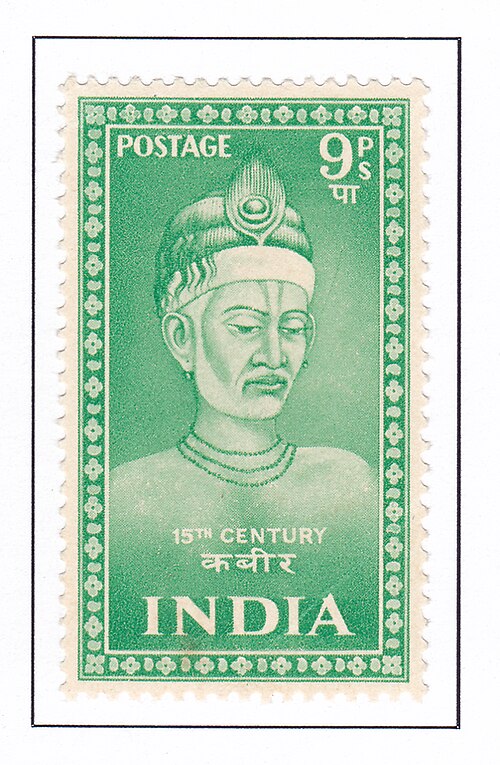
Start at the top for an easy introduction. Go further down for more detail and scholarship.
- Easy
- Intermediate
- Advanced
For young readers
About 550 years ago, in the holy city of Varanasi on the River Ganges in India, there lived a weaver named Kabir. All day he sat at his loom, passing thread back and forth to make cloth. While he worked, he made up songs.
Kabir’s songs were short and surprising. He said that God is not hidden in a temple or a mosque, or on a far-away mountain. God is close, inside you, like the smell inside a flower. He teased priests who read many books but had no love in their hearts. “Learn just the few letters of the word ‘love’,” he said, “and you will be wiser than any scholar.”
In Kabir’s time, people were divided by religion and by caste, groups you were born into that decided what work you did and whom you could eat with. Kabir said these walls were made by people, not by God. He came from a family of Muslim weavers, yet he sang about Ram, a name of God used by Hindus. He did not want to belong to only one side.
Kabir probably could not read or write. His songs were remembered and sung by others, and only written down many years later. Because people loved them, they kept adding new songs with Kabir’s name, so today it is hard to know which ones he really made.
A famous story says that when Kabir died, Hindus wanted to burn his body and Muslims wanted to bury it. When they lifted the cloth, they found only flowers. They shared the flowers, and each group honoured him in its own way.
At a glance
- Lived
- 15th century, possibly into the early 16th; dates such as c. 1398–1448 and c. 1440–1518 are both proposed
- Place
- Varanasi (Benares, Kashi); died, according to tradition, at Maghar in present-day Uttar Pradesh
- Background
- Raised in a family of julaha (Muslim weavers); worked as a weaver
- Language
- A mixed early Hindi (sometimes called Sadhukkari), combining features of Bhojpuri, Awadhi, Braj and Khari Boli
- Forms
- Sakhi (couplets), sabad or pad (songs) and ramaini (short verse sections)
- Main collections
- The Bijak (Kabir Panth), the Kabir Granthavali (Rajasthan, Dadu Panth) and hymns in the Sikh Guru Granth Sahib
- Tradition
- A leading voice of nirguna bhakti (devotion to God without form) in the Sant tradition
- Legacy
- Revered by Hindus, Muslims and Sikhs; the Kabir Panth regards him as its founder
Easy
Who was Kabir?
Kabir was a poet and religious teacher who lived in and around Varanasi, the sacred city on the Ganges in northern India, in the fifteenth century. He belonged to a community of weavers, called julaha, which had converted to Islam, probably not many generations before his time. He earned his living at the loom, and images of weaving, spinning and thread run through his poetry.
He is one of the best-loved poets of South Asia. His couplets are learned by schoolchildren, quoted in speeches and newspapers, and sung by folk musicians, classical singers and devotional groups from Rajasthan to Bengal and from Punjab to Madhya Pradesh. More than five centuries after his death, his name is still a byword for plain speaking about religion.
Kabir did not found a temple or write a book. His teaching lived in performance: songs and sayings passed from singer to singer, and many were written down only a century or more later. This makes him both very present, since his words are everywhere, and very hard to know as a historical person.
Easy
The life of Kabir in legend
Almost everything told about Kabir’s life comes from legends recorded long after his time, many of them in hagiographies (lives of saints) written by his followers or by other devotional communities. They are important for understanding how people have remembered him, even if they cannot be treated as simple history.
One widely told story says that Kabir was born to a Brahmin widow who abandoned him, and that he was found as a baby floating on a lotus in Lahartara pond near Varanasi by a Muslim weaver named Niru and his wife Nima, who raised him. The story explains how a Muslim weaver could be the voice of a devotion associated with Hindu names for God. Many modern readers see it as an attempt to give him a respectable birth; the Kabir Panth tells a different version, in which he appeared miraculously on the lotus.
Another famous legend concerns his guru. Kabir wished to become a disciple of the great Vaishnava teacher Ramananda, who would not normally accept a Muslim. So Kabir lay on the steps of a bathing ghat before dawn. Ramananda, coming down to bathe, stepped on him and cried “Ram! Ram!”, and Kabir took the holy name as his initiation. Historians doubt whether the two men’s lifetimes overlapped, but the story connects Kabir to the widespread devotion to Ram in northern India.
Other legends tell of trials before the Delhi sultan Sikandar Lodi, from which Kabir was miraculously saved, and of meetings with Guru Nanak, the founder of Sikhism. Tradition says that at the end of his life Kabir deliberately left Varanasi, where many believed that dying brought liberation, and went to die in Maghar, a town said to bring an evil rebirth, to show that such beliefs were false. After his death, the story of the flowers under the shroud expresses his place between Hindus and Muslims. At Maghar today a Hindu samadhi and a Muslim tomb stand side by side.
Easy
What Kabir’s poems are like
Kabir’s best-known form is the sakhi, a two-line couplet (in the doha metre) that states a truth like a proverb. The word sakhi means “witness”: each couplet is a testimony to something the poet has seen. One of the most famous sakhis can be rendered: “Reading books, the whole world died, and no one became learned; / read just the two and a half letters of love, and you become wise.” In Hindi the word for love, prem, is written with two and a half letters.
His longer poems, called sabad (“word”) or pad, are songs meant to be sung, often addressed to “brother seekers” (sadho) or to a pandit or a qazi. Many end with a signature line, such as “Kabir says, listen, brother seekers”. A third form, the ramaini, uses a different metre for teaching passages.
The poems are direct, funny and often harsh. Kabir mocks people who bathe in sacred rivers but stay impure within, who wear holy threads or pray loudly from minarets, who count rosary beads while their minds wander. He uses everyday images from the market, the kitchen, the cremation ground and, above all, the loom. His language is simple, but some poems are riddles, known as ulatbamsi (“upside-down language”), which describe impossible scenes, like a cow milking its calf or a fish climbing a tree, to jolt listeners out of ordinary thinking.
Intermediate
Kabir’s world: Varanasi in the fifteenth century
Varanasi (also called Benares or Kashi) was, and is, one of the holiest cities of Hinduism, a centre of Brahmin learning, pilgrimage and death rituals on the ghats of the Ganges. In Kabir’s time the region was ruled by Muslim dynasties: first the Delhi Sultanate and the Sharqi sultans of Jaunpur, then, from the late fifteenth century, the Lodi sultans of Delhi. Muslims and Hindus lived side by side, and Sufi orders were active in the cities and the countryside.
Society was ordered by caste, the hierarchy of hereditary groups (jati) that determined occupation, marriage and ritual purity. Weavers were a low-status artisan community, and many had converted to Islam, possibly hoping to escape some of the burdens of caste, though caste-like distinctions persisted among Muslims too. Kabir thus stood outside both the Brahmin elite and the Muslim religious scholars (ulama).
This period saw a flowering of bhakti, devotional religion that emphasized a personal, loving relationship with God and often challenged the authority of priests and the barriers of caste. Bhakti poets used the regional languages of ordinary people rather than Sanskrit or Persian. Among Kabir’s near-contemporaries were Ravidas, a leatherworker-saint of Varanasi, and, a generation later, Guru Nanak in Punjab.
Intermediate
Kabir’s teachings: God without form
Kabir is the most famous voice of nirguna bhakti, devotion to God “without qualities” or without form. Unlike devotees of Krishna or of Ram as a divine king with a story, a family and images in temples, Kabir addressed a God who cannot be pictured or located. He often calls this God Ram, but his Ram is not the hero of the Ramayana; he also uses names such as Hari, Allah, Rahim and Sahib, and insists that all these names point to the same reality.
For Kabir, God is found within. He compares people searching for God in pilgrimages to a musk deer that runs through the forest seeking the scent that comes from its own body. The way to God is through the Name (nam), the remembrance of God in the heart; through the true guru, the teacher who awakens the disciple; and through the Word (shabad), a spiritual sound or insight beyond ordinary speech. These ideas draw on earlier traditions, especially the yogic Nath sect, as well as on Vaishnava devotion and possibly on Sufism.
From this inner religion comes Kabir’s criticism of outward religion. He rejected idol worship, pilgrimage, fasting, animal sacrifice, circumcision, the authority of the Vedas and the Qur’an as books, and the claims of Brahmins and mullahs to special holiness. He attacked caste directly, asking whether a Brahmin’s blood is milk while others’ is blood. He also spoke often and vividly about death, urging listeners to wake up before it is too late.
Kabir’s poetry is not only critical. Many poems express longing, love and joy: the soul as a bride waiting for her husband, the drunkenness of divine love, or the silence of union. It is this combination of fierce criticism and tender devotion that has kept his work alive.
Intermediate
Reading Kabir: the loom, the market and the body
One of the most loved songs sung in Kabir’s name, “Jhini jhini bini chadariya” (“Finely, finely woven is the shawl”), describes the human body as a shawl woven by God. Its warp and weft are made of breath, its threads are the channels of the body, and it took months to weave. Gods, sages and ordinary people wore it and stained it; only the true devotee wore it carefully and gave it back to its maker as clean as when he received it. The song turns a weaver’s daily work into a picture of an entire human life.
The market (bazaar) is another frequent image. Life is a short visit to a fair: people haggle, show off and quarrel, but everyone must leave at nightfall, and nothing bought there can be taken along. Kabir also uses the image of the potter who shapes and breaks pots, the washerman who beats clothes clean, the goldsmith who tests metal in the fire and the thief who waits for the careless traveller. These images made his teaching easy to remember for artisans and farmers who never entered a school.
Death is Kabir’s constant companion. Many sakhis describe Kal, Time or Death, as a hunter who is always close at hand, and warn that the body is like a clay pot that may break at any moment. This is not meant to frighten for its own sake: for Kabir, the awareness of death strips away pride and false security and turns the mind toward what is real. Scholars have noted that these themes connect him with the yogic Nath tradition and with the wider medieval literature of renunciation across religions.
Intermediate
How the poems were preserved: three textual traditions
Kabir’s poems circulated orally for a long time before they were written down, and they survive in several regional traditions that overlap only partly. Scholars usually distinguish three main streams.
The eastern stream is the Bijak (“seed” or “account”), the scripture of the Kabir Panth, associated with the region of Varanasi and Bihar. It contains three main sections: ramainis, sabads and sakhis. The Bijak is often considered the most radical and critical of the collections. Its surviving manuscripts are relatively late, and scholars debate when it took its present form; it is well known in English through the translation by Linda Hess and Shukdeo Singh.
The western stream, preserved in Rajasthan, especially by the Dadu Panth, a devotional community founded in the sixteenth century, is known as the Kabir Granthavali. The most widely used edition, published by Shyamsundar Das in 1928, was based on a manuscript that he dated to 1504, but this date has been questioned. The Rajasthani collections include many love and longing poems.
The Punjabi stream is the Guru Granth Sahib, the scripture of the Sikhs, compiled by Guru Arjan and completed in 1604. It contains more hymns and couplets by Kabir than by any other non-Sikh bhagat (saint); one common count gives 541. Earlier Sikh manuscripts, the Goindval pothis of the late sixteenth century, already include Kabir’s verses. Because the Sikh texts are firmly dated, many scholars regard them as the most reliable early witnesses to the Kabir tradition.
Intermediate
Followers and legacy: the Kabir Panth, Sikhs and beyond
The Kabir Panth (“path of Kabir”) is a religious community that regards Kabir as its founder and teacher. It developed after his death, with major branches such as the Kabir Chaura monastery in Varanasi and the Dharamdas lineage centred in Chhattisgarh. Its followers, estimated in the millions, have historically come largely from low-caste and Dalit communities, and the Panth has spread with the South Asian diaspora to places such as Trinidad, Fiji and North America. Ironically, it has developed its own rituals, lineages of gurus and sacred texts, which Kabir himself criticized in other contexts.
Kabir shaped many later Sant traditions of northern India, including the Dadu Panth in Rajasthan, and his inclusion in the Guru Granth Sahib means that his words are sung daily in Sikh gurdwaras around the world. Dalit movements have claimed him as a forerunner of the struggle against caste.
In the twentieth century Kabir became a national poet. Rabindranath Tagore’s English translation Songs of Kabir (1915), made with Evelyn Underhill, introduced him to Western readers, although many of those poems came from a modern Bengali collection and are not found in early manuscripts. In Hindi literature, Hazari Prasad Dwivedi’s study Kabir (1942) helped establish him as a founding figure. Indian political leaders and writers have cited him as a symbol of Hindu–Muslim harmony.
Kabir’s songs continue in living performance: in the folk traditions of Malwa and Rajasthan, in the singing of artists such as Kumar Gandharva and Prahlad Singh Tipanya, and in films, festivals and recordings such as the Kabir Project led by Shabnam Virmani. Each performance reshapes the words, continuing the oral life that has always carried Kabir.
Advanced
Debates: when did Kabir live, and what can we know?
Kabir’s dates are uncertain. The Kabir Panth traditionally gives 1398 for his birth and 1518 for his death, a lifespan of 120 years that most historians regard as legendary. Scholars have argued for two main alternatives. One places his life around 1398–1448, keeping the traditional birth year but rejecting the impossibly long lifespan. The other puts his activity later, roughly 1440–1518, partly because legends link him with Sikandar Lodi (ruled 1489–1517) and with Guru Nanak (1469–1539). Neither view rests on contemporary documents; both depend on the reliability of later traditions.
The main external evidence is that Kabir is mentioned and praised by poets of the sixteenth century, including verses attributed to Ravidas, the Sikh gurus and the saint Dadu, and that his poems appear in the Goindval pothis of the 1570s. By the late sixteenth century, therefore, he was already a famous figure of the past. The hagiographies, such as the Bhaktamal of Nabhadas (c. 1600) and the Kabir Parachai attributed to Anantadas, contain valuable information about how he was remembered but are shaped by devotional aims, as David Lorenzen and others have shown.
The link with Ramananda is particularly debated. Ramananda’s own dates are uncertain, and his role as the teacher of saints from many castes, including Kabir and Ravidas, may reflect later efforts by the Ramanandi order to claim these popular figures. Some scholars accept a real connection; others see Kabir as independent of any Vaishnava lineage.
Key ideas
- Nirguna bhakti
- Devotion to God without form or qualities, found within rather than in images or temples.
- Critique of ritual
- Kabir mocked pilgrimages, fasting, idol worship and religious display by both Hindus and Muslims.
- Rejection of caste
- He denied that birth could make anyone purer or holier than others.
- Name and guru
- Remembering God’s name and following a true teacher are the path to realization.
- Everyday imagery
- Weaving, the market and daily life become images for spiritual truths.
- Upside-down language
- Paradoxical riddle-poems (ulatbamsi) shake listeners out of habitual thinking.
- Oral tradition
- Kabir’s poetry lives in performance, so each singer and region shapes the corpus.
- Between religions
- Claimed by Hindus, Muslims, Sikhs and Dalits, Kabir resists fitting into any single identity.
Records
- c. 1398 — Traditional birth year of Kabir according to the Kabir Panth.
- c. 1448 — Death year proposed by some scholars.
- 1469 — Birth of Guru Nanak, founder of Sikhism, whom legends connect with Kabir.
- 1489 — Sikandar Lodi becomes sultan of Delhi; legends tell of Kabir’s trials before him.
- c. 1518 — Traditional death year of Kabir, at Maghar.
- c. 1570 — The Goindval pothis, early Sikh manuscripts, include Kabir’s verses.
- c. 1600 — Nabhadas’s Bhaktamal includes Kabir among the great devotees.
- 1604 — Guru Arjan completes the Adi Granth (Guru Granth Sahib), containing hundreds of Kabir’s compositions.
- 1915 — Rabindranath Tagore publishes Songs of Kabir in English.
- 1928 — Shyamsundar Das publishes the Kabir Granthavali.
- 1942 — Hazari Prasad Dwivedi publishes his influential Hindi study Kabir.
Glossary
- Bhakti
- Loving devotion to God; a religious movement in medieval India expressed in regional languages.
- Nirguna
- “Without qualities”; describes God as formless and beyond description.
- Sant
- A “good one” or saint; the name for the poet-saints of northern India who worshipped a formless God.
- Sakhi
- “Witness”; a two-line couplet, Kabir’s most famous form.
- Sabad / pad
- A song or hymn meant to be sung.
- Julaha
- A community of weavers in northern India, many of whom were Muslim.
- Caste (jati)
- A hereditary social group that traditionally determined occupation, marriage and ritual status.
- Guru
- A spiritual teacher.
- Bijak
- The main scripture of the Kabir Panth, a collection of Kabir’s poems.
- Kabir Panth
- The religious community that follows Kabir as its founder.
- Hagiography
- A biography of a saint written to inspire devotion rather than as critical history.
Questions and answers
Could Kabir read and write?
Probably not. One of his poems says he never touched ink or paper. His songs were remembered and sung, and written down later by others.
Was Kabir a Hindu or a Muslim?
He grew up in a Muslim weaver family and used Hindu names for God, but he criticized both religions’ leaders and rituals. People of both faiths, and Sikhs, honour him.
When exactly did Kabir live?
We don’t know for sure. Tradition says 1398–1518; scholars suggest either about 1398–1448 or about 1440–1518.
Why are Kabir’s poems in the Sikh holy book?
The Sikh gurus admired poets who shared their devotion to one formless God, and Guru Arjan included Kabir’s hymns when he compiled the Adi Granth in 1604.
Did Kabir write all the poems that carry his name?
Certainly not all. Singers and poets added many songs with his signature line over the centuries, so scholars compare the oldest collections to identify an early core.
What does “Ram” mean in Kabir’s poems?
It is a name for the one formless God, not the prince of the Ramayana; Kabir also uses names like Hari, Allah and Rahim.
Are Tagore’s translations reliable guides to Kabir?
They are beautiful, but many of those poems come from a modern Bengali collection and are not found in early manuscripts, so scholars treat them cautiously.
Sources and further reading
- Kabir. Wikipedia
- Kabir Panth. Wikipedia
- Guru Granth Sahib. Wikipedia
- Bhakti movement. Wikipedia
- Ramananda. Wikipedia
- Linda Hess, Shukdeo Singh (trans.), The Bijak of Kabir. Oxford University Press, 2002
- Charlotte Vaudeville, A Weaver Named Kabir: Selected Verses with a Detailed Biographical and Historical Introduction. Oxford University Press, 1993
- John Stratton Hawley, Mark Juergensmeyer, Songs of the Saints of India. Oxford University Press, 1988
- Linda Hess, Bodies of Song: Kabir Oral Traditions and Performative Worlds in North India. Oxford University Press, 2015
- David N. Lorenzen, Kabir Legends and Ananta-Das’s Kabir Parachai. State University of New York Press, 1991
Related
- RumiPersian-language poet and Sufi teacher whose verse explores love and spiritual transformation.
- HafezPersian lyric poet especially known for ghazals of love, longing and spiritual ambiguity.
- Rabindranath TagoreBengali poet, writer and educator whose work reached readers across India and the wider world.
- Adi ShankaraIndian philosopher associated with Advaita Vedanta, which teaches the ultimate unity of the self and brahman.
- Early UpanishadsTexts that ask what the self (ātman) is and how it relates to ultimate reality (brahman) — a foundation of later Indian philosophy.
- RamayanaA Sanskrit epic about Rama, Sita and their exile, preserved in many versions across South and Southeast Asia.
Written with AI assistance from the published sources listed above, and revised as new research appears.