Start at the top for an easy introduction. Go further down for more detail and scholarship.
- Easy
- Intermediate
- Advanced
For young readers
Constantinople was one of the greatest cities in the world. It sat where Europe meets Asia, on a narrow strip of sea. For more than a thousand years it was the capital of the Byzantine Empire, which continued the old Roman Empire in the east. Its giant walls had stopped many armies.
By 1453 the empire had become tiny, not much more than the city itself. All around it was the growing Ottoman Empire. Its new ruler, Sultan Mehmed II, was only 21 years old, and he wanted Constantinople to be his capital.
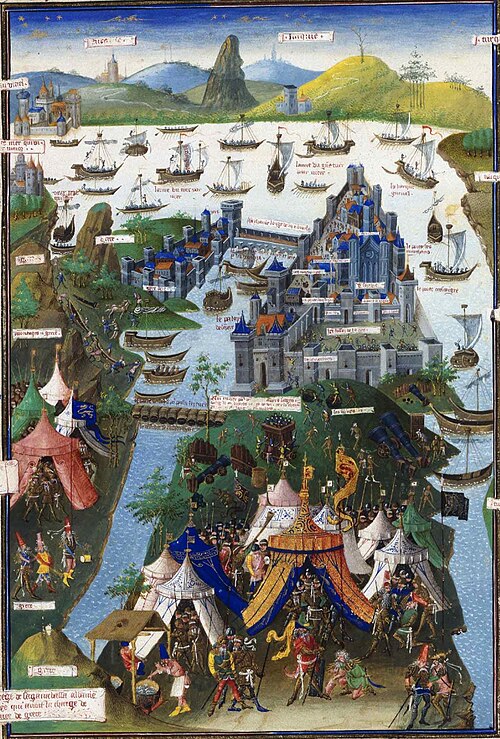
Mehmed brought a huge army, many ships, and enormous cannons that could throw stone balls as heavy as a small car. The defenders, led by Emperor Constantine XI, had only a few thousand soldiers, including helpers from Genoa and Venice. They put a great iron chain across the harbour so enemy ships could not get in.
Mehmed had a surprising idea: he had his ships pulled over the hills on greased wooden rails and slid into the harbour behind the chain. For about seven weeks the cannons pounded the walls. On 29 May 1453 the Ottoman soldiers broke into the city. The emperor died in the fighting.
It was a terrible day for the people who lived there. Many were killed, and many thousands were taken away as captives. Afterwards Mehmed made the city his capital, turned the great church of Hagia Sophia into a mosque, and brought in new people to live there. The city is today called Istanbul.
At a glance
- Date
- Siege from early April (2 or 6 April) to 29 May 1453
- Duration
- About seven to eight weeks (roughly 53–57 days, depending on the starting date used)
- Place
- Constantinople (modern Istanbul, Türkiye)
- Sides
- Ottoman Empire under Mehmed II vs. Byzantine Empire under Constantine XI Palaiologos, with Genoese, Venetian and other allies
- Forces
- Modern estimates: Ottomans about 50,000–80,000 or more; defenders about 7,000–10,000, of whom George Sphrantzes counted 4,773 Greeks and some 200 foreigners fit to fight
- Outcome
- Ottoman capture of the city; death of the last Byzantine emperor; end of the Byzantine Empire
- Human cost
- Thousands of defenders and civilians killed; tens of thousands of inhabitants enslaved or displaced
- Aftermath
- The city became the Ottoman capital; Hagia Sophia was converted into a mosque
Easy
The city at the crossroads
Constantinople stood on a triangular peninsula between the Sea of Marmara, the Bosphorus strait and a long natural harbour called the Golden Horn. The Roman emperor Constantine the Great refounded the old Greek town of Byzantion as his new capital in 330. After the western Roman Empire collapsed in the fifth century, the eastern empire, ruled from Constantinople, continued for another thousand years. Historians call it the Byzantine Empire, but its people called themselves Romans (Rhomaioi).
The city was protected on its land side by the Theodosian Walls, built in the fifth century: a moat, an outer wall and a massive inner wall with towers, stretching about 6 km from sea to sea. Sea walls guarded the other sides. These defences had turned back Avars, Persians, Arabs, Bulgarians and Rus’ over many centuries.
But the city had been taken once before. In 1204 the knights of the Fourth Crusade, who had set out to fight in the Holy Land, captured and sacked it. The Byzantines recovered the city in 1261, but the empire never regained its former strength.
Easy
Background: a shrinking empire and a rising power
In the fourteenth century the Ottomans, a Turkish Muslim dynasty from north-western Anatolia, expanded rapidly into both Anatolia and the Balkans. By the early fifteenth century Byzantium had been reduced to Constantinople and its surroundings, a few islands and the Morea (Peloponnese) in southern Greece. The emperors paid tribute to the Ottoman sultan and sought help from western Europe.
The Ottomans had besieged Constantinople before, notably under Bayezid I in the 1390s and under Murad II in 1422, but had not taken it. Bayezid’s siege ended when Timur defeated him at the Battle of Ankara in 1402, which gave Byzantium half a century more of life.
To win western military help, Emperor John VIII agreed at the Council of Florence (1439) to reunite the Orthodox and Catholic churches under papal authority. Many Byzantine clergy and ordinary people rejected this union, which divided the city bitterly. The union was finally proclaimed in Hagia Sophia on 12 December 1452, only months before the siege, but western aid remained small.
Easy
The two rulers: Mehmed II and Constantine XI
Mehmed II (1432–1481) became sultan for the second time in 1451, at nineteen. He was well educated, spoke several languages, and was fascinated by the history of Alexander the Great and of Rome. Taking Constantinople would give him an unrivalled capital, secure the link between the Ottoman lands in Europe and Asia, and fulfil an old Islamic hope, reflected in a hadith that praised the future conqueror of the city.
Constantine XI Palaiologos (1404–1453) became emperor in 1449. He had governed in the Morea and was proclaimed emperor at Mystras rather than crowned in Constantinople, partly because of tensions over church union. He accepted the union in the hope of western help and stayed in the city to defend it to the end.
Relations broke down quickly. When the Byzantines hinted that they might release an Ottoman pretender, Prince Orhan, who was living in Constantinople, Mehmed used this as a reason to prepare for war.
Intermediate
Preparations: a fortress, cannons and a fleet
In 1452 Mehmed built a fortress, Rumelihisarı, on the European shore of the Bosphorus at its narrowest point, opposite an older Ottoman fortress on the Asian side. Its guns could stop ships sailing to Constantinople from the Black Sea. In November 1452 a Venetian ship that refused to stop was sunk and its crew executed, a warning to all.
Mehmed invested heavily in gunpowder artillery. A cannon-founder usually called Orban, from Hungary or Transylvania, who had first offered his services to the Byzantines, cast huge bronze bombards for the sultan. The largest, over 8 m long, could fire stone balls weighing around 500 kg, though it could be fired only a few times a day. The Ottomans also assembled a large fleet and a powerful army that included the elite Janissaries, cavalry, irregular troops and Christian contingents from vassal states.
On the Byzantine side, Constantine repaired the walls and gathered supplies. Among those who came to help were the Genoese commander Giovanni Giustiniani Longo with about 700 soldiers, who arrived in January 1453 and was put in charge of the land walls; Venetian residents and ships; the papal legate Cardinal Isidore of Kiev with a small force; and volunteers from Catalonia, Castile and elsewhere. The Genoese colony of Galata (Pera), across the Golden Horn, remained officially neutral. A great chain (boom) was stretched across the mouth of the Golden Horn.
Intermediate
Who fought: more than Christians against Muslims
It is tempting to describe the siege as a simple clash of Christians and Muslims, or of Europe and Asia, but the two sides were more mixed. Mehmed’s army included Christian soldiers from his Balkan vassal states, among them a contingent sent by the Serbian ruler, as well as renegades and European specialists such as the cannon-founder Orban. Many of the Janissaries had themselves been born into Christian families and recruited as boys.
On the defending side, the Ottoman prince Orhan, a rival claimant to the sultanate who lived in Constantinople, fought for the city with his Turkish followers and died when it fell. The defenders were Greeks, Genoese, Venetians, Catalans and others, and they did not always trust one another: Venetians and Genoese were fierce commercial rivals, and many Orthodox Greeks distrusted the Latin allies because of the church union and memories of 1204. A remark attributed to the Byzantine official Loukas Notaras, that he would rather see the Turkish turban in the city than the Latin mitre, expressed this bitterness, although it is reported by the historian Doukas and may not be his exact words.
The Genoese of Galata, across the Golden Horn, tried to stay on good terms with both sides; some of them fought on the walls while their colony traded with the besiegers. After the conquest Galata surrendered peacefully and received a charter from Mehmed guaranteeing its inhabitants’ property and religion, though its walls were partly pulled down.
Intermediate
The siege, April–May 1453
The Ottoman army arrived in early April and began a bombardment that went on for weeks. The cannons broke parts of the land walls, especially in the valley of the Lykos river near the Gate of St Romanos, but each night the defenders repaired the gaps with earth, timber and barrels. Early Ottoman assaults were driven back.
On 20 April, three Genoese ships and a Byzantine transport carrying supplies fought their way through the Ottoman fleet into the Golden Horn, a great boost to the defenders’ morale. Two days later, on 22 April, Mehmed answered with his most famous manoeuvre: dozens of ships (about 70, according to several accounts) were hauled overland on greased rollers behind Galata and launched into the upper Golden Horn. The defenders now had to guard the harbour walls as well, stretching their small force even thinner.
In May, Ottoman miners, many of them Serbian miners from Novo Brdo, tried to tunnel under the walls. The defenders, guided by an engineer named Johannes Grant, dug counter-mines and destroyed the tunnels. Negotiations were attempted: Mehmed reportedly offered to spare the inhabitants if the city surrendered, and Constantine refused to give up the city. Omens such as a lunar eclipse and strange lights around Hagia Sophia deepened the defenders’ fear.
The final assault began in the early hours of 29 May. Waves of irregular troops, then Anatolian soldiers, then the Janissaries attacked the land walls. Giustiniani was badly wounded and was carried from the walls; his departure caused confusion among the defenders. According to the historian Doukas, a small gate called the Kerkoporta had been left open, allowing some attackers inside. The Ottomans broke through, and the city fell that morning.
Intermediate
The sack and its victims
Constantine XI died in the fighting; his body was never identified with certainty. Many defenders were killed, while some Venetian and Genoese ships escaped with refugees. Following the customs of war of the time for a city taken by storm, the soldiers were allowed to plunder. Contemporary Greek and Italian witnesses describe killing, rape, the desecration of churches, and the enslavement of families who had taken refuge in Hagia Sophia and other buildings.
Numbers are uncertain. Modern estimates, based on contemporary reports, suggest that about 4,000 people were killed and that tens of thousands, perhaps up to 50,000 or more, were taken captive and sold as slaves; some were later ransomed. Mehmed ended the plundering, according to most sources, after one day or less, although the traditional period granted was three days. By early June the city was largely empty.
For the Greek Orthodox inhabitants, the fall was a catastrophe remembered in laments and folk songs for centuries. It is important to remember them not only as symbols of the end of an empire, but as individual people who lost their lives, families and freedom.
Intermediate
After the conquest: an Ottoman capital
Mehmed, now called Fatih (“the Conqueror”), entered the city on 29 May and went to Hagia Sophia, which was converted into a mosque; the first Friday prayer was held there on 1 June. He made the city his capital. Its official Ottoman name was Kostantiniyye, while the name İstanbul, derived from a Greek phrase meaning “to the city”, was widely used and became official in the Turkish Republic.
To revive the depopulated city, Mehmed resettled people from across his empire, Muslims, Christians and Jews, sometimes by force, and invited others to return. In 1454 he appointed the anti-unionist scholar Gennadios Scholarios as Orthodox patriarch, giving the church a recognised role in governing Orthodox Christians. He built a new palace (later Topkapı), the Fatih mosque complex and a covered market. Within a century Istanbul was again one of the largest cities in the world.
Mehmed’s policy was pragmatic. He wanted a rich, populous capital, not a ruin, and he allowed Christians and Jews to keep their religion in return for paying a special tax and accepting Muslim rule. Many churches were converted into mosques over the following decades, but others, including the patriarchal church, continued to function. Greek-speaking scholars and officials also served at his court, and he collected Greek and Latin manuscripts and commissioned a portrait from the Venetian painter Gentile Bellini in 1480.
The remaining Byzantine territories soon fell as well: the Morea in 1460 and the Empire of Trebizond in 1461. The Ottoman state, now straddling Europe and Asia, became a great power of the Mediterranean world for centuries.
Intermediate
Why it mattered
The fall ended the political continuity of the Roman Empire, which had lasted, in one form or another, since the first century BC. Many textbooks use 1453 as a dividing line between the Middle Ages and the early modern period, alongside other events such as the invention of printing in Europe (the Gutenberg Bible was printed in Mainz in these same years).
In military history, the siege is often cited as showing the growing power of gunpowder artillery against medieval walls. Historians note, however, that the Ottoman victory also depended on numbers, naval action, logistics and the defenders’ isolation, not on cannons alone.
In Europe the news caused shock and calls for crusade, which came to little. Russian churchmen and rulers later developed the idea that Moscow, as the leading Orthodox power, inherited Byzantium’s role, sometimes called the “Third Rome”.
Advanced
Memory and national narratives
The event is remembered very differently. In Turkey it is known as the Conquest (Fetih) of Istanbul, celebrated each year on 29 May as a triumph that opened a new era. Mehmed is a national hero, and the conquest has been the subject of popular films and a large panorama museum in Istanbul. In Islamic tradition it is also linked to the hadith praising the city’s conqueror.
In Greek memory it is the Fall (Alosis) or the Capture of the City, a national tragedy. Legends told of the “Marble Emperor”, Constantine XI turned to stone and waiting to return, and of a priest who vanished into a wall of Hagia Sophia with the Eucharist, to reappear when the city was Christian again. Tuesday, the day of the week on which the city fell, is still considered unlucky by many Greeks.
Hagia Sophia itself shows how the memory remains alive. A mosque from 1453, it became a museum in 1934 under the Turkish Republic and was reconverted to a mosque in 2020, a decision welcomed by many in Turkey and criticised by Greece, UNESCO and many Christian bodies. Historians aim to present the conquest in a way that acknowledges both the achievement of the Ottoman state and the suffering of the city’s inhabitants.
Advanced
Sources and scholarly debates
The siege is unusually well documented. Byzantine sources include George Sphrantzes, a close friend of Constantine XI whose short chronicle (the Minus) is an eyewitness account; Doukas and Laonikos Chalkokondyles, who wrote later in the fifteenth century; and Michael Kritoboulos, a Greek who served Mehmed and wrote a history in his honour. Western eyewitnesses include the Venetian surgeon Nicolò Barbaro, whose diary is day-by-day, and Archbishop Leonard of Chios, who wrote a letter to the pope. Ottoman accounts include the chronicle of Tursun Beg, who was present, and Aşıkpaşazade. A Russian account attributed to Nestor Iskander also survives.
Each source has a viewpoint. Leonard blames the Greeks and the opponents of church union; Venetian and Genoese writers blame each other; Kritoboulos presents Mehmed as a just ruler; Ottoman chroniclers frame the conquest as a holy victory. The longer version of Sphrantzes’s chronicle (the Maius), once used as a major source, is now widely regarded as a sixteenth-century expansion by Makarios Melissenos, so historians rely on the Minus where possible.
Debates include the size of the armies (contemporary western claims of 160,000–300,000 Ottomans are generally rejected), the truth of the Kerkoporta story, the death of Constantine XI (in battle, or by suicide according to one Venetian account), the duration and scale of the sack, and the causes of the fall. Some historians stress Ottoman strength and planning; others stress Byzantine weakness, western indifference or Italian rivalries. The older idea that fleeing Greek scholars caused the Italian Renaissance is now considered an oversimplification, because Byzantine scholars had been teaching in Italy for decades before 1453. Likewise, the claim that the conquest “closed” eastern trade routes and caused European voyages of discovery has been challenged since the early twentieth century.
Standard modern accounts in English include Steven Runciman’s The Fall of Constantinople 1453 (1965) and the source-critical study by Marios Philippides and Walter K. Hanak (2011).
Key ideas
- End of Byzantium
- The capture of Constantinople ended the last state that continued the Roman Empire without interruption.
- Gunpowder and walls
- Great cannons helped breach walls that had stood for a thousand years, a sign of changing warfare.
- Ships over land
- Mehmed’s transport of ships into the Golden Horn outflanked the harbour chain and stretched the defenders.
- Church union
- The attempt to unite Orthodox and Catholic churches to win western help divided the city and brought little aid.
- Imperial capital
- Istanbul became the centre of a multi-religious Ottoman empire spanning Europe and Asia.
- Contested memory
- The same event is a conquest to celebrate in Turkey and a fall to mourn in Greece.
- Human cost
- The sack killed and enslaved thousands of ordinary inhabitants, whose suffering is part of the history.
Records
- 330 CE — Constantine the Great dedicates Constantinople as his new capital.
- 1204 — Crusaders of the Fourth Crusade capture and sack the city.
- 1261 — The Byzantines recover Constantinople.
- 1402 — Timur defeats Bayezid I at Ankara, ending an Ottoman blockade of the city.
- 1439 — Council of Florence proclaims union of the Orthodox and Catholic churches.
- 1449 — Constantine XI becomes emperor.
- 1451 — Mehmed II becomes sultan for the second time.
- 1452 — Rumelihisarı is built; church union is proclaimed in Hagia Sophia (12 December).
- 1453 — Siege from early April; ships moved overland (22 April); city falls on 29 May.
- 1454 — Gennadios Scholarios becomes Orthodox patriarch under Ottoman rule.
- 1461 — Trebizond, the last Byzantine successor state, falls to Mehmed II.
- 2020 — Hagia Sophia, a museum since 1934, is reconverted into a mosque.
Glossary
- Byzantine Empire
- The modern name for the eastern Roman Empire, ruled from Constantinople until 1453.
- Ottoman Empire
- A Turkish Muslim state founded around 1300 that became a great empire and lasted until 1922.
- Sultan
- The title of the Ottoman ruler.
- Janissaries
- Elite Ottoman infantry, recruited largely from Christian boys through the devshirme system.
- Golden Horn
- The long harbour on the northern side of Constantinople.
- Bombard
- A large early cannon that fired stone balls.
- Theodosian Walls
- The fifth-century land walls of Constantinople.
- Church union
- The agreement of Florence (1439) to reunite the Orthodox and Catholic churches, rejected by many Orthodox believers.
- Sack
- The plundering of a captured city by soldiers.
- Patriarch
- The head of the Orthodox Church of Constantinople.
Questions and answers
Why was Constantinople so hard to capture?
It was surrounded by water on three sides and protected on land by huge triple walls, and it could be supplied by sea.
How did ships get over land?
Mehmed’s men built a track of greased wooden rollers over the hill behind Galata and pulled the ships across into the Golden Horn.
What happened to the last emperor?
Constantine XI died on 29 May 1453, most likely in the fighting near the walls, but his body was never identified with certainty.
Is Istanbul the same city as Constantinople?
Yes. The name Istanbul comes from a Greek phrase meaning “to the city” and became the official name in the twentieth century.
Did the fall of Constantinople cause the Renaissance?
Not by itself. Greek scholars had been teaching in Italy long before 1453, though the fall increased the flow of refugees and manuscripts.
How reliable are the numbers of soldiers and victims?
Not very. Contemporary writers often exaggerated; modern historians give ranges based on comparing sources and what the land and supplies could support.
Why is the event remembered so differently in Turkey and Greece?
For Turks it marks the founding of Ottoman Istanbul and a great victory; for Greeks it marks the loss of their medieval capital and centuries of foreign rule.
Why did western Europe send so little help?
Western rulers were divided and busy with their own wars, many Catholics distrusted the Orthodox Greeks, and the church union of 1452 was too late and too unpopular to bring a real crusade. Venice and Genoa also had trading interests in the Ottoman lands.
Sources and further reading
- Fall of Constantinople. Wikipedia
- Constantine XI Palaiologos. Wikipedia
- Mehmed II. Wikipedia
- Walls of Constantinople (Theodosian Walls). Wikipedia
- Orban. Wikipedia
- Giovanni Giustiniani. Wikipedia
- Byzantine Empire. Wikipedia
- Mark Cartwright, The Fall of Constantinople in 1453. World History Encyclopedia, 2018
- Steven Runciman, The Fall of Constantinople 1453. Cambridge University Press, 1965
- Marios Philippides and Walter K. Hanak, The Siege and the Fall of Constantinople in 1453: Historiography, Topography, and Military Studies. Ashgate, 2011
Related
- Hagia SophiaA monumental church built for the Byzantine emperor Justinian I in Constantinople between 532 and 537 CE.
- Fall of the Western Roman EmpireThe removal of the western emperor Romulus Augustulus in 476 CE, often used as a marker for the end of the Western Roman Empire.
- Gutenberg BibleLatin Bible printed in Mainz in the 1450s using movable metal type.
- Columbus's First VoyageChristopher Columbus's 1492 Atlantic voyage for the Spanish Crown reached islands inhabited by Indigenous peoples.
- Coronation of CharlemagneCoronation of the Frankish king Charlemagne as emperor by Pope Leo III on Christmas Day 800.
Written with AI assistance from the published sources listed above, and revised as new research appears.