Start at the top for an easy introduction. Go further down for more detail and scholarship.
- Easy
- Intermediate
- Advanced
For young readers
Long ago in Europe, every book had to be copied by hand. A scribe could spend a year or more writing out one Bible with a feather pen. That made books rare and very expensive.
Johannes Gutenberg, a metalworker from the city of Mainz in Germany, had a big idea. He made thousands of tiny metal letters, each one a single piece that could be moved around. Workers lined them up to make words and pages, spread sticky ink on them, and pressed paper on top with a machine called a printing press. Then they could take the letters apart and use them again for the next page.
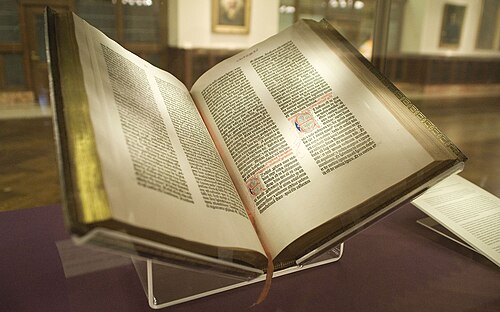
Around 1454–55 his workshop finished printing a Bible in Latin. It was enormous: about 1,280 pages, usually bound in two heavy volumes. Each page has two columns of 42 lines, so people also call it the 42-line Bible. They printed about 180 copies, some on paper and some on smooth animal skin called vellum.
The printed pages look almost like handwriting, because Gutenberg wanted his book to be as beautiful as the best hand-copied books. After printing, artists painted red and blue letters and colourful flowers into the margins by hand, so every copy looks a little different.
About 49 copies survive today, some complete and some in pieces. They are kept in great libraries and museums around the world. The Gutenberg Bible showed that books could be made much faster, and printing soon spread all over Europe.
At a glance
- Printed
- Mainz, c. 1452–1455; finished by 1455 at the latest
- Printers
- Workshop of Johannes Gutenberg, financed by Johann Fust; Peter Schöffer probably worked there
- Text
- The Latin Vulgate Bible, in a version close to the medieval “Paris Bible”
- Format
- Large folio, about 1,280 pages (641–643 leaves), usually bound in two volumes; two columns of 42 lines
- Copies
- About 160–185 printed (roughly 135 on paper, 45 on vellum); about 49 survive, around 21 complete
- Type
- Gothic textura type with about 290 different characters, including ligatures and abbreviations
- Recognition
- Göttingen vellum copy inscribed on UNESCO’s Memory of the World Register (2001)
- Other names
- 42-line Bible (B42), Mazarin Bible
Easy
What is the Gutenberg Bible?
The Gutenberg Bible is an edition of the Latin Bible printed in the German city of Mainz in the mid-1450s. It is the earliest major book printed in Europe with movable metal type, a technique that allowed the same letters to be arranged, printed, taken apart and reused. It was produced in the workshop of Johannes Gutenberg with money lent by the Mainz merchant Johann Fust.
Because each column has 42 lines, bibliographers call it the 42-line Bible, or B42 for short. It is also called the Mazarin Bible, because the first copy to attract scholarly attention, in the eighteenth century, was in the library of Cardinal Mazarin in Paris.
Printing was not invented in Mainz: woodblock printing had been used in China, Korea and Japan for many centuries, and movable type had been made in China from the eleventh century and in metal in Korea by the thirteenth century. What Gutenberg created was a complete system for producing metal type in large quantities and printing with it efficiently, and this system spread rapidly across Europe.
Easy
Who was Johannes Gutenberg?
Johannes Gensfleisch zur Laden zum Gutenberg was born in Mainz around 1400; the exact year is unknown. He came from a patrician family and took his usual name from the family house, the Hof zum Gutenberg. He seems to have been trained in metalworking and may have worked with the city mint.
Because of political conflicts in Mainz, he lived for many years in Strasbourg. Records of a lawsuit there in 1439 show that he had a secret business with partners that involved making polished metal mirrors for pilgrims to Aachen, and that it used a press, lead and “forms”. Many historians think he was already experimenting with printing.
By 1448 he was back in Mainz. There he borrowed money, first from relatives and then, around 1450, 800 guilders from Johann Fust, followed by another 800 guilders a few years later for the Bible project. These debts would later cost him control of his own workshop.
Easy
How was it printed?
The key invention was a way to cast many identical letters quickly. A craftsman first carved a letter in reverse on the end of a hard steel rod, called a punch. The punch was struck into a block of softer copper to make a mould of the letter, called a matrix. The matrix was fitted into an adjustable hand mould, and molten metal was poured in. In a few seconds a small metal letter, or sort, was ready. The metal was an alloy of lead, tin and antimony, which melts easily, cools quickly and is hard enough to survive printing.
Compositors picked the sorts from type cases and arranged them in lines to form a page. The page of type was locked in a frame, inked with an oil-based ink that stuck to metal better than the water-based inks used by scribes, and pressed onto dampened paper or vellum using a screw press, probably adapted from presses used for wine, paper or linen.
To make the pages look like fine handwriting, Gutenberg’s workshop cast about 290 different characters: capitals, small letters, many ligatures (joined letters) and abbreviations, and letters of slightly different widths. This allowed the lines to be perfectly justified, with straight left and right edges, as in the best manuscripts.
The work was huge. Scholars estimate that several presses and perhaps a few dozen workers were busy for two to three years. The first pages were set with 40 lines per column, then 41, then 42, probably to save paper. A few early sheets were printed with red headings in a second pass, but this was soon abandoned and red was added by hand instead.
Easy
Paper and vellum, rubrication and decoration
About 180 copies were printed, most on high-quality paper imported from Italy and about a quarter on vellum (calfskin), which was much more expensive. Each vellum copy required the skins of many calves.
The printed sheets were sold unbound. Buyers then paid local craftsmen to finish them. A rubricator added red and blue initials, chapter headings and page headings; an illuminator could add gold, painted initials and decorated borders; and a binder bound the volumes. As a result, no two copies look alike. Some are richly painted, while the Library of Congress copy, for example, has simpler penwork initials.
A copy in Paris contains a note by the rubricator Heinrich Cremer stating that he finished his work in August 1456. That note is one of the pieces of evidence showing that printing was complete by then.
Intermediate
Why Mainz, and why the 1450s?
Several conditions came together in the Rhineland in the mid-fifteenth century. Paper, once an import from the Islamic world, was now produced in Italy and increasingly north of the Alps, so it was far cheaper than parchment. German towns had skilled goldsmiths, coin-makers and metal-casters who knew how to work precise punches and moulds. Wine and paper presses were familiar machines. And there was a growing market of readers: universities, schools, monasteries, clergy and prosperous townspeople.
The Church also had reasons to want reliable, uniform texts. Reform movements of the period complained that hand-copied liturgical books and Bibles contained many errors and variations. The papal legate Nicholas of Cusa, who travelled through Germany in 1451–52 promoting church reform, called for correct and uniform service books. Some historians suggest that such demands encouraged Gutenberg to choose a Bible as his great project, although there is no direct evidence linking Cusa to the workshop.
Finally, printing was a business. Gutenberg needed large loans to buy metal, paper and vellum and to pay workers long before any copies could be sold. A Bible was a risky but potentially profitable choice: every church and monastery needed one, and the text did not change. Smaller jobs, such as indulgences, calendars and school grammars (the Latin grammar of Donatus was printed many times in Mainz), brought in quicker income while the Bible was in production.
Intermediate
Dating the Bible: a letter from a future pope
The Bible has no printed date or colophon, so its date must be worked out from other evidence. The most important is a letter written in March 1455 by Enea Silvio Piccolomini, the future Pope Pius II, to Cardinal Juan de Carvajal. Piccolomini reported that at the Frankfurt fair in October 1454 he had seen a “marvellous man” displaying quires (gatherings of pages) of a Bible, written so clearly that they could be read without glasses. He added that all the copies were said to have been sold already.
A second key document is the Helmasperger Notarial Instrument of 6 November 1455, a legal record of Fust’s lawsuit against Gutenberg. It shows that Fust demanded repayment of his loans with interest and that the court largely supported him. After the lawsuit Fust took over much of the equipment, and together with Peter Schöffer, a former scribe who had worked with Gutenberg and later married Fust’s daughter, he became a successful printer.
Putting this evidence together, most scholars date the start of work to around 1452 and the completion of printing to 1454 or early 1455. The same workshop printed other items around this time, including letters of indulgence (1454–55) and a small pamphlet calling for a crusade against the Turks after the fall of Constantinople, known as the Türkenkalender.
Intermediate
The text and design
The text is the Latin Vulgate, the translation associated with St Jerome that was the standard Bible of the western Church. Gutenberg’s edition follows the tradition of the thirteenth-century “Paris Bible”, which fixed the order of books and the chapter divisions still used today, and it includes Jerome’s prefaces to the biblical books.
The typeface is a textura, the formal Gothic script used in liturgical manuscripts. Its dense, dark letters with angular strokes gave the page the look of a luxurious handwritten book. The generous margins, two-column layout and careful spacing reflect the aesthetics of the best manuscripts of the time.
The book was intended mainly for churches and monasteries, which needed large, legible Bibles for reading aloud in services and during meals. At about 30 florins for a paper copy, according to one estimate, it was expensive, but cheaper and much quicker to obtain than a comparable manuscript.
Intermediate
The spread of printing
After Gutenberg lost control of the Bible workshop, he seems to have continued printing on a smaller scale. Fust and Schöffer produced the Mainz Psalter in 1457, the first European printed book with a printed date and printers’ names, and famous for its coloured printed initials. A 36-line Bible, printed with an earlier version of Gutenberg’s type, probably in Bamberg, followed around 1458–61.
In 1462 Mainz was sacked during a conflict between rival archbishops, and many printers left the city. They took the new craft to other towns in Germany and then to Italy, France, the Low Countries and beyond. In 1465 the victorious archbishop, Adolf II of Nassau, gave Gutenberg a court title with an annual allowance of cloth, grain and wine. He died in Mainz on 3 February 1468.
By 1500 printing presses were active in more than 250 European towns, and they had produced tens of thousands of editions. Books printed before 1501 are called incunabula, from a Latin word for “cradle”, because they come from the infancy of printing.
Intermediate
Surviving copies
About 49 copies survive in substantial form, though some are incomplete; around 21 are complete. They are held in libraries in Germany, the United States, the United Kingdom, France, Spain, Poland, Russia, Japan and elsewhere. The Morgan Library & Museum in New York holds three, and single copies are held by the Library of Congress, the British Library, the Bibliothèque nationale de France, and Keio University in Tokyo, among others. The Harry Ransom Center at the University of Texas at Austin acquired its complete paper copy in 1978 and keeps it on permanent display.
The vellum copy in the Göttingen State and University Library is special because it is preserved together with two related documents: the Göttingen Model Book, a manual for illuminators that matches the decoration in the copy, and the Helmasperger Notarial Instrument. Together they were inscribed on UNESCO’s Memory of the World Register in 2001. Göttingen has also made its copy freely available online in digital form.
The last complete copy to be sold, in 1978, fetched about 2.4 million US dollars. Individual leaves, separated from damaged copies in the past, occasionally appear on the market; modern librarians regard the breaking up of old books for sale as a loss to scholarship.
Intermediate
East Asian printing and the question of priority
Long before Gutenberg, printing flourished in East Asia. The oldest surviving printed book with a date is the Diamond Sutra of 868, found at Dunhuang in China. The Chinese artisan Bi Sheng made movable type from baked clay in the 1040s, according to the scholar Shen Kuo. In Korea, metal movable type was used during the Goryeo dynasty, and the Jikji, a Buddhist text printed at Heungdeoksa temple in 1377, is the oldest surviving book printed with metal movable type. The massive woodblock Tripitaka Koreana was carved in the thirteenth century.
Whether knowledge of Asian printing reached Gutenberg is unknown. There is no documentary evidence of transmission, and his methods, especially the hand mould, the alloy, oil-based ink and the press, differ from East Asian techniques. Most historians therefore regard European printing as an independent development, while recognising the much earlier Asian achievements. Some writers have argued for indirect transmission along trade routes, but this remains speculative.
One reason movable type had different effects in East Asia and Europe is the writing system. Chinese requires thousands of distinct characters, so woodblocks were often more practical, while an alphabet with a few dozen letters is well suited to reusable type. It is interesting that in Korea, the Hangeul alphabet was created in 1443–46, just as Gutenberg was developing his press.
Advanced
Debate: how revolutionary was printing?
Printing is often called a revolution. The historian Elizabeth Eisenstein, in The Printing Press as an Agent of Change (1979), argued that print transformed European culture by making texts standardised, widely available and permanently preserved. In her view, these changes helped make possible the Renaissance’s recovery of classical texts, the Protestant Reformation and the Scientific Revolution.
Other scholars have criticised this view. Adrian Johns, in The Nature of the Book (1998), argued that early printed books were not automatically reliable or uniform: piracy, errors and local practices were common, and trust in print had to be built by people and institutions over time. Others point out that manuscript copying continued for centuries, and that the effects of printing depended on literacy, religion, trade and politics.
The Gutenberg Bible itself shows both sides of the story. It is a technological breakthrough, yet it was deliberately designed to imitate manuscripts, sold in small numbers to churches, and finished by hand. Its immediate audience was the medieval Church, not a mass reading public. The more dramatic changes came in the following decades, as cheaper books, pamphlets and vernacular texts multiplied.
Advanced
Evidence and methods
Almost everything we know about Gutenberg comes from a small number of legal and financial documents, such as the Strasbourg lawsuit of 1439, loan records, and the Helmasperger Instrument. None of his surviving printed works bears his name. His role is reconstructed by combining these documents with physical study of the books.
Bibliographers compare the surviving copies in detail. Variations in type, the change from 40 to 42 lines, differences between paper and vellum copies, watermarks in the paper, and places where pages were reset reveal how the work was organised and how many compositors and presses were used. Rubricators’ notes and bindings help establish dates and early owners.
New techniques continue to shed light on the question of how the type was made. In 2001 the scholars Paul Needham and Blaise Agüera y Arcas used digital analysis of letterforms in early Mainz printing to argue that the earliest type may not have been cast from a single permanent matrix for each letter, as traditionally assumed, but by a more improvised method. Their conclusions are still debated. Scientific analysis of inks has also shown that Gutenberg’s ink contained metallic components such as copper and lead, which help explain its lasting glossy black appearance.
Key ideas
- Movable metal type
- Individual cast-metal letters that can be arranged, printed and reused.
- Hand mould
- An adjustable mould that allowed a caster to make large numbers of identical letters quickly.
- Imitation of manuscripts
- The Bible’s type, layout and hand decoration were designed to rival the best handwritten books.
- Hand finishing
- Rubrication, illumination and binding were added by hand, so every copy is unique.
- Printing as a system
- Gutenberg combined type-casting, ink, paper and the press into an efficient production system.
- Independent invention
- East Asia had printing and movable type much earlier; European printing appears to have developed separately.
- Print culture
- Historians debate how far printing changed how knowledge was preserved, trusted and spread.
- Dating without a date
- Because the Bible carries no printed date, scholars date it by combining letters, legal records, rubricators’ notes and physical evidence from the surviving copies.
Records
- 1377 — The Jikji is printed with metal movable type in Goryeo, Korea.
- c. 1400 — Johannes Gutenberg is born in Mainz.
- 1439 — A lawsuit in Strasbourg reveals Gutenberg’s secret business involving a press.
- 1448 — Gutenberg is back in Mainz and borrows money.
- c. 1450 — Gutenberg borrows 800 guilders from Johann Fust.
- c. 1452 — Work on the 42-line Bible begins.
- 1454 — Piccolomini sees quires of the Bible at the Frankfurt fair in October.
- 1455 — Piccolomini’s letter (March); Helmasperger Notarial Instrument records Fust’s lawsuit (6 November).
- 1456 — Rubricator Heinrich Cremer finishes decorating a copy now in Paris (August).
- 1457 — Fust and Schöffer print the Mainz Psalter, the first dated printed book in Europe.
- 1468 — Gutenberg dies in Mainz on 3 February.
- 2001 — The Göttingen copy is inscribed on UNESCO’s Memory of the World Register.
Glossary
- Movable type
- Individual letters or characters that can be rearranged to print different texts.
- Punch
- A steel rod with a letter carved in relief on its end, used to make a matrix.
- Matrix
- A copper block with the impression of a letter, used as a mould for casting type.
- Sort
- A single piece of metal type.
- Compositor
- A worker who arranges type into lines and pages.
- Vellum
- Fine parchment made from calfskin, used for luxury books.
- Rubrication
- Adding red (and often blue) headings and initials to a book by hand.
- Illumination
- Painted decoration in a book, often with gold.
- Vulgate
- The Latin translation of the Bible, associated with St Jerome, used in the western Church.
- Incunabula
- Books printed in Europe before 1501.
- Quire
- A group of folded sheets that forms a section of a book.
- Colophon
- A note at the end of a book giving information such as the printer, place and date; the Gutenberg Bible has none, while the Mainz Psalter of 1457 has one.
Questions and answers
Was the Gutenberg Bible the first printed book?
No. Printed books existed much earlier in East Asia, and some small items were printed in Europe before it. It is the first major book printed in Europe with movable metal type.
How many copies are left?
About 49, of which around 21 are complete. The rest are incomplete copies or fragments.
Why does every copy look different?
The coloured initials, decorations and bindings were added by hand after printing, by different artists chosen by each buyer.
What language is it in?
Latin. It prints the Vulgate, the Latin Bible used by the western Church in the Middle Ages.
Did Gutenberg become rich from his invention?
No. He lost much of his workshop to his lender Johann Fust after a lawsuit in 1455, although he later received a pension from the archbishop of Mainz.
Did Gutenberg know about Korean metal type?
There is no evidence that he did. Most historians think European printing developed independently, even though Korea used metal type earlier.
How do we know when it was printed if it has no date?
From Piccolomini’s letter of March 1455, the legal record of Fust’s lawsuit in November 1455, and a rubricator’s note of August 1456 in a Paris copy.
Why is it also called the Mazarin Bible?
Because the copy that first drew scholars’ attention in the eighteenth century belonged to the library of Cardinal Mazarin in Paris.
Sources and further reading
- Gutenberg Bible. Wikipedia
- Johannes Gutenberg. Wikipedia
- Movable type. Wikipedia
- Incunable. Wikipedia
- Memory of the World Register – Europe and North America (entry: 42-line Gutenberg Bible, printed on vellum, and its contemporary documentary background). Wikipedia
- The Gutenberg Bible. Harry Ransom Center, University of Texas at Austin
- The Gutenberg Bible at the Library of Congress: A Resource Guide. Library of Congress
- 구텐베르크 성서. 위키백과 (Korean Wikipedia)
- Elizabeth L. Eisenstein, The Printing Press as an Agent of Change. Cambridge University Press, 1979
- Albert Kapr (translated by Douglas Martin), Johann Gutenberg: The Man and His Invention. Scolar Press, 1996
Related
- Cai LunAn Eastern Han court official traditionally credited with presenting an improved method of making paper in 105 CE.
- Tripitaka KoreanaGoryeo Buddhist canon carved on woodblocks in the thirteenth century.
- HunminjeongeumThe Korean alphabet promulgated by King Sejong in 1446, and the title of the text explaining it.
- Fall of ConstantinopleOttoman capture of Constantinople in 1453, ending the Byzantine Empire.
- Columbus's First VoyageChristopher Columbus's 1492 Atlantic voyage for the Spanish Crown reached islands inhabited by Indigenous peoples.
Written with AI assistance from the published sources listed above, and revised as new research appears.