Start at the top for an easy introduction. Go further down for more detail and scholarship.
- Easy
- Intermediate
- Advanced
For young readers
Imagine sitting on the ground next to a wise teacher, listening closely as they explain the biggest questions anyone can ask: Who am I, really? What happens when we die? What is everything made of? That is what the word “Upanishad” suggests: sitting down near a teacher to learn something special.
The Upanishads come from ancient India, more than 2,500 years ago. At first nobody wrote them down. Students learned them by heart, word by word, and taught them to their own students, generation after generation.
In one famous story, a father named Uddalaka asks his son Shvetaketu to drop some salt into a cup of water and bring it back the next morning. The salt has disappeared! “Taste the water from the top,” says the father. “Salty.” “From the middle.” “Salty.” “From the bottom.” “Salty.” You cannot see the salt, but it is everywhere in the water. In the same way, says the father, there is a hidden essence in everything—and that is what you are too.
In another story, a boy named Nachiketa goes to the house of Death himself and refuses to leave until Death tells him what happens to a person after they die. Death offers him riches and long life instead, but the boy says no—he wants the truth.
The Upanishads teach that deep inside each of us is a true self, called ātman, and that the great reality behind the whole world is called brahman. Many teachers in India came to believe that these two are really one. People have been thinking about these ideas ever since, in India and all over the world.
At a glance
- Date
- Oldest texts c. 7th–6th centuries BCE (give or take a century); later principal Upanishads to around the start of the Common Era
- Place
- Northern India: Kuru-Panchala in the west and Kosala-Videha in the east of the Ganges plain
- Language
- Vedic and early Classical Sanskrit, in prose and verse
- Form
- Dialogues, debates, stories and teachings attached to the four Vedas as their final part (Vedanta)
- Number
- Over 200 texts carry the name; a traditional canon lists 108; about 10–13 “principal” Upanishads are the oldest and most important
- Oldest works
- Brihadaranyaka and Chandogya (prose), followed by Taittiriya, Aitareya and Kaushitaki
- Key ideas
- Ātman (self), brahman (ultimate reality), their relationship, karma, rebirth and liberation (mokṣa)
- Significance
- Foundation of the Vedanta schools and a major source for Hindu philosophy, with worldwide influence
Easy
What are the Upanishads?
The Upanishads are a group of ancient Sanskrit texts from India that explore the nature of the self, the universe and the relationship between them. They form the last layer of the Veda, the oldest body of sacred literature in Hinduism, and for this reason are also called Vedanta, “the end of the Veda”. For many Hindus they are śruti, “what was heard”: revealed knowledge, not the work of ordinary human authors.
The word upaniṣad is formed from upa (“near”), ni (“down”) and sad (“to sit”), and is often explained as “sitting down near” a teacher. In the texts themselves the word also means a hidden connection or secret teaching—an insight into how things are linked that is shared only with qualified students.
More than 200 works are called Upanishads, and some were composed as late as the medieval and early modern periods. This page focuses on the early or “principal” Upanishads, about a dozen texts that are the oldest and on which later philosophers wrote their commentaries.
Easy
What is inside: stories, debates and dialogues
The Upanishads are not a single book with one argument. They are collections of teachings in many forms: stories, debates at royal courts, conversations between husband and wife, father and son, teacher and student, and short poetic verses. Different teachers express different views, and the same text can contain several layers.
The Brihadaranyaka Upanishad (“Great Forest Teaching”) is the longest and probably the oldest. Its central figure is the sage Yajnavalkya. At the court of King Janaka of Videha, who offers a thousand cows with gold on their horns to the wisest brahmin, Yajnavalkya answers challenge after challenge, including hard questions from the woman philosopher Gargi Vachaknavi. In another scene he explains to his wife Maitreyi, who asks whether wealth could make her immortal, that everything is dear for the sake of the self.
The Chandogya Upanishad includes the famous teaching of Uddalaka Aruni to his son Shvetaketu, with examples of salt dissolved in water and the tiny seed of a banyan tree, each ending with the refrain tat tvam asi. It also tells of Satyakama, a boy who does not know who his father is; when he tells the truth about it, his teacher accepts him as a student because honesty shows his worth.
Later verse Upanishads are shorter and more poetic. The Katha Upanishad tells the story of the boy Nachiketa, who questions Yama, the god of death, about what survives death. The Isha Upanishad, only eighteen verses long, teaches how to live in the world while seeing the divine in everything. The Mundaka contains the words satyam eva jayate, “truth alone triumphs”, today the national motto of India.
Easy
The big idea: ātman and brahman
Earlier Vedic religion centred on sacrifice: priests performed complex rituals with fire, chants and offerings to maintain order in the world. The Upanishads turn inward. They ask what lies behind the ritual, behind the world, and behind the person who experiences it.
Their answer uses two key words. Brahman is the ultimate reality, the ground from which everything comes and into which it returns. Ātman is the self: not the body, not even the changing mind, but the innermost witness that sees, hears and knows. Yajnavalkya calls it the “inner controller” and says it cannot be seen because it is the seer.
Many passages suggest that ātman and brahman are ultimately the same. The Brihadaranyaka has “I am brahman” (aham brahmāsmi); the Chandogya has “you are that” (tat tvam asi). Later tradition collected four such “great sayings” (mahāvākyas), one from each Veda. Knowing this truth directly, not just as a belief, was said to free a person from fear, from death, and from the cycle of rebirth.
Intermediate
Historical context: a changing Ganges world
The oldest Upanishads took shape in northern India in the first millennium BCE. Vedic culture, which had developed first in the north-west, was spreading east along the Ganges. New kingdoms such as Kosala and Videha were growing, agriculture was expanding, and towns were beginning to appear. The texts themselves mention the regions of Kuru-Panchala in the west and Kosala-Videha in the east.
Each early Upanishad belongs to a particular Vedic school (śākhā) and is attached to a Brahmana or Aranyaka (“forest book”) of one of the four Vedas. This shows that the Upanishads grew out of priestly traditions of explaining the meaning of ritual. Yet they also record a new questioning of that ritual, and several of their most important teachings are put in the mouths of kings rather than priests: King Pravahana Jaivali teaches the brahmin Uddalaka the doctrine of the five fires, and King Ajatashatru of Kashi instructs a proud brahmin about the self.
The same centuries saw the rise of other movements that questioned Vedic ritual, including the renunciant traditions from which Buddhism and Jainism emerged. The Upanishads, the Buddha and Mahavira all addressed similar questions about karma, rebirth and liberation. This is why the period is often compared with the “Axial Age” in Greece and China, when thinkers such as Thales and Confucius also asked new questions about the world and human life.
Intermediate
Key teachings: karma, rebirth and liberation
Karma and rebirth. The idea that a person’s actions (karma) shape their future existence and that beings are reborn appears in explicit form in the early Upanishads. In the Brihadaranyaka Yajnavalkya says that a person becomes good by good action and bad by bad action. The “five fires” teaching describes a cycle in which the dead pass through smoke, the moon, rain and food to be born again, while those who know the truth take a different path.
Liberation (mokṣa). If the self is reborn again and again, the highest goal is to be freed from this cycle. The Upanishads teach that liberation comes not from rituals or good deeds alone but from knowledge (jñāna): direct realisation of the self. The knower of brahman, says one text, becomes brahman.
Neti neti. Because the self is the subject of all knowing, it cannot be described like an object. Yajnavalkya therefore describes it only by negation: “not this, not this” (neti neti). This way of speaking about ultimate reality influenced later Indian philosophy and has been compared with “negative theology” in other traditions.
States of consciousness and the sacred syllable. The Mandukya Upanishad analyses consciousness into waking, dreaming and deep sleep, and a fourth state (turīya) beyond them, linking these to the parts of the sacred syllable Om. The Taittiriya describes the person as layered in five “sheaths”, from food and breath to mind, understanding and bliss. The Katha compares the self to a rider in a chariot, with the body as the chariot, the intellect as the driver and the senses as horses.
Intermediate
A closer look: Nachiketa and Death
The Katha Upanishad opens with a story that turns a ritual scene into a philosophical quest. A man named Vajashravasa is performing a sacrifice in which he is supposed to give away all his possessions, but he donates only old cows that can no longer give milk. His young son Nachiketa, troubled by this, asks him, “To whom will you give me?” He asks a second and a third time, until his father angrily answers, “I give you to Death!”
Nachiketa goes to the house of Yama, the god of death, and waits three days without food because Yama is away. To make up for this failure of hospitality, Yama offers him three wishes. First, Nachiketa asks that his father be calm and welcome him home. Second, he asks to learn the fire ritual that leads to heaven, which Yama teaches and names after him. Third, he asks the great question: when a person dies, some say he exists and some say he does not—which is true?
Yama tries to avoid the question. He offers Nachiketa sons and grandsons, cattle, gold, long life, kingdoms and beautiful companions instead. The boy refuses them all: these things do not last, and even a long life is short. Yama then praises him for choosing the good (śreyas) over the merely pleasant (preyas), a distinction that runs through later Indian ethics.
Yama’s teaching is that the self is not born and does not die; it is not killed when the body is killed. It is subtler than the subtle and greater than the great, hidden in the heart of every being. It is grasped not by argument or much learning but by one whom it chooses, through a disciplined, calm mind. The image of the chariot, in which the self rides while the intellect holds the reins of the mind and senses, describes this discipline and later influenced yoga. Very similar verses reappear in the Bhagavad Gita, showing how the Upanishads flowed into later Hindu literature.
Intermediate
How the Upanishads were passed down
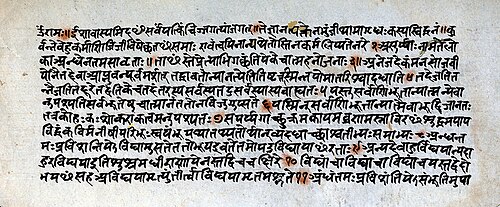
For centuries the Upanishads were transmitted orally within Vedic schools. Students memorised them precisely, using techniques that preserved not only the words but their sound. Writing came much later; the surviving manuscripts, on palm leaf or paper, are mostly from the last few centuries, although the texts themselves are far older.
From the first millennium CE, the Upanishads became the subject of philosophical commentaries. The Brahma Sutras, attributed to Badarayana, systematised their teachings. The philosopher Adi Shankara (traditionally 8th century) wrote influential commentaries on the principal Upanishads, arguing for Advaita (non-dualism): ātman and brahman are identical, and the world of plurality is a kind of appearance. Later teachers such as Ramanuja and Madhva read the same texts differently, as teaching qualified non-dualism or dualism between souls and God.
The Upanishads reached a wider world through translation. In 1657 the Mughal prince Dara Shikoh, who believed the Upanishads were the “hidden book” mentioned in the Qur’an, had about fifty of them translated into Persian as Sirr-i-Akbar (“The Greatest Secret”). The French scholar Abraham Hyacinthe Anquetil-Duperron translated this Persian version into Latin, published as Oupnek’hat in 1801–1802, the first European translation.
Intermediate
Influence and legacy
In India the principal Upanishads, together with the Bhagavad Gita and the Brahma Sutras, form the “three foundations” (prasthānatrayī) of all Vedanta schools. Their ideas run through later Hindu philosophy, devotion and yoga, and they were drawn on in the 19th- and 20th-century Hindu reform movements. Rammohan Roy translated several Upanishads into Bengali and English in the early 19th century, and Swami Vivekananda presented Vedanta to audiences in the West.
In Europe, the German philosopher Arthur Schopenhauer read the Latin Oupnek’hat and famously called it the most rewarding and elevating reading possible in the world. Max Müller’s English translations in the Sacred Books of the East series (from 1879) made the texts widely available. Writers and thinkers from Ralph Waldo Emerson to T. S. Eliot, whose poem The Waste Land ends with words from the Brihadaranyaka and the chant “Shantih shantih shantih”, drew on them.
The Upanishads also stand in dialogue with Buddhism. The Buddha’s teaching of anātman (“no-self”) is often understood as a rejection of an unchanging self like the Upanishadic ātman, and debates between Buddhist and Vedanta philosophers continued for more than a thousand years. Today the Upanishads are read by Hindus as sacred teaching and by people of all backgrounds as some of the world’s earliest works of philosophy.
Advanced
Dating and chronology
Dating the Upanishads is notoriously difficult, since they contain no firm historical references and were transmitted orally. Scholars rely on relative chronology: language, metre, the Vedic school to which a text belongs, the development of ideas, and cross-references between texts.
A widely used framework, associated especially with Patrick Olivelle, places the Brihadaranyaka and Chandogya in roughly the 7th–6th centuries BCE, “give or take a century”, before the Buddha; the other early prose Upanishads (Taittiriya, Aitareya, Kaushitaki) slightly later; the verse Upanishads (Kena, Katha, Isha, Shvetashvatara, Mundaka) in the last centuries BCE; and the Prashna, Maitri and Mandukya around the beginning of the Common Era. The Brihadaranyaka itself is composite, with sections of different ages.
These dates are debated in both directions. Some traditional Indian scholars place the texts much earlier. On the other side, Johannes Bronkhorst has argued that key ideas such as karma and rebirth came from a non-Vedic culture in the eastern Ganges region (“Greater Magadha”) and that the relevant Upanishadic passages may be later than often assumed, perhaps even post-Buddhist. The relative chronology of the Upanishads and early Buddhist texts remains an active question.
Advanced
Interpretive debates
One text or many voices? Classical Vedanta commentators read the Upanishads as a single consistent teaching, disagreeing only about what it is. Modern historical scholarship emphasises diversity: the texts record different teachers, regions and periods, and cosmological, ritual and psychological ideas stand side by side. Reading a passage in its own context, rather than through a later system, often changes its meaning.
Tat tvam asi is a famous example. Traditionally translated “you are that” and read by Advaita as a statement of identity between self and brahman, it has been reinterpreted by Joel Brereton and Patrick Olivelle. They note that the neuter pronoun tat does not agree grammatically with the masculine tvam and argue that in context the phrase means something like “that’s how you are”: Shvetaketu, like everything else, has that subtle essence as his self. The debate shows how philological detail can bear on philosophical interpretation.
Social context has also drawn attention. The Upanishads were composed and transmitted largely within male brahmin circles, yet they include women such as Gargi and Maitreyi as philosophers, kings as teachers of brahmins, and a boy of uncertain birth accepted because of his truthfulness. Scholars debate how far these episodes reflect real social openness and how far they serve the texts’ arguments about the priority of knowledge over birth and ritual.
Advanced
Texts, editions and methods
The Upanishads have no single “original manuscript”. Scholars reconstruct the texts from manuscripts, from the recitation traditions of living Vedic schools, and from the texts cited by commentators such as Shankara. Some Upanishads survive in more than one recension; the Brihadaranyaka, for example, exists in two versions associated with the Kanva and Madhyandina branches of the White Yajurveda.
Nineteenth- and early 20th-century scholars such as Max Müller, Paul Deussen and Robert Ernest Hume produced pioneering translations. Patrick Olivelle’s annotated translation of the early Upanishads (1996) and his edition with the Sanskrit text are now standard references in English. Brian Black and others have explored the narrative and dialogical dimensions of the texts, reading their stories as part of their philosophical method.
Translation itself is interpretation. Words such as ātman (“self”, “soul”, “body” in some contexts), brahman (originally “formulation” or the power of sacred speech, later “ultimate reality”) and upaniṣad (“connection”, “secret teaching”) have shifted in meaning over time. Responsible reading attends to these shifts, to the ritual context from which the texts emerged, and to the living traditions for which they remain sacred.
Key ideas
- Ātman
- The self: the innermost, unchanging witness in each being, distinct from body and changing mind.
- Brahman
- The ultimate reality or ground of all that exists; originally linked with the power of sacred speech.
- Identity of ātman and brahman
- The teaching, expressed in sayings like “I am brahman”, that the true self and ultimate reality are one.
- Karma and rebirth
- Actions shape future existence, and beings are reborn in a cycle; the early Upanishads are among the first texts to state this clearly.
- Mokṣa
- Liberation from the cycle of rebirth, attained through direct knowledge of the self.
- Neti neti
- “Not this, not this”: describing the self only by what it is not, because it cannot be an object of knowledge.
- Inward turn
- The shift from outward ritual to inner knowledge and meditation, which marks the Upanishads within the Vedic tradition.
Records
- c. 1500 BCE — Composition of the Rigveda begins (to c. 1200 BCE), the oldest layer of the Veda.
- c. 900 BCE — Brahmana texts explaining the Vedic ritual are composed (to c. 700 BCE).
- c. 700 BCE — The Brihadaranyaka and Chandogya Upanishads take shape (c. 7th–6th centuries BCE).
- c. 500 BCE — Other early prose Upanishads: Taittiriya, Aitareya, Kaushitaki.
- c. 450 BCE — The Buddha and Mahavira teach in the eastern Ganges plain (their dates are debated).
- c. 300 BCE — Verse Upanishads such as the Katha, Isha, Shvetashvatara and Mundaka are composed (last centuries BCE).
- c. 1 CE — Later principal Upanishads, the Prashna and Mandukya, take shape around the start of the Common Era.
- c. 750 CE — Adi Shankara writes commentaries on the principal Upanishads (traditional dating).
- 1657 — Dara Shikoh completes the Persian translation Sirr-i-Akbar.
- 1801 — Anquetil-Duperron’s Latin Oupnek’hat begins to appear (1801–1802), the first European translation.
- 1879 — Max Müller’s English translation appears in the first volume of the Sacred Books of the East.
- 1996 — Patrick Olivelle publishes his annotated English translation of the early Upanishads.
Glossary
- Veda
- The oldest body of Hindu sacred texts, in four collections: Rig, Sama, Yajur and Atharva.
- Vedanta
- “End of the Veda”: the Upanishads, and the philosophical schools based on them.
- Śruti
- “What was heard”: revealed scripture, including the Vedas and Upanishads.
- Brahmana
- Prose texts explaining the meaning and performance of Vedic rituals.
- Aranyaka
- “Forest books”: Vedic texts on the inner meaning of ritual, often containing Upanishads.
- Mahāvākya
- “Great saying”: short Upanishadic statements such as tat tvam asi, taken to express the core teaching.
- Śākhā
- A Vedic school or branch that preserved and recited a particular version of the texts.
- Advaita
- “Non-duality”: the Vedanta school, associated with Shankara, holding that self and brahman are identical.
- Om
- The sacred syllable, analysed in the Mandukya Upanishad as representing all states of consciousness.
- Anātman
- The Buddhist teaching of “no-self”, often contrasted with the Upanishadic ātman.
Questions and answers
What does “Upanishad” mean?
It is usually explained as “sitting down near” a teacher, and it also means a secret teaching or hidden connection.
Who wrote the Upanishads?
No single author. They record the teachings of many sages, such as Yajnavalkya and Uddalaka, and were shaped over centuries in Vedic schools.
How old are they?
The oldest probably date to around the 7th–6th centuries BCE, though exact dates are uncertain and debated.
What does tat tvam asi mean?
It is traditionally translated “you are that”, meaning your true self is one with ultimate reality; some scholars translate it “that’s how you are”.
Are there women in the Upanishads?
Yes. Gargi challenges Yajnavalkya in debate, and Maitreyi asks him about immortality; both are remembered as seekers of wisdom.
How are the Upanishads related to Buddhism?
They share concerns with karma, rebirth and liberation, but Buddhism rejected an unchanging self; which ideas came first is debated.
How did the West learn about the Upanishads?
Through Dara Shikoh’s Persian translation, rendered into Latin by Anquetil-Duperron in 1801–1802, which Schopenhauer read and admired.
Sources and further reading
- Upanishads. Wikipedia
- Principal Upanishads. Wikipedia
- Brihadaranyaka Upanishad. Wikipedia
- Chandogya Upanishad. Wikipedia
- Brian Black, Upaniṣads. Internet Encyclopedia of Philosophy
- Tat Tvam Asi. Wikipedia
- Ātman (Hinduism). Wikipedia
- Sirr-i-Akbar. Wikipedia
- Patrick Olivelle (trans.), Upaniṣads (Oxford World’s Classics). Oxford University Press, 1996
Related
- RigvedaThe oldest collection of Vedic Sanskrit hymns, handed down orally for centuries before it was written down.
- Siddhartha Gautama (the Buddha)Founder of Buddhism, who taught a path to liberation from suffering on the Ganges plain. His dates are disputed.
- Adi ShankaraIndian philosopher associated with Advaita Vedanta, which teaches the ultimate unity of the self and brahman.
- MahabharataA vast Sanskrit epic centered on a conflict between related royal families, with the Bhagavad Gita among its parts.
- Thales of MiletusCounted by Aristotle as the first Greek philosopher, he looked for a single natural principle behind everything that exists.
Written with AI assistance from the published sources listed above, and revised as new research appears.