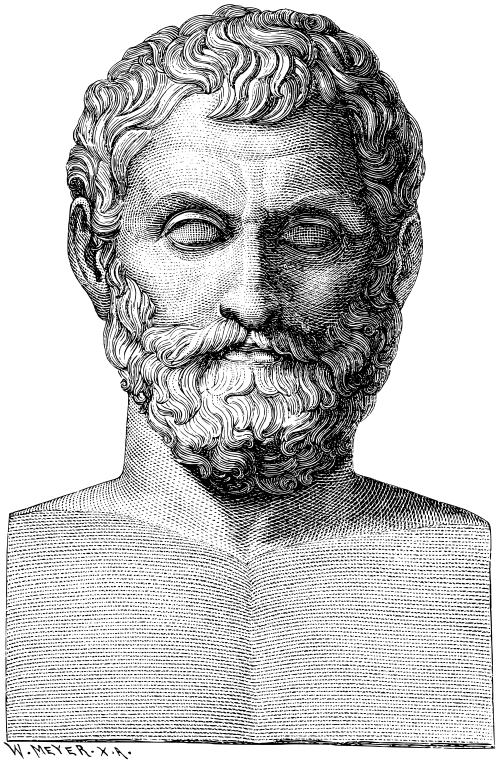
Start at the top for an easy introduction. Go further down for more detail and scholarship.
- Easy
- Intermediate
- Advanced
For young readers
About 2,600 years ago, in a busy port city called Miletus on the coast of what is now Turkey, there lived a man named Thales. Ships came and went from Egypt, from Phoenicia and from all over the Greek world, bringing goods, news and new ideas.
Thales asked a question that sounds simple but is very big: What is everything made of? He looked at the world around him—rain, rivers, the sea, plants that need water to grow—and gave a bold answer: everything comes from water. He was not right, but he was trying to find one natural thing that could explain all the others.
People told amazing stories about him. They said he measured the height of an Egyptian pyramid just by looking at its shadow. They said he could work out how far away a ship was at sea. And they said he predicted a solar eclipse, when the Moon blocks the Sun and day turns dark, so that two armies were so frightened they stopped fighting.
There are funny stories too. One says Thales was so busy looking up at the stars that he fell into a well, and a servant girl laughed at him for trying to understand the sky when he could not even see what was at his feet! Another says he used his knowledge of the weather to guess that there would be lots of olives, rented all the olive presses, and got rich—to show that thinkers could make money if they wanted to.
Thales did not write any books that have survived, so everything we know comes from people who wrote about him later. But because he asked “why?” and looked for answers in nature, the Greek philosopher Aristotle called him the first philosopher, and he is often called the father of science.
At a glance
- Lived
- c. 624/623 – c. 548/545 BCE (ancient chronology; exact dates uncertain)
- Place
- Miletus, a Greek city in Ionia on the west coast of Asia Minor (near modern Balat, Türkiye)
- Known for
- Being named by Aristotle as the founder of natural philosophy; the claim that water is the origin of all things
- Other claims
- The earth floats on water; the magnet has a soul; all things are full of gods
- Science and mathematics
- Traditionally credited with predicting a solar eclipse (585 BCE) and with early geometric theorems
- Writings
- None survive; he may have written nothing. Everything comes from later reports
- Honours
- Counted among the Seven Sages of ancient Greece
- Followers
- Anaximander and Anaximenes, together called the Milesian school
Easy
Who was Thales?
Thales of Miletus is traditionally regarded as the first Greek philosopher and one of the first people anywhere known by name for trying to explain nature through natural causes. He lived in the early 6th century BCE in Miletus, a prosperous Greek city on the coast of Asia Minor.
Aristotle, writing more than two centuries later, called Thales the founder of the kind of philosophy that seeks the basic principles of all things. Thales is said to have claimed that the origin of everything is water. Behind this answer lies a new kind of question: not “which god made the world?” but “what is the world made of, and how does it work?”
Thales was also remembered as a practical genius—an engineer, astronomer, mathematician and political adviser—and he was counted among the Seven Sages, the wise men of early Greece. But he left no writings, and nearly everything about him comes from later authors, so it is often hard to separate the historical Thales from the legend.
Easy
Miletus: a city at a crossroads
Miletus was one of the richest Greek cities of its time. It stood near the mouth of the Maeander River in the region called Ionia, where Greeks had settled along the coast of Asia Minor. Its harbours linked it to the Black Sea, where it founded many colonies, and to Egypt, where Greeks traded at Naucratis.
Next door lay the kingdom of Lydia, whose kings Alyattes and Croesus were powerful and wealthy; Lydia was one of the first places to use coins. Further east were the Medes and, soon, the Persians. To the south and east were the ancient civilisations of Egypt and Mesopotamia, with centuries of astronomical records and practical mathematics.
This mix of trade, travel and contact with older cultures made Miletus a good place for new ideas. Ancient writers say Thales travelled to Egypt, and many scholars think that Babylonian astronomy and Egyptian geometry reached him in some form, although how much he borrowed and how much he invented is debated.
Easy
His life: what the ancient writers say
According to the chronographer Apollodorus, reported by Diogenes Laertius, Thales was born in the first year of the 39th Olympiad (624/623 BCE) and died during the 58th Olympiad (548–545 BCE) at the age of 78, while watching athletic games in the heat. His parents are named as Examyes and Cleobulina. Herodotus says Thales was “of Phoenician descent”, a claim that scholars interpret in different ways.
Herodotus also tells two political stories. Before the Persian conquest of Ionia, Thales advised the Ionian Greeks to form a single council with its seat at Teos, in the centre of Ionia, while the other cities kept their own laws—an early proposal for a federal union. And when King Croesus of Lydia could not get his army across the River Halys, some Greeks said Thales diverted the river into two channels. Herodotus himself doubted this and thought Croesus used bridges.
Two famous anecdotes show how later Greeks imagined him. In Plato’s Theaetetus, Thales falls into a well while looking at the stars, and a witty Thracian servant girl teases him for wanting to know what is in the sky while not seeing what is at his feet. In Aristotle’s Politics, Thales, mocked for being poor, uses his knowledge of the stars to foresee a good olive harvest, rents all the olive presses in Miletus and Chios in winter, and makes a fortune—to show that philosophers could be rich if they chose.
Intermediate
“All is water”: the first natural philosophy
Aristotle, in the first book of his Metaphysics, surveys earlier thinkers who looked for the material principle (archē) from which all things come and into which they return. “Thales, the founder of this type of philosophy,” he writes, “says that it is water.” He also reports that Thales held that the earth rests on water, floating like a piece of wood.
Aristotle admits that he does not know Thales’ reasons and offers guesses of his own: that the nourishment of all things is moist, that heat itself is generated from moisture and kept alive by it, and that the seeds of all things have a moist nature. Modern scholars add other possibilities: water’s ability to exist as solid, liquid and vapour; its role in the flooding Nile and in rain; and the widespread Near Eastern myths of a primeval ocean from which the world emerged.
What was new was not the idea of water as origin—myths in Mesopotamia, Egypt and Greece had similar images—but the way Thales seems to have used it. Instead of a story in which gods create the world by their actions, he offered a single natural substance as an explanation that could be discussed, questioned and improved. His successors did exactly that: Anaximander replaced water with “the boundless” (apeiron), and Anaximenes with air.
Intermediate
Magnets, souls and gods
In his work On the Soul, Aristotle reports two further ideas. First, Thales thought the magnet (the lodestone) has a soul, because it moves iron; later writers add amber, which attracts light objects when rubbed. For Thales, it seems, the soul was what causes movement, and so things that make other things move must be in some sense alive.
Second, Aristotle says that some people think soul is mixed throughout the universe, “which is perhaps why Thales thought all things are full of gods.” This saying suggests that Thales did not simply remove the divine from nature. Rather, he may have seen life and divine power as present within the natural world itself, a view sometimes called hylozoism (“living matter”).
These reports show how careful we must be with the image of Thales as a purely “scientific” thinker. His ideas combined naturalistic explanation with a sense that the world is alive and divine. The break with myth was real, but it was gradual and partial.
Intermediate
The eclipse of 585 BCE
The most famous story about Thales comes from Herodotus. The Lydians and the Medes had been at war for five years. In the sixth year, during a battle, day suddenly turned into night. Thales, says Herodotus, had foretold to the Ionians that this would happen, fixing the year in which it did. Both sides were so alarmed that they stopped fighting and made peace.
Modern astronomers have identified this event with a total solar eclipse visible in Asia Minor on 28 May 585 BCE. If Thales really predicted it, it would be one of the most striking scientific achievements of the ancient world, and the date is often used as a symbolic starting point for Greek philosophy.
But did he? Many historians of astronomy, including Otto Neugebauer and D. R. Dicks, have argued that no method available in the 6th century BCE could have predicted whether a solar eclipse would be visible at a particular place. Babylonian astronomers could predict when eclipses were possible by using cycles such as the 18-year “saros”, which might have let someone say an eclipse was possible in a certain year. Others have suggested that the story grew up after the event, or that it originally referred to a different phenomenon. The question remains open.
Intermediate
Geometry and astronomy
The Neoplatonist philosopher Proclus, writing in the 5th century CE and drawing on a lost History of Geometry by Aristotle’s student Eudemus, credits Thales with bringing geometry from Egypt to Greece and with several discoveries: that a diameter divides a circle into two equal parts; that the base angles of an isosceles triangle are equal; that vertical angles formed by two intersecting lines are equal; and that two triangles are equal if they have one side and the two adjacent angles equal. Eudemus reportedly said Thales must have used this last theorem to find the distance of ships at sea.
Diogenes Laertius, citing the writer Pamphila, says Thales was the first to inscribe a right-angled triangle in a circle, which is why the theorem that an angle inscribed in a semicircle is a right angle is still called “Thales’ theorem” in many countries. Another report says he measured the height of the pyramids by waiting until the time of day when a person’s shadow equals their height, and then measuring the pyramid’s shadow.
In astronomy, he is said to have advised sailors to navigate by the Little Bear (Ursa Minor), as the Phoenicians did, and to have studied the solstices. Some ancient writers attributed a Nautical Star Guide to him, but others already doubted this. Modern scholars are cautious: the reports come many centuries later and ancient writers tended to attach discoveries to famous names. Still, they show that Greeks remembered Thales as the beginning of their mathematical and astronomical tradition.
Intermediate
Why did it start in Ionia?
Historians have long asked why this new way of thinking appeared in Miletus in the 6th century BCE rather than somewhere else. No single answer is accepted, but several factors are often proposed, and they probably worked together.
Contact and comparison. Ionian cities stood on the edge of the Greek world, in daily contact with Lydians, Phoenicians, Egyptians and, through them, Mesopotamia. Travellers who met several different accounts of how the world began might be encouraged to ask which one was true, and to look for explanations that did not depend on the gods of any one people.
No single religious authority. Greek religion had no sacred book and no priestly class that controlled teaching about the origin of the world. Myths existed in many versions, and poets such as Homer and Hesiod were admired but not treated as dogma. This left room for individuals to propose their own accounts.
The city-state. In the Greek polis, laws and decisions were increasingly debated in public. The French historian Jean-Pierre Vernant argued that this political culture of open argument shaped the new philosophy, in which claims had to be defended with reasons before others. Thales’ own reported proposal for an Ionian federal council shows how closely political and theoretical thinking could be linked.
Wealth, writing and money. Trade brought prosperity and leisure; the alphabet made it easier to record and circulate ideas; and the new Lydian and Greek coinage accustomed people to thinking of one abstract measure of value that could be exchanged for everything. Richard Seaford has argued that this experience of money helped make the idea of a single underlying substance thinkable. Such explanations are debated, but together they help us see Thales as part of a particular society, not as a lonely genius.
Intermediate
Influence and legacy
Thales’ most important legacy may be the tradition of critical discussion he started. His fellow Milesians Anaximander, said to be his pupil and kinsman, and Anaximenes took up his question about the origin of things and proposed different answers. Together they are known as the Milesian school. This pattern of one thinker proposing a theory and the next criticising and improving it is often seen as the seed of both philosophy and science.
Later Greek writers treated Thales as the model sage. He appears in lists of the Seven Sages alongside Solon of Athens, Bias of Priene and Pittacus of Mytilene, and famous maxims such as “Know thyself” were sometimes attributed to him, though also to others. Plato used the well story to reflect on the philosopher’s place in society, and Aristotle placed him at the start of the history of philosophy, an arrangement that historians have followed ever since.
In modern times, Thales often appears as the “father of science” or the starting point of Western philosophy. His name lives on in Thales’ theorem, taught in schools worldwide. Historians today also emphasise that the Greek beginning was part of a wider story: in the same centuries, the authors of the Upanishads in India and thinkers such as Confucius in China were also asking new questions about the world and human life.
Advanced
How do we know? The problem of the sources
No text by Thales survives, and it is unclear whether he wrote anything at all. Our evidence is entirely indirect and falls into layers. The earliest are brief mentions in Herodotus (5th century BCE) and in Plato. The most important philosophical testimony comes from Aristotle in the 4th century BCE, who himself had no writings of Thales and often signals uncertainty with words like “they say” and “perhaps”.
Aristotle’s student Theophrastus compiled a history of the opinions of earlier natural philosophers, which, though lost, became the basis of the later doxographical tradition (collections of philosophers’ views). Much later sources—Diogenes Laertius (probably 3rd century CE), Proclus (5th century CE) and others—preserve anecdotes, dates and attributions of varying reliability.
Modern scholarship organises this material using Hermann Diels’s collections, especially Die Fragmente der Vorsokratiker (1903), later revised by Walther Kranz; Thales is chapter 11 in the standard Diels–Kranz numbering. Because the evidence comes through Aristotle’s own framework of “material causes”, many scholars warn that the idea of Thales as the first thinker to seek an archē may partly be Aristotle’s reconstruction rather than Thales’ own terms.
Advanced
Debates: first philosopher, sage or engineer?
Was Thales really the first philosopher? In the 19th and early 20th centuries, historians such as John Burnet stressed the novelty of the Milesians and saw in them the birth of rational science. Others, such as F. M. Cornford, argued that early Greek philosophy developed out of religious and mythical ideas and remained deeply continuous with them. Today most scholars take a middle view: Thales’ approach was genuinely new in its search for natural explanations open to debate, yet it drew on older cosmological images.
How important were Near Eastern influences? Parallels between Thales’ water and the primeval waters of Mesopotamian and Egyptian cosmogonies, and the reports of his Egyptian travels and Babylonian astronomical knowledge, have led some scholars to see him as a transmitter of older wisdom. Others stress that the Greek novelty lay less in content than in method and social setting: ideas were argued for in public in a competitive culture of city-states.
Some historians also question the category of “philosopher” itself. In the ancient reports, Thales is as much an engineer, statesman and practical sage as a theorist. Seeing him in this broader way helps explain why later Greeks told so many stories about him, and reminds us that early Greek thought was bound up with navigation, trade, politics and the calendar, not separated from everyday life.
Key ideas
- Archē
- The origin or first principle of all things; Aristotle says Thales identified it with water.
- Natural explanation
- Explaining events by causes within nature rather than by the actions of gods; Thales is remembered as its pioneer.
- Monism
- The view that all things come from one basic substance, as in the Milesian theories of water, the boundless and air.
- Hylozoism
- The idea that matter is alive or ensouled, suggested by Thales’ claims about the magnet and “all things are full of gods”.
- Critical tradition
- The practice of successors questioning and improving earlier theories, begun among the Milesians.
- Deductive geometry
- Proving general truths about shapes; Greek tradition credited Thales with the first theorems.
- Sage tradition
- The Greek image of the wise man, practical and political as well as theoretical, exemplified by the Seven Sages.
Records
- c. 624 BCE — Thales is born in Miletus, according to the chronology of Apollodorus (Olympiad 39.1).
- c. 610 BCE — Birth of Anaximander, later said to be Thales’ pupil and successor.
- 585 BCE — A total solar eclipse (28 May) halts a battle between Lydians and Medes; Herodotus says Thales foretold it.
- c. 547 BCE — Croesus of Lydia is defeated by Cyrus of Persia; Ionia soon comes under Persian rule.
- c. 546 BCE — Thales dies at about 78, according to Diogenes Laertius (Olympiad 58).
- 494 BCE — Miletus is captured and sacked by the Persians after the Ionian Revolt.
- c. 340 BCE — Aristotle, in the Metaphysics, names Thales the founder of natural philosophy.
- c. 220 CE — Diogenes Laertius compiles his Lives of the Eminent Philosophers, including a life of Thales.
- c. 450 CE — Proclus, drawing on Eudemus, lists Thales’ geometrical discoveries in his commentary on Euclid.
- 1903 — Hermann Diels publishes Die Fragmente der Vorsokratiker, the standard collection of Presocratic evidence.
Glossary
- Ionia
- The central west coast of Asia Minor and nearby islands, home to Greek cities such as Miletus and Ephesus.
- Presocratics
- Greek thinkers before or contemporary with Socrates, from Thales to Democritus.
- Milesian school
- Thales, Anaximander and Anaximenes, the three early natural philosophers of Miletus.
- Seven Sages
- A traditional group of wise men of archaic Greece, whose lists always include Thales.
- Doxography
- Ancient collections summarising the opinions of philosophers, often our main source for the Presocratics.
- Testimonium
- A later report about a thinker’s life or views, as opposed to a direct quotation (fragment).
- Saros
- A cycle of about 18 years after which eclipses repeat, known to Babylonian astronomers.
- Lodestone
- A naturally magnetic stone that attracts iron.
- Thales’ theorem
- An angle inscribed in a semicircle is always a right angle.
- Diels–Kranz
- The standard numbering system for Presocratic fragments and testimonies.
Questions and answers
Did Thales really think everything is made of water?
Aristotle says so, though he admits he does not know Thales’ reasons. Thales may have meant that water is the origin of things rather than that everything is literally water now.
Did he really predict an eclipse?
Herodotus says he did, but many historians of astronomy doubt that anyone in his time could predict a solar eclipse for a particular place. It remains debated.
Why is he called the first philosopher?
Because Aristotle named him the founder of natural philosophy: he looked for a natural principle behind all things instead of relying on myth.
Did he fall into a well?
That story comes from Plato and is probably a joke about absent-minded thinkers, not a historical report.
What books did Thales write?
None survive, and he may not have written any. All we know comes from later writers.
How reliable is our evidence about Thales?
It is indirect and late, filtered especially through Aristotle’s framework, so scholars treat each report with caution.
Was Thales influenced by Egypt and Babylon?
Probably in some way, through trade and travel, but how much he borrowed and how much was new is debated.
Sources and further reading
- Patricia O’Grady, Thales of Miletus (c. 620 B.C.E.—c. 546 B.C.E.). Internet Encyclopedia of Philosophy
- Thales of Miletus. Wikipedia
- Presocratic Philosophy. Stanford Encyclopedia of Philosophy
- Eclipse of Thales. Wikipedia
- Thales’s theorem. Wikipedia
- Anaximander. Wikipedia
- Herodotus, Herodotus, The Histories. Perseus Digital Library, Tufts University
- Aristotle, Aristotle, Metaphysics. Perseus Digital Library, Tufts University
- G. S. Kirk, J. E. Raven and M. Schofield, The Presocratic Philosophers (2nd edition). Cambridge University Press, 1983
Related
- AristotlePlato's student and Alexander's tutor. He founded the Lyceum and wrote on logic, ethics, politics and the natural world.
- PlatoStudent of Socrates and founder of the Academy. His dialogues remain a cornerstone of Western philosophy.
- SocratesAthenian philosopher who wrote nothing himself. Known through Plato and Xenophon, he was tried and executed in 399 BCE.
- Early UpanishadsTexts that ask what the self (ātman) is and how it relates to ultimate reality (brahman) — a foundation of later Indian philosophy.
- ConfuciusTeacher from the state of Lu whose sayings, gathered in the Analects, shaped ethics and government across East Asia.
Written with AI assistance from the published sources listed above, and revised as new research appears.