Start at the top for an easy introduction. Go further down for more detail and scholarship.
- Easy
- Intermediate
- Advanced
For young readers
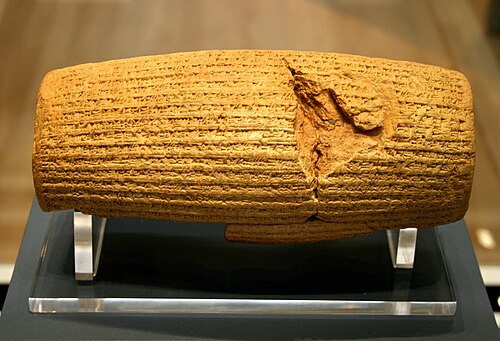
About 2,500 years ago a Persian king called Cyrus conquered the great city of Babylon, in what is now Iraq. Soon afterwards, scribes wrote a message about him on a lump of clay shaped like a small barrel. It is a little longer than a pencil.
The message was written in cuneiform, the old wedge-shaped writing of Mesopotamia, and in the Babylonian language. It says that the last king of Babylon had treated people and gods badly, and that the god Marduk chose Cyrus to put things right.
The cylinder says Cyrus entered Babylon peacefully, fixed temples, let some people who had been moved away go home, and repaired the city wall. Then the clay barrel was buried in the foundations of a building, as a message for the gods and for future kings.
It stayed underground for more than 2,400 years until an archaeologist dug it up in 1879. Today it is in the British Museum in London.
Some people call it “the first charter of human rights”. Historians say that is not really what it is: it is a king’s boastful building inscription. But it is still a very important object for understanding ancient Persia, Babylon and how rulers explained their power.
At a glance
- What
- Baked-clay foundation cylinder with a royal inscription in the name of Cyrus II (“the Great”) of Persia
- Date
- After the Persian conquest of Babylon in October 539 BCE; the British Museum dates it to 539–530 BCE
- Language and script
- Akkadian (Late Babylonian) in cuneiform script; 45 surviving lines, some badly damaged
- Size
- About 22.5 cm long and 10 cm in maximum diameter
- Found
- At Babylon (modern Iraq) in March 1879 by Hormuzd Rassam, excavating for the British Museum
- Location today
- British Museum, London (museum number BM 90920 / 1880,0617.1941); a small fragment belonging to Yale is lent to the museum
- Genre
- Babylonian royal building inscription deposited in a foundation, following a long Mesopotamian tradition
- Modern fame
- Promoted by the last Shah of Iran as the “first charter of human rights”; replica at UN Headquarters since 1971
Easy
What is the Cyrus Cylinder?
The Cyrus Cylinder is a barrel-shaped object of baked clay, about 22.5 centimetres long, covered with lines of cuneiform writing. It was made in Babylon after the Persian king Cyrus II, known as Cyrus the Great, conquered the city in 539 BCE and ended the Neo-Babylonian Empire. The text is written in Akkadian, the language of Babylonia, not in Persian.
The cylinder was a foundation deposit. Mesopotamian kings buried inscribed objects in the foundations of temples, palaces and city walls to record their building work, to honour the gods, and to speak to future kings who might one day repair the building and find the inscription. The Cyrus Cylinder was probably buried in connection with Cyrus’s repairs to Babylon’s city wall, which its final lines describe.
Today the cylinder is one of the most famous objects in the British Museum. It is admired as a key document of the founding of the Persian Empire, used as a symbol of national identity in Iran, and discussed in debates about religious tolerance and human rights, even though its actual text is a traditional Babylonian royal inscription.
Easy
What does the text say?
The beginning of the text is broken, but what survives accuses Nabonidus, the last king of Babylon, of wrongdoing: neglecting the worship of Marduk, the chief god of Babylon, disrupting temple rituals and burdening the people with forced labour. According to the text, the gods abandoned the city, and Marduk searched all the lands for a righteous king.
Marduk chose Cyrus, “king of the city of Anshan”, and ordered him to march to Babylon. The text claims that Cyrus’s army entered the city without a battle and that the people of Babylon welcomed him with joy. Halfway through, the text switches to Cyrus speaking in the first person: “I am Cyrus, king of the universe, the great king, the mighty king, king of Babylon, king of Sumer and Akkad, king of the four quarters.”
Cyrus then lists his good deeds. He says he brought peace to Babylon, relieved its inhabitants of their burdens, and returned the statues of gods that Nabonidus had brought into Babylon to their home cities in Mesopotamia and the lands to the east, together with the people who had lived there. He asks the gods to pray for him and his son Cambyses. The final lines describe his repairs to the city wall of Babylon, where he found an inscription of the earlier Assyrian king Ashurbanipal.
Scholars usually divide the text into six parts: an introduction condemning Nabonidus and describing Marduk’s search for a new king (lines 1–19); Cyrus’s titles, ancestry and peaceful entry into Babylon (20–22); his restoration of Babylon (22–34); a prayer to Marduk for Cyrus and Cambyses (34–35); a statement that the people live in peace and offerings to the gods have increased (36–37); and the account of building work on the city wall (38–45). The first and last lines are badly damaged, so parts of the text are reconstructed.
Easy
The object itself
The cylinder was made in several stages around a cone-shaped core of clay containing large grey stones. Extra layers of clay gave it its barrel shape, and a fine clay surface was added for the writing. The surviving inscription has 45 lines of small, neat cuneiform, running around the curved surface.
It was broken in antiquity and survives as two main pieces. The large fragment, known as A, was excavated in 1879. A smaller fragment, known as B, measuring about 8.6 by 5.6 centimetres, was bought from a dealer and published by J. B. Nies of Yale University in 1920, but it was not recognised as part of the Cyrus Cylinder until 1970. Yale lent the fragment to the British Museum, and the two parts were joined in 1972. The main fragment had already been restored in 1961.
Foundation cylinders like this one were not meant to be seen after burial. Yet the text was probably also copied and publicised. In 2010 the British Museum identified two fragments of a clay tablet, from a site near Babylon, inscribed with the same text, which suggests that copies circulated beyond the buried original.
Intermediate
Historical background: Cyrus and the fall of Babylon
Cyrus II came from the royal house of Anshan in south-western Iran, in the region of Persis (modern Fars). In the 550s and 540s BCE he defeated the Median king Astyages, conquered the kingdom of Lydia in western Anatolia with its capital Sardis, and extended his power over much of Iran and Central Asia. This created the Achaemenid Persian Empire, the largest state the world had seen up to that time.
Babylon was the capital of the Neo-Babylonian Empire, which had risen under Nebuchadnezzar II. Its last king, Nabonidus (reigned 556–539 BCE), was an unusual ruler: he promoted the worship of the moon god Sin, spent about ten years at the oasis of Tayma in Arabia while his son Belshazzar governed in Babylon, and so the important New Year festival of Marduk could not be celebrated in the normal way. These choices angered parts of Babylon’s priestly elite.
In 539 BCE Cyrus invaded Babylonia. According to the Nabonidus Chronicle, a Babylonian record written in cuneiform, his army defeated the Babylonians at the Battle of Opis on the Tigris and then took Sippar. Babylon itself was taken in October 539 BCE, apparently without a major fight, and Cyrus entered the city about two and a half weeks later. Nabonidus was captured.
Cyrus kept Babylon’s institutions largely in place and presented himself as a legitimate Babylonian king. His son Cambyses took part in the New Year ceremonies. The Cylinder is part of this effort to show continuity with Babylonian tradition.
Intermediate
A Babylonian royal inscription, not a Persian manifesto
Specialists agree that the Cyrus Cylinder belongs to a long Mesopotamian tradition of royal inscriptions. Since the third millennium BCE, kings had begun their reigns by claiming to restore order, protect the weak and rebuild temples. Conquerors of Babylon in particular, such as the Assyrian king Sargon II and the Chaldean Marduk-apla-iddina II, had used the same themes: the previous ruler offended the gods; the gods chose the new king; he restored temples, cults and the city.
The Cylinder follows this pattern closely, and its language echoes Babylonian literature. Scholars think it was composed by Babylonian scribes and priests of Marduk on behalf of the new king. It praises Cyrus in Mesopotamian terms, with Mesopotamian royal titles, and it never mentions Persian gods such as Ahura Mazda.
The text is also propaganda. It ignores the Battle of Opis, where Cyrus’s army defeated and, according to the Nabonidus Chronicle, killed many Babylonians. It describes Nabonidus in the darkest colours, although other sources show that his long reign was largely stable and that he supported many temples. As the Assyriologist Amélie Kuhrt argued, the Cylinder reflects both the new ruler’s need for legitimacy and the influence of Babylonian elites who shaped how he was presented.
One detail reveals the careful choice of models. When Cyrus describes the old inscription he found in the wall, he names the Assyrian king Ashurbanipal, who had ruled Babylon in the seventh century BCE, rather than any native Babylonian king. Having condemned the last Babylonian ruler, the text seems to look past him to an older imperial predecessor. Some historians see this as an early sign that Achaemenid kings drew on Assyrian models of empire, while presenting themselves in Babylon as protectors of Babylonian gods.
The Cylinder is also unusual among Persian royal texts. Later Achaemenid kings, beginning with Darius I, set up inscriptions in three languages, Old Persian, Elamite and Babylonian, often invoking Ahura Mazda. The Cyrus Cylinder, by contrast, is monolingual and purely Babylonian in its religious language. It shows the empire at its very beginning, adapting to each conquered land’s own traditions of kingship.
Intermediate
The Cylinder and the Bible
The Hebrew Bible remembers Cyrus very positively. The Book of Ezra says that Cyrus issued a decree allowing the Jews exiled to Babylon by Nebuchadnezzar to return to Jerusalem and rebuild their Temple, and the Book of Isaiah calls Cyrus the Lord’s “anointed”. For this reason, when the Cylinder was discovered, many readers saw it as confirmation of the biblical account.
The Cylinder says that Cyrus returned gods and people to their homes. However, the places it names are all in Mesopotamia and the lands to the east of the Tigris, such as Ashur, Susa, Akkad and Der. It does not mention Jews, Judah, Jerusalem or the God of Israel. Most historians therefore think the text does not directly refer to the return of the Jews.
Still, the Cylinder shows the kind of policy that Cyrus wanted to be known for: supporting local cults and allowing displaced communities to return, in order to win loyalty. Many scholars think the biblical decrees reflect something of this Persian policy, even if their exact wording, preserved in Hebrew and Aramaic versions in Ezra, is debated.
Intermediate
Discovery and publication
The Cylinder was discovered in March 1879 by Hormuzd Rassam, an Assyrian-born archaeologist from Mosul who worked for the British Museum. At that time Mesopotamia was part of the Ottoman Empire, and Rassam excavated under a permit (firman) from the Ottoman sultan that allowed him to send finds to London. He found the Cylinder in the ruins of Babylon, but his own accounts of the exact findspot are inconsistent.
The discovery was announced by Sir Henry Rawlinson, one of the decipherers of cuneiform, at the Royal Asiatic Society in November 1879, and he published the first partial translation in 1880. Since then the text has been re-edited several times, especially after the identification of fragment B. The British Museum curator Irving Finkel has published a modern translation and led the study of associated fragments.
The Cylinder has been on display at the British Museum since the early twentieth century and has been lent abroad several times: to Iran in 1971 and again in 2010–11, to Spain in 2006, on a tour of the United States in 2013, to India in 2013–14, and to Yale in 2024.
Intermediate
A modern symbol: Iran, the UN and “human rights”
In the twentieth century the Cylinder became a political symbol. Shah Mohammad Reza Pahlavi, the last monarch of Iran, promoted Cyrus as the founder of Iranian kingship and called the Cylinder the first declaration of human rights. In 1968 he opened the first United Nations International Conference on Human Rights in Tehran with this claim.
In October 1971 Iran held lavish celebrations of 2,500 years of Persian monarchy, with the Cyrus Cylinder as their emblem. The British Museum lent the original for display in Tehran, and the Shah’s sister, Princess Ashraf Pahlavi, presented a replica to UN Secretary-General U Thant. The replica is still displayed at UN Headquarters in New York.
After the 1979 revolution the Islamic Republic at first distanced itself from the monarchy’s symbols, but the Cylinder remained popular among Iranians. When it was lent to the National Museum of Iran in 2010, hundreds of thousands of people came to see it. For many Iranians inside and outside the country it is a cherished sign of an ancient heritage of justice and tolerance.
False “translations” circulate widely on the internet, claiming that the Cylinder abolished slavery, guaranteed freedom of religion or set a minimum wage, sometimes even naming the Zoroastrian god Ahura Mazda. None of this appears on the real Cylinder.
Advanced
Scholarly debates: tolerance, propaganda and authorship
Was Cyrus exceptionally tolerant? An older view, shaped by the Bible and by Greek writers such as Herodotus and Xenophon, saw Cyrus as a uniquely humane conqueror in contrast to the Assyrians and Babylonians. Many historians now argue that his policies were pragmatic. The Persian Empire was vast and diverse; supporting local elites, gods and customs was cheaper and more effective than ruling by force alone. Scholars such as Pierre Briant and Amélie Kuhrt have pointed out that Assyrian kings, too, sometimes returned divine statues and deported people, and that the idea of Cyrus as unique depends heavily on a few sources.
Others stress real differences in tone. Compared with Assyrian inscriptions that boast of massacres and destruction, such as Sennacherib’s account of razing Babylon in 689 BCE, the Cylinder’s language of peaceful entry and restoration is striking. The debate thus concerns not only what Cyrus did, but how to compare royal rhetoric across periods and genres.
The human-rights reading is widely rejected by specialists as anachronistic. The Cylinder contains no concept of individual rights; it speaks of the favour of gods, the proper order of cults and the king’s care for his subjects in traditional terms. At the same time, some scholars and museum curators argue that it is legitimate for modern people to draw inspiration from the Cylinder’s ideals of restoration and coexistence, as long as they distinguish these modern uses from the ancient meaning.
Authorship and audience are also discussed. The Cylinder’s close parallels with the Verse Account of Nabonidus, another hostile Babylonian text, suggest that both came from circles of Babylonian priests supporting the new regime. Whether they drew on Persian propaganda spread before the conquest, as the historian Morton Smith suggested, or were composed afterwards from traditional themes, as others argue, remains open.
Advanced
Evidence, fragments and forgeries
Our understanding of the Cylinder rests on combining it with other sources. The Nabonidus Chronicle provides a terse, year-by-year Babylonian account of the conquest, including the Battle of Opis and the two-week gap between the fall of Babylon and the surrender of the Esagila temple district. The Verse Account of Nabonidus offers a similar hostile portrait of the old king. Nabonidus’s own inscriptions, such as those from Harran, show how he presented himself. Archaeology has so far found little direct evidence of temple rebuilding by Cyrus in Mesopotamia.
The identification in 2010 of tablet fragments with the same text, from the collection acquired in the 1880s from Dailem near Babylon, changed the discussion. It showed that the Cylinder’s text existed in tablet form and was probably copied for archives or circulation. Scholars now see the buried cylinder as one version of a wider proclamation.
The Cylinder has also attracted forgeries. Two inscribed horse bones that surfaced in China in the twentieth century carry cuneiform signs copied from the Cylinder text. After long debate, Irving Finkel and others concluded that they were modern forgeries, copied from an 1884 publication of the text, a conclusion most scholars accept.
Finally, the Cylinder raises questions of ownership and heritage. Iranian commentators have sometimes called for its return to Iran, although it was excavated in present-day Iraq under Ottoman authority and acquired legally under the rules of the time. The British Museum presents it as belonging to the shared history of the Near East, of Mesopotamian kingship and of the Jewish diaspora, as well as of Iran.
Key ideas
- Foundation deposit
- An inscribed object buried in a building’s foundations to commemorate construction and address the gods and future kings.
- Royal legitimacy
- The Cylinder presents Cyrus as a lawful king chosen by Marduk, continuing Babylonian tradition.
- Propaganda
- The text shapes events in Cyrus’s favour, omitting battles and blackening his predecessor Nabonidus.
- Restoration
- The central theme: restoring gods to their temples, people to their homes, and order to Babylon.
- Reception
- The later uses of the Cylinder, from biblical interpretation to Iranian national symbol and UN human-rights rhetoric.
- Anachronism
- Reading modern ideas, such as human rights, into an ancient text where they do not exist.
Records
- 556 BCE — Nabonidus becomes king of Babylon (556 BCE).
- c. 550 BCE — Cyrus defeats the Median king Astyages and begins building his empire.
- c. 547 BCE — Cyrus conquers Lydia and its capital Sardis.
- 539 BCE — Cyrus defeats the Babylonian army at Opis; Babylon falls in October 539 BCE and Cyrus enters the city.
- c. 539 BCE — The Cylinder is inscribed and buried as a foundation deposit in Babylon (539–530 BCE).
- 530 BCE — Death of Cyrus (530 BCE); Cambyses succeeds him.
- 1879 — Hormuzd Rassam discovers the Cylinder at Babylon; Rawlinson announces it in London.
- 1970 — Fragment B at Yale is identified as part of the Cylinder; the pieces are joined in 1972.
- 1971 — The Cylinder is the emblem of Iran’s 2,500-year celebrations; a replica is given to the United Nations.
- 2010 — Tablet fragments with the same text are identified; the Cylinder is lent to the National Museum of Iran.
- 2013 — The Cylinder tours museums in the United States.
Glossary
- Achaemenid Empire
- The Persian empire founded by Cyrus II in the 6th century BCE and ruled by his successors until Alexander the Great.
- Babylon
- A great city on the Euphrates in modern Iraq, capital of the Neo-Babylonian Empire.
- Marduk
- The chief god of Babylon, whose temple was the Esagila.
- Akkadian
- The Semitic language of Babylonia and Assyria, written in cuneiform.
- Cuneiform
- The wedge-shaped script of ancient Mesopotamia, pressed into clay with a reed.
- Nabonidus
- The last king of the Neo-Babylonian Empire (556–539 BCE), deposed by Cyrus.
- Chronicle
- Here, a Babylonian cuneiform record listing events year by year.
- Firman
- A decree issued by the Ottoman sultan, such as a permit for excavation.
Questions and answers
Is the Cyrus Cylinder the first human rights charter?
Not really. It was called that in the 20th century, but historians see it as a traditional Babylonian building inscription praising the king. It says nothing about individual rights.
Why is it written in Babylonian and not in Persian?
It was made in Babylon for a Babylonian audience and for Babylon’s gods, so it followed local traditions and language.
Does the Cylinder mention the Jews?
No. It mentions returning gods and people to cities in Mesopotamia and nearby lands, but not Jerusalem or the Jews. It does show the type of policy that the Bible links to Cyrus.
Why is it in London?
It was excavated in 1879 by an archaeologist working for the British Museum, under a permit from the Ottoman Empire, which then ruled Iraq.
Who actually wrote the text?
Probably Babylonian scribes and priests of Marduk working for Cyrus, because the text uses Babylonian literary themes and royal titles.
How reliable is its account of a peaceful conquest?
Only partly. The Nabonidus Chronicle shows that Cyrus fought a battle at Opis before Babylon fell, and the Cylinder’s picture of the hated Nabonidus is one-sided.
Are the translations on the internet accurate?
Be careful. A widely shared “translation” invents claims about ending slavery and religious freedom. Use translations from museums or scholarly publications instead.
Can I see the Cyrus Cylinder?
Yes. It is usually on display in the British Museum in London, and many museums around the world, including in Iran, show replicas.
Sources and further reading
- The Cyrus Cylinder (museum number 1880,0617.1941). British Museum
- Cyrus Cylinder. Wikipedia
- 키루스 원통 (Cyrus Cylinder). Korean Wikipedia
- Cyrus Cylinder. Livius.org
- Nabonidus Chronicle. Wikipedia
- Cyrus the Great. Wikipedia
- Irving Finkel (ed.), The Cyrus Cylinder: The King of Persia’s Proclamation from Ancient Babylon. I.B. Tauris, 2013
Related
- PersepolisA ceremonial and administrative center of the Achaemenid Empire in southwestern Iran, begun under Darius I.
- CuneiformOne of the world’s earliest writing systems, made by pressing a reed into wet clay; invented in southern Mesopotamia and used for more than 3,000 years to write many languages.
- AvestaThe sacred texts of Zoroastrianism: prayers, hymns and ritual laws in the ancient Avestan language, memorised by priests for centuries before being written down.
- Code of HammurabiA collection of legal judgments issued under Hammurabi, king of Babylon, in the eighteenth century BCE.
- Epic of GilgameshA king's friendship with Enkidu and his search for immortality, assembled from earlier Sumerian poems into a Babylonian epic.
- Rosetta StoneGranodiorite stele fragment inscribed in 196 BC with a priestly decree honouring Ptolemy V in hieroglyphic, Demotic and Greek; the parallel texts became the key to deciphering ancient Egyptian writing.
Written with AI assistance from the published sources listed above, and revised as new research appears.