Start at the top for an easy introduction. Go further down for more detail and scholarship.
- Easy
- Intermediate
- Advanced
For young readers
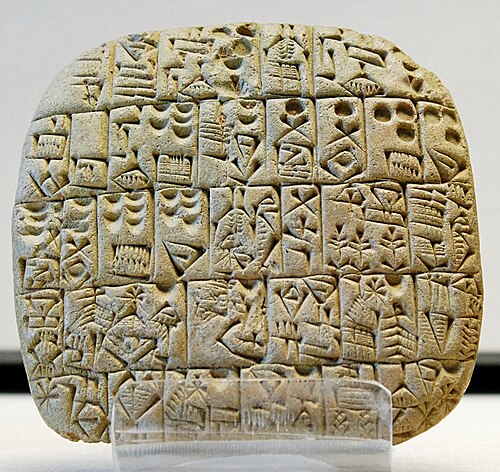
Long, long ago, in the land between two rivers that we now call Iraq, people had no paper and no pencils. But they had lots of mud and clay from the riverbanks. So they flattened a lump of clay into a small tablet and pressed marks into it with a cut piece of reed.
Each press of the reed left a tiny triangle shape, like a wedge or a little nail. That is why we call this writing cuneiform, which means “wedge-shaped” in Latin.
At first, people used the marks to keep track of things: how many sheep, how much barley, how many jars of beer. The first signs looked like little pictures, for example a head, a fish or an ear of grain. Over time, the pictures turned into groups of wedges that stood for words and sounds.
Children who wanted to become scribes went to a “tablet house” and practised for years, copying signs and lists again and again. Some of their homework tablets still survive, complete with mistakes!
People used cuneiform for letters, laws, stories, prayers, maths and star charts. The famous story of Gilgamesh and the laws of King Hammurabi were written in cuneiform. After it was forgotten for almost 2,000 years, clever scholars learned to read it again in the 1800s.
At a glance
- Type
- Logo-syllabic writing system: signs stand for whole words, for syllables, or act as silent classifiers
- Origin
- Southern Mesopotamia, especially the city of Uruk, around 3350–3200 BCE (the proto-cuneiform stage)
- In use
- More than 3,000 years; the latest firmly datable tablet, an astronomical text from Uruk, dates to 79/80 CE
- Languages
- Sumerian, Akkadian (Babylonian and Assyrian), Eblaite, Elamite, Hittite, Hurrian, Luwian, Urartian and others; Old Persian and Ugaritic used cuneiform-style signs in separate scripts
- Materials
- Mostly clay tablets inscribed with a reed stylus; also stone, metal and wax-covered boards
- Number of signs
- About 1,500 in the earliest phase, reduced to roughly 600 in common use later
- Surviving texts
- Estimates range from about half a million to two million excavated tablets; only a fraction are published
- Decipherment
- Old Persian from 1802 (Grotefend); Akkadian in the 1840s–50s, tested publicly in 1857
Easy
What is cuneiform?
Cuneiform is a writing system that was used in the ancient Near East from the late fourth millennium BCE until the first century CE. Its name comes from the Latin word cuneus, “wedge”, because its signs are made of wedge-shaped impressions. Scribes pressed the end of a cut reed into soft clay; each press left a mark with a triangular head and a thin tail.
Cuneiform is, together with Egyptian hieroglyphs, the oldest known writing system in the world. It was first developed to record the Sumerian language of southern Mesopotamia, the land between the Tigris and Euphrates rivers in what is now Iraq. Over three thousand years it was adapted for more than a dozen languages, from Anatolia (modern Turkey) to Iran.
Cuneiform is not an alphabet. A single sign could stand for a whole word (a logogram), for a syllable such as ba or ku, or for a silent “classifier” (a determinative) telling the reader that the next word is, for example, a god, a city or a wooden object. Reading cuneiform means working out from context which of these roles each sign plays.
In its mature form, every sign is built from just a few basic strokes: horizontal, vertical and diagonal wedges, plus a small hook-like mark made with the corner of the stylus. A typical sign has about five to ten wedges, while complicated signs can have twenty or more. Experienced scribes wrote quickly, and their handwriting, like ours, changed from place to place and century to century, which helps scholars date tablets.
Easy
Clay, reeds and how a tablet was made
Mesopotamia had few trees and little stone, but its rivers supplied endless clay and reeds. A scribe kneaded clean clay, shaped it into a tablet that could fit in the palm of a hand or be as large as a book, and smoothed the surface. With a stylus of reed, cut to a sharp edge, he or she pressed the signs into the clay while it was still damp.
Early signs were drawn with a pointed tool. By the middle of the third millennium BCE scribes used a stylus with a wedge-shaped tip that was pushed rather than dragged, producing the typical wedges. By turning the stylus, a writer could make horizontal, vertical and diagonal wedges and a small corner-shaped mark, and combine them into signs.
Most tablets were simply left to dry in the sun. Dried clay can be softened and reused, and many everyday tablets were thrown away. Paradoxically, disasters helped preservation: when palaces and libraries burned, their tablets were baked hard in the fire and survived for thousands of years. Important documents were sometimes fired deliberately, and letters and contracts could be sealed inside clay envelopes to prevent tampering.
Cuneiform was also carved on stone monuments, such as royal inscriptions and law steles, cast in metal, and written on hinged boards coated with wax, which could be erased and reused but rarely survive.
Easy
How writing was invented
Cuneiform began with bookkeeping. In the fourth millennium BCE the cities of southern Mesopotamia, above all Uruk, grew into large communities organised around temples and administrative institutions. These institutions collected, stored and distributed huge quantities of barley, animals, textiles and beer, and they needed ways to keep track of who owed and received what.
For thousands of years before this, people across the Near East had used small clay tokens of different shapes as counters. By the mid-fourth millennium tokens were sometimes sealed inside hollow clay balls (bullae), with their shapes pressed on the outside. Then came flat clay tablets impressed with number signs, and finally tablets combining numbers with picture-like signs for goods, people and institutions.
The first real texts come from the Uruk IV period, around 3350–3200 BCE. About 5,000 such proto-cuneiform tablets are known, most of them from Uruk. The great majority are administrative records; most of the rest are lists of signs and words arranged by theme, which scribes used for training. These early texts record numbers and nouns but hardly any grammar, so scholars still debate which language, if any, lay behind them, though Sumerian is usually assumed.
Intermediate
From pictures to sounds
In its earliest form the script had perhaps 1,500 signs, many of them simplified drawings. Over the third millennium the signs became more abstract, and for reasons still unclear they were turned 90 degrees on their side, so that lines of writing ran horizontally from left to right. By the second millennium the original pictures were no longer recognisable.
The key step towards writing language, not just lists, was the rebus principle: using a sign for its sound rather than its meaning. The Sumerian word for “arrow”, ti, sounded like the word for “life”, til, so the arrow sign could be used to write “life”, and then for the syllable ti in any word. Around 2800–2600 BCE scribes began to write personal names, grammatical endings and eventually full sentences in this way.
At the same time new signs were created by combining old ones. The sign for “mouth” with the sign for “water” inside it meant “to drink”. Scribes also added phonetic complements, extra syllable signs that hinted at the pronunciation, and determinatives such as the star-shaped sign for “god” placed before divine names. The result was a flexible but complex system with around 600 signs in regular use, many of which had several possible readings.
Intermediate
One script, many languages
Cuneiform outlived the Sumerian language it was created for. From the twenty-fourth century BCE, under the Akkadian Empire of Sargon, scribes adapted it to Akkadian, a Semitic language completely different in structure from Sumerian. Akkadian, in its Babylonian and Assyrian dialects, became the main language of cuneiform and, for several centuries, an international language of diplomacy. In the fourteenth century BCE, rulers of Egypt, Babylonia, Assyria, Mitanni, the Hittites and the cities of the Levant corresponded in Akkadian cuneiform, as the Amarna letters found in Egypt show.
Sumerian stopped being spoken, probably by the early second millennium BCE, but it survived for two thousand years as a language of religion and scholarship, rather like Latin in medieval Europe. Scribes produced bilingual Sumerian–Akkadian texts and word lists that later helped modern scholars understand Sumerian.
Other peoples borrowed the script for their own languages: the Elamites of south-western Iran, the Hittites and Luwians of Anatolia, the Hurrians of northern Mesopotamia and Syria, and the Urartians around Lake Van. At Ugarit on the Syrian coast, scribes invented an alphabet of 30 cuneiform-style signs, and the Achaemenid Persian kings created a separate semi-alphabetic cuneiform for Old Persian.
In the first millennium BCE Aramaic, written in a much simpler alphabet on parchment and papyrus, gradually replaced Akkadian as the everyday language of the Near East. Cuneiform retreated into temples, where priests and scholars used it for rituals, omens and astronomy. The last known datable cuneiform tablet, an astronomical almanac from Uruk, was written in 79/80 CE.
Intermediate
What people wrote: from receipts to epics
Most cuneiform texts are ordinary documents: receipts, ration lists, loans, sales, marriage contracts, adoptions, court cases and letters. Private archives, such as those of Assyrian merchants trading with Anatolia in the early second millennium BCE, let historians follow families and businesses in extraordinary detail.
Cuneiform also preserved the world’s earliest literature. It includes Sumerian hymns attributed to the priestess Enheduanna, proverbs and wisdom texts like the Instructions of Shuruppak, laments for destroyed cities, and epics such as the stories of Gilgamesh. Law collections, most famously the Code of Hammurabi of about 1750 BCE, were written on tablets and monumental steles.
Scholars wrote in cuneiform about mathematics, medicine, divination and astronomy. Babylonian mathematicians used a place-value system based on 60, which survives in our 60 minutes and 360 degrees. Late Babylonian astronomers kept observational diaries for centuries and developed mathematical methods for predicting the movements of the moon and planets.
Scribes trained in schools, called in Sumerian the é-dub-ba-a, “tablet house”. Students copied sign lists, vocabulary, model contracts and literary texts. Thousands of these exercise tablets survive, some with a teacher’s model on one side and a student’s wobbly copy on the other.
Intermediate
Forgotten and rediscovered
After the first century CE no one could read cuneiform. European travellers began copying inscriptions from the ruins of Persepolis in Iran in the seventeenth century, and in 1778 the Danish traveller Carsten Niebuhr published accurate copies. He recognised that the inscriptions contained three different kinds of cuneiform script.
The simplest of the three was Old Persian. In 1802 the German schoolteacher Georg Friedrich Grotefend correctly guessed that certain repeated groups meant “king” and the names of Persian kings, and several scholars built on his work. The great breakthrough came from the trilingual Behistun inscription of Darius I in western Iran, carved on a cliff in Old Persian, Elamite and Babylonian. The British officer Henry Rawlinson copied it in the 1830s and 1840s at considerable risk, and he and the Irish clergyman Edward Hincks used it to decipher Akkadian.
In 1857 the Royal Asiatic Society in London tested the decipherment. Four scholars, Rawlinson, Hincks, Julius Oppert and William Henry Fox Talbot, were each sent a copy of a newly found inscription of the Assyrian king Tiglath-Pileser I and translated it independently. Their versions agreed closely, convincing the public that cuneiform could be read. Sumerian, a language unrelated to any living language, was recognised and deciphered later in the nineteenth century.
Excavations at Nineveh, Nimrud and other Assyrian cities in the mid-nineteenth century uncovered vast collections of tablets, including the library of the Assyrian king Ashurbanipal. In 1872 George Smith of the British Museum identified among them a flood story resembling the account of Noah, which caused a sensation and made cuneiform famous.
Intermediate
Cuneiform studies today
The study of cuneiform is called Assyriology, because the first large finds came from Assyria. Tablets are held in museums around the world; the British Museum has the largest collection, estimated at about 130,000 tablets, followed by collections in Berlin, Paris, Istanbul, Baghdad, Yale and Philadelphia. Only a few hundred specialists can read them, so many tablets have never been published.
Digital projects are transforming the field. The Cuneiform Digital Library Initiative (CDLI) catalogues and photographs hundreds of thousands of objects, and the Open Richly Annotated Cuneiform Corpus (Oracc) publishes edited, translated and linguistically annotated texts online. Cuneiform signs have been encoded in the Unicode standard, and researchers are experimenting with 3D scanning and machine learning to help read damaged tablets.
Cuneiform heritage has also suffered from war and looting. Sites in Iraq and Syria have been illegally dug during periods of conflict, and many tablets without known findspots have entered the antiquities market. Scholars debate the ethics of studying such unprovenanced tablets, and several have been returned to Iraq in recent years.
Advanced
Debates on the origins of writing
The link between clay tokens and writing is one of the best-known theories in the field. The archaeologist Denise Schmandt-Besserat, building on earlier work, argued that the shapes of Neolithic tokens were the direct ancestors of many proto-cuneiform signs, so that writing evolved from a long tradition of accounting. The connection between tokens, bullae, numerical tablets and the earliest numerical signs is widely accepted. Critics, however, have questioned whether most token shapes correspond to later signs, noting that many tokens come from non-administrative contexts such as graves and that the proto-cuneiform sign repertoire was far larger and more systematic than any token system.
Many specialists therefore describe writing as a rapid, deliberate invention by administrators in Uruk around 3300 BCE, building on existing numerical notations and seal imagery, rather than a slow evolution. Robert Englund and Hans Nissen, who studied the archaic Uruk texts in detail, emphasised the metrological systems: different counting systems were used for different commodities, such as grain, animals and land, which shows that proto-cuneiform was designed as an accounting technology before it became a way of recording language.
A related question is whether writing was invented once and spread, or several times independently. Egyptian hieroglyphs appear at about the same time as or slightly later than proto-cuneiform. Some scholars think the idea of writing passed from Mesopotamia to Egypt, while others stress the very different signs and structure of the two systems and see independent inventions. Chinese writing and Maya script are generally considered separate inventions.
The language of the earliest tablets is also debated. Because proto-cuneiform records little grammar, it is hard to prove that its users spoke Sumerian. Arguments rest on a few possible phonetic spellings and on continuity with later, clearly Sumerian texts. Some scholars have suggested the presence of other languages in early Uruk, but the evidence remains thin.
Advanced
The scholar’s craft: transliteration and uncertainty
Because cuneiform signs are polyvalent, editing a tablet involves many decisions. Assyriologists publish texts in transliteration, a sign-by-sign rendering in Latin letters. Conventions show the scholar’s interpretation: syllabic readings in lower-case italics, logograms in capitals (for example KÙ.BABBAR, Sumerian “silver”, read in Akkadian as kaspum), determinatives as superscripts, and index numbers or accents to distinguish signs with the same sound, such as u, ú and ù. A transliteration thus records both what is on the tablet and how the editor has chosen to read it.
Pronunciation is partly reconstructed. Akkadian is relatively well understood thanks to its Semitic relatives, but Sumerian has no known relatives, and its sounds and grammar are reconstructed from bilingual texts and ancient grammatical lists. Readings of Sumerian names have changed as knowledge improved: the king once read as Ur-Engur is now read Ur-Namma.
Chronology is another challenge. Dates in the third and second millennia BCE depend on king lists, year names and a few astronomical observations, such as the Venus observations of the time of King Ammi-saduqa. Scholars have long debated alternative “high”, “middle” and “low” chronologies that differ by decades or more; the Middle Chronology is used by convention, though recent studies using tree rings and radiocarbon have refined the discussion.
Finally, the surviving record is uneven. Some cities and periods are documented by tens of thousands of tablets, others hardly at all, and archaeological context was often lost in early excavations and looting. Historians must therefore be careful not to mistake the accidents of survival for the realities of ancient life.
Key ideas
- Logo-syllabic writing
- A system that mixes word signs (logograms) with sound signs (syllabograms), as cuneiform does.
- Rebus principle
- Using a sign for its sound rather than its meaning, which let scribes write names, grammar and eventually any word.
- Determinative
- A silent sign that classifies the next word, for example as a god, a city or something made of wood.
- Polyvalence
- One sign can have several readings, both as sounds and as words; readers choose from context.
- Accounting origins
- Writing first served to record goods, people and obligations in the institutions of early Mesopotamian cities.
- Script versus language
- Cuneiform is a writing system, not a language; it was used for Sumerian, Akkadian, Hittite and many other languages.
- Decipherment
- The modern recovery of a forgotten script, achieved for cuneiform with trilingual inscriptions such as Behistun.
Records
- c. 3300 BCE — Proto-cuneiform tablets of the Uruk IV period, the earliest known writing in Mesopotamia.
- c. 2600 BCE — Cuneiform increasingly used to write Sumerian language, including names and early literary texts.
- c. 2334 BCE — Under the Akkadian Empire, cuneiform is adapted to write Akkadian.
- c. 1750 BCE — The Code of Hammurabi is inscribed in Old Babylonian cuneiform.
- c. 1350 BCE — The Amarna letters show Akkadian cuneiform as the language of international diplomacy.
- c. 650 BCE — Ashurbanipal assembles his great library of tablets at Nineveh.
- c. 520 BCE — Darius I carves the trilingual Behistun inscription in Old Persian, Elamite and Babylonian.
- 79 CE — The latest firmly datable cuneiform tablet, an astronomical text from Uruk (79/80 CE).
- 1778 — Carsten Niebuhr publishes accurate copies of the Persepolis inscriptions.
- 1802 — Grotefend makes the first successful steps in reading Old Persian cuneiform.
- 1857 — The Royal Asiatic Society’s test confirms that Akkadian cuneiform can be read.
- 1872 — George Smith identifies a Babylonian flood story on a tablet from Nineveh.
Glossary
- Mesopotamia
- Greek for “between the rivers”: the land of the Tigris and Euphrates, mostly in modern Iraq.
- Stylus
- A writing tool; in cuneiform, a cut reed pressed into clay.
- Tablet
- A flat piece of clay (or other material) used for writing.
- Scribe
- A person trained to read and write, working for temples, palaces or private clients.
- Sumerian
- The language of southern Mesopotamia’s earliest cities; it has no known relatives.
- Akkadian
- A Semitic language of Mesopotamia, with Babylonian and Assyrian dialects; the main language written in cuneiform.
- Transliteration
- Writing each sign of a text in another script, such as Latin letters, to show how it is read.
- Assyriology
- The scholarly study of cuneiform texts and the civilisations that produced them.
- Bulla
- A hollow clay ball that held accounting tokens, used before writing.
Questions and answers
Is cuneiform a language?
No. It is a way of writing. People used it to write many languages, such as Sumerian, Akkadian and Hittite, a bit like the Latin alphabet is used for English, French and Vietnamese.
Why did they write on clay?
Clay was cheap and everywhere in Mesopotamia, and reeds for pens grew along the rivers. Clay tablets also last a very long time, especially if they are baked.
How many signs did people have to learn?
In later periods a scribe needed several hundred signs, around 600 in regular use, and many had more than one reading. It took years of school to learn.
Is cuneiform older than Egyptian hieroglyphs?
The earliest proto-cuneiform tablets are about as old as or slightly older than the first Egyptian hieroglyphs. Scholars debate whether one influenced the other.
How did scholars learn to read it again?
They started with the simpler Old Persian script from Persepolis and then used trilingual inscriptions, especially the Behistun inscription, to decipher Akkadian. A public test in 1857 showed the decipherment worked.
Did writing develop from clay tokens?
Tokens and numerical tablets were important precursors, but many scholars see the first proto-cuneiform tablets of Uruk as a deliberate invention of administrators rather than a simple evolution from tokens.
How many cuneiform tablets are there?
Estimates range from about half a million to two million excavated tablets. Only a small part has been fully published, and new ones are still being found.
Why is dating early cuneiform texts difficult?
Dates rely on king lists, year names and a few astronomical records, and scholars have debated competing chronologies. Tree-ring and radiocarbon studies are now helping to narrow the options.
Sources and further reading
- Cuneiform. Wikipedia
- 쐐기 문자 (Cuneiform). Korean Wikipedia
- Proto-cuneiform. Wikipedia
- Decipherment of cuneiform. Wikipedia
- Behistun Inscription. Wikipedia
- Cuneiform Digital Library Initiative (CDLI). CDLI
- Assyriology. Wikipedia
- C. B. F. Walker, Cuneiform (Reading the Past). British Museum Publications, 1987
- Irving Finkel and Jonathan Taylor, Cuneiform. British Museum Press, 2015
Related
- Epic of GilgameshA king's friendship with Enkidu and his search for immortality, assembled from earlier Sumerian poems into a Babylonian epic.
- Code of HammurabiA collection of legal judgments issued under Hammurabi, king of Babylon, in the eighteenth century BCE.
- EnheduannaHigh priestess of the moon god at Ur and daughter of Sargon of Akkad, often called the earliest author known by name.
- Instructions of ShuruppakOne of the oldest surviving works of literature: a Sumerian father's advice to his son, preserved on clay tablets.
- Cyrus CylinderA clay foundation cylinder inscribed in Babylonian cuneiform after Cyrus the Great conquered Babylon in 539 BCE, presenting him as a just king chosen by the god Marduk.
- PersepolisA ceremonial and administrative center of the Achaemenid Empire in southwestern Iran, begun under Darius I.
Written with AI assistance from the published sources listed above, and revised as new research appears.