Start at the top for an easy introduction. Go further down for more detail and scholarship.
- Easy
- Intermediate
- Advanced
For young readers
Imagine a king who wants everyone to know his side of a story, forever. About 2,500 years ago, King Darius of Persia ordered his workers to carve a huge picture and a long message into a rocky mountain beside a busy road in what is now western Iran. It is so high up that nobody can reach it without climbing gear.
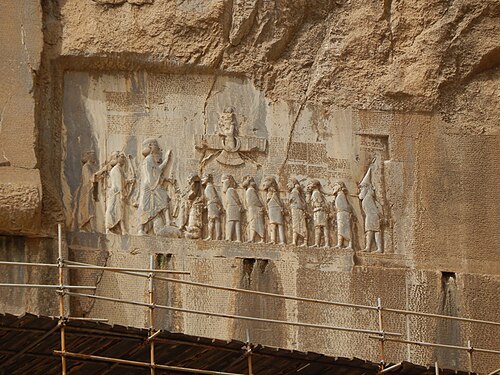
The picture shows Darius standing tall with his foot on a man lying on his back. In front of him stands a row of small prisoners with ropes around their necks. Above them floats a winged figure, usually understood as the god Ahuramazda, whom Darius thanked for his victories.
The message tells how Darius became king. He says a man named Gaumata pretended to be the old king’s brother and stole the throne. Darius says he defeated Gaumata and then the other rebel “kings” who lied about their right to rule—nine “liar kings” in all, counting Gaumata. Not everyone believes Darius told the whole truth. Some historians think he may have been the real liar!
Darius had the same message carved in three different languages, all written with little wedge-shaped marks called cuneiform. For a long time nobody could read these marks. In the 1800s a brave British officer climbed the cliff to copy them, and scholars compared the three versions like a puzzle with three answer keys. This helped them learn to read cuneiform again.
Later people added their own carvings nearby, such as a resting Hercules and Parthian kings. Today the archaeological site of Bisotun is protected as a UNESCO World Heritage Site.
At a glance
- What
- A royal rock relief with a long cuneiform inscription in three languages: Old Persian, Elamite and Babylonian
- Place
- Mount Bisotun, Kermanshah Province, western Iran, beside the ancient road between Babylon and Ecbatana (Hamadan)
- Made by
- Darius I (reigned 522–486 BC), early in his reign
- When
- Begun about 520 BC and enlarged in stages until about 518 BC; the main narrative covers 522–521 BC, and a fifth Old Persian column adds campaigns of the following two years
- Size
- The whole carved area is roughly 15 m high and 25 m wide, high on the cliff: about 60 m above the plain (UNESCO), about 66 m above the springs at the foot (Encyclopaedia Iranica), and up to 100 m above the old road in other accounts
- Texts
- Old Persian: 414 lines in five columns; Elamite: two versions; Babylonian: 112 lines; in all roughly 1,200 lines
- Copies
- Fragments of a Babylonian copy found at Babylon; an Aramaic translation on papyrus from Elephantine in Egypt (about 420 BC)
- Status
- UNESCO World Heritage Site “Bisotun” (2006)
Easy
What is the Behistun inscription?
On a limestone mountain in western Iran, above an old road that joined Mesopotamia to the Iranian plateau, the Persian king Darius I had a scene of victory and a long account of his deeds carved into the rock. Greek writers called the mountain Bagistanon, from which scholars reconstruct the Old Persian place-name *Bagastāna, “place of the gods”. Medieval Arabic and Persian geographers knew it as Behistun, the form Europeans later adopted; the modern Persian name is Bisotun.
The monument has two parts that work together: a relief, a picture cut into the stone so that the figures stand out, and an inscription that surrounds it. The inscription is written in three languages—Old Persian, Elamite and Babylonian—all in cuneiform, the wedge-shaped writing first developed in Mesopotamia. It is the longest of the Achaemenid royal inscriptions and the only one that tells a connected story of events.
Darius chose a spot that could be seen from afar but not easily reached. Ancient workers appear to have cut away the approach below the finished carving, and the difficulty of climbing up probably spared it much deliberate damage over the centuries—though rain and seeping water still wore away parts of the text, and nobody can read it from the foot of the cliff.
In the 19th century the inscription became famous for a second reason: because it repeats one text in three scripts, it helped scholars learn to read cuneiform, and it is often compared to the Rosetta Stone. In 2006 the site of Bisotun, with its many later monuments, was added to UNESCO’s World Heritage List.
Easy
How to read the relief
Start with the largest figure. Darius, shown about life-size, holds a bow, a sign of kingship, and rests his foot on the chest of a man lying on his back. The inscription names this fallen man as Gaumata, the “Magian” whom Darius accuses of stealing the throne. Behind the king stand two Persian nobles carrying his weapons.
In front of Darius stands a line of captives, much smaller than the king, hands tied and necks joined by a rope; size shows importance, an old convention in Near Eastern art. Short labels give each prisoner’s name and his “lie”—one, for example, claimed to be Nebuchadnezzar, son of Nabonidus, king of Babylon. The last figure, in a tall pointed cap, is Skunkha, leader of a Scythian (Saka) people, squeezed into the scene later.
Above everything hovers a winged figure in a ring. Darius repeatedly says he won “by the favour of Ahuramazda”, and the figure is usually identified as that god watching over the scene. The overall composition—a victorious ruler treading on an enemy before a row of prisoners—echoes much older rock reliefs in the same mountains, especially the relief of the Lullubi king Anubanini at Sar-e Pol-e Zahab, about 150 km to the west.
Easy
The story Darius tells
The text begins with Darius introducing himself: his name, his titles, and his family tree, which runs back through his father Hystaspes to an ancestor called Achaemenes. From this ancestor the royal family took the name Achaemenids. He then lists twenty-three lands that, he says, belonged to him when he became king, from Persia and Babylonia to Egypt, the Ionian Greeks, Bactria and Gandhara.
Next comes the story of how he gained power. According to Darius, King Cambyses, son of Cyrus the Great, secretly killed his own brother Bardiya. While Cambyses was away in Egypt, a Magian named Gaumata rose up in 522 BC, claiming to be Bardiya, and many people accepted him. Cambyses died, and nobody dared to challenge the false king—until Darius, with a few companions, killed Gaumata in a fortress in Media and became king. The date he gives corresponds to 29 September 522 BC.
Then the rebellions began. In province after province—Elam, Babylonia, Media, Persia itself, Armenia, Margiana and others—men declared themselves kings. Darius describes defeating them in nineteen battles and insists that it all happened within a single year. He explains the rebellions with one word, drauga, “the Lie”: the rebels lied, and the Lie made the lands rebel. He ends by warning future kings to punish liars, to protect the monument, and to honour the six nobles who helped him.
Intermediate
Nine “liar kings” and a year of war
The relief shows the defeated rivals in the order in which they fell, while the text groups them roughly by region. After Gaumata come Açina in Elam; Nidintu-Bel, who ruled Babylon for some months as “Nebuchadnezzar”; Fravartish, who claimed descent from the old Median kings; Martiya, a second Elamite rebel; Chissantakhma in Sagartia; Vahyazdata, a second “Bardiya”, in Persia; Arakha, an Armenian who again proclaimed himself Nebuchadnezzar in Babylon; and Frada in Margiana, in Central Asia.
Two of these claims are revealing. Two rebels in Babylon called themselves Nebuchadnezzar, son of Nabonidus, borrowing the name of the most famous king of the Neo-Babylonian empire and claiming descent from its last independent ruler, whom Cyrus had overthrown in 539 BC; the memory of independence was clearly still powerful. And two men claimed to be Bardiya, the son of Cyrus, which suggests that loyalty to Cyrus’s family remained a strong political force after his line ended.
Darius’s boast that he won all these battles “in one and the same year” was long doubted. The Assyriologist Rykle Borger argued that, if the killing of Gaumata is left aside, the dated campaigns—from the first victory over the Babylonians on 13 December 522 BC to the defeat of Frada on 28 December 521 BC—do fit within a single year as the Babylonian calendar reckoned it, a year lengthened by an extra (intercalary) month. On this reading the king’s claim is less exaggerated than it seems, although it holds only with that qualification.
The Babylonian and Aramaic versions add details missing from the Old Persian, such as the numbers of enemies killed and captured. Punishments are described bluntly: some rebel leaders were mutilated, displayed at the palace gate and impaled. The inscription was meant to intimidate as well as to inform.
Intermediate
One monument, three languages, several stages
The monument was not planned as a finished trilingual text from the start. Study from scaffolding in the 1960s, especially by Heinz Luschey, followed by work by Leo Trümpelmann, Walther Hinz and Rykle Borger, showed that it grew in stages. Work probably began early in 520 BC, after the last of the rebellions had been crushed. The relief came first, then a short Elamite label beside the king and the main Elamite text to the right of the relief.
Elamite, the language of the old kingdom of Elam in south-western Iran, was the language of record-keeping at the Persian court at this time, so it made sense as the first written version. A Babylonian version followed on a sloping face to the left of the relief, and finally the Old Persian text was carved directly beneath the scene. These Old Persian texts, in Darius’s own language, are the earliest securely dated examples of the Old Persian cuneiform script.
Then events forced changes. After further campaigns in his second and third years—against a new Elamite rebel, Atamaita, and against the Scythians led by Skunkha—Darius had Skunkha’s figure added at the end of the line of prisoners. The new figure cut into the first Elamite text, which had to be abandoned and carved again in a different place. A fifth column describing these later campaigns was added to the Old Persian version only.
As a result the three versions are not identical. The Old Persian, which Darius seems to have treated as definitive, closes its original four columns with a paragraph about writing and copies (paragraph 70) that is missing from the main Elamite and Babylonian texts; an Elamite counterpart was squeezed into a free space above the relief, and the fifth column on the later campaigns follows. The monument was probably completed around 518 BC.
Intermediate
A new script, and copies across the empire
In the added paragraph of the Old Persian text, Darius says, in a free translation: “By the favour of Ahuramazda, this is the form of writing that I made, in Aryan.” He goes on to say that it was set down on clay tablets and on parchment, read aloud before him, and then sent “everywhere into the lands”. Many scholars take this as a claim that Old Persian cuneiform was created on his orders for this very monument.
The script supports this to some extent. Old Persian cuneiform has only about thirty-six signs for sounds, plus a few word-signs and a word divider—far fewer than the hundreds used for Babylonian. Although it looks like cuneiform, it is a new, simplified system. At Bisotun two signs, including the word divider, have slightly different shapes from those in all later Old Persian inscriptions, a hint that this was the script’s first trial. Old Persian was used almost only for royal display inscriptions; everyday government ran in Elamite and, increasingly, Aramaic.
Surviving copies confirm that the text was circulated. At Babylon, fragments of a basalt monument carry part of the Babylonian version, perhaps with a copy of the relief. At Elephantine, a Nile island in southern Egypt where a Jewish military colony served the Persian kings, papyrus fragments preserve an Aramaic translation copied around 420 BC, under Darius II, about a century after the events. The official story was still being copied in a distant garrison.
Intermediate
Unlocking cuneiform: from Persepolis to Behistun
Even in Achaemenid times the Greek court physician Ctesias, later quoted by Diodorus, took the relief for a monument of the legendary queen Semiramis. After the empire fell, the ability to read cuneiform gradually died out, and European travellers who passed from 1598 onwards made their own guesses. Serious decipherment began not here but at Persepolis, whose short royal inscriptions the Danish expedition member Carsten Niebuhr copied and published in 1778. He saw that they used three kinds of cuneiform, the simplest with only a few dozen signs.
The first breakthrough came in 1802 from Georg Friedrich Grotefend, a young schoolteacher in Göttingen. Working only from the Persepolis copies—Behistun had not yet been copied—he assumed that the texts belonged to Achaemenid kings and followed the pattern of much later Sasanian royal inscriptions recently read by Silvestre de Sacy: “X, great king, king of kings, son of Y”. Building on observations by Oluf Tychsen and Friedrich Münter, he noticed that in one text the king’s father was not called king. That fitted Darius, son of the non-royal Hystaspes, and Darius’s son Xerxes. He thus identified the names Darius, Xerxes and Hystaspes and gave approximate values to around ten signs, not all correct. He presented his paper to the Göttingen Academy of Sciences on 4 September 1802; it was not printed then, and his own first published account appeared in 1805.
Rasmus Rask, Eugène Burnouf, Christian Lassen and others then refined the Old Persian alphabet with the help of Avestan and Sanskrit. Meanwhile Henry Rawlinson, a British East India Company officer serving as a military adviser in Persia, began work at Bisotun. He first saw the rock in 1835; in 1836–37 he climbed repeatedly to the ledge and copied the whole Old Persian text, finishing in September 1837. In September 1844 he recopied it and took paper casts (squeezes) of the Elamite, and in 1847 he obtained the badly damaged main Babylonian text, partly by telescope and partly through squeezes made by a hired Kurdish boy who scrambled across the cliff face. He published the Old Persian in 1846–47 and the Babylonian in 1851.
Babylonian was much harder: its script has hundreds of signs, many with more than one value. The Irish clergyman Edward Hincks showed in 1846 that these scripts were partly syllabic and recognised that the language was Semitic. Rawlinson, Hincks, Julius Oppert and others built on each other’s work, helped by new texts excavated at Assyrian sites such as Nineveh. In 1857 the Royal Asiatic Society in London asked Rawlinson, Hincks, Oppert and William Henry Fox Talbot to translate the same newly found inscription of the Assyrian king Tiglath-Pileser I independently; the examiners found the versions close enough to show that the decipherment was real. Akkadian, the language of Babylonia and Assyria, could now be read.
Intermediate
A mountain of many layers: later carvings and conservation
Darius’s relief is only one layer of a long history. Caves nearby were used in the Palaeolithic, and a fortress on the slope may be the Median stronghold where, according to Darius, Gaumata was killed, though this is not certain. In 148 BC, under the Seleucid kings who followed Alexander, a reclining Heracles with a dated Greek inscription was carved by the road. The Parthians added reliefs of Mithridates II and, later, Gotarzes II.
The Sasanian kings left the most ambitious traces: large carved capitals showing a king, probably Khosrow II (r. 590–628), and the goddess Anahita, and a vast smoothed rock face about 200 m wide and 30 m high, apparently prepared for a project never finished. Local tradition and the 12th-century poet Nizami’s romance Khosrow and Shirin linked such works to Farhad, the lovesick sculptor who cut through the mountain for Shirin; the cliff is still called Farhad Tarash, “Farhad’s cutting”.
Later rulers built here too. A Mongol-period building is linked to the Ilkhanid ruler Öljeitü in the early 14th century, and in 1681–85 the governor Shaikh Ali Khan Zangana built a large caravanserai. His endowment inscription of 1684–85 destroyed much of the Parthian relief of Mithridates.
The Darius monument has suffered from rain, seasonal torrents and water seeping through the rock; mineral crusts cover some signs but have also protected others. In the 20th century soldiers on the road below reportedly used the figures for target practice. UNESCO’s published description names water infiltration behind the relief as the main threat and says that emergency measures needed to be turned into a permanent solution; it also records a management plan approved in 2004 and a new one adopted in 2010.
Intermediate
Meanwhile in the world
Darius’s list of lands includes the Yauna, the Ionian Greeks of western Anatolia, under Persian rule since Cyrus’s conquests. Greeks also worked for the empire: in his foundation inscription from Susa, Darius names Ionians and Lydians as the stonecutters. A generation later the Ionian cities revolted (499–493 BC), and Persia’s punitive campaign led to the battle of Marathon in 490 BC. Herodotus of Halicarnassus, writing decades later, gave a version of Darius’s rise so close in places to the Behistun text that some scholars think official accounts reached him, directly or indirectly.
In Egypt, conquered by Cambyses in 525 BC, the official Udjahorresnet had his career inscribed on a statue set up at Sais, probably in Darius’s third year (about 519 BC)—while Bisotun was being carved. He presents himself as a loyal servant who taught the Persian kings to respect Egyptian temples. Read side by side, the two texts show the same years from the centre and from a province: a king proclaiming his legitimacy, and a local elite explaining why it served him.
In Judah, the book of Haggai dates its prophecies to “the second year of Darius the king”—520 BC if, as most scholars think, this is Darius I—when work on rebuilding the Jerusalem Temple resumed; the book of Ezra says the Temple was finished in his sixth year.
Darius was also working in an old Near Eastern tradition of royal propaganda. When Cyrus took Babylon in 539 BC, the Cyrus Cylinder presented him as chosen by the god Marduk to replace an impious king; Darius presented himself as chosen by Ahuramazda to replace a lying impostor. Both drew on Mesopotamian models.
Advanced
Different perspectives
Gaumata or Bardiya? Darius and Herodotus agree on the outline: a secret murder of Cyrus’s younger son, a Magian impostor, and seven conspirators who killed him. Herodotus adds vivid details—an impostor exposed because his ears had been cut off, a debate among the conspirators about the best form of government, Darius winning the throne by a trick with his horse—and only one name in his list of the seven differs from Darius’s. But agreement is not proof, because Herodotus may depend on versions that grew out of Darius’s own propaganda. Babylonian documents confirm only that a king called Barziya (Bardiya) was recognised for some months in 522 BC.
Since A. T. Olmstead in 1938, many historians—among them Muhammad Dandamayev and Pierre Briant—have suspected that Darius killed the real Bardiya and invented “Gaumata” to justify a coup by a distant relative with weak claims. Briant notes that rulers who seize power by force often portray their predecessor as an impostor who destroyed tradition. Others, such as A. Shapur Shahbazi, defend Darius: his chronology has proved accurate, the Babylonian version calls Gaumata a Mede, and no ancient writer accused Darius of usurpation. The evidence cannot settle the question, so Darius’s narrative is best presented as the king’s official claim rather than plain fact.
Who invented Old Persian writing? Darius’s statement and the building stages of the monument, in which all the Old Persian texts are later additions, have convinced many scholars that the script was created under Darius around 520 BC. Others think work had begun under Cyrus, pointing for example to the simple shapes of the signs needed for his name, Kuruš. Short Old Persian texts in Cyrus’s name at Pasargadae and gold tablets in the names of Darius’s ancestors were once taken as proof of earlier use, but most specialists now regard them as later. Even the key word in paragraph 70 is disputed—older translations render it “inscription”, later ones “script”—and new readings are still proposed.
A “Rosetta Stone” for cuneiform? The comparison is useful but simplified. The Old Persian version gave scholars a long, reliable text, and Rawlinson’s copies later underpinned editions of the other versions. But the historian Kevin Cathcart stresses that Rawlinson’s Babylonian text from Bisotun was published only at the end of 1851, after Hincks and others had made key advances using inscriptions from Persepolis, Mesopotamia and Lake Van, and Peter Daniels notes that facsimiles of the Elamite and Babylonian copies appeared only in 1855 and after 1866. Akkadian was deciphered by several rival scholars, and popular accounts that credit Rawlinson alone are one-sided.
Advanced
Evidence and method: reading a damaged royal text
No version is complete; erosion has hit the Babylonian text hardest. Modern editions combine Rawlinson’s copies with later work: photographs by A. V. Williams Jackson (1903), a British Museum expedition under L. W. King and R. C. Thompson (1904), and George G. Cameron’s latex casts (1948), which recovered much of the first Elamite version once thought illegible. Standard editions include Roland Kent’s Old Persian texts (1950, revised 1953), Elizabeth von Voigtlander’s Babylonian edition (1978), Jonas Greenfield and Bezalel Porten’s Aramaic version (1982) and Rüdiger Schmitt’s Old Persian edition (1991). Because older copies contain errors and unread gaps, new work continues: since 2013 Saber Amiri Parian has been making fresh copies for a new edition of the Elamite version, published in parts from 2017.
Comparing the versions is itself a research method. The Babylonian and Aramaic versions resemble each other, sharing figures for enemies killed and captured and forms of names; the Elamite and Old Persian versions form another pair. Some scholars have suggested that the text was first drafted in Aramaic, the empire’s working language, but the evidence is inconclusive. Rüdiger Schmitt infers that the Old Persian was read out to the king and approved by him, which would explain its small omissions and changes.
The text is also literature. It follows Mesopotamian, especially Assyrian, royal annals, yet every paragraph opens with “Says Darius the king”, giving it the rhythm of a spoken proclamation; some formulas, such as “by the favour of Ahuramazda”, have been compared with royal inscriptions of Urartu in eastern Anatolia. Historians must therefore read it on two levels: as evidence for events, checked against Babylonian documents and Greek writers, and as a carefully built argument for one man’s right to rule.
Dating combines internal evidence—regnal years, carving stages visible on the rock, differences in the king’s titles between versions—with the Babylonian calendar. The result is a range, roughly 520 to 518 BC. UNESCO’s description gives 521 BC for the monument’s creation, so reference works do not always agree.
Key ideas
- The Lie (drauga)
- Darius explains every rebellion as the work of the Lie and presents himself as the defender of truth chosen by Ahuramazda.
- Legitimacy through lineage
- The inscription opens with a family tree linking Darius to Achaemenes, to answer doubts about his right to the throne.
- One empire, many languages
- Using Elamite, Babylonian and the new Old Persian script let the king address the old written cultures of his realm in their own terms.
- Publication as power
- Darius had the text copied on tablets and parchment and sent across the empire; copies reached Babylon and Egypt.
- A monument in stages
- The relief and texts were enlarged and altered as new victories were won, which explains differences between the versions.
- Key to cuneiform
- The trilingual text, alongside other inscriptions, helped 19th-century scholars decipher Old Persian, Elamite and Akkadian.
- Layers of memory
- Seleucid, Parthian, Sasanian and later rulers and storytellers added their own carvings, buildings and legends to the mountain.
Records
- 522 BCE — According to Darius, in 522 BC Gaumata, posing as Cyrus’s son Bardiya, rose against Cambyses; after Cambyses died, Darius killed him on 29 September and became king.
- 521 BCE — Darius and his generals defeat the rebel kings; the last, Frada of Margiana, falls on 28 December 521 BC.
- c. 520 BCE — Work on the Bisotun relief begins (about 520 BC); the Elamite text is carved first.
- c. 519 BCE — Babylonian and Old Persian versions are added; after campaigns against Elam and the Scythians, Skunkha’s figure and a fifth Old Persian column are added (c. 519–518 BC).
- c. 420 BCE — An Aramaic translation of the inscription is copied on papyrus at Elephantine in Egypt under Darius II (about 420 BC).
- 148 BCE — A reclining Heracles with a dated Greek inscription is carved at Bisotun under Seleucid rule (148 BC).
- c. 600 CE — Sasanian capitals showing a king, probably Khosrow II, and the goddess Anahita are carved; a vast rock face is prepared for an unfinished project.
- 1802 — On 4 September Grotefend presents his reading of royal names in the Persepolis inscriptions to the Göttingen Academy.
- 1835 — Henry Rawlinson first sees the Bisotun inscription; in 1836–37 he copies the whole Old Persian text.
- 1847 — Rawlinson takes paper casts of the Babylonian version; his Babylonian edition follows in 1851.
- 1857 — The Royal Asiatic Society’s test: four scholars independently translate an inscription of Tiglath-Pileser I, confirming the decipherment of Akkadian.
- 2006 — Bisotun is inscribed on the UNESCO World Heritage List.
Glossary
- Cuneiform
- Writing made of wedge-shaped marks, first developed in Mesopotamia and later adapted for many languages.
- Old Persian
- The language of the Persian royal family, written in a simplified cuneiform script used mainly for royal inscriptions.
- Elamite
- The language of Elam in south-western Iran; it was used for administrative records at the Persian court.
- Babylonian (Akkadian)
- A form of Akkadian, the Semitic language of Babylonia and Assyria, written in complex cuneiform.
- Relief
- A carving in which figures stand out from a flat background.
- Trilingual
- Written in three languages; at Bisotun, the same text appears in three versions.
- Magian (magus)
- A member of a Median group associated with priestly roles; Darius calls Gaumata “the Magian”.
- Squeeze
- An impression of an inscription made by pressing wet paper (or, later, latex) onto the stone.
- Res gestae
- Latin for “things done”: a ruler’s official account of his own achievements.
- Ahuramazda
- The supreme god whom Darius credits with every victory.
Questions and answers
Why did Darius carve the inscription so high up?
Probably so that it could be seen from the road but not easily damaged. Workers appear to have cut away the approach below once the carving was finished.
Can you read it from the ground?
No. The figures can be seen, but the text is far too high and small to read without climbing or using photographs.
Is the story about Gaumata true?
Nobody knows for sure. Darius and Herodotus tell a similar story of an impostor, but many historians suspect Darius killed the real Bardiya and invented the impostor to justify taking power. Others accept Darius’s account.
Did Grotefend decipher the Behistun inscription in 1802?
No. In 1802 he worked on short inscriptions copied at Persepolis and correctly identified the names Darius, Xerxes and Hystaspes. The Behistun texts were copied only from the 1830s, by Rawlinson.
Is it really the “Rosetta Stone” of cuneiform?
It played a similar role, especially for Old Persian and Elamite, but the decipherment of Akkadian also depended on many other inscriptions and on several scholars, notably Edward Hincks.
Did Darius invent Old Persian writing?
He claims to have created a new form of writing, and the monument suggests the Old Persian texts were added last. Some scholars think the script was already being developed under Cyrus, so the question is still debated.
What else is at Bisotun?
A Seleucid Heracles, Parthian reliefs, Sasanian carvings and a huge unfinished rock face, an Ilkhanid building and a Safavid caravanserai, among other remains.
Sources and further reading
- Rüdiger Schmitt, BISOTUN iii. Darius’s Inscriptions. Encyclopaedia Iranica, 2000 (online edition)
- Rüdiger Schmitt, BISOTUN i. Introduction. Encyclopaedia Iranica
- Heinz Luschey, BISOTUN ii. Archeology. Encyclopaedia Iranica
- Bisotun. UNESCO World Heritage Centre
- Jona Lendering, Behistun. Livius.org
- Behistun, Persian Text (adapted from the King/Thompson translation). Livius.org
- Pierre Briant, GAUMĀTA. Encyclopaedia Iranica
- A. Shapur Shahbazi, DARIUS iii. Darius I the Great. Encyclopaedia Iranica
- Rüdiger Schmitt, CUNEIFORM SCRIPT. Encyclopaedia Iranica, 1993
- GROTEFEND, GEORG FRIEDRICH. Encyclopaedia Iranica
- CTESIAS. Encyclopaedia Iranica
- Peter T. Daniels, RAWLINSON, HENRY ii. Contributions to Assyriology and Iranian Studies. Encyclopaedia Iranica
- Arthur John Booth, The Discovery and Decipherment of the Trilingual Cuneiform Inscriptions. Longmans, Green, and Co. (Project Gutenberg edition), 1902
- Kevin J. Cathcart, The Earliest Contributions to the Decipherment of Sumerian and Akkadian. Cuneiform Digital Library Journal 2011:1, 2011
- Kathryn E. Kelley, Bīsitūn Inscription. Cuneiform Digital Library Initiative
- Saber Amiri Parian, A New Edition of the Elamite Version of the Behistun Inscription (I). Cuneiform Digital Library Bulletin 2017:3, 2017
- Herodotus, The Histories, Book 3 (from 3.61), tr. A. D. Godley. Perseus Digital Library, Tufts University
- DSf: Darius’s foundation charter from Susa. Livius.org
- Behistun inscription. Wikipedia
- Decipherment of cuneiform. Wikipedia
- Bardiya. Wikipedia
- Udjahorresnet. Wikipedia
- Ionian Revolt. Wikipedia
- Alan B. Lloyd, The Inscription of Udjahorresnet: A Collaborator’s Testament. Journal of Egyptian Archaeology 68, 1982
- Haggai, chapter 1 (Hebrew–English, JPS 1917 translation). Mechon Mamre
- Ezra, chapter 6 (Hebrew–English, JPS 1917 translation). Mechon Mamre
- Book of Haggai. Wikipedia
- Cyrus Cylinder. Wikipedia
Related
- PersepolisA ceremonial and administrative center of the Achaemenid Empire in southwestern Iran, begun under Darius I.
- Cyrus CylinderA clay foundation cylinder inscribed in Babylonian cuneiform after Cyrus the Great conquered Babylon in 539 BCE, presenting him as a just king chosen by the god Marduk.
- CuneiformOne of the world’s earliest writing systems, made by pressing a reed into wet clay; invented in southern Mesopotamia and used for more than 3,000 years to write many languages.
- Code of HammurabiA collection of legal judgments issued under Hammurabi, king of Babylon, in the eighteenth century BCE.
- Rosetta StoneGranodiorite stele fragment inscribed in 196 BC with a priestly decree honouring Ptolemy V in hieroglyphic, Demotic and Greek; the parallel texts became the key to deciphering ancient Egyptian writing.
- Battle of MarathonA battle in 490 BCE in which an Athenian-led Greek force defeated a Persian expedition at Marathon.
Written with AI assistance from the published sources listed above, and revised as new research appears.