Start at the top for an easy introduction. Go further down for more detail and scholarship.
- Easy
- Intermediate
- Advanced
For young readers
About 400 years ago, a powerful emperor named Shah Jahan ruled a huge empire in South Asia. His favourite wife, Mumtaz Mahal, went with him everywhere, even on long army journeys. In 1631 she died after giving birth to their fourteenth child. The emperor was heartbroken, and he decided to build her the most beautiful tomb in the world.
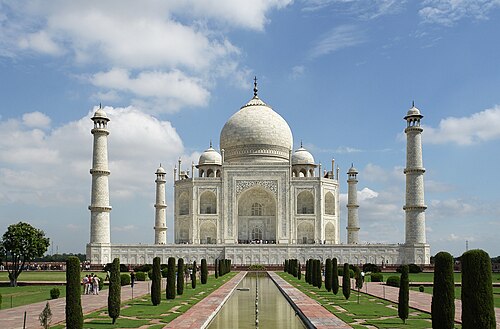
The tomb is made of white marble, a smooth, shiny stone. In the morning it can look pink, at noon bright white, and in the evening golden or orange, because the marble catches the colour of the sky. On top sits a huge round dome shaped a little like an onion, and at the four corners stand four tall, thin towers called minarets.
If you look closely at the walls, you can see flowers made of tiny pieces of coloured stone fitted into the marble like a jigsaw puzzle. There are also beautiful letters in black stone. They are verses from the Qur’an, the holy book of Islam, and some of them talk about paradise.
In front of the tomb is a big garden divided into four parts by long water channels. The garden was meant to remind visitors of the gardens of paradise. Everything is arranged so that the left side matches the right side, like a reflection in a mirror.
More than 20,000 workers, including stone carvers, builders and artists, worked on the Taj Mahal for about twenty years. Today millions of people from all over the world visit it every year, and it is one of the most famous buildings on Earth.
At a glance
- Built
- Begun 1632; mausoleum essentially finished by about 1643–48; whole complex completed about 1653
- Place
- Right (south) bank of the Yamuna River, Agra, Uttar Pradesh, India (then the Mughal Empire)
- Patron
- Shah Jahan (r. 1628–1658), fifth Mughal emperor
- For whom
- Mumtaz Mahal (Arjumand Banu Begum, 1593–1631); Shah Jahan himself was buried beside her in 1666
- Architect
- Usually attributed to Ustad Ahmad Lahauri, working with a large team of designers, calligraphers and craftsmen
- Materials
- Brick core faced with white Makrana marble; red sandstone for the gateway, mosque and other buildings; inlay of semi-precious stones
- Size
- Complex about 17 ha; tomb on a plinth about 95 m square; total height about 73 m
- Status
- UNESCO World Heritage Site since 1983; protected by the Archaeological Survey of India
Easy
What is the Taj Mahal?
The Taj Mahal is a mausoleum, a large and grand tomb, in the city of Agra in northern India. It was built by Shah Jahan, the fifth emperor of the Mughal dynasty, for his wife Mumtaz Mahal, who died in 1631. It is not just one building but a whole walled complex: a forecourt, a monumental gateway, a large garden with water channels, and at the far end, raised on a platform beside the river, the white marble tomb flanked by two red sandstone buildings.
The name “Taj Mahal” is usually explained as a shortened form of Mumtaz Mahal’s title, which means something like “the exalted one of the palace”. Mughal court writers of the seventeenth century, however, did not use the name “Taj Mahal”. They called the building the rauza-i munawwara, “the illumined tomb”, or simply the tomb of the lady. The popular name became common later.
The Taj Mahal is often called a monument to love, and the story of the grieving emperor is an important part of why people are moved by it. But it is also a statement of imperial power, a religious building full of Qur’anic inscriptions, and one of the greatest achievements of Mughal architecture and craftsmanship. It was inscribed on the UNESCO World Heritage List in 1983 as “the jewel of Muslim art in India”.
Easy
How to “read” the complex: from the city gate to the river
The complex is laid out along a single north–south axis and is almost perfectly symmetrical. A visitor coming from the south first entered a bazaar and caravanserai area, then a forecourt (the jilaukhana), where visitors and attendants gathered. From there a huge red sandstone gateway, the Darwaza-i Rauza, leads into the garden. Framed by the arch of the gateway, the white tomb appears suddenly at the far end, like a picture.
The garden is a charbagh, a “fourfold garden”, divided into four quarters by raised walkways and water channels, each quarter divided again. In the Persian and Islamic tradition, this kind of garden recalls the gardens of paradise described in the Qur’an, with their flowing rivers. A long reflecting pool runs down the centre, and in still weather the tomb is mirrored in its water.
Unlike many earlier Mughal tombs, which stand in the middle of their gardens, the Taj Mahal stands at the northern end, on a terrace at the river’s edge. It is flanked by two identical red sandstone buildings: on the west a mosque, facing Mecca, and on the east a matching building usually called the jawab, “the answer”, which exists mainly to keep the symmetry. Across the river lies the Mahtab Bagh, the “Moonlight Garden”, laid out on the same axis, from which the tomb could be seen reflected in an octagonal pool.
The tomb itself stands on a square marble plinth about 95 m on each side, with a minaret at each corner. The minarets lean very slightly outward, possibly so that if one ever fell it would fall away from the tomb. The building is an octagon with cut corners; each face has a great arched opening (iwan), and above rises the double dome, crowned by a gilded finial.
Easy
Inside the tomb: cenotaphs, screens and light
In the central octagonal chamber stand two cenotaphs, empty memorial tombs: Mumtaz Mahal’s in the exact centre and Shah Jahan’s, larger, beside it to the west. The real graves are in a crypt directly below, as was usual in Islamic tombs. Following Muslim custom, the bodies lie with their faces turned toward Mecca.
The cenotaphs are surrounded by an octagonal screen (jali) of marble carved so finely that it looks like lace. Light enters the chamber indirectly through carved marble screens in the upper walls, so the space is soft and dim. The chamber is famous for its echo.
Shah Jahan’s cenotaph is the only thing in the whole complex that breaks the symmetry. It was not part of the original plan: the emperor was placed beside his wife only after his death in 1666. Some people have taken this as a clue that he had intended a separate tomb for himself, but there is no reliable evidence for this.
Intermediate
Decoration: pietra dura, relief carving and calligraphy
Three kinds of decoration cover the Taj Mahal. The first is inlay: flowers, vines and geometric patterns made by cutting shapes out of the marble and fitting in pieces of coloured stone such as carnelian, jasper, lapis lazuli and jade. This technique, known in Italian as pietra dura and in South Asia as parchin kari, was brought to perfection in the Mughal workshops. A single flower may contain dozens of tiny pieces.
The second is relief carving. Around the base of the walls run panels of flowering plants, carved in shallow relief, with tulips, lilies and irises drawn with a naturalism that owes something to European botanical prints that reached the Mughal court. The flowers underline the theme of paradise as a garden.
The third is calligraphy. Verses of the Qur’an in elegant thuluth script, inlaid in black marble, frame the arches of the tomb and the gateway. The calligrapher Amanat Khan, originally from Shiraz, signed his work, which was highly unusual. Because the letters are made larger the higher they are placed, they appear the same size to a person standing below. The inscription on the great gateway includes the verses from Surah 89 addressed to the righteous soul: “O soul at peace, return to your Lord, well pleased and pleasing… enter My paradise.”
Intermediate
How it was built
Mumtaz Mahal died on 17 June 1631 at Burhanpur in the Deccan, where Shah Jahan was on campaign. She was buried temporarily in a garden there, and in December 1631 her body was brought to Agra and placed in a temporary grave on the chosen site. The land, on the riverbank that was lined with the gardens of the Mughal nobility, belonged to Raja Jai Singh of Amber; imperial documents record that he was given other property in the city in exchange.
Work started in 1632. Mughal chroniclers record that the mausoleum was substantially complete by around the twelfth anniversary of Mumtaz’s death in 1643, although decoration continued for some years, and that the whole complex, including the gateway and subsidiary buildings, was finished around 1653. Contemporary and later sources give very different figures for the total cost, ranging from about 5 million to more than 30 million rupees of the time, so the true figure is uncertain.
The walls have a core of brick and rubble faced with marble and sandstone. White marble was brought from Makrana in Rajasthan, more than 300 km away, and red sandstone from quarries near Fatehpur Sikri; the precious stones came from across Asia. A ramp of earth and teams of oxen, elephants and buffalo are said to have moved the heavy blocks, and the foundation near the river rests on wells filled with rubble to cope with the soft ground.
The workforce is traditionally put at around 20,000 people: masons, stonecutters, inlayers, carvers, painters and calligraphers from across the empire and beyond. The design is usually attributed to Ustad Ahmad Lahauri, an architect named as the builder in a later text written by his son, but the Taj was certainly the work of a team supervised by court officials and shaped by the emperor’s own interest in architecture. Stories that Shah Jahan cut off the workers’ hands so they could never build anything as beautiful again have no historical basis.
Intermediate
The Mughal Empire and Shah Jahan’s age
The Mughal dynasty was founded in 1526 when Babur, a Central Asian prince descended from both Timur and Genghis Khan, defeated the Sultan of Delhi. Under his successors, especially Akbar (r. 1556–1605), the empire came to rule most of the Indian subcontinent. Its court culture was Persianate: Persian was the language of government and poetry, while the population was mostly Hindu, with large Muslim, Sikh, Jain and other communities.
Shah Jahan (born Prince Khurram, 1592–1666) came to the throne in 1628. His reign is often seen as the high point of Mughal architecture. Besides the Taj Mahal, he rebuilt parts of the Agra Fort in white marble, commissioned the Peacock Throne, and founded a new capital, Shahjahanabad (Old Delhi), with the Red Fort and the Jama Masjid.
Mughal architecture combined Timurid and Persian traditions (domes on high drums, iwans, charbagh gardens) with Indian building crafts and forms (chhatris, or domed kiosks, bracketed eaves, local stone). The Taj Mahal grew out of earlier Mughal tombs, above all the tomb of Humayun in Delhi (completed around 1570), which already combined a double dome, an octagonal plan and a charbagh setting.
In 1657 Shah Jahan fell ill, and a war of succession broke out among his sons. The victor, Aurangzeb, deposed his father in 1658 and kept him confined in the Agra Fort until his death in 1666. According to tradition, Shah Jahan could see the Taj Mahal across the river bend from his rooms. He was buried beside Mumtaz Mahal.
Intermediate
Love, paradise and power: what does it mean?
For most visitors the Taj Mahal is first of all a monument to love and grief. Court histories do describe Shah Jahan’s mourning: he is said to have withdrawn from public life for a time, given up music and fine clothes, and his beard is said to have turned grey. Poets in many languages, including Rabindranath Tagore, have written about the building as a symbol of love and loss; Tagore’s poem “Shah-Jahan” contains an image often translated as “a teardrop on the cheek of time”.
The building is also deeply religious. Its Qur’anic inscriptions, chosen with care, speak of the Day of Judgement, God’s mercy and the reward of the faithful in paradise. The garden, the water channels and the flowers carved on the walls all evoke the paradise garden. In this sense the complex is a picture of the afterlife that the Qur’an promises to believers, in which Mumtaz Mahal is imagined to rest.
Finally, the Taj Mahal was an expression of Mughal imperial power. Its scale, its costly materials, its perfect symmetry and the huge workforce it required all displayed the wealth and order of Shah Jahan’s rule. Court writers presented the emperor as an ideal ruler and the building as a wonder of the age. The complex also supported an income: the markets and caravanserais around it paid for its upkeep.
Intermediate
Later history: decline, colonial repair and mass tourism
As Mughal power declined in the eighteenth century, the Taj Mahal suffered. Jat forces who occupied Agra in the 1760s are reported to have removed valuable fittings, and the precious metals and some inlaid stones were stripped over time. When the British East India Company took control of Agra in 1803, the tomb was already in need of repair, and in the early nineteenth century British visitors sometimes held picnics and parties in its garden.
In the late nineteenth century the Taj became a symbol of “India” for the British Empire, and a major restoration was carried out under the Viceroy Lord Curzon, completed around 1908. It repaired the structure, but it also changed the garden, replacing dense Mughal planting of trees and flowers with open English-style lawns, which is how most visitors see it today. Stories that an earlier governor-general planned to demolish the Taj and sell its marble have no reliable evidence.
After India’s independence in 1947 the monument has been cared for by the Archaeological Survey of India. It is now one of the most visited sites in the world, with several million visitors a year. During the Second World War and the India–Pakistan wars of 1965 and 1971, it was covered with scaffolding or cloth to hide it from possible air attack.
Intermediate
Conservation: pollution, the river and the crowds
The greatest modern threat to the Taj Mahal has been air pollution. Emissions from industry, vehicles and a nearby oil refinery have yellowed and browned the marble. In 1996 India’s Supreme Court, in a case brought by the lawyer M. C. Mehta, ordered polluting industries in the surrounding Taj Trapezium Zone, an area of about 10,400 square kilometres, to close, switch to cleaner fuel or relocate. Only electric or non-polluting vehicles may approach the complex.
To clean the marble, conservators apply a clay pack (multani mitti, Fuller’s earth) that draws out dirt when it is washed off, a traditional beauty treatment now used on a monument. Insects breeding in the polluted Yamuna have also left green stains on the marble.
The river itself matters to the building. Some engineers have warned that falling groundwater and the drying of the Yamuna could affect the foundations, which were designed for a wet riverbank, although the Archaeological Survey reports that the structure is stable. Managing millions of visitors, with timed tickets and limits on entry to the main tomb, is another ongoing challenge.
Advanced
Scholarly debates: symbolism, design and the garden
Throne of God or tomb of love? In an influential article of 1979, the art historian Wayne Begley argued that the complex was designed as a symbolic replica of the Throne of God above the gardens of paradise on the Day of Judgement. He based this on the choice of Qur’anic passages, a diagram in the mystical writings of Ibn Arabi, and the unusual placing of the tomb at the end of the garden. Many scholars accept that paradise imagery is central, but the specific “Throne of God” reading has been criticised as too schematic and as relying on texts not clearly known to the designers.
The riverfront garden. Ebba Koch, who led a long survey of the complex, argues that the Taj must be understood as the grandest example of the Agra “riverfront garden”, a type in which the main building stands on a terrace at the river’s edge rather than in the centre of a charbagh. On this view the Mahtab Bagh across the river completes the design, and the Taj belongs to a whole landscape of gardens along the Yamuna. Koch also emphasises the precise geometric and proportional system of the plan, based on a grid of Mughal units (gaz).
Who was the architect? Persian sources from Shah Jahan’s court name supervisors but say little about the designer. The attribution to Ustad Ahmad Lahauri comes from a later text by his son Lutfullah Muhandis. Nineteenth-century European claims that an Italian or French craftsman designed the Taj have no support in the evidence and are now regarded as products of colonial prejudice.
Myths and politics. The “Black Taj” legend, that Shah Jahan planned an identical tomb in black marble across the river, is not supported by excavations in the Mahtab Bagh, which found a garden, not the foundations of a tomb. A claim promoted since the 1960s that the Taj was originally a Hindu temple has been rejected by historians and by the Archaeological Survey of India; Indian courts have dismissed petitions based on it. These debates show that the building is also an object of modern identity politics.
Advanced
Sources and methods
Written sources. The main contemporary accounts are Persian court chronicles of Shah Jahan’s reign, especially the Padshahnama of Abd al-Hamid Lahauri and works by Muhammad Salih Kambo and others, which describe the construction and the annual death-anniversary ceremonies (urs). Imperial orders (farmans) concerning the land exchange with Raja Jai Singh survive. European travellers such as the French jeweller Jean-Baptiste Tavernier and the physician François Bernier left descriptions, but their figures (for example Tavernier’s claim that 20,000 men worked for 22 years) must be used with caution.
Documents and translations. Wayne Begley and Z. A. Desai collected and translated the principal Mughal texts concerning the Taj in Taj Mahal: The Illumined Tomb (1989), which remains the basic documentary source for English readers.
The building as evidence. Architectural survey, measured drawings, the study of masons’ marks, and analysis of materials have revealed much about how the Taj was planned and built. Excavation of the Mahtab Bagh in the 1990s clarified the relation between the tomb and the garden across the river. Comparison with other Mughal tombs and gardens places the Taj in a sequence of experiment rather than treating it as an isolated miracle.
Methodological caution. The Taj has attracted legends in every period, from the tales told to colonial tourists to modern political claims. Historians distinguish between what seventeenth-century documents and the building itself show and what later stories add, and they read European travellers’ accounts alongside, not above, Persian and Indian sources.
Key ideas
- Mausoleum
- A monumental tomb building; the Taj Mahal is the most famous example of a Mughal garden tomb.
- Charbagh
- A garden divided into four parts by paths and water channels, recalling the rivers of paradise in Islamic tradition.
- Symmetry and axis
- The whole complex is organised along one north–south line, with each side mirroring the other; only Shah Jahan’s cenotaph breaks the pattern.
- Paradise imagery
- Qur’anic verses, flowing water and carved flowers present the tomb as a dwelling in the gardens of paradise.
- Riverfront garden
- An Agra garden type in which the main building stands on a terrace by the river; Koch sees the Taj as its supreme example.
- Imperial display
- The scale and cost of the building expressed the wealth, order and legitimacy of Shah Jahan’s rule.
- Heritage under pressure
- Pollution, a changing river and mass tourism make conservation an ongoing scientific and political task.
Records
- 1526 — Babur defeats the Sultan of Delhi at Panipat and founds the Mughal Empire.
- 1612 — Prince Khurram (the future Shah Jahan) marries Arjumand Banu Begum (Mumtaz Mahal).
- 1628 — Shah Jahan becomes emperor.
- 1631 — Mumtaz Mahal dies at Burhanpur on 17 June; in December her body is brought to Agra.
- 1632 — Construction of the tomb complex begins on land obtained from Raja Jai Singh.
- c. 1643 — The mausoleum is substantially complete by the twelfth anniversary of Mumtaz Mahal’s death.
- c. 1653 — The whole complex, including gateway and subsidiary buildings, is completed.
- 1658 — Aurangzeb deposes Shah Jahan and confines him in the Agra Fort.
- 1666 — Shah Jahan dies and is buried beside Mumtaz Mahal.
- c. 1908 — Restoration under Viceroy Lord Curzon is completed; the garden is relaid with lawns.
- 1983 — The Taj Mahal is inscribed on the UNESCO World Heritage List.
- 1996 — India’s Supreme Court orders measures against polluting industries in the Taj Trapezium Zone.
Glossary
- Mughal
- The dynasty that ruled much of South Asia from 1526 to the mid-nineteenth century.
- Cenotaph
- An empty tomb-shaped memorial placed above or away from the real grave.
- Iwan
- A tall vaulted hall or arched portal open on one side, common in Persian and Islamic architecture.
- Jali
- A pierced stone screen with carved patterns that lets in light and air.
- Pietra dura (parchin kari)
- Inlay of cut and polished coloured stones into a stone background to form pictures or patterns.
- Thuluth
- A large, flowing style of Arabic script often used for monumental inscriptions.
- Minaret
- A tall slender tower, usually associated with a mosque.
- Jilaukhana
- The forecourt in front of the main gateway of a Mughal complex.
- Makrana marble
- Fine white marble from Makrana in Rajasthan, used for the Taj Mahal.
- Urs
- The anniversary of a death commemorated at a tomb; imperial ceremonies were held at the Taj each year.
Questions and answers
Why was the Taj Mahal built?
Shah Jahan built it as a tomb for his wife Mumtaz Mahal, who died in 1631. It was also meant to show the glory of his empire and to present an image of paradise.
Is the Taj Mahal a palace?
No. Despite the word “Mahal” (palace) in its name, it is a tomb. The name comes from Mumtaz Mahal’s title.
Why does the marble change colour?
White marble reflects the colour of the light around it, so it can look pinkish at dawn, white at noon and golden at sunset, and bluish in moonlight.
Did Shah Jahan really cut off the workers’ hands?
No. There is no historical evidence for this story, which is a later legend.
Was there going to be a Black Taj?
Probably not. Excavations across the river found a garden, the Mahtab Bagh, and no sign of a planned black tomb.
Who designed the Taj Mahal?
It is usually attributed to Ustad Ahmad Lahauri, but the building was the work of a large team, and the emperor himself took a close interest in its design.
How do historians interpret the inscriptions?
The Qur’anic verses emphasise judgement, mercy and paradise. Wayne Begley read the whole complex as an image of God’s Throne over paradise; others accept the paradise theme but not this specific interpretation.
Sources and further reading
- Taj Mahal. UNESCO World Heritage Centre
- Taj Mahal. Wikipedia
- Mumtaz Mahal. Wikipedia
- Shah Jahan. Wikipedia
- Ustad Ahmad Lahauri. Wikipedia
- Mughal architecture. Wikipedia
- Mehtab Bagh. Wikipedia
- Ebba Koch, The Complete Taj Mahal and the Riverfront Gardens of Agra. Thames & Hudson, 2006
- W. E. Begley and Z. A. Desai, Taj Mahal: The Illumined Tomb. Aga Khan Program for Islamic Architecture / University of Washington Press, 1989
- Wayne E. Begley, The Myth of the Taj Mahal and a New Theory of Its Symbolic Meaning. The Art Bulletin, 1979
Related
- Hagia SophiaA monumental church built for the Byzantine emperor Justinian I in Constantinople between 532 and 537 CE.
- PantheonA Roman temple rebuilt under Hadrian, celebrated for its vast concrete dome and central opening.
- Angkor WatMonumental temple complex built in the Khmer Empire under King Suryavarman II.
- HafezPersian lyric poet especially known for ghazals of love, longing and spiritual ambiguity.
- Rabindranath TagoreBengali poet, writer and educator whose work reached readers across India and the wider world.
Written with AI assistance from the published sources listed above, and revised as new research appears.