Start at the top for an easy introduction. Go further down for more detail and scholarship.
- Easy
- Intermediate
- Advanced
For young readers
More than 350 years ago, in a village between two volcanoes in what is now Mexico, there lived a girl called Juana Inés who loved books more than anything. She learned to read at about three by following her older sister to lessons, and later, as she remembered it, she read eagerly in her grandfather’s library.
At that time girls could not go to university. Juana Inés even begged her mother to dress her up as a boy so she could study in the big city. That did not happen, but her cleverness became so famous that she was invited to live at the palace of the viceroy, the king’s representative in Mexico.
When she was about twenty she became a nun. For her the convent was a place where she could have a room full of books, maps and musical and scientific instruments, and time to think and write. She wrote poems, plays and songs for church festivals, some with lines in Nahuatl, the language of the Aztecs, and some with characters who imitate the Spanish of Africans and their descendants in Mexico, sometimes in the stereotyped way theatre used then.
Some powerful churchmen thought that a nun should not write so much about worldly things. Sor Juana answered with a long letter explaining why women should be allowed to study. It is still read today as one of the first great defences of girls’ education.
Near the end of her life she almost stopped writing and gave up her books. She died in 1695 while caring for sick sisters during an epidemic. Today her face is on a Mexican banknote, and her poems are read all over the world.
At a glance
- Who
- Poet, playwright, scholar and Hieronymite nun of the Viceroyalty of New Spain
- Born
- San Miguel Nepantla, near Mexico City; 1648 (baptism record) or 1651 (her first biographer, Diego Calleja)
- Died
- 17 April 1695, Mexico City, during an epidemic
- Lived in
- The viceregal court from about 1664 (interrupted by a brief stay with the Carmelites in 1667), then the convent of San Jerónimo, Mexico City (1669–1695)
- Major works
- Primero sueño; the redondillas “Hombres necios”; sonnets; Los empeños de una casa; El divino Narciso and its loa; cycles of villancicos; Respuesta a Sor Filotea (1691)
- First collected edition
- Inundación castálida, printed in Madrid in 1689 through the Countess of Paredes (earlier, some single works had been printed in Mexico)
- Languages
- Wrote mainly in Spanish, with Latin, Nahuatl and Afro-Hispanic speech in some songs
- Remembered on
- Mexican banknotes, most recently the 100-peso note issued in 2020
Easy
Who was Sor Juana?
Sor Juana Inés de la Cruz was a writer and thinker of New Spain, the Spanish viceroyalty that included most of present-day Mexico. “Sor” means “Sister”: she spent the second half of her life as a nun in the convent of San Jerónimo in Mexico City. From there she produced lyric poetry, plays, song texts for church festivals, theology and letters that made her famous on both sides of the Atlantic.
Her contemporaries called her the “Tenth Muse”, adding her to the nine Muses of Greek myth, and the title page of the first collection of her poems, printed in Madrid in 1689, presented her as the “única poetisa”, the one and only poetess. Critics today place her among the major poets of the Spanish Baroque, alongside writers from Spain such as Luis de Góngora and Pedro Calderón de la Barca, whom she read closely.
She is equally remembered for what she argued. In a long letter of 1691, the Respuesta a Sor Filotea, she defended her lifelong passion for study and claimed for women the right to learn. That letter has made her a founding figure for Latin American feminist thought, while religious readers stress that she framed her arguments as a Catholic nun devoted to theology.
Easy
A child who wanted to read everything
Juana Inés was born at San Miguel Nepantla, a village about 60 km south-east of Mexico City, in the shadow of the volcanoes Popocatépetl and Iztaccíhuatl. Her mother, Isabel Ramírez de Santillana, was a criolla, a woman of Spanish descent born in America; her father, Pedro Manuel de Asuaje (also spelled Asbaje), was a Spaniard. Her parents were not married, which was not unusual at the time but limited her social prospects.
Even her birth year is uncertain. Her first biographer, the Jesuit Diego Calleja, wrote in 1700 that she was born in November 1651. In 1952 a baptism record from the parish of Chimalhuacán, dated December 1648, was published for a girl named Inés, “daughter of the Church” (the usual phrase for a child of unmarried parents); many scholars, including Octavio Paz and Antonio Alatorre, identify this child as Juana Inés. Others still prefer 1651. Since neither date can be proved beyond doubt, careful works give “1648 or 1651”.
She grew up partly on her grandfather Pedro Ramírez’s estate at Panoayan, where she found his books. In her own account she learned to read at three, secretly joining her sister’s lessons, and gave up eating cheese because she had heard it made people slow-witted. When she heard that Mexico City had a university, she begged her mother to dress her as a boy so that she could attend it. Instead she was sent to relatives in the capital, where she studied Latin with a tutor and taught herself much more.
Easy
At the viceroy’s court
In about 1664 the teenage Juana Inés entered the household of the new viceroy, the Marquis of Mancera, as a lady-in-waiting to his wife, the vicereine Leonor Carreto. The viceregal palace was the centre of courtly life in New Spain, full of music, theatre and poetry written for birthdays, festivals and deaths. The young woman quickly became known for her verses and her learning.
The best-known story from these years comes from Calleja’s biography. To test whether her knowledge was real, the viceroy gathered about forty learned men—theologians, philosophers, mathematicians, historians and poets—to question her. According to the account Calleja attributes to Mancera, she fended off their questions “as a royal galleon would defend itself against a few small boats attacking it”. The story was told decades later by an admirer, so its details may be polished, but it shows how famous she already was.
Leonor Carreto was her first great patroness. Sor Juana later wrote poems to her under the poetic name “Laura”, borrowed from Petrarch’s beloved, including elegiac sonnets after the vicereine died on the road to Veracruz as the Manceras were returning to Spain in the early 1670s.
Intermediate
Why the convent? San Jerónimo and its famous cell
In 1667 Juana Inés entered the convent of the Discalced Carmelites, one of the strictest orders in the city, but she left after about three months. In 1669 she took her vows in the convent of San Jerónimo, a community of Hieronymite nuns with a gentler rule, and there she remained for the rest of her life.
In the Respuesta she explained her choice with striking frankness. Marriage did not attract her, and the convent was the most fitting way of life for securing her salvation, though she worried about giving up her wish “to have no fixed occupation that might hinder the freedom of my studies”. Life in a large colonial convent allowed this: nuns could own private cells, keep servants and receive visitors in the locutory, the convent’s parlour.
Her cell became a small academy. She collected a large library—estimates range from a few hundred to some four thousand volumes—together with musical and mathematical instruments. From behind the convent grille she corresponded with scholars in Mexico and Spain and kept close ties with the court.
In 1680 she was commissioned to design an allegorical triumphal arch welcoming the new viceroys, the Marquis of La Laguna and his wife María Luisa Manrique de Lara y Gonzaga, Countess of Paredes; she explained its images in a prose work, the Neptuno alegórico. From then until the couple returned to Spain in 1688, the countess was her closest friend and protector. She inspired some of Sor Juana’s most passionate poems, addressed to “Lysi” or “Filis”, and it was she who took the poet’s manuscripts to Madrid.
Intermediate
The poetry: from witty verses to the First Dream
Most of Sor Juana’s poems were written for occasions—a birthday at court, a gift, a death—in the many verse forms of Spanish Baroque poetry. Within those conventions she developed a personal voice. Her best-known poem today is a set of redondillas (four-line stanzas of eight-syllable lines) that begins “Hombres necios que acusáis / a la mujer sin razón” (“Foolish men, who accuse / women without reason”). With quick logic it exposes a double standard: men pursue women and then blame them for yielding, or for refusing.
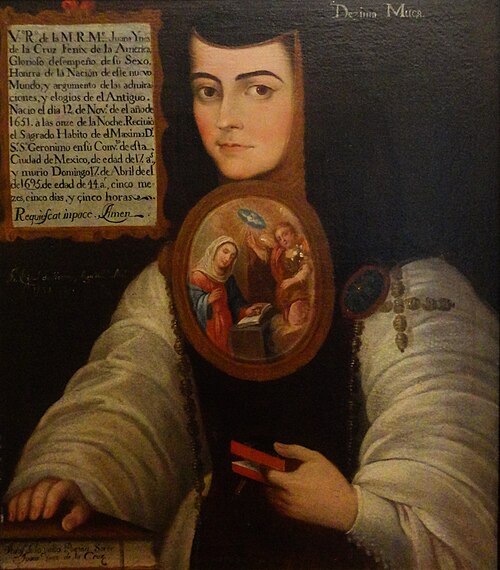
Her sonnets range from love and jealousy to reflections on time and illusion. In the sonnet on her own portrait, “Este que ves, engaño colorido”, she calls the painting a flattering deception and ends with the line “es cadáver, es polvo, es sombra, es nada” (“it is a corpse, it is dust, it is shadow, it is nothing”), a clear echo of the close of Góngora’s sonnet “Mientras por competir con tu cabello”, which ends “en tierra, en humo, en polvo, en sombra, en nada”. Sor Juana applies the familiar Baroque warning against vanity to her own painted image and rejects the praise it attracts; some readers also see in the poem a comment on how women are valued for their looks.
Her most ambitious work is Primero sueño (First Dream), a philosophical poem of almost a thousand lines published in 1692. It is written as a silva, a free mix of long and short lines, and its title and dense style pay homage to Góngora’s Soledades. It opens with night spreading over the earth: “Piramidal, funesta, de la tierra / nacida sombra” (“Pyramid-shaped and mournful, born / of the earth, a shadow”).
While the body sleeps, the soul tries to grasp the whole universe in a single glance and fails, dazzled; then it tries to climb step by step through the categories of knowledge, and fails again, until dawn wakes the sleeper. Sor Juana said it was the only work she wrote for her own pleasure, a “papelillo que llaman El Sueño” (“a little paper they call The Dream”). Readers have seen in it a Scholastic, a Neoplatonic or even an almost modern, Cartesian drama of the mind confronting the limits of what it can know.
Intermediate
Theatre and songs for many voices
Sor Juana wrote nearly as much for performance as for reading. Her comedy Los empeños de una casa (The Trials of a Household), staged in 1683 during celebrations at court, follows the rules of Spanish Golden Age comedy, with mistaken identities, hidden lovers and a sharp-witted heroine. Her model for drama was above all Calderón.
El divino Narciso (The Divine Narcissus), composed at the request of the Countess of Paredes and printed in Mexico around 1690, is an auto sacramental, a one-act allegorical play celebrating the Eucharist. In it the Greek myth of Narcissus becomes an image of Christ, who falls in love with his own reflection in Human Nature. Its prologue, the loa, is even more unusual. Characters called Occidente (the West) and América, dressed as Aztec nobles, worship the “God of the Seeds” with a dance until Religion and Zeal, figures of the Spanish conquest, interrupt them. Instead of ending with simple submission, the loa argues through dialogue and draws a parallel between the Aztec rite of eating an image of the god and Christian communion.
Sor Juana also wrote the words for many villancicos, sets of sacred songs performed at matins on great feasts in the cathedrals of Mexico City, Puebla and Oaxaca. Several cycles from 1676 onwards give a voice to the people of the colonial city. In the Assumption villancicos of 1676 and those for Saint Peter Nolasco of 1677 she included a tocotín, a dance-song in Nahuatl or in mixed Nahuatl and Spanish, and songs in the Spanish of enslaved and free Africans and their descendants. Nahuatl had been a written language in Latin letters since the sixteenth century. How well Sor Juana knew it is debated: Sara Poot Herrera stresses her feel for its expressive nuances, while the historian Camilla Townsend has found grammatical errors suggesting that she did not have full command of the language.
These pieces drew on stereotypes common in Spanish theatre, and scholars debate how far they simply imitated them. Recent studies argue that Sor Juana also used these voices to say serious things: one villancico for Saint Peter Nolasco, patron of the Mercedarians who ransomed captives, plays on the hope that where Peter enters, nobody remains a slave.
Intermediate
1690–1691: a letter on theology and the reply to “Sor Filotea”
The Portuguese Jesuit António Vieira, one of the most famous preachers of the age, who spent much of his life in Brazil, had preached a sermon on Christ’s greatest “fineza”, the supreme proof of his love. Vieira boasted that he could improve on the opinions of Saints Augustine, Thomas Aquinas and John Chrysostom. The sermon is traditionally dated to 1650, in the royal chapel in Lisbon, although some scholars have questioned that date. Decades later, at someone’s request, Sor Juana wrote a careful critique of the sermon, defending the Church Fathers against Vieira and closing with an idea of her own: that God’s greatest kindness might be the “negative benefits”, the gifts he holds back because we would misuse them.
In November 1690 the bishop of Puebla, Manuel Fernández de Santa Cruz, printed her critique without asking her, under the title Carta atenagórica (“a letter worthy of Athena”). He added a preface in the form of a letter signed by an invented nun, “Sor Filotea de la Cruz”. It praised her talent but advised her to spend it on sacred rather than worldly studies.
Sor Juana answered on 1 March 1691 with the Respuesta a Sor Filotea de la Cruz. Courteous and full of conventional humility, it is also a sharp self-defence. She tells the story of her vocation for learning, insists that she studies “not to write, still less to teach… but only to see whether by studying I may be less ignorant”, and lists learned women from the Bible, antiquity and her own time. She argues that secular knowledge is needed to understand theology, that women should be taught by older learned women, and that thinking can happen anywhere—even in the kitchen: “Si Aristóteles hubiera guisado, mucho más hubiera escrito” (“If Aristotle had cooked, he would have written much more”).
The Respuesta was not printed during her lifetime. It appeared in 1700 in the posthumous volume Fama y obras póstumas. Already in a letter of about 1681 to her confessor, the Jesuit Antonio Núñez de Miranda, which only came to light in 1980, she had asked him why women should not study: did they not have a rational soul like men?
Intermediate
Renunciation and death
Between 1692 and 1694 Sor Juana’s life changed direction. She returned to the spiritual guidance of Núñez de Miranda, whom she had dismissed about a decade earlier, and in early 1694 she signed a series of penitential documents in which she renewed her vows and confessed her faith. One is signed “yo, la peor de todas” (“I, the worst of all women”); a similar formula, “la peor del mundo”, appears in the convent’s book of professions. Some of these texts were signed in her own blood, a devotional gesture of the time.
She also parted with her library and instruments. The will of José de Lombeida, a secular priest and chaplain who had long been her friend, found in Mexico’s Archivo General de la Nación by Ken Ward, a curator at Brown University, and made public in 2011, records that she gave him books to sell and that after her death he went on selling them on the orders of the archbishop, Francisco de Aguiar y Seijas, and handed him the money. Early accounts such as Calleja’s say that the proceeds went to the poor. Her literary production seems to have almost stopped, though not completely: riddles she wrote for a circle of Portuguese nuns, discovered in Lisbon in 1968, were gathered into a manuscript book with approvals dated 1695, although when exactly she composed them is debated.
In 1695 an epidemic swept through Mexico City and her convent. Sor Juana nursed her sick sisters, fell ill herself and died on 17 April 1695. Her friend Carlos de Sigüenza y Góngora, the leading scholar of New Spain, gave the funeral oration. Why she fell silent in her last years is the most debated question of her biography (see “Different perspectives” below).
Intermediate
Meanwhile in the world
Sor Juana never left the valley of Mexico, yet her work belonged to a literary world spanning the Atlantic. She read and imitated poets from Spain—Góngora above all, whose Soledades shaped Primero sueño, and Calderón, whose allegorical theatre shaped her autos. Her sermon critique answered a Portuguese Jesuit who had preached in Lisbon and worked in Brazil, and it was printed in Puebla. Ideas, books and quarrels moved between Madrid, Lisbon, the Americas and Rome through the networks of the Spanish monarchy and the Catholic Church.
Her fame was made in Europe as much as in Mexico. After the Countess of Paredes carried her manuscripts back to Spain, the Inundación castálida appeared in Madrid in 1689, a Segundo volumen in Seville in 1692 and the posthumous Fama y obras póstumas in Madrid in 1700. According to one count, these three collections went through about twenty printings and issues between 1689 and 1725, in Madrid, Barcelona, Seville, Zaragoza, Valencia and Lisbon—a Baroque best seller written by a nun in America.
She also belonged to a network of learned women. In the Respuesta she names among the learned women of her own day Queen Christina of Sweden, who had abdicated in 1654 and lived in Rome as a patron of scholars, and the Duchess of Aveiro, a learned Portuguese noblewoman who was the Countess of Paredes’s cousin. The countess wrote to that cousin in 1682 that the nun of San Jerónimo was “rara mujer”, an extraordinary woman, and through the same circle Sor Juana sent her riddles to a literary “academy” of Portuguese nuns.
A comparison from another empire shows how colonial women writers reached print. In 1650 a volume of poems by Anne Bradstreet, a Puritan settler in Massachusetts, was published in London, without her knowledge, as The Tenth Muse Lately Sprung Up in America. Like Sor Juana’s Inundación castálida, it was carried to the imperial capital by others and sold under the label of a “tenth Muse” from the New World, a sign of how unusual, and how marketable, a learned woman poet from the Americas seemed to European readers.
Intermediate
Forgotten, rediscovered, celebrated
After the early eighteenth century, when the taste for Baroque poetry faded, Sor Juana was read far less. Interest returned from the late nineteenth century onwards, and in the twentieth she became a central figure of Mexican literature. Alfonso Méndez Plancarte and Alberto G. Salceda published her complete works between 1951 and 1957, and that edition remained the standard text for decades.
The Mexican poet Octavio Paz, later a Nobel laureate, published Sor Juana Inés de la Cruz o las trampas de la fe (Sor Juana, or The Traps of Faith) in 1982. In a long essay that combines biography, social history and literary criticism, he placed her in the society of New Spain and argued that she had been forced into silence by a hostile ecclesiastical world. The book made her internationally known and inspired María Luisa Bemberg’s film Yo, la peor de todas (I, the Worst of All, 1990).
Her image is now part of Mexico’s public life. She appeared on the 1,000-peso note issued in 1978 and later on successive designs of the 200-peso note from the 1990s, until a new 200-peso design with other figures was issued in 2019. Since November 2020 she has been on the red polymer 100-peso note, which the Bank of Mexico describes as honouring the most important poet and writer of the colonial period. Her former convent now houses a university, the Universidad del Claustro de Sor Juana, and the town of her birth is called Nepantla de Sor Juana Inés de la Cruz.
Outside Mexico she is read as a major poet of the Spanish language and, a century before Mary Wollstonecraft’s Vindication of the Rights of Woman (1792), as one of the earliest writers in the Americas to argue in writing for women’s intellectual equality. Philosophers increasingly study her as a thinker in her own right, especially for Primero sueño and the Respuesta.
Advanced
Different perspectives
Why did she stop writing? One influential reading, developed by Octavio Paz and supported by historians such as Elías Trabulse, sees her final years as the result of pressure: a misogynistic archbishop, Aguiar y Seijas, a demanding confessor, the departure of her protectors at court, and a city shaken by floods, food shortages and the riot of 1692 that strengthened the Church’s hand. On this view the penitential documents were a forced capitulation. An older Catholic reading, represented by Méndez Plancarte, interprets the same events as a sincere spiritual conversion, a nun choosing to devote herself fully to God.
New documents have revived the debate without settling it. In 1995 Trabulse claimed to have found evidence of a secret trial against her, but in 1999 he acknowledged that no such documents existed and that it had been a conjecture. In 2010 Alejandro Soriano Vallés published letters from Bishop Fernández de Santa Cruz, found in the Biblioteca Palafoxiana in Puebla by Jesús Joel Peña Espinosa, including a warm reply of March 1691 to the Respuesta and an extract of a letter of 1692. He argues that they disprove a “black legend” of persecution and show that the bishop encouraged her studies. Critics such as José Pascual Buxó have disputed his interpretation, and some scholars warn against replacing one legend with another, that of a “saintly” Sor Juana. There is no reliable evidence that she was forced to burn her books—the surviving documents record sales instead—and some writing from her last years, such as the riddles, survives, although how late she kept writing is debated.
Feminist or religious? Since the 1980s Sor Juana has been read as a pioneer of feminism, and philosophers describe the Respuesta as a defence of the rational equality of women and men. Other scholars insist that her arguments are made from inside Catholic theology and Scholastic method: she presents learning as a path to understanding God and models herself on Saint Jerome and Saint Paula. Earlier critics called her a mystic; some have seen Cartesian rationalism in her work, while Gerard Flynn argued that her method is Scholastic. Many recent scholars see no contradiction: her claim for women’s minds was made in the theological language available to her.
Who were her patronesses to her? Critics long debated how to read her poems to Leonor Carreto (“Laura”) and especially to María Luisa (“Lysi”, “Filis”). Méndez Plancarte called them pure friendship expressed in Neoplatonic convention; Paz heard in them the intensity of authentic passion; Antonio Alatorre concluded that Sor Juana was in love with María Luisa. Some readers now discuss them as early poems of love between women. Two autograph letters of the countess found at Tulane University and published by Hortensia Calvo and Beatriz Colombi in 2015 confirm, for the first time in the patroness’s own words, how much she valued the nun’s company, though they cannot tell us what either woman felt in private.
Advanced
Evidence and method: reading a life through its documents
Much of what we know comes from a few kinds of source, each with its own slant. The earliest biography, by Diego Calleja, appeared in Fama y obras póstumas (1700); it is written as a pious eulogy and tends towards hagiography. The Respuesta is Sor Juana’s own account, but it is a carefully constructed piece of rhetoric, full of formulas of humility, written for a powerful reader. The portrait of the child who stopped eating cheese or cut her hair to punish herself for learning slowly is how she chose to present herself.
The archive keeps growing, and almost every find has been contested. Since the complete works of 1951–1957 scholars have published the riddles found in Lisbon (1968), the letter to Núñez de Miranda found in Monterrey (1980), the so-called Carta de Serafina de Cristo (published by Trabulse in 1996, whose authorship is disputed), versions of her Protesta de fe, the convent’s Libro de profesiones (2013) and the bishop’s letters (2010). Attribution is a recurring problem: an anonymous continuation of La segunda Celestina, a play by Agustín de Salazar y Torres, was proposed as hers in 1990 without consensus.
The printed editions are evidence too. The three collections of 1689, 1692 and 1700 were prepared in Spain by admirers of the poet, with prologues, approvals and headnotes that frame how she was to be read—as a marvel, as a pure soul, as an American prodigy. Historians of the book now study who edited them; recent work argues that Juan Camacho Gayna, a member of the Paredes household, rather than the secretary Francisco de las Heras, was responsible for the Inundación castálida.
For these reasons, careful accounts keep certain things open: her birth year, the exact reasons she entered and then withdrew within the convent, the nature of her relationship with María Luisa, and how much of her silence was imposed or chosen. What is not in doubt is the scale of her achievement and the fact that she argued in her writings, some published in her lifetime and others after her death, that a woman’s mind deserved the same freedom as a man’s.
Key ideas
- Women’s right to learn
- In the Respuesta and her letter to her confessor, Sor Juana argued that women have rational souls like men and should be allowed to study, ideally taught by learned older women.
- Learning as a path to God
- She claimed that logic, rhetoric, physics, music and history are steps needed to understand theology, the “queen of the sciences”, so secular study is not a distraction from faith.
- The limits of knowledge
- Primero sueño dramatises the mind’s attempt to know the whole universe, first in a single intuition and then step by step, and its failure, which is also a kind of heroism.
- The double standard
- The redondillas “Hombres necios” use tight logic to show that men blame women for the very behaviour they provoke.
- A chorus of voices
- Her villancicos and loas give speaking parts to Nahuatl speakers, Africans and their descendants, students and sacristans, reflecting the mixed society of colonial Mexico City.
- Humility as rhetoric
- Sor Juana often wrote with formulas of self-abasement that also worked as shields, allowing her to say bold things in an acceptable form.
Records
- c. 1648 — Born at San Miguel Nepantla; a baptism record of December 1648 is usually linked to her, while her biographer Calleja gives November 1651.
- c. 1664 — Enters the viceregal court as lady-in-waiting to the vicereine Leonor Carreto, Marchioness of Mancera.
- 1669 — Takes her vows in the Hieronymite convent of San Jerónimo, Mexico City, after a brief stay with the Discalced Carmelites in 1667.
- 1683 — Her comedy Los empeños de una casa is staged during court festivities.
- 1689 — Inundación castálida, her first collection, is printed in Madrid through the Countess of Paredes.
- 1690 — The bishop of Puebla prints her critique of Vieira’s sermon as the Carta atenagórica, with the letter of “Sor Filotea”.
- 1691 — Dates the Respuesta a Sor Filotea de la Cruz 1 March 1691.
- 1692 — Segundo volumen of her works, including Primero sueño, is printed in Seville.
- 1694 — Signs penitential documents renewing her vows; around this time she hands over her books to be sold.
- 1695 — Dies on 17 April during an epidemic in Mexico City.
- 1700 — Fama y obras póstumas appears in Madrid, with Calleja’s biography and the Respuesta.
- 1982 — Octavio Paz publishes Sor Juana Inés de la Cruz o las trampas de la fe.
Glossary
- New Spain
- The Spanish viceroyalty, governed from Mexico City, that covered most of present-day Mexico and neighbouring regions.
- Viceroy / vicereine
- The king’s representative who governed a viceroyalty, and his wife, who presided over the court.
- Criollo / criolla
- A person of Spanish descent born in the Americas.
- Hieronymites
- A religious order named after Saint Jerome; Sor Juana’s convent of San Jerónimo belonged to its female branch.
- Redondilla
- A Spanish stanza of four eight-syllable lines rhyming abba.
- Silva
- A flexible verse form mixing lines of seven and eleven syllables with free rhyme, used by Góngora and in Primero sueño.
- Auto sacramental
- A one-act allegorical religious play celebrating the Eucharist, performed especially for the feast of Corpus Christi.
- Loa
- A short dramatic prologue performed before a play.
- Villancico
- A song with refrain and stanzas, originally secular; in Sor Juana’s time sacred villancicos were written in sets for church feasts and sung at matins.
- Tocotín
- A dance and song of Nahua origin, used by Sor Juana in Nahuatl or mixed Nahuatl–Spanish verses.
Questions and answers
Why did Sor Juana become a nun?
In her own words, she did not want to marry, and the convent was the safest path to salvation that still left her time to study. She chose San Jerónimo after finding the Carmelites too strict.
Was she born in 1648 or 1651?
We do not know for certain. A baptism record of 1648 is usually identified with her, but her first biographer gave 1651, and some scholars still prefer that date.
Did she really write in Nahuatl?
Yes. Some of her villancicos and the tocotines in them are written in Nahuatl or a mix of Nahuatl and Spanish. Scholars disagree about how fluently she knew the language.
Who was “Sor Filotea”?
A pen name. The letter signed by “Sor Filotea de la Cruz” was written by Manuel Fernández de Santa Cruz, bishop of Puebla, who also printed her Carta atenagórica.
Was she forced to stop writing?
Scholars disagree. Some see clerical pressure; others see a voluntary spiritual turn. Letters found in 2010 show that the bishop of Puebla supported her, but they do not settle what happened in 1693–1694.
Did the Church burn her books?
No reliable evidence says so. A priest’s will records that she gave him books to sell, and early accounts say the money went to the poor.
Why is she called the “Tenth Muse”?
Admirers added her to the nine Muses of Greek mythology to praise her as a poet; the title page of her first collected volume called her “musa décima”.
Sources and further reading
- Sor Juana (1648–1695). Project Vox, Duke University Libraries
- Juana Inés de la Cruz, Sor: Introduction. Feminism in Literature: A Gale Critical Companion (via Encyclopedia.com)
- Juana Inés de la Cruz. Encyclopedia of Science, Technology, and Ethics (via Encyclopedia.com)
- Latin American Philosophy. Internet Encyclopedia of Philosophy
- Juana Inés de la Cruz. Wikipedia
- Sor Juana Inés de la Cruz. Wikipedia (Spanish)
- Carla Anabella Fumagalli, Sor Juana Inés de la Cruz: articulaciones entre obra y archivo en los preliminares de sus ediciones originales. Anclajes 22.1 (Universidad Nacional de La Pampa), 2018
- Jorge Gutiérrez Reyna, La Inundación castálida de sor Juana Inés de la Cruz. Historia de un best seller. Anales del Museo de América 30, 2024
- Carla Fumagalli, Review of Hortensia Calvo and Beatriz Colombi (eds.), Cartas de Lysi: la mecenas de sor Juana Inés de la Cruz en correspondencia inédita (2015). Orbis Tertius 20.22 (Universidad Nacional de La Plata), 2015
- Sor Juana Inés de la Cruz, Respuesta a sor Filotea de la Cruz (1691), Spanish text. Wikisource
- Sor Juana Inés de la Cruz, Redondillas (“Hombres necios que acusáis”), Spanish text. Wikisource
- Sor Juana Inés de la Cruz, Primero sueño, Spanish text. Wikisource
- Primero sueño. Wikipedia (Spanish)
- El divino Narciso (auto). Wikipedia (Spanish)
- Nicholas R. Jones, Sor Juana’s Black Atlantic: Colonial Blackness and the Poetic Subversions of Habla de negros. Hispanic Review 86.3 (University of Pennsylvania Press), 2018
- Sara Poot Herrera, Sor Juana y sus versos amestizados en una sociedad variopinta. La Lengua de Sor Juana
- Interrogación y argumentación en la Carta atenagórica de sor Juana Inés de la Cruz. Forma y Función (Universidad Nacional de Colombia), 2017
- Alejandro Soriano Vallès, Un género supremo de providencia: sor Juana Inés de la Cruz y la tesis de los beneficios negativos en la Carta atenagórica. Literatura Mexicana 14.1 (UNAM), 2003
- Inéditos sobre Sor Juana reviven la polémica con Octavio Paz. Proceso, 2010
- Biblioteca Palafoxiana resguarda cartas de Sor Juana Inés de la Cruz. Milenio
- Anthony Stanton, Review of Octavio Paz, Sor Juana Inés de la Cruz o las trampas de la fe (1982). Literatura Mexicana 1.1 (UNAM), 1990
- Billete de 100 pesos de la familia G. Banco de México
- Diego Calleja, Aprobación (vida de sor Juana) en Fama y obras póstumas (1700), transcripción. SILEM, Universidad de Córdoba
- Camilla Townsend, Sor Juana’s Nahuatl. Le Verger, bouquet VIII, 2015
- Alejandro Soriano Vallès, José de Lombeyda (testamento). Revista Imágenes (Instituto de Investigaciones Estéticas, UNAM), 2020
- Sor Juana Inés de la Cruz, A su retrato (“Este que ves, engaño colorido”). Wikisource
- Luis de Góngora, Mientras por competir con tu cabello. Wikisource
- Sor Juana Inés de la Cruz, biografía. Banco de México
- ¿En qué billetes ha aparecido Sor Juana Inés de la Cruz?. Milenio
- Billete de 200 pesos de la familia G (comunicado). Banco de México, 2019
- The Tenth Muse: Lately sprung up in America (1650). Massachusetts Historical Society
- The Tenth Muse Lately Sprung Up in America. Wikipedia
Related
- TenochtitlanCapital of the Mexica, founded on an island in Lake Texcoco and conquered in 1521.
- Florentine CodexA twelve-book encyclopedia of Nahua (Aztec) life in parallel Nahuatl and Spanish, painted with nearly 2,500 images and completed at Tlatelolco in 1575–1577.
- René DescartesFrench philosopher and mathematician whose method of systematic doubt became central to early modern philosophy.
- A Vindication of the Rights of WomanMary Wollstonecraft’s 1792 argument that women seem weaker in mind and character only because they are raised to please, and deserve the same education, moral standard and independence as men.
Written with AI assistance from the published sources listed above, and revised as new research appears.