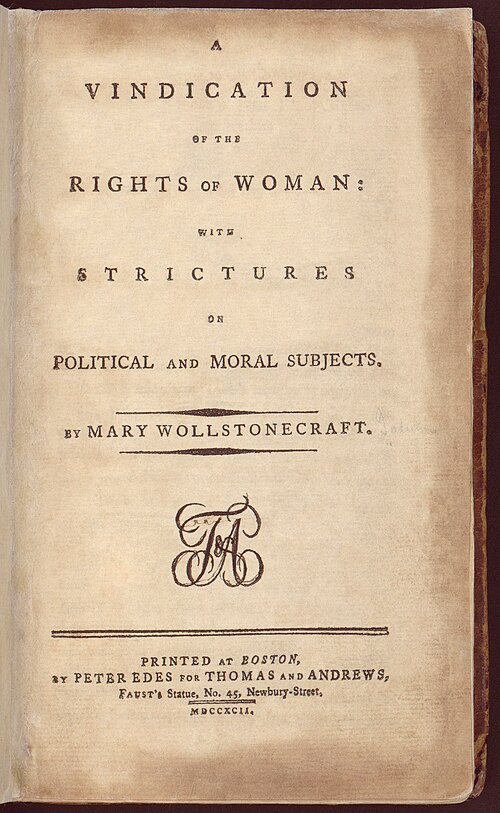
Start at the top for an easy introduction. Go further down for more detail and scholarship.
- Easy
- Intermediate
- Advanced
For young readers
More than 230 years ago in London, a writer named Mary Wollstonecraft wrote a book with a very long name: A Vindication of the Rights of Woman. “Vindication” means standing up for something that has been attacked. She was standing up for women.
In her time many people believed that girls were naturally silly, weak and good only at looking pretty. Wollstonecraft said this was wrong. Girls only seemed that way because they were taught from babyhood that being pretty and pleasing men mattered most, and they were not allowed to study serious subjects.
She compared these girls to flowers planted in soil that is too rich: they look beautiful for a while, but they grow weak and fade early. If girls were taught to think, she said, they would grow strong, sensible and good, just like boys can.
Her big idea was simple: being good and being wise are the same for everyone. So boys and girls should go to school together, women should be able to work as doctors or run a shop or a farm, and husbands and wives should be friends and equals.
Some readers liked the book at once. Later, after people learned shocking things about her private life, many attacked her. But about fifty years after she died, women in America and Europe who were fighting for their rights rediscovered the book, and today it is read all over the world.
At a glance
- What
- A book-length argument for women’s education, moral equality and independence, written as a reply to the political debates of the French Revolution
- Author
- Mary Wollstonecraft (1759–1797), English writer and philosopher
- Published
- London, January 1792, by the radical publisher Joseph Johnson; a second edition, an American edition (Boston) and a French translation followed the same year
- Dedication
- To Charles-Maurice de Talleyrand-Périgord, “late Bishop of Autun”, whose 1791 report on public education for the French Assembly proposed a home-based education for girls
- Structure
- Dedication, a short “Advertisement”, an introduction and 13 chapters
- Writing time
- About six weeks, according to her husband William Godwin
- Unfinished plan
- Announced as the first part of a larger work; the promised second volume on women’s legal position was never written
- Language
- English
Easy
What is the Vindication?
A Vindication of the Rights of Woman is a book by the English writer Mary Wollstonecraft, published in London in January 1792 by her publisher and friend Joseph Johnson. Its full title adds “with Strictures on Political and Moral Subjects”, strictures meaning critical remarks. Put simply, it is a long argument that women are thinking beings just as men are, and that they should be educated to use their minds, be able to support themselves, and be treated as partners rather than ornaments.
A “vindication” is a defence of something under attack. Wollstonecraft had already used the word in 1790 for A Vindication of the Rights of Men, her reply to the politician Edmund Burke. Repeating it was a deliberate move. Revolutionaries in France and radicals in Britain were talking about the rights of man; Wollstonecraft asked what those rights meant for the other half of humanity.
The book is not a calm textbook. Godwin, whom she married in 1797, later wrote that it was begun and finished in no more than six weeks, and he admitted it was “deficient in method and arrangement”. It is passionate, sometimes repetitive, and full of quotations from the writers it attacks. Yet Godwin also predicted that it would be read as long as the English language lasted, and it is now counted among the founding texts of feminist thought, although the word “feminism” did not exist in her lifetime.
Easy
A tour of the book
The book opens with an open letter to the French statesman Talleyrand, followed by a short note to readers (the “Advertisement”) and an introduction. Then come 13 chapters. The first three set out principles: what rights and duties all human beings share, and whether women really have a separate “sexual character”, a different nature that suits them only for pleasing. Chapter 4 describes how women are “degraded” by their upbringing. Chapter 5, the longest, attacks writers on female education one by one, above all Jean-Jacques Rousseau.
The later chapters move outwards. Chapter 6 asks how early habits of thought shape a person’s character; Chapter 7 says modesty is a virtue for both sexes, not a female ornament; Chapter 8 complains that women are taught to care about their reputation rather than their actual goodness; Chapter 9 blames inherited rank and wealth as well as sex for corrupting society. Chapters 10 and 11 deal with parents and children, Chapter 12 sets out a plan for national schools, and Chapter 13 ends with examples of the foolishness that ignorance produces and a call for “a revolution in female manners”.
A single image from the introduction sums up the book’s diagnosis. Women, she wrote, are like flowers planted in soil that is too rich: “strength and usefulness are sacrificed to beauty”. They are not silly by nature; they have been made that way. Her own sex, she hoped, would forgive her for treating them “like rational creatures” instead of flattering them as if they were permanent children.
Intermediate
Why 1792? Talleyrand, Burke and Rousseau
The immediate occasion was French. On 10, 11 and 19 September 1791 Talleyrand presented a report on public education to the National Constituent Assembly on behalf of its constitutional committee. He proposed a national system of schools. Girls could attend the primary schools in early childhood, but the report argued that “the father’s house is better for the education of women”, who were destined for domestic life; for girls without a suitable home he proposed retreat houses and training in trades suited to their sex. Wollstonecraft dedicated her book to him and asked him to reconsider. “I plead for my sex,” she wrote, “not for myself.”
Her relation to the report was not simple rejection. In Chapter 12 a footnote says she had “borrowed some hints” from Talleyrand’s “very sensible pamphlet” for her own plan of public day schools. Her quarrel was with the exception he made for girls. If the new France was founded on reason and rights, she argued, it could not shut half its citizens inside their families; doing so was the same kind of tyranny the revolutionaries claimed to have overthrown.
Behind the dedication lay the British “Revolution Controversy”. Burke’s Reflections on the Revolution in France (1790) defended tradition, monarchy and inherited rank, and Wollstonecraft’s Rights of Men, first published anonymously in November 1790, was one of the earliest replies. In it she had already called the slave trade “an atrocious insult to humanity”. The Rights of Woman carried the same arguments about reason and inherited privilege into the household and the relations between the sexes.
The third target was Rousseau. In Émile (1762), his influential book on education, the boy Émile is raised to be independent, while Sophie, the girl intended as his wife, is raised to please him. Wollstonecraft quotes Rousseau’s warning that the more women are educated like men, the less power they will have over men, and replies: “This is the very point I aim at. I do not wish them to have power over men; but over themselves.”
Intermediate
The core argument: reason, virtue and the critique of “sensibility”
The argument starts from a religious and philosophical premise. Human beings are distinguished from animals by reason, which God gave so that they could grow in virtue. If that is true, virtue cannot come in a male version and a female version: “how can they, if virtue has only one eternal standard?” Gentleness, obedience and charm are not a woman’s virtues if they are not also a man’s. Women must therefore develop understanding and self-command in the same way as men, and men must be held to the same moral standard as women, including in sexual conduct.
From this follows her attack on “sensibility”, a cult of refined and easily stirred feeling that fashionable novels and manners praised as the essence of femininity. Wollstonecraft did not condemn feeling itself; she condemned an upbringing that inflamed the senses while neglecting the understanding, so that women became, as she put it, “the prey of their senses, delicately termed sensibility”. Such women were easy to manipulate, unhappy in idleness, and incapable of being either good mothers or good citizens.
Much of Chapter 5 is close reading of conduct books, the advice manuals that taught young women how to behave. James Fordyce’s Sermons to Young Women, she noted, had long been part of every young woman’s library, and she would remove it from any pupil she wanted to make sensible. She treats John Gregory’s A Father’s Legacy to His Daughters with more respect but quotes, with dismay, his advice that a girl who happened to have any learning should keep it “a profound secret, especially from the men”. For Wollstonecraft such advice trained women in cunning rather than honesty.
She also praises women writers who had argued for female education before her, most warmly the historian Catharine Macaulay, whose style, she said, showed no sex because it was “strong and clear”. The book thus places itself in an existing tradition of women’s argument, even as it pushes that tradition in a more political direction.
Intermediate
Concrete proposals: schools, work, marriage and citizenship
Chapter 12 offers a practical plan. The government should set up day schools in which boys and girls are taught together; for children aged five to nine these schools should be free “and open to all classes”, with parents able to complain about negligent teachers. Rich and poor children would sit side by side, dressed alike so that vanity could not divide them. Lessons would include reading, writing, arithmetic, natural history and simple experiments, never at the expense of “gymnastic plays in the open air”, while religion, history and politics could be taught through Socratic conversation. Day schools, rather than boarding schools or private tutors, would keep children attached to home life while giving them a common public education.
Education was meant to lead to independence. Women, she suggested, might study medicine and be physicians as well as nurses, practise midwifery, study politics, regulate a farm or manage a shop, “supported by their own industry”. Without such a road, she wrote, worthy women waste their lives in discontent or marry merely to gain a living. She insisted that women need “a civil existence in the state, married or single”, a pointed phrase, since she observes in Chapter 13 that married women were not allowed a civil existence except in criminal cases.
Marriage itself should rest on friendship between equals rather than on property, flattery or passing physical attraction. A wife educated to reason would be a better companion and a better mother, and the household would cease to be a little kingdom ruled by the husband. In the book’s best-known appeal, she asks men to “snap our chains” and be content with “rational fellowship, instead of slavish obedience”.
On political rights she is cautious. In Chapter 9 she drops what she calls “a hint”: women “ought to have representatives” instead of being arbitrarily governed without any share in government. She then remarks that in Britain’s unreformed system most men were not truly represented either. Later readers have debated whether this amounts to a demand for votes for women; it is at least the first step towards one.
Intermediate
The second volume that never appeared
The 1792 edition carries a brief Advertisement in which Wollstonecraft explains that she had planned the work in three parts, expecting one volume to be enough, but that new illustrations kept occurring to her, so she was presenting only the first part. Many subjects she had only touched on, “especially the laws relative to women, and the consideration of their peculiar duties”, would fill a second volume “which in due time will be published”.
That volume never came. In December 1792 Wollstonecraft left for revolutionary Paris, and the following years brought war, the Terror, her relationship with Gilbert Imlay, the birth of her first daughter, two suicide attempts and her travels in Scandinavia. When she died in September 1797, days after giving birth to her second daughter, the planned continuation existed only in fragments.
In 1798 Godwin published four volumes of her Posthumous Works. The fourth includes a set of short notes headed “Hints”, which Godwin described as “chiefly designed to have been incorporated in the Second Part of the Vindication of the Rights of Woman”. They are aphorisms on education, imagination and love rather than the legal study she had announced. Her unfinished novel Maria, or The Wrongs of Woman, published in the same collection, portrays a wife left powerless by marriage law, and it is often read alongside the Vindication as a fictional treatment of the “wrongs” the second volume was meant to address.
Intermediate
From praise to scandal: the book’s first readers
A common modern belief is that the book was greeted with outrage. The evidence points the other way. In a study published in 1978 the literary scholar R. M. Janes showed that most early reviews were favourable, in British periodicals such as the Analytical Review and the Monthly Review in 1792 and, in the United States, the New York Magazine in 1793. Many reviewers read it less as a political manifesto than as a sensible treatise on female education. The Critical Review was the main exception, objecting to her claims about the equal understanding of the sexes.
The book also travelled quickly. A second London edition appeared in 1792, as did an edition printed in Boston; a Philadelphia edition followed in 1794. A French translation, Défense des droits des femmes, was published in Paris and Lyon in 1792, still dedicated to the former bishop of Autun, and the German educator Christian Gotthilf Salzmann, some of whose work Wollstonecraft had translated, produced a German version.
The turn came after her death. In 1798 Godwin published Memoirs of the Author of A Vindication of the Rights of Woman, a loving but frank account that revealed her love affairs, the birth of a daughter outside marriage and her suicide attempts. Conservative writers seized on it. In the same year Richard Polwhele’s poem The Unsex’d Females placed her at the head of a group of radical women writers: “See Wollstonecraft, whom no decorum checks”. Her name became a warning, and the book’s ideas were judged through her life.
For much of the nineteenth century, British reformers who shared her views rarely named her. The historian Barbara Caine, quoted by Ann Curthoys, put it this way: Wollstonecraft was not so much unknown to mid-Victorian feminists as “carefully and consciously avoided”. Even so, as Curthoys and other accounts note, in an essay of 1855 the novelist George Eliot defended the book as “eminently serious, severely moral”.
Intermediate
Later influence: from Seneca Falls to modern feminism
The book’s strongest early afterlife was in the United States. In 1840 the Quaker reformer Lucretia Mott, a delegate to the World Anti-Slavery Convention in London, met Elizabeth Cady Stanton there; according to Curthoys, Mott spoke enthusiastically of Wollstonecraft, and Stanton came to share her admiration. In July 1848 the two women and three others organised the women’s rights convention at Seneca Falls, New York. Its Declaration of Sentiments rewrote the American Declaration of Independence to read “all men and women are created equal”. The declaration does not cite Wollstonecraft, so her influence on it is indirect, but when Stanton, Susan B. Anthony and Matilda Joslyn Gage published the first volume of their History of Woman Suffrage in 1881, Mary Wollstonecraft was the first of the women named in its dedication.
In Europe the book reached advocates such as Flora Tristan in France and Mathilde Franziska Anneke in Germany. In Britain, according to the Stanford Encyclopedia of Philosophy, which follows Caine, her work helped open the ground for later arguments by William Thompson, Anna Wheeler, the Owenite socialists and, ultimately, John Stuart Mill, whose The Subjection of Women (1869) then overshadowed it. Around the book’s centenary, a new London edition appeared with an introduction by the suffragist Millicent Garrett Fawcett, who presented Wollstonecraft as a forerunner of the campaign for the vote.
That embrace had limits. Curthoys notes that many late-Victorian feminists believed women were morally superior to men, the opposite of Wollstonecraft’s blunt account of women’s faults, and that a movement focused on the vote found little in a book that mentioned representation only in passing. In the twentieth century, readers often drew on her life as much as her text: the anarchist Emma Goldman lectured on her in 1911 as “the pioneer of modern womanhood”, and Virginia Woolf wrote an essay on her that was collected in 1932. Simone de Beauvoir’s The Second Sex named her among the rare women who had resisted male domination before modern times.
From the 1960s and 1970s, with the growth of the women’s movement and of women’s studies, the Vindication became a standard text, read for its claim that women’s subordination is a social product rather than a law of nature. Since then philosophers have increasingly read it not only as a forerunner of later feminism but as serious moral and political philosophy in its own right.
Intermediate
Meanwhile in the world: rights of woman, rights of the enslaved
Wollstonecraft was not the only person in 1791–92 to ask whether the rights of man included women. In September 1791, the same month as Talleyrand’s report, the Paris playwright Olympe de Gouges published her Declaration of the Rights of Woman and of the Female Citizen, rewriting the 1789 Declaration of the Rights of Man article by article. Its first article declares that woman is born free and remains equal to man in rights, and another adds that if a woman has the right to mount the scaffold she must equally have the right to mount the speaker’s platform. The two works arose from the same revolutionary debate, but there is no sign that Wollstonecraft knew Gouges’s text; the Vindication never mentions her. Gouges was guillotined in November 1793.
The same years were a turning point in the struggle over slavery. In April 1791 the British House of Commons rejected William Wilberforce’s bill to abolish the slave trade. In August 1791 enslaved people rose in the French Caribbean colony of Saint-Domingue, beginning the revolution that would create independent Haiti in 1804. When abolitionists returned to Parliament in April 1792, backed, according to the historian Christopher L. Brown, by 519 petitions bearing about 390,000 signatures, the Commons voted only for “gradual” abolition, an amendment proposed by Henry Dundas, and the House of Lords then stalled even that. Opponents of abolition used the upheavals in France and Saint-Domingue to argue for delay.
Gouges, too, had written against slavery: her play on the subject, submitted to the Comédie-Française in the 1780s, was finally staged there in December 1789 as L’Esclavage des noirs and closed after three performances amid clashes between supporters and opponents of slavery. Wollstonecraft had reviewed Olaudah Equiano’s autobiography in 1789, and the literary scholar Moira Ferguson argues that the Rights of Woman was written in the middle of these events. Ferguson counts more than eighty references to slavery in the book, most of them metaphors for women’s subjection.
One passage refers directly to the Atlantic trade. Asking why women should be governed by blind propriety rather than principle, Wollstonecraft writes: “Is sugar always to be produced by vital blood?” and asks whether half the human species is, “like the poor African slaves”, to be kept under brutalising prejudice. In late summer 1791 William Fox’s pamphlet urging Britons to stop buying slave-grown sugar and rum had begun to circulate widely. The text does not say whether she had that campaign in mind, but the question shows that she knew where the sugar on British tables came from.
Advanced
Different perspectives
Radical or limited? On one reading the book is profoundly radical: it denies that sex determines moral nature, proposes free co-educational schooling across classes, calls for women’s economic independence and a civil existence within marriage, and hints at political representation. Godwin recalled that some readers were “in arms against the author of so heretical and blasphemous a doctrine”. On another reading it is cautious. Wollstonecraft concedes that men are physically stronger and, speaking of the sexes collectively, that men “seem to be designed by Providence to attain a greater degree of virtue”; she addresses her final appeal to men; and she mentions representation only as a hint. Both readings can be supported from the text, which is one reason the debate continues.
Class is a second axis. Wollstonecraft says openly that she pays “particular attention to those in the middle class, because they appear to be in the most natural state”, and she attacks the idle rich as fiercely as she attacks male privilege. Her school plan, though open to all children up to nine, then separates children destined for domestic work or trades, sending girls to needlework and millinery in the afternoons. The critic Cora Kaplan, quoted by Ferguson, urged readers to remember that the book is addressed “mainly to women of the middle class” and is deeply class-bound.
A third debate concerns her picture of women “as they are”. The book’s portraits of vain, cunning, idle women can read as contempt. Ferguson describes Wollstonecraft treating middle-class women as a homogeneous group and setting herself apart as their mentor and censor, and Curthoys notes that many late-Victorian feminists rejected her stress on women’s moral weaknesses. Defenders reply that her target is the upbringing that produces these faults, which she repeatedly presents as products of education rather than of nature, and that she judges men’s vices just as sharply.
Modern readings of sexuality and the body are especially divided. In her essay “Wild Nights” (1983) Kaplan argued that the book gives up women’s claim to sexual pleasure in order to establish them as rational beings, pointing to advice such as letting passion “subside into friendship” in marriage; Mary Poovey read it as anxious about female desire, while also noting that men’s appetites are its main target. Other readers stress what the book does affirm about the body: outdoor play, exercise and strength for girls, health, breastfeeding, women as physicians and midwives, and frank criticism of male unchastity. Ferguson even finds in the “vital blood” passage a veiled reference to the sexual abuse of enslaved women.
Finally, post-colonial critics have examined the book’s use of other peoples as foils. Wollstonecraft repeatedly compares English women to the inmates of a “seraglio” and condemns ideas she calls “Mahometan”, drawing on a European stereotype that Islam denied women souls. The literary scholar Joyce Zonana (1993) called this “feminist orientalism”. Others, following bell hooks and Deirdre Coleman as summarised by Curthoys, criticise the analogy between middle-class white women and enslaved Africans as one that can obscure real differences in suffering. Ferguson, by contrast, sees Wollstonecraft as a pioneer in thinking about gender and colonial slavery together. These readings need not cancel each other out: the book can be both an early bridge between causes and an example of their unequal terms.
Advanced
Evidence and method: reading the text rather than the legend
Because her life became so famous, the book has often been read through the biography, and the biography through Godwin’s Memoirs. The Stanford Encyclopedia of Philosophy notes that nineteenth-century curiosity about her private life distracted readers from her ideas, and Curthoys observes that many twentieth-century feminists were inspired more by the life than by the thought. Going back to the sources has corrected several assumptions: Janes’s survey of the 1792 reviews overturned the idea of an immediately hostile reception, and the 1792 Advertisement and the “Hints” of 1798 show that the book was only the first part of a larger plan, which helps explain why the legal position of women is treated so briefly.
Interpretation remains open. The Stanford Encyclopedia lists recent work reading the Vindication as a treatise on education, as part of the republican tradition that defines freedom as independence from another’s arbitrary will, as a theological argument for equality and as an early critique of commercial society. Its rhetoric, which borrows the languages of rights, religion, revolution and anti-slavery all at once, is one reason why so many later movements have found themselves in it, and why careful readers try to set it back among the books and events it was answering.
Key ideas
- One standard of virtue
- Virtue has “only one eternal standard”, so the qualities that make a man good, such as understanding, self-command and honesty, are the same ones that make a woman good.
- Character is made, not born
- Women’s apparent weakness and vanity are the product of an education aimed at pleasing men, not of nature; change the education and the character changes.
- Against false sensibility
- A culture that inflames women’s feelings while neglecting their reason makes them dependent and unhappy; feeling should be guided by reason, not replace it.
- National co-education
- Free public day schools where boys and girls of all classes learn together in the early years, so that the sexes grow up as fellow citizens.
- Independence
- Women should be able to earn their own living, for example as physicians, farmers or shopkeepers, and should have a civil existence in the state whether married or single.
- Marriage as friendship
- Marriage should be a partnership of equals based on respect and friendship rather than property, flattery or passing passion.
- Power over themselves
- The goal is not to give women power over men, but to give them power over themselves through reason.
Records
- 1762 — Rousseau publishes Émile, whose portrait of Sophie, educated to please her husband, becomes a main target of the Vindication.
- 1790 — Burke publishes Reflections on the Revolution in France; Wollstonecraft replies in A Vindication of the Rights of Men (November).
- 1791 — April: the House of Commons rejects Wilberforce’s bill against the slave trade. August: enslaved people rise in Saint-Domingue. September: Talleyrand presents his report on public education; Olympe de Gouges publishes her Declaration of the Rights of Woman.
- 1792 — January: A Vindication of the Rights of Woman is published in London. A second edition, a Boston edition and a French translation appear the same year; in April the Commons votes for only “gradual” abolition of the slave trade.
- 1797 — Wollstonecraft dies in London on 10 September, days after the birth of her daughter Mary; the promised second volume remains unwritten.
- 1798 — Godwin publishes his Memoirs and her Posthumous Works, including the “Hints” for the second part; Polwhele’s The Unsex’d Females attacks her.
- 1848 — The Seneca Falls convention adopts the Declaration of Sentiments, declaring that “all men and women are created equal”.
- 1869 — John Stuart Mill publishes The Subjection of Women, which comes to overshadow the Vindication in Victorian debate.
- 1881 — The first volume of the History of Woman Suffrage is dedicated first of all to the memory of Mary Wollstonecraft.
- c. 1891 — Around the book’s centenary, a London edition appears with an introduction by the suffragist Millicent Garrett Fawcett.
- 1911 — Emma Goldman lectures in New York on Wollstonecraft as “the pioneer of modern womanhood”.
Glossary
- Vindication
- A defence or justification of something that has been attacked or doubted.
- Strictures
- Critical remarks; the subtitle promises criticism of political and moral ideas.
- Sensibility
- In the eighteenth century, a capacity for refined and quickly stirred feeling, fashionable in novels and often treated as the essence of femininity.
- Conduct book
- An advice manual teaching good behaviour, especially to young women, such as Fordyce’s Sermons to Young Women or Gregory’s A Father’s Legacy to His Daughters.
- Revolution Controversy
- The British pamphlet war of the 1790s over the French Revolution, sparked by Burke’s Reflections and the replies to it.
- Co-education
- Teaching boys and girls together in the same schools and classes.
- Civil existence
- Recognition as a person in law, able to own property and act independently; married women in Wollstonecraft’s England largely lacked it.
- Advertisement
- In older books, a short note to readers placed before the main text; Wollstonecraft’s announces the planned second volume.
- Feminist orientalism
- Joyce Zonana’s term for using stereotyped images of the East, such as the harem, to criticise the treatment of women in the West.
Questions and answers
Did Mary Wollstonecraft say women are better than men?
No. She said women and men have the same kind of mind and should be judged by the same standard of goodness. She accepted that men are generally stronger in body, but thought women seemed weaker in mind and character only because of how they were brought up.
Why did she dedicate the book to a French bishop?
Talleyrand, the former Bishop of Autun, had proposed a plan for public education in France in which girls could attend primary school only until the age of eight and would then be educated mainly at home, with some training in trades for those who needed it. She dedicated the book to him to persuade him to change his mind, while admitting that she borrowed some ideas from his plan for boys’ schools.
Did the book ask for votes for women?
Only briefly. She dropped what she called a “hint” that women ought to have representatives in government and said she would return to it later. The full demand for votes came from later movements.
Was the book hated when it came out?
Mostly not. Most early reviews were positive, although the Critical Review attacked it. The fierce attacks on her and her reputation came after 1798, when Godwin’s Memoirs revealed details of her private life.
Is there a second volume?
No. She announced one, mainly on the laws affecting women, but never wrote it. Godwin published some notes for it, called “Hints”, in 1798.
Why do scholars argue about whether the book is radical?
Because it combines bold proposals, such as co-education, women’s work and representation, with concessions about male superiority, a focus on the middle class and an uneasy treatment of sexuality. Different readers weigh these elements differently.
How is the book connected to the debates about slavery?
It was written as the British campaign against the slave trade peaked and the Saint-Domingue revolution began. Moira Ferguson counts more than eighty references to slavery in it, many of them metaphors for women’s condition, and Wollstonecraft once refers directly to sugar produced by enslaved Africans; modern critics debate whether that analogy illuminates or obscures.
Sources and further reading
- Sylvana Tomaselli, Mary Wollstonecraft. Stanford Encyclopedia of Philosophy, 2025
- Mary Wollstonecraft, A Vindication of the Rights of Woman: with Strictures on Political and Moral Subjects (London, 1792; scanned copy). J. Johnson / Internet Archive, 1792
- Mary Wollstonecraft, A Vindication of the Rights of Woman (full text). Project Gutenberg
- Mary Wollstonecraft, A Vindication of the Rights of Woman (Boston: Peter Edes for Thomas and Andrews, 1792; scanned copy). Internet Archive, 1792
- Mary Wollstonecraft (anonymous French translation), Défense des droits des femmes (Paris: Buisson; Lyon: Bruyset, 1792). Wikisource (French), 1792
- Charles-Maurice de Talleyrand-Périgord, Rapport sur l’instruction publique, fait au nom du Comité de Constitution, les 10, 11 et 19 septembre 1791. Project Gutenberg, 1791
- William Godwin, Memoirs of the Author of A Vindication of the Rights of Woman. Project Gutenberg, 1798
- Mary Wollstonecraft, ed. William Godwin, Posthumous Works of the Author of A Vindication of the Rights of Woman, vol. 4 (includes “Hints”). J. Johnson / Internet Archive, 1798
- Richard Polwhele, The Unsex’d Females: A Poem. Cadell and Davies / Internet Archive, 1798
- Mary Wollstonecraft; Millicent Garrett Fawcett, A Vindication of the Rights of Woman, new edition with an introduction by Mrs Henry Fawcett. T. Fisher Unwin / Internet Archive, 1891
- R. M. Janes, On the Reception of Mary Wollstonecraft’s A Vindication of the Rights of Woman. Journal of the History of Ideas 39, 1978
- Ethan Croitoru, Mary Wollstonecraft (Woman Is Rational project). University of Chicago, 2022
- Ann Curthoys, Mary Wollstonecraft revisited. Humanities Research 16:2, ANU Press, 2010
- Moira Ferguson, Mary Wollstonecraft and the Problematic of Slavery. Feminist Review 42, 1992
- A Vindication of the Rights of Woman. Wikipedia
- Olympe de Gouges, The Declaration of the Rights of Woman. Liberty, Equality, Fraternity: Exploring the French Revolution (Roy Rosenzweig Center for History and New Media)
- Olympe de Gouges. Wikipedia
- L’esclavage des noirs ou l’heureux naufrage. Bibliothèque nationale de France, Essentiels
- Christopher L. Brown, Later, Not Now: Histories of Emancipation. London Review of Books 43:14, 2021
- Timothy Whelan, William Fox (fl. 1791–1794). brycchancarey.com
- Lucretia Mott. Women’s Rights National Historical Park, U.S. National Park Service
- Declaration of Sentiments. Women’s Rights National Historical Park, U.S. National Park Service
- Elizabeth Cady Stanton, Susan B. Anthony and Matilda Joslyn Gage (eds.), History of Woman Suffrage, Volume I. Fowler & Wells / Internet Archive, 1881
- Emma Goldman; trans. Nathalie Zimpfer, Mary Wollstonecraft, the Pioneer of Modern Womanhood (1911 lecture), in Mary Wollstonecraft : aux origines du féminisme politique et social en Angleterre. ENS Éditions (OpenEdition Books), 2015
Related
- Mary WollstonecraftEnglish writer and philosopher whose A Vindication of the Rights of Woman (1792) argued that women seem inferior only because they are denied education, a founding text of feminist thought.
- Jean-Jacques RousseauGeneva-born writer whose arguments about inequality, political authority and education influenced European thought.
- Storming of the BastilleThe seizure of a Paris fortress and prison on 14 July 1789 became an early emblem of the French Revolution.
- Haitian RevolutionA revolution beginning with an uprising of enslaved people in Saint-Domingue led to the abolition of slavery there and Haiti’s independence in 1804.
- Seneca Falls ConventionTwo-day meeting in July 1848, usually called the first women’s rights convention in the United States, where 100 people signed the Declaration of Sentiments.
- United States Declaration of IndependenceDocument adopted by the Continental Congress on 4 July 1776 declaring the thirteen colonies independent of Britain.
Written with AI assistance from the published sources listed above, and revised as new research appears.